Steve Hanke finds that Iran’s currency is stabilizing:
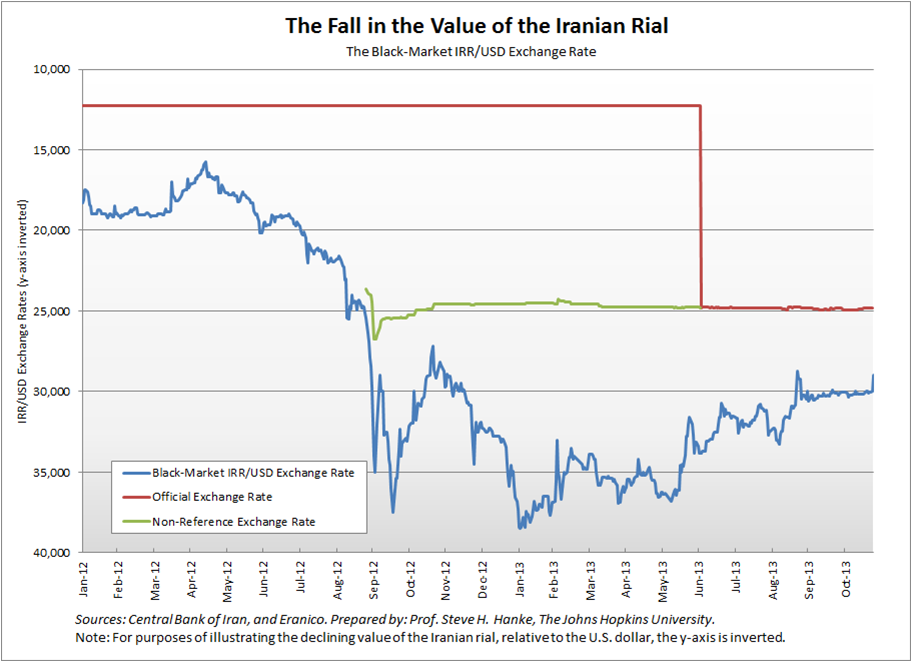
In light of the rial’s recent stability, I have delisted the rial from my list of “Troubled Currencies,” as tracked by the Troubled Currencies Project. For starters, the rial no longer appears to be in trouble. And, on a technical note, implied inflation calculations are less reliable during sustained periods of exchange rate stability.
That said, we must continue to pay the most careful and anxious attention to the black-market IRR/USD exchange rate in the coming months. Like the P5+1 agreement, Rouhani’s economic progress in Iran is tentative and likely quite fragile. Since the black-market IRR/USD is one of the only objective prices in the Iranian economy – and perhaps the most important one of all – it will continue to serve as an important weather vane, as the diplomatic process continues, and as Iran’s economy gradually moves into a post-sanctions era.
Millman imagines an ideal Republican response to the Iran agreement and Healthcare.gov:
To me, there’s an obvious way for the GOP to respond to both developments: run against healthcare.gov as proof that Democrats can’t even build a website, and argue that the Iran deal vindicates a tough negotiating posture with adversaries, and now requires continued vigilance in implementation. But I suspect they will do neither, instead running against healthcare.gov as proof that government can’t even build a website (implicitly conceding that Republicans wouldn’t do any better), and arguing that the fact that we got a deal with Iran proves that we weren’t tough enough (implicitly conceding that their goal is continued conflict, possibly war, and not a solution to the nuclear standoff). In other words, I expect a depressingly ideological rather than pragmatic response to both the Administration’s failures and its successes.
In response to Netanyahu’s opposition to the new Iran-US deal, Kerry argued that the deal is good for Israel:
Ben Birnbaum considers what would have happened if Israel bombed Iran:
I wrote a couple weeks ago that Netanyahu was probably reconsidering his previous decisions not to strike Iran at a time when Ahmadinejad was still the face of the Iranian regime and when Barack Obama was still concerned with re-election. But it is worth considering where Israel would be had Netanyahu gotten his way in 2010, when his cabinet first seriously debated a strike on Iran. As Ha’aretz’s Amir Oren rightly put it, “if Netanyahu and Barack’s plans between spring 2010 and spring 2011 had succeeded, Israel would now be dealing with the wounds of the first Iranian war and preparing for the second, while Iran’s efforts to build a nuclear bomb would be about to finish.”
Another top Israeli security figure recently noted to me that if the deal taking shape in Geneva were to forestall a nuclear-armed Iran for a couple of years, it would be almost as effective as an Israeli military strike—with none of the consequences, of course. Compared to the current situation, the Geneva deal does not clear that bar. But compared to where the Iranian program would be six months from now without a deal, it could come close.
If Netanyahu and company have no better strategy for preventing an Iranian nuke, why call Obama’s deal a Munich-style surrender? Because that’s their name for any diplomatic agreement that requires Western compromise. For Netanyahu and his American allies, it’s always 1938, because if it’s not 1938 and your opponents aren’t Neville Chamberlain, then you’re not Winston Churchill. And if you’re not Churchill, you’ve got no compelling rationale for wielding power.
So what explains Bibi’s continued, vocal opposition? He has never seemed less powerful (and nor, not incidentally, has the vaunted “Israel lobby”). It actually happened: The Obama administration actually did the thing Netanyahu most didn’t want it to do, even if his (and ally-of-convenience Saudi Arabia’s) noisy, and totally valid, lobbying on behalf of his own country surely drove the negotiators to drive a harder bargain. There is the all-politics-is-local angle: Having just sustained a major defeat on his signature issue, Netanyahu’s Israeli rivals, on left and right, correctly smell blood in the water. He wants to ensure that the House of Representatives and the Senate—which traditionally look upon Israel’s (and Netanyahu’s) views far more favorably than the president—keep up the threat of further sanctions, which would scuttle the deal almost by definition. But so far, the talk on Capitol Hill, while extremely skeptical of the agreement, is of readying further sanctions if Iran fails to live up to its end of the deal. That is a lot different from passing sanctions now, and actually should in theory make the deal more likely to work, and to lead to a subsequent deal.
Jeffrey Goldberg, who is skeptical that a longterm deal is possible, nevertheless supports our diplomatic efforts:
[T]he U.S. might just have to walk away because there isn’t much proof that Hassan Rouhani, the putatively reformist new Iranian president, or the foreign minister, Mohammad Javad Zarif, are authorized by the Supreme Leader, Ayatollah Khamenei, to actually agree to a meaningful deconstruction of the nuclear program. Strategic pauses are fine, but actual dismantling? It seems hard to believe, for any number of reasons, the simplest one being that it is in the best long-term interest of the regime to have the means to quickly build a nuclear weapon. It’s certainly not in the interest of the regime to agree to be disarmed by the U.S., its arch-enemy and the country still often referred to as the Great Satan.
So everything that has happened over these past months may not amount to anything at all. Contra Netanyahu, who unrealistically seeks only total Iranian capitulation, it isn’t stupid for Obama to find out for sure what, if anything, the Iranians are willing to give up for good.
“We’ll retain huge leverage — the leverage that comes from cutting into their oil sales. No good negotiator is going to give that up, and Barack Obama and John Kerry are smart negotiators. But it’s in the American national interest to try to make this negotiation work. If it’s not in the Israeli interest or the Saudi interest, so be it,” – Nicholas Burns, the former under secretary of state for policy behind the Iran sanctions during the Bush administration.
A quarter-century after the release of Cannibal Tours, Dennis O’Rourke’s documentary about global tourism, Rolf Potts draws a few recent parallels:
Though Cannibal Tours was never meant to be taken as comedy, its more memorable scenes have a cringe-inducing quality that calls to mind the delicious discomfort of watching Curb Your Enthusiasm or The Office. In basic narrative terms, the documentary depicts a meandering series of interactions between luxury liner tourists and the Papuans who live in various Sepik River villages. What the film lacks in plot arc, however, it makes up for in awkward tension as it probes the mutual suspicion and misunderstanding that arises when wealthy outsiders visit once-primitive communities in a far-flung corner of the world.
Potts describes the movie’s “most iconic moment” (seen above):
As the sweaty white folks wander around snapping photos and haggling for souvenirs, a handsome young Papuan tribesman speaks to an offscreen interviewer, earnestly explaining what he thinks of the outsiders. “When the tourists come to our village, we are friendly towards them,” he says, his words translated in the subtitles. “They like to see all the things in the village. We accept them here.” While he’s saying this, an elderly German woman wearing high-hitched khaki trousers and silver horn-rimmed spectacles creeps into the background, fumbles with the settings on her camera, and — oblivious to what the tribesman is saying — snaps a picture of him before scuttling back out of the frame. Upon initial viewing, this interaction seems to perfectly encapsulate the strained guest-host dynamic portrayed in Cannibal Tours: even as the Sepik native takes pains to affirm the humanity of tourists, the tourist’s first instinct is to treat him like scenery.
Prospero’s R.L.G. isn’t worrying about technology’s transformation of common parlance:
When words and phrases mutate, they do so in order to fill some niche that needs filling. Often, that change involves taking a formerly powerful word or phrase (“awesome“, “oh my god”, “what the fuck”) and turning it into a wry comment (“If you could stop tapping your foot, that would be awesome”; “My boss was in a weird mood all morning and I was like WTF?” “OMG this cheesecake is amazing.”) This is why people actually speak “OMG” and “LOL” out loud, though they are no shorter than the phrases they replace. (“WTF” takes even longer to say than “what the fuck”.) As organisms adapt to ecological niches, so do new bits of language.
What are the long-term effects of all this?
We might see language littered with ever more phrases born of keyboard brevity. Another intriguing possibility involves the rise and spread of speech-to-text technology. One quirk of these systems is that they require speakers to enunciate punctuation and other typographical manoeuvres. (Eg: “Are you coming tonight question mark;New paragraph on another point, I’d like to mention that…”) As speech recognition software improves, we might go from language designed for a tiny keyboards entering our speech (people speaking “OMG” out loud), to language designed for speech recognition software entering our speech (people speaking “new paragraph” out loud to signal a change in topic). Such spoken punctuation would probably find the same special niche function as “WTF” and “LOL” have today. “Wow, I can’t wait to read your screenplay exclamation point” would mean something quite different from “Wow, I can’t wait to read your screenplay!”—namely, semi-ironic detachment.
Adam Corner traces how advertizing agencies co-opted anti-consumerism and irony to create more effective copy. He writes, “It seems almost quaint, now that popular culture is riddled with knowing, self-referential nods to itself, but the aim of advertising used to be straightforward: to associate a product in a literal and direct way with positive images of a desirable, aspirational life”:
Genre-subverting ads started to emerge as early as 1959, when the Volkswagen Beetle’s US ‘Think Small’ campaign began poking fun at the German car’s size and idiosyncratic design. In stark contrast to traditional US car adverts, whose brightly coloured depictions of gargantuan front ends left the viewer in no doubt that bigger was better, the Beetle posters left most of the page blank, a tiny image of the car itself tucked away in a corner. These designs spoke to a generation that was becoming aware of how the media and advertising industries worked. The American journalist Vance Packard had blown the whistle on the tricks of the advertising trade in The Hidden Persuaders (1957), and younger consumers increasingly saw themselves as savvy. Selling to this demographic required not overeager direct pitches, but insouciant ‘cool’, laced with irony.
In subsequent decades, self-aware adverts became the norm, and advertising began to satirise the very concept of itself.
In 1996, Sprite launched a successful campaign with the slogan ‘Image is nothing. Thirst is everything. Obey your thirst’. In 2010, Kotex sent up the bizarre conventions of 1980s tampon adverts (happy, dancing women, jars of blue liquid being spilt) by flashing up the question ‘Why are Tampon adverts so ridiculous?’ before displaying its latest range of sanitary products.
‘Companies try to convince you that they are part of your family,’ says Tim Kasser, professor of psychology and an expert on consumer culture at Knox College in Illinois. ‘They want to create a sense of connection or even intimacy between the viewer and the advertiser. An ad that says: “Yes, I know you know that I’m an ad, and I know that you know that I’m annoying you” is a statement of empathy, and thus a statement of connection. And as any salesperson will tell you, connection is key to the sales.’
Copyranter, from his new perch at Vice, recently examined this phenomenon on a more meta level:
The purpose of an advertising agency’s existence is to advertise things. You would think, then, that they would be great at advertising their own services. That is not the case. In fact, ad agencies, even the so-called “creative” ones, are nearly, universally terrible at it. Not just not good—terrible. They do things like create insipid videos that make you wonder why the place is still in business, or create ads that are pathetically derivative or pointless or laughable or worse—look like they were created by a 10-year-old boy. But, if you really want to show potential clients how edgy you are, you make your employees pose nude in space helmets, and without a whiff of irony call it “The Creative Influence.”
The above ads and ideas were all hatched by big or “hot” shops. Which is just sad. However, there is one agency that seems to have at least a clue: john st. in Toronto. For several years now, john st. has released videos that perfectly mock a current advertising trend. Mocking advertising trends is like bashing a dead horse in the face. But doing it memorably and originally and as an insider is another thing.
The latest example from john st.:
Previous Dish on various advertising strategies here, here, and here.
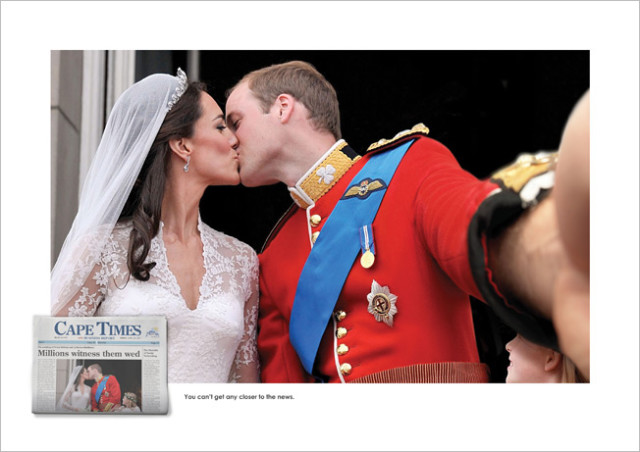
(Image: An ad for South African newspaper The Cape Times, part of a series turning iconic photos into selfies, via Laughing Squid)
What [are] the lessons that Americans and supporters of Obamacare can learn from Australia’s experience? The most obvious is that no piece is legislation is permanent, but must be sustained politically. If it is passed over the opposition of a rival party, and if that party comes into power, it can always repeal it or simply make it impossible to implement. The only way to ensure that the legislation will survive a change in the party in power is if the legislation becomes thoroughly popular. If it can’t be fully implemented—which is what happened to the original Medibank legislation—it will be vulnerable to a challenge.
From all appearances, the Obama administration seemed to believe that the mere act of getting the Affordable Care Act through Congress would ensure its survival and popularity. But now it faces the very real possibility that the Republicans, campaigning on the failure of Obamacare and flagging recovery, would win back the Senate in 2014, and be in a position to force the administration to accept changes in the Affordable Care Act that will weaken the program. Obama has already embraced modifications to the act—allowing insurance companies to bypass the exchanges and their regulations—that will hurt it. And if Republicans were to win the White House and Congress in 2016, they could simply repeal the Affordable Care Act.
James Capretta, one of Obamacare’s strongest critics, wants the GOP to keep gunning for the individual mandate:
Obamacare’s most vulnerable provision remains the mandate. It’s already very weak, and yet the law’s supporters are counting on it to salvage the faltering program. The assumption is that, eventually, many millions of people will sign up for insurance in the Obamacare exchanges because they will have no other choice. But it is also clear that, if pressed, Democrats can no longer defend the mandate based on what has transpired over the past two months. The enrollment process simply does not work, and, even if it did, millions of middle-class Americans will find the plans being offered on the exchanges far too expensive for them to purchase. Americans don’t trust Obamacare. Forcing them into this program is a non-starter politically.
That’s why, in early December, the GOP should again press the case for a one-year delay of the mandate tax. It will be a win-win proposition. At that point, the website may be limping along, but it will still not be fully functional. Democratic support for compelling people into this dysfunctional system will be faltering. If Democrats continue to resist a delay anyway, the GOP will have an issue that could become the focus of the entire 2014 midterm election. And if Democrats agree to the delay, it will be one more step toward undoing the damage of Obamacare.
Tuan C. Nguyen rounds up commentary about “Multi-View,” a feature on Samsung’s new OLED TV set that allows two people to watch different shows simultaneously:
Techlicious blogger Dan O’Halloran raved about the technology, praising the display’s picture quality as “impressive” and describing the imagery as “sharp and clear, the colors vibrant, and blacks deep.” Consumer Reports, however, points out that one of the major drawbacks with watching television in this mode is that you can’t adjust the picture quality. ”We couldn’t optimize the picture and found it to be over-sharpened,” notes the writer. Another criticism was that “resolution was visibly reduced when watching a 3D movie in the Multiview mode.”
Of course, it still all boils down to how actual couples take to the idea after an evening spent divvying up their screen. Reviewing the S9C for the Daily Mail, writer Ben Hatch and his wife Dinah had the kind of experience that made for a predictable story line. At first, “it is utterly blissful. I could enjoy watching TV with my beloved wife without having to watch any of her unbeloved dross,” he writes. She concurred, revealing that “At first, both of us revelled in our new-found TV independence. I looked over at Ben on the sofa, his face deadly serious as he absorbed the horrors of World War II, and felt pleased we had avoided the usual channel wrangle,” she writes.
But while their initial impressions were positive, Ben admitted to feeling “lonely” and Dinah, being wary of welcoming something so disruptive into their home, ultimately gave the feature a thumbs down. “Overall, this experience is not great for our relationship,” she concludes. “I noticed that Ben and I were sitting further apart on the sofa than normal.”
In September, Dr. Thomas Frieden, the director of the CDC, cautioned: “If we’re not careful, we will soon be in a post antibiotic era. And, in fact, for some patients and some microbes, we are already there.” Maryn McKenna considers what losing the effectiveness of antibiotics would mean:
The ability to treat cancer, and to transplant organs, because doing those successfully relies on suppressing the immune system and willingly making ourselves vulnerable to infection. Any treatment that relies on a permanent port into the bloodstream — for instance, kidney dialysis. Any major open-cavity surgery, on the heart, the lungs, the abdomen. Any surgery on a part of the body that already harbors a population of bacteria: the guts, the bladder, the genitals. Implantable devices: new hips, new knees, new heart valves. Cosmetic plastic surgery. Liposuction. Tattoos.
We’d lose the ability to treat people after traumatic accidents, as major as crashing your car and as minor as your kid falling out of a tree. We’d lose the safety of modern childbirth: Before the antibiotic era, 5 women died out of every 1,000 who gave birth. One out of every nine skin infections killed. Three out of every 10 people who got pneumonia died from it.
 The Dish