A colorful debut single from the Leeds-based band Fun Adults:
Year: 2013
The Author Draws A Blank
Jason Resnikoff traces the evolution of the word “indescribable” – first used by Jefferson describing Virginia’s “Natural Bridge,” and used repeatedly by Mary Shelley in Frankenstein:
Obviously, words can describe the shape of a natural bridge; they can describe the shape of a monster. But they cannot describe the shape of the soul, changeable yet persistent, overwhelming but subtle. Feelings, Shelley and Jefferson agree, render words puny and inadequate. So yes, Shelley can tell you about feelings and their physiological manifestations, as can Jefferson, but neither can tell you the feeling itself.
At the turn of the nineteenth century, English speakers discovered that the word, the work of humanity, the fashioning of significance to sound, could not be conflated with reality. The name of the soul was not the soul, despite John and his Gospel. The discovery of the psyche coincided with the discovery of humanity’s powerlessness to control the universe by naming it, as Adam did in the Garden of Eden, or for people to understand their feelings by naming them. Mary Shelley could describe neither Frankenstein nor his monster, and the failure was magnificent.
Reaching For His Fate

Jerry Saltz praises an exhibition at The Frick Museum gathering seven works by the the 15th century painter Piero della Francesca. Saltz was especially stuck by the painting “Virgin and Child Enthroned with Four Angels” (detail above):
Mary isn’t looking at her child and looks instead at the rose he reaches for. You begin to glean the revelation she is having. The flower represents love, devotion, and beauty. It also symbolizes blood and the crown of thorns Christ will wear. This child who will suffer a horrendous death reaches for his acceptance of fate. Mary does not pull the flower back. You sense an inner agony, noticing her deep-blue robe open to reveal scarlet beneath, symbol of outward passion and pain to come. In the dead-center vertical line of the painting is Christ’s right palm that will be nailed to the cross.
Walter Kaiser steps back to find the core of Piero’s brilliance:
[W]hat, in the end, is most idiosyncratic about Piero is the essential nature of his mind, which was molded both by artistic and by mathematical, geometric perceptions—a perfect union of art and science. When Piero looked at the world, he ineluctably perceived its geometric forms and mathematical perspectives, and it is this uncommon mental capacity that caused Roger Fry and others to see him as a precursor to the formalism of Cézanne and Seurat.
The Survival Of The Judgmental
The Dish is delighted to announce the debut of The Mind Report, a collaboration with Bloggingheads.tv and a team of cognitive scientists at Yale University. Each week, one of these leading-edge thinkers will find someone whose work they consider important and provocative and interrogate them about it. The goal is to bring you the latest thinking on how humans think – and how we feel and behave and navigate the social landscape and make sense of our universe.
This week features Kiley Hamlin of the University of British Columbia, who has used puppet shows to demonstrate that infants have a basic sense of right and wrong. Hamlin considers humanity’s innate morality and why we naturally judge others with Jonathan Phillips of Yale:
You can watch the entire video here, and subscribe to The Mind Report here.
Thinking Like A Fox
Sixty years ago Isaiah Berlin published his famous essay on Tolstoy, “The Hedgehog and the Fox,” in which he declared, “The fox knows many things, but the hedgehog knows one big thing.” Robert Zaretsky believes the philosopher should be counted among the foxes:
His landmark essays in political thought, particularly on the notions of negative and positive liberty, as well as his critique of historical determinism, reveal Berlin’s attachment to the values of pluralism. Not only do the variety and density of historical and human experience undermine any effort to reduce them to a solitary truth, he declares, but there is also a variety of ways of attempting to understand those experiences. In his essay “Historical Inevitability,” he is categorical about the wrongheadedness of believing that there is just one legitimate category: “The same facts can be arranged in more than one pattern, seen from several perspectives, displayed in many lights.”
Levi Asher complicates this argument:
[W]e can be foxes and hedgehogs on many levels at once, and I think Zaretsky calcifies the distinction when he suggests that a pluralist must be a fox. I think the determining factor between a hedgehog and a fox has more to do with a person’s style of thinking than with their metaphysical beliefs. … In one sense, as Zaretsky emphasizes in his article, a hedgehog is a monist and a fox is a pluralist. But in another sense, a hedgehog is simply single-minded about something, anything, while a fox exists in a passive mental state, observing and reacting rather than projecting a strong vision of reality.
Faces Of The Day
Quote For The Day
“In the Gospels Jesus is always talking to the crowds in parables, which he later ‘explains’ to his disciples. The dynamic is odd in a couple of ways: either the parables are obvious, and the explanations seem almost patronizing, or they are opaque, and the explanations only compound their opacity. (Or could it be—and I confess to relishing this possibility—that the explanations illustrate Christ’s wry sense of humor, which is nowhere else evident?) In any case, the notable point is just how little the explanations amount to, how completely the ultimate truths of the parables—just like dreams and poems—remain within their own occurrence.
Behind every urge to interpret is unease, anxiety. This can be a productive and necessary endeavor, whether it’s literary criticism or theology or even the dogmas and rituals of a religion (since all religion is, ultimately, an attempt to interpret God and numinous experience). Such effort deepens and complicates our initial response, even as it gives us an aperture through which to see our moments of mystery, crisis, and revelation more clearly—to give them ‘meanings,’ to integrate them into our lives. The trouble comes when the effort to name and know an experience replaces the experience itself. Just as we seem to have grasped every level of meaning in a poem, the private and silent power that compelled us in the first place seems to drain right out of it. Just as we plant the flag of faith on a mountain of doctrine and dogma it has taken every ounce of our intellect to climb, our vision becomes a ‘view,’ which is already clouding over, and is in any event cluttered with the trash of others who have fought their way to this same spot. Nowhere to go now but down,” – Christian Wiman, “Hive of Nerves”
Previous Dish coverage of Wiman’s writing here, here, here, and here.
Forging Words
In an August 2011 interview conducted just after he was named Poet Laureate, Philip Levine described his work:
Mark Levine recalls taking a seminar with the former Poet Laureate:
He seemed uninterested in interpreting poems, which was at first mystifying to a student like me, who had been trained to believe that the most valuable response to a poem was finding something clever or unexpected to say about it. He thought that the right words in the right sequence held a power that was magical and instantaneous. He read poems to us — W.B. Yeats, Thomas Hardy, Wilfred Owen, Elizabeth Bishop — with a passion I had never before encountered. His voice was rough and magisterial. Words were alive in him. He read with a clenched jaw and his body almost shaking. He described John Keats’s letters and made clear his sense that the imagination was a sacred place breeding authenticity in words. He insisted that the poem be lived. One student turned in a poem that used the word “lion” a single time, to symbolize power. Levine almost blew up. “Goddamn it,” he shouted, “if you’re going to put a poor lion in your poem, I want that lion to be there.” He seemed to hunger after the texture of reality, which took many forms, but which was instantly recognizable to him.
Raining On His Pulpit
Kerry Howley takes a stab at highbrow humor, using real excerpts from their books to imagine an exchange between the feel-good megachurch pastor Joel Osteen and the 19th century philosopher of pessimism, Arthur Schopenhauer:
OSTEEN: Well, guess what, Arthur! Our life is a gift from God, and the appropriate response to His gift is joy.
SCHOPENHAUER: Human existence, far from bearing the character of a gift, has entirely the character of a debt that has been contracted. The calling in of this debt appears in the form of the pressing wants, tormenting desires, and endless misery established through this existence…
OSTEEN: The Bible says, “Rejoice in the Lord always.” One translation says, “Be happy all the time.”
SCHOPENHAUER: The inmost kernel of Christianity is the truth that suffering—the cross—is the real end and object of life. That in recent times Christianity has forgotten its true significance, and degenerated into dull optimism, does not concern us here.
The View From Your Window
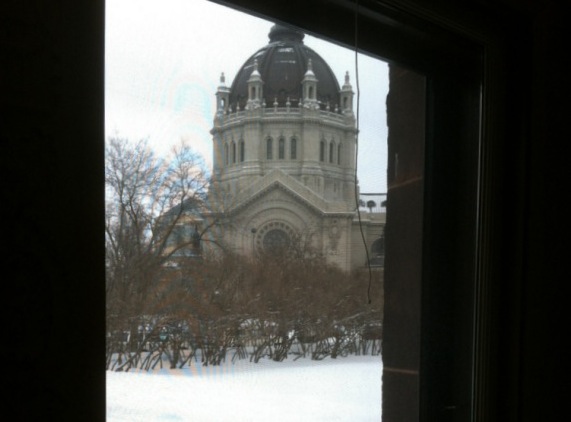
St. Paul, Minnesota, 12 pm

