Has The Novel Lost Its Faith? Ctd

J.L. Wall examines an exception to Paul Elie’s much debated claim that the “novel of belief” is disappearing – fiction by Jewish-American writers:

Even novels that aren’t explicitly about belief have taken to depicting—sometimes in great detail—the lives of traditional believers. The imagined Alaskan Jewish community in Michael Chabon’s The Yiddish Policeman’s Union is defined by the small but visible “Verbover” Hasidic sect. Chabon’s corrupt, conspiring Verbovers are less sympathetic than [Zoe] Heller’s sometimes abrasive but genuinely caring Monsey Orthodox, but in painting his Jewish world Chabon still needs to include the Orthodox…

Jewish novelists are, I would wager, no more likely to be traditional believers now than they were a generation ago. Of the three mentioned above, Henkin and Chabon describe themselves as practicing Judaism—but not the Orthodoxy which defines their believers. Yet Jewish life in New York City—which remains (somewhat to the chagrin of this lifelong resident of flyover country) the capital of both American Jewish and American literary life—is increasingly lived in relation to Orthodoxy. Everyone has a frum (religious) cousin and if you think you don’t—the joke goes—then he’s you. Knowing or being related to someone who has turned to traditional Jewish belief and practice is increasingly common. Even, one suspects, among secular literary figures.

“From Time To Time, We Produce Miracles”

miracles

Conor P. Williams writes to his newborn child:

Humans are many things; we are users, choosers, planners, dreamers, and so much more. No one of these roles defines us on its own. We are a multitude of different potentials. And many of these roles reveal us to be cruel and selfish. … We are ingenious justifiers of our basest instincts. We are destructive dissemblers, though we rarely recognize it.

But—and now I’m finally getting back to you—we are best when we are creators. We have strange, unpredictable capacities for transcending our own petty selves and their concerns. From time to time, we astonish ourselves by making something that is unquestionably good. From time to time, we produce beauty that is almost wholly illuminated by the wild possibilities therein contained. From time to time we produce such shining potential that the daily grind of human life becomes not just tolerable, but comprehensible. From time to time, we produce miracles.

It is no accident that our most sublime moments usually burst forth from partnership. Human love is the only antidote to our selfishness. It forms the other option of our lives. We flit through time, living at turns for ourselves or for others…but our greatest triumphs always come with the latter. We are best when we love.

(Photo by Anthony Kelly)

Incapable Of Quitting

In an excerpt taken from his memoir, Blood Horses, John Jeremiah Sullivan movingly reflects on his father’s tobacco-related death:

Late one night, in the room where I slept whenever I stayed with him, I sat down at his old desk, his father’s desk. In the drawer were his “quitting journals”, as he called them, special notebooks, set apart from the others, filled with his rapid, loopy script. He would start a clean one with each new attempt to kick cigarettes. I had glanced at them once or twice when he was alive. Now they belonged to me, along with all of his “creative work”, under the terms of the will. They were largely self-excoriations, full of black thoughts, efforts to locate and take hold of his own willpower. How badly he wanted to change. Worse than any of us could have wanted that for him. (There was a notecard on the table by the bed, written when he was going to a support group: “Reasons to quit: 1. It worries my children.”) I flipped through one of the notebooks. He was writing about how embarrassed he was every morning when he would start to cough and could not stop, and he knew the neighbours could hear him through the thin walls. Turning the page, I found a one-sentence paragraph, set off by itself. When I read it, I knew that I would never look at the journals again. “If I should not wake up tomorrow,” he had written, “know that my love is timeless and fond.”

Man-Made Moons

At the dawn of the age of electricity, many people believed “the future of municipal lighting was glowing orbs suspended high above cities” in the form of moon towers:

Aurora, Illinois — ironically named only in retrospect — was one of the early places to experiment with artificial moonlight. The town contracted with Charles Francis Brush, an inventor and an entrepreneur and one of Edison’s chief competitors in the race to electrify America. In his wonderful book The Age of Edison: Electric Light and the Invention of Modern America, Ernest Freeberg describes what it’s like to be a town lit, suddenly, by imitation moons. Brush installed his enormous lights, Freeberg notes, via six iron towers studded across Aurora — structures “rising like gigantic pencils over the city’s rooftops.” Stretching high above the skyline, Brush arc lamps provided intense light to the areas directly below them. They also, Freeberg writes, “bathed the surrounding fields and ‘lonely outskirts’ of the city with something like ‘full summer moonlight.'”

Amazingly, 17 of the towers erected in 1894-95 still exist, in Austin:

(You may remember the teenagers from Dazed and Confused assembling kegs for a “party at the moon tower.”) They are now, in the words of one historian, “much-loved curiosities” — objects, generally speaking, of awesomeness rather than awe. And they are, it seems, the last of their kind in America.

(Photo of Austin’s moon tower by Matthew Rutledge via Wikimedia)

Spoons For Sale

This embed is invalid


At the Snuggery in Rochester, New York, clients can pay for non-sexual physical affection. Rose Surnow isn’t surprised to hear “nearly 50 percent of her male clients get boners”:

Here at the Snuggery, clothes stay on. There are strict boundaries and no genital touch is allowed. “Jacqueline established the Snuggery because she believes in the healing power of touch,” the website for her business explains. “She aims to make the world a gentler place, one snuggle at a time.” As a graduate student in social work, she just sees her latest venture as a different way to help people.

The clientele that visits the Snuggery is overwhelmingly male, and ranges in age from about 21 to 85. One or two women have come in since the place opened, but “they mostly just wanted to chat” — oh, women — and that’s not really the point. Though touching genitals isn’t allowed, I was surprised to learn that clients are allowed to caress their designated snuggler’s face, hair, and arms. They are also allowed to intertwine legs and play footsie. As long as it doesn’t involve lady parts, it’s basically fair game. It almost seems like men are paying to get blue balls. I had a hard time understanding what, exactly, they’re getting from the experience.

“A lot of people come in when they’re going through a divorce or breakup,” [owner Jacqueline Samuels] explains. “Because they don’t want to get into another relationship but they miss being touched.”

Pot Nostalgia

On the 2oth anniversary of Dazed And Confused, Tom Junod considers the film’s legacy:

But the movie caught, like no other piece of art I’m aware of, what really was at play in 1976 — that weed was the solvent that, for one blessed moment, managed to cut through the most rigid social stratifications in existence, which are the social stratifications of high school. The class of ’76 wasn’t just one big party; it was a big democratic party, and a glimpse of how things could be different. But it didn’t last, or else we were too stoned to care, and Dazed and Confused captures that feeling as well. For a long time, I felt that the greatest cultural failure of my generation was its refusal to accept punk rock and admit it to the rock and roll pantheon — that we decided we’d rather listen to Boston than the Clash. Now I think its greatest failure is its refusal to see itself in the mirror of Dazed and Confused.

Michael Hoinski filed a report from this week’s reunion screening in Austin:

[Director Richard] Linklater encouraged the crowd to accept the movie in the spirit in which it was made. “Let’s go back to 1976,” he said. “We’re in a small town, let’s say in East Texas — the kind of town you have to actually drive 70 miles to get Aerosmith tickets. And it’s a Friday or Saturday night. And you’re in a pick-up truck. And you’re just driving around … driving around — that’s all you ever do. But on this particular night you drive to the drive-in movie theater. You’ve got a couple friends with you. You’ve got a Schlitz tall boy. You’ve got a bag of pot. You and a friend went in 10 or 15 dollars — takes about three or four joints to get your first buzz. And that’s where you are: You’re in a drive-in movie. That’s what this is: It’s a drive-in movie from the ’70s.”

Still In Vogue

Niall Connolly delves into the history and enduring popularity of “voguing” and “ballroom”:

To be clear, “ballroom” takes it name from the venues in which the “ball” events take place, and is not to be confused with the “strictly” kind of ballroom. Like hip hop, ballroom encompasses many different elements of artistic expression, from music and language to clothes and design, and, of course, dance. It deals directly with some of society’s most controversial issues, namely sexuality, race, class, gender roles and expression, beauty modes, self-definition and competition. It doesn’t do this in the polemical style we may be used to from punk and political hip-hop, however, where topics are theorised and discussed. In ballroom these issues are lived and experienced, as a vast number of those taking part in this underground scene are transgender, working class, people of colour.

Ballroom includes society’s most marginalised: minorities within minorities within minorities, for whom voguing and ballroom culture is an important resource. In a world where they have been rejected, ballroom not only accepts these people for who they are, it celebrates them, in a variety of unique and different categories. The competitive, prize-winning aspect of ballroom gives some participants a sense of worth lacking in the “real” world (not to mention money), and the familial structure of the “houses”—mother, father, sister, brother—often acts as a real surrogate, as many in this world have been disowned by their biological families.

(Video: A scene from the 1990 documentary Paris Is Burning)

Faces Of The Day

Claire O’Neill admires the work of British photographer Bill Brandt, who captured “World War II-era social documentary, street scenes in England, where he lived, editorial portraits, [and] abstract female nudes”:

The Museum of Modern Art has taken on the task of distilling Brandt’s lifetime oeuvre into a comprehensive retrospective, which opened Wednesday. The exhibition’s catalog describes him as “the artist who defined the potential of photographic modernism in England for much of the twentieth century.” In that catalog, in the chapter about portraiture, Brandt himself is quoted as having said: “The photographer has to wait until something between dreaming and action occurs in the expression of the face.”

(Northumbrian Miner at His Evening Meal, 1937 by Bill Brandt. Courtesy of The Museum of Modern Art, John Parkinson III Fund. © 2012 Bill Brandt Archive Ltd.)

Going Soft On Sex

Conner Habib criticizes Alain de Botton’s How To Think More about Sex for “bemoaning all the problems that come with sex and sexual freedom”:

For de Botton, sex is not a giving capacity; it isn’t valuable in and of itself, and it doesn’t add to life through its own merits. Instead, sex is a means to an end. One end is procreation. The other — more thoroughly examined in the book — is the temporary relief from loneliness. The result is — and Alain de Botton doesn’t seem to have noticed this — that How To Think More about Sex is a book that is far more about loneliness and alienation than about sex itself. Because alienation is the book’s main concern, and because de Botton tells us that we all feel alienated by sex, the book is permeated by and never quite shakes the feeling of Original Sin; in other words, he assumes we all start from a fallen place, since we are born into loneliness. He asks us to reconsider our alienation, and believes that it can even be seen as a triumph. But his way of going about this is by demonizing sex.

When he writes about the ordeal of impotence, for instance, he tries to convince us that impotence is “an achievement of the ethical imagination,” because it excuses us from the imposition of initiating sex. Impotence is a gift of civilization that can stop us from giving in to the “free flow of animal impulses.”

Previous Dish on de Botton’s book here.

Webcamming The Classics

venus

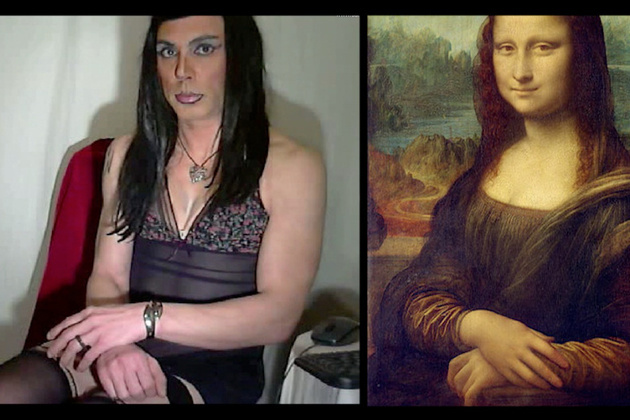
Marina Galperina highlights a poignant (and unembeddable) NSFW project, Webcam Venus, from Addie Wagenknecht and Pablo Garcia, who asked webcam performers to pose like works of classic art:

The work brilliantly accentuates and blurs the line between pornography and fine art, “lowbrow” internet phenomena and culture of the elite, erotic fantasy then and erotic fantasy now. Hardcore is hardcore, but let’s not pretend that Egon Schiele never told his models, “bend over and touch yourself.”