High Risers

Montgolfiere_1783

Graham Robb reviews Falling Upwards: How We Took to the Air by Richard Holmes, a chronicle of the aeronauts who ventured into the skies in hot air balloons during the 18th and 19th centuries:

For some time, the practical advantages of the balloon seemed to be primarily military.Tethered balloons were used by Napoleon, and, later, in the American Civil War, as observation platforms. Apart from providing strategic intelligence—and a very obvious target for the enemy’s muskets—the “spy in the sky” was a formidable psychological weapon. An Austrian officer complained of a demoralizing impression that “the French General’s eyes were in our camp.”

However, for most balloonists, the main purpose of what Victor Hugo called “the floating egg” was to feed the imagination and to fill the mind with awe. Like a wonderful hallucinogenic cloud, the balloon was capable of generating seemingly endless novelties. It became possible, as Holmes recounts, to see the sun set twice on the same day, to hear the orchestra of sounds that the earth sent up to the heavens, to navigate under the stars by the smellscape of crops, pine forests, ponds, and chimneys, to explore the realm whose skies were a dark Prussian blue and where butterflies fluttered past as though in a field of flowers.

In April, Peter Conrad emphasized the grimmer side of book’s subjects:

[B]alloonists were dangerous existential gamblers, anxious, as HG Wells put it, “to pass extraordinarily out of human things” and to probe the proper limits of life. Their vertical journeys soon ran out of breathable air, and reached a perimeter where the sky turns black and alien. The last and longest of Holmes’s stories therefore passes from Shelleyan fantasy to Coleridgean horror: a Scandinavian expedition to the north pole by balloon in 1897 turns into a grim re-enactment of The Rime of the Ancient Mariner, as ice takes the gallant aeronauts captive and slowly kills them. By then those silken puffballs had lost their innocence. The balloons in Jules Verne’s novels are symbols of “imperial command and scientific superiority”, and Holmes casually notices a Prussian officer called Zeppelin observing the ways balloons were used to evade blockades and as eyries for military spies during the American civil war: it was he who later gave his name to a new fleet of engine-powered dirigibles that could rain down destruction from a sky that had become a theatre of battle.

(Image by Claude-Louis Desrais, 1783, via Wikimedia Commons)

The Misery Of Miscarriage, Ctd

The popular and personal thread continues:

My wife and I had been married for about six months before we found out we were expecting. We were so thrilled that we immediately told family, friends, and announced it on social media. We started reading as much information as we could and I started looking online for baby clothes with my favorite sports teams’ logos on them. I was already a proud father. We are religious, and the night we found out I put my hands on my wife’s stomach and we prayed that our baby would be healthy and we’d be good parents.

Five weeks later my wife started bleeding, and the next day she miscarried in the bathroom of our apartment. Later the doctor told us it was too early to have even been a baby and we must have just seen the egg sac, but I’ll never forget my wife’s hysterical screaming and sobbing as we saw what looked to us like a tiny baby-shaped thing. I somehow made it to our couch and broke down sobbing because it hit me that I would never teach our child how to play basketball.

A couple hours later we drove in shock to a nearby park and buried our future plans and hopes in the woods. I said a few words through my tears, never expecting I’d have to bury my own child before it was even a child.

Another reader:

This thread took me back to a dark day nearly 30 years ago.  I remember so clearly sitting on my living room sofa with an extra-big maxi pad on, while the remains of what would have been my first child lumpily left my body. Then I went on to have two children and, while I grieved the one I lost, I can’t imagine having any other children than the ones I have. I know intellectually that I would have loved that one as much as I love these two adults who have been a part of my life all these years, but my emotions won’t follow my brain there. I just feel as though these particular people were the ones given to me to love. This sounds ridiculous, I know, but I feel as though I would have grieved not knowing them.

Another:

About seven years ago my wife woke me with a piercing scream.  I ran into the bathroom to find her holding a pregnancy test and crying tears of joy.  The child we had been trying for years to conceive was finally coming.

Those were some happy months – possibly the happiest in my entire life.  That happiness ended in a pediatric cardiologist’s office as my wife and I sat together, holding hands, listening to the doctor explain how our son had a major heart defect that he would not survive.  Just one of those things.  Nobody’s fault.  It just happens and no one knows why.

Abortion was an option on the table, but one we quickly discarded.  Our son was too wanted, too loved.  We decided to give him what life we could.

The time leading up to his birth is a painful blur.  My memories of my wife’s labor is a series of disjointed, painful images.  My son’s life stands in sharp contrast to all of that.  I remember every moment, every breath he took, how it felt to hold him, the way the world shifted when he died in my arms.  The next day we went to the mortuary, gave him a teddy bear and my childhood blanket, watched the flames consume his mortal shell, then finally took him home.

I still can’t drive by the crematorium without crying.

The grief nearly destroyed our marriage, but we survived and now have two other children.  Our four-year-old son knows he had a brother and likes to talk to him – which both breaks and warms my heart.  Our 18-month-old daughter owes her life to her oldest brother, as it was his condition that convinced a doctor to run the test which discovered her heart defect before it had a chance to do any damage. I like to think my son sacrificed his life to give my daughter a chance to live hers, which helps with the pain somewhat.

We were also fortunate in that we heard of the services of Now I Lay Me Down To Sleep before my oldest son was born.  We have a complete picture record of every moment of his life thanks to a photographer who met the darkest moment of our lives with grace, dignity and overwhelming compassion.  We are finally at a point in our grief where we can have pictures of all of our children on the walls and I am profoundly grateful that we have something we can show our other children and say “this is your brother”.

Still, I would give everything I have to hold my first-born in my arms one more time.

Another:

I expect you’ll get an outpouring of stories on the topic of miscarriage and stillbirth. It’s a painful experience and one that is often easier to talk about anonymously. I had just read Ariel Levy’s article, barely held back tears all the way through, then after a short walk to clear my head opened up your site and there it was again.  Ms. Levy’s account was heartbreaking for me to read since I’ve endured three miscarriages of my own.  None were anywhere near this level of drama, but I could still relate and my heart is heavy for her and her child.

Since mine were early miscarriages, sometimes it feels like they don’t count.  I had no ultrasound photos, never heard a heartbeat, didn’t even take a photo of my positive tests.  No one besides my husband and my doctor knew I was pregnant or even considering it.  I lived with a huge weight for three years.  (And, even if you do want to share, it’s a little hard to just bring up in conversation.)

When I got pregnant again, for a fourth time, I was terrified. I did not truly believe I would carry this child full term until all of a sudden I held him in my arms.  It was only after the birth of my son that I’ve been able to more freely talk about my experiences, because I feel like I’m safely on the other side.  Other side of what?  I don’t know.  A terrible rite of passage maybe.

Those “babies” (mushy bunch of cells, really) were as real to me though as my lively 17-month-old son is now.  I was briefly a mother, and then suddenly I wasn’t.  (Then again, and again.)  I think about them often, though less than I used to (the mind of a working mom of a toddler is full enough).  What I wonder the most is who they might have been. Would one of them have been just like my son, but three years older?   Would they have had his eyes, his voice, his belly laugh?  Or, if the first one had worked out would we have stopped then – in which case, perhaps I would never have met my son?

Gradually the pain has faded and changed into … something else.  A deepening perhaps.  Motherhood has been a revelation to me. I feel like a hazy curtain has been pulled back and I’ve been tugged across an invisible line, for better or worse and there’s no turning back.  Experiencing those losses is part of that journey and I am actually thankful now for having gone through them.  Would I feel the same if I didn’t have my son today?  If I was still without a child?  I can’t say.

Since you’re a poetry guy, I would like to pass along one of my favorite Mary Oliver poems:

The Uses of Sorrow
(In my sleep I dreamed this poem)

Someone I loved once gave me
a box full of darkness.

It took me years to understand
that this, too, was a gift.

The Best Of The Dish This Weekend

leafpetermcdiarmidgetty.jpg

I’m in London right now (check out the cartoon) to pick up an award from the British Political Studies Association for “policy innovation,” i.e. the long fight for marriage equality, and to see friends and family. I’m still a little jet-lagged so I’ll keep this short. The weekend saw the breakthrough with Iran that this blog has longed for since 2009. Obama’s pitch perfect speech last night on this remarkable achievement can be watched here. Netanyahu’s continued hole-digging can be seen and assessed here. We were, of course, on call through the weekend, and you can find a post of reactions from around the blogosphere here; terser tweets are here.

The weekend’s recommended short story is here. Luminescent poems from the winner of this year’s National Book Award, Mary Szybist, can be read here and here. I get one-upped by a real Doctor Who aficionado here; Aiden Kimel quietly dismembers the glibness of Richard Dawkins here; while a Dish reader sends a family heirloom photograph of JFK shirtless on a beach.

If you read one post, see this one on re-imagining the concept of “Original Sin” as more simply “The Human Propensity To Fuck Things Up,” or HPtFTU.

The most popular post of the weekend was A Deal With Iran: Blog Reax, followed by A Deal With Iran: Tweet Reax.

See you in the, er, morning.

(Photo: A green leaf in autumn, by Peter McDiarmid/Getty Images)

The Liberal Reagan, Ctd

Obamas-Crucial-Six-Months-SD

If I had one single reason for supporting Obama in the last election, it was that he and he alone had the strategy and perseverance to end the Cold War with Iran. He hasn’t done that yet – but he has, with remarkable global unity, started down a diplomatic path that could liberate the forces for moderation and democracy in that country, and unwind a dangerous ratchet toward war. That was always his larger promise from the get-go: not just to end the disastrous wars in Afghanistan and Iraq; not just to end the torture regime that made a war criminal of the president and ruined both our moral authority and the integrity of our intelligence-gathering; but to begin to defuse the deeper forces of polarization and conflict that seemed only likely to intensify after 9/11. I have always seen Obama as the antidote to Bush. This weekend, he fully inhabited the role.

For this blog, the question of Iran has particular resonance. Patrick, Chris and I truly soldered our partnership in the heady days of the Green green-peaceRevolution, as we became immersed in every tweet, every gesture and every tragedy of that great awakening. I know Dish readers were glued to those events as well – and feel the relief and exhilaration of this partial but still real breakthrough.

Which is why we should make this clear: this blog favors this agreement primarily because of our love of and admiration for the people of Iran. We saw them in June 2009 dare to believe that their long nightmare of isolation, extremism and theocratic rule might end one day. And there are times when commentary on all of this too easily misses their central place in this diplomacy. We are doing this not just because it is in the interests of the United States for there to be peace and non-proliferation in the Middle East; but because it as an act of basic respect toward the people of Iran. They were the ones who risked their lives and fortunes to fight against theocracy in 2009 and they are the ones who recently elected the most moderate leaders allowed. And we owe it to them to reciprocate their courage and perseverance. To be sure, Rouhani is not all of the regime, but he is very much a part of it, and has the sole democratic legitimacy. Not to engage this newly elected leader’s diplomatic outreach would be to turn our back on fledgling democracy in the Middle East – and kindling those democratic forces was and is the best response to the polarization unleashed in the crime of September 11, 2001.

Now consider this: in the past few months, Obama has both begun to remove the threat of WMDs in Syria through diplomacy and found a way to ensure that Iran’s irrevocable nuclear know-how will be verifiably channeled into peaceful, civilian use. These two acts of diplomacy compound one another to make the world a much more peaceful place. Yes, there remains a risk. Of course there does.

But there was also a risk in reaching out to Gorbachev in the 1980s, and yet two Cold Warriors, Reagan and Thatcher, chose to do business with him. And they were right to. As with the Soviets and the arms race, there comes a point when the pain inflicted on the other party by sanctions is so great you have maximal external leverage for reform. Too much and the sanctions would be counter-productive; not enough and we would only have military power as a lever. It takes judgment to know if the time is ripe to take yes for an answer. But, in my view, Reagan was as right to embrace Gorbachev as Obama is to reward Rouhani.

Reagan’s pragmatism and genuine horror of nuclear weapons have not been replicated in today’s Republican right. But those qualities defined him and his legacy just as much as his ideological fervor did. Obama is today acting on exactly those principles – as well as those of president George H W Bush, and Dwight Eisenhower. He is, in other words, the corrective to the second Bush and the neoconservative propensity for both utopianism and war (always a deadly combination). He is, yes, fulfilling his initial promise – to bring about the change we can still believe in and to rekindle the hope that region so desperately needs.

Update from a reader:

Hearing news of the deal with Iran makes me incredibly happy. I am a first-generation Persian and have lived happily in the United States all my life and have never truly understood our country’s issues with Iran. Understandably, there is the tumultuous political history for the past 40 years, but it’s even weirder that it took so long for this deal to come around. My family’s immersion into American life, along with thousands of other Iranians, has left me wondering why Iranians and Americans can get along but Iran and America can’t.

But really the problem was that the two countries just won’t – or at least it used to be that way. And it wasn’t until each leader decided to seize upon the opportunity to talk again. You highlighted the Green Revolution extensively and always showed an enormous amount of respect towards Iranians. You remained skeptical of the mullahs and the Ayatollah while always seeing the best in the people. Not everyone dedicated daily attention to their marches for freedom and the impact of bringing them back into the international community. So it’s with Obama and Rouhani (with the Ayatollah’s backing or permission we don’t know) that finally found a way to make it happen.

I’ve never thought of myself out of place in the US and adore the Stars and Stripes, so I can’t tell you how great it is that my ancestral home and my home are finally moving towards peace.

(Photos: Getty Images)

A Poem For Sunday

backstage

“Heroine” by Mary Szybist:

Just before the curtain closes, she turns
toward me, loosening
her gauzy veil & bright hair—

This, she seems to say, this
to create scene, the pure sweep of it,
this to give in, feel the lushness,
this & just a little theatrical lighting
& you, too, can be happy,
she’s sure of it—

It’s as if I cut her heart-whole from the sky,
rag & twist & tongue & the now terrible speed
of her turning

toward me like the spirit
I meant to portray, indefatigable—

see how bravely she turns, how exactly true to the turning,
& in the turning
most herself,
as she arranges herself for the exit

withholding nothing, unraveling
the light in her hair as her face

her bright, unapproachable face
says only that
whatever the next scene is,
she will fill it.

(From Incarnadine © 2013 by Mary Szybist. Reprinted by kind permission of Graywolf Press. Photo by Julija Rauluševičiūtė)

Blessed Beards

dish_more

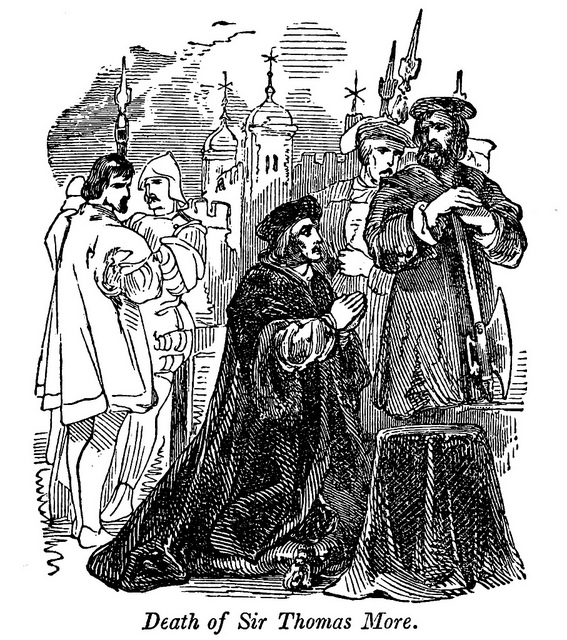
Melissa Keating rounds up the “four best beards in the history of Christendom.” One belonged to St. Thomas More:

Henry VIII condemned St. Thomas More to death after he refused to deny papal supremacy. More had been confined in the Tower of London for over a year (hence the beard, and why it’s not pictured). As the executioner lifted his axe, More asked him to wait. The blindfolded saint-to-be carefully laid his beard on the outside of the block, out of the executioner’s path. “This hath not offended the king,” he quipped, thus protecting his beard from the blade.

Then the axe fell.

You read that correctly. His last words before beholding the Beatific Vision were a beard joke. While that might not fit the modern notion of a saint, it completely matches his personality. One biographer wrote, “that innocent mirth which had been so conspicuous in his life, did not forsake him to the last … his death was of a piece with his life.”

Thomas More was my confirmation saint. Now it makes even more sense.

(Image of a not-so-bearded More at the chopping block via Flickr user CircaSassy)

Is Catholic School Just For Rich Kids?

Mike Dwyer fears it’s getting that way:

I attended Catholic schools at the end of a long era of affordability. For decades parochial education was subsidized by a large supply of clergy. When most of your staff has taken a vow of poverty it certainly keeps overhead down. As the number of clergy began to dwindle in size during the 1980s, tuition rates began to creep upwards. For comparison my high school alma mater charged about $150 per year when it opened in 1953. By the time I graduated 40 years later, tuition had risen to about $2,700, Still affordable enough that I could pay it myself with a part-time job bagging groceries at the local supermarket. Today this would be impossible. A full year at the school I attended costs roughly $12,000.

The once erroneous perception that a Catholic education was only for the well-off has now become a reality. What does this mean for a faith with deep roots in the middle class? Whereas parochial schools were the norm for most Catholic children a half-century ago, will there be a day when American Catholics become sharply divided among the haves and have-nots, with a private education being the wedge?

In response, Mike Schilling says he doesn’t expect a Catholic class divide to open up in America anytime soon and suggests there are more interesting questions to ask:

Both of my kids went to Catholic middle and high schools, because they were the best schools we could afford. The middle school was highly subsidized; the high schools were not, but were still half the price of a non-parochial private high school. They got amazing educations, and I don’t regret the expense.

The high schools in particular fostered religious values without being sectarian. The open house at which my son fell in love with his featured students of all denominations explaining why they loved the school, including a Jewish girl whose ambition was to become a cantor. This was great for us, but I’ll ask Mike D.: is that a good thing, or does it mean that the schools aren’t focusing enough on their duty to children who are Catholics?

More context for the debate: the average Catholic schools charged $9,066 in tuition in 2007-08, the most recent year for which statistics are available, while nonsectarian private schools charged $16,247.

Face Of The Day

dish_fotdsat23

Photographer Sasha Leahovcenco traveled to Siberia for his project Chukota: A Story From the End of the Earth:

Both trips into the heart of Siberia had two purposes: the first was to give the tribes along the way “warm clothes, shoes, gifts, and simply show them grace and love.” The second was to take professional photographs and print them right there, which usually meant handing people the one and only photo they have ever owned of themselves.

Leahovcenco also created a short film of his experience in Siberia:

This embed is invalid

(Photo by Sasha Leahovcenco)

Of Gods, God, And Men

Those following the work of the New Atheists have probably encountered the Richard Dawkins quip, “We are all atheists about most of the gods that humanity has ever believed in. Some of us just go one god further.” Aidan Kimel responds by remarking that “God is not a god,” and turns to this passage from theologian Herbert McCabe’s God Matters to explain what he means – and why he finds that Dawkins statement missing the mark:

God must be incomprehensible to us precisely because he is creator of all that is and, as Aquinas puts it, outside the order of all beings. God therefore cannot be classified as any kind of being. God cannot be compared to or contrasted with other things in respect of what they are like as dogs can be compared and contrasted with cats and both of them with stones or stars. God is not an inhabitant of the universe; he is the reason why there is a universe at all. God is in everything holding it constantly in existence but he is not located anywhere, nor is what it is to be God located anywhere in logical space. When you have finished classifying and counting all the things in the universe you cannot add: ‘And also there is God.’ When you have finished classifying and counting everything in the universe you have finished, period. There is no God in the world.

Kimel’s commentary on the passage – with a surprising twist at the end:

If God is not a being but rather the ultimate source and cause of all that he has freely brought into existence, then he cannot be understood as a god. Deities are but “bits of the universe”; but the God and Father of Jesus Christ is the transcendent creator of the universe. He is the reason why there is a universe, whether it contains gods, fairies, sprites, centaurs or whatnot.

But if God is not a god, then what is he? McCabe is direct: we do not know. We do not know what God is. We cannot provide a definition of his nature. We cannot comprehend his essence. Hence we really do not know what we are talking about when we use the word “God.” All we know is that whatever God is, he is the transcendent Mystery of our existence…. Perhaps now we can understand why Christians were sometimes accused by pagans of being atheists.

Recent Dish on the topic here.