[In democracies, citizens] hold governments accountable for their preparations for and responses to disasters. Incumbent governments know this, and their responses are typically geared toward shoring up political support among key constituencies. In functioning democracies, this tends to result in more effective post-disaster emergency response. Michael Bechtel and Jens Hainmueller found that effective emergency response to the 2002 Elbe River flood in Germany immediately increased incumbent vote shares in disaster-affected areas, and that the effect carried over to elections three years later. Andrew Reeves found that in the United States, “swing” states receive presidential disaster declarations – which can move billions of dollars – about twice as frequently as non-competitive states.
In non-democratic systems, disaster response policies generally cater to the more narrow interests of urbanites in important political and economic centers … These more targeted responses (or non-responses) to disasters make for bad humanitarian outcomes but good politics: Alastair Smith and Alejandro Quiroz Flores found that while democratic governments are often ousted from office following major earthquakes, the rate at which autocratic governments are deposed is not significantly different following similar disasters.
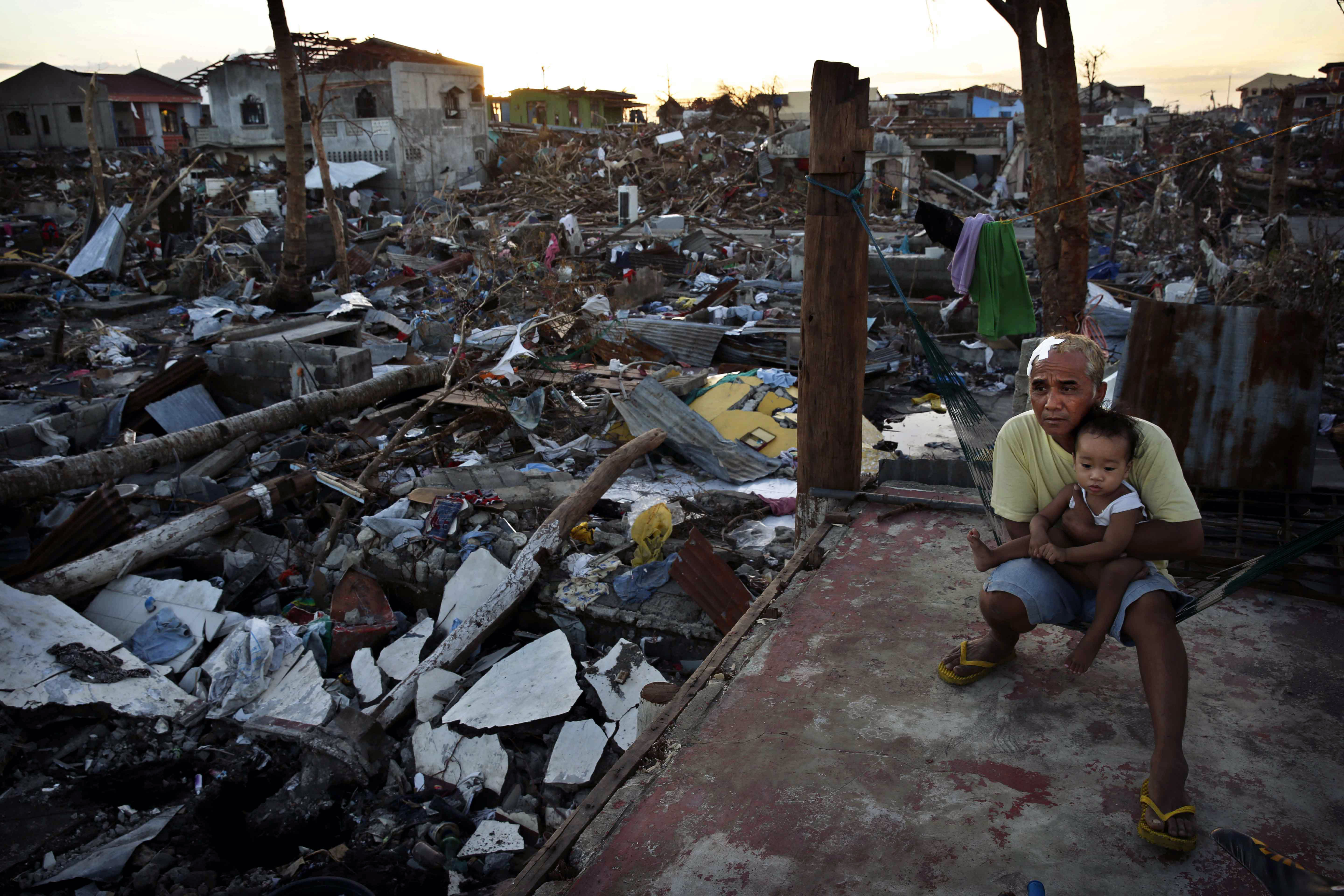
(Photo of the aftermath of Typhoon Haiyan from Getty)
A young man wearing a Santa hat searches for food amid the garbage at the municipal rubbish dump, 20 km north of Tegucigalpa, on November 21, 2013. Honduras, one of the poorest Latin American countries, will elect new president on November 24. By Orlando Sierra/AFP/Getty Images.
To share a story is in part to take ownership of it, especially because you are often able to comment on a story that you are sharing on social media. If you can share a piece of information that’s an absolute truth – whether that’s how to uninstall apps on your phone, or what the NSA is really doing – you too become a truth teller. And that feels good. Just as good as it does to be the person who has the cutest cat picture on the Internet.
So that leaves us with the stories that don’t make it. These are the articles and essays that have fallen into the valley of ambiguity – reports on important scientific findings with difficult-to-interpret results, political news with a long and tangled back story attached, and opinion essays that require us to account for points of view that may be unfamiliar or strange.
We just want to share stories that make us seem like we know something. Most of all, we don’t want to say something that we didn’t intend.
And that is the danger with any story that falls into the valley of ambiguity. We can’t be sure how people will take it. We don’t want to risk our reputations on a story that can be taken more than one way.
More than anything, the fear of a smeared reputation is what creates that dip in virality. Sharing a story means that in some sense we stake our reputation on it. That’s why sharing a story is not the same thing as enjoying a story, reading a story, or even learning from a story. I know for certain that there are plenty of stories that get read, but not shared. I have seen the statistics on io9’s back end. But when we measure a story’s success by virality, which is what we must do in the age of social media, the content of our popular culture changes. We measure success by what people aren’t afraid to share with their neighbors, rather than what people will read on their own.
A good recent example of a Dish post that was read a lot but not relatively shared a lot was the controversial debate between Max Blumenthal and Eric Alterman over the former’s new book, Goliath: Life and Loathing in Greater Israel. Many posts that day that were less polarizing – about gays in the South, Ted Cruz’s nutty Christianist dad, and sizing up Election Day, for example – garnered many more Facebook likes than the Blumenthal-Alterman showdown, which was the most popular post of the day by traffic. Evidently many readers don’t want others to know they “like” a post criticizing Greater Israel.
Adelle Waldman wonders whether older books about marriage and romance are more powerful because “their protagonists contended with societal repression, instead of merely struggling with their lovers and with themselves—with their conflicting desires and changing moods”:
“Madame Bovary” isn’t really a didactic story of a woman who is tragically stuck in a bad marriage—though there is enough of that in the novel so that generations of college freshmen can spin essays about the bad old days and the subjugation of women. The book itself paints a rather more complicated picture of Emma’s situation. Most of the novel’s true admirers prize it for reasons less likely to make for neat five-paragraph essays: because of the lovely yet unsentimental precision of Flaubert’s prose, because of his shrewdness about his characters—the way he exposes what is trite and bourgeois, as well as what is real and often inexpressible, the way he forces us to simultaneously recoil and pity—and because of his relentless depiction of the dullness of provincial life and the hypocrisy of those who at first appear to be less dull, more cosmopolitan. Very little of this feels dated to me.
It could still be, however, that the power of “Madame Bovary” is amplified by the social and historical backdrop. That Emma was trapped in a marriage that, officially, could only be dissolved by death (although she was willing to run off to Italy with Rodolphe) perhaps raised the tension and gave Flaubert an ideal canvas on which to exercise his other talents.
Teen boys can express vulnerability more freely than they did in previous generations thanks in part to social media, according to Andrew Simmons, a high school teacher:
On Facebook, even popular students post statuses in which they express insecurities. I see a dozen every time I log on. A kid frets that his longtime girlfriend is straying and wishes he hadn’t upset her. Another admits to being lonely (with weepy emoticons added for effect). Another asks friends to pray for his sick little sister. Another worries the girl he gave his number to isn’t interested because she hasn’t called in the 17 minutes that have passed since the fateful transaction. …
Individually these may seem like small-scale admissions. But the broader trend I have witnessed in the past few years stands in sharp contrast to the vigilance with which my generation guarded our fears both trivial and deep. In this sense, social networking has dramatically altered how high-school boys deal with their emotions. Instead of being mocked for revealing too much, students who share in this way win likes and supportive comments from male friends. Perhaps part of it is the fact that girls appear to appreciate the emotional candor and publicly validate it with likes and comments, giving boys the initiative to do the same. In high-school halls, guards stay up, but online, male emotional transparency is not only permitted but also celebrated.
Donations rise during good times and fall during bad; the $316 billion given last year is high, but it’s still less than any of the three years leading up to the last recession. It’s understandable that people would have less to give when times are hard, but happens to be the exact time when the need is highest. …
The food stamps program cost $78 billion last year, and Medicaid cost, $251 billion. Temporary Assistance for Needy Families, or what used to be called welfare, cost another $31 billion. Once the Obamacare exchanges reach something like full capacity in 2017, federal subsidies for insurance on those exchanges is projected to cost about $108 billion. And that’s before we even mention Social Security, which cost $773 billion in 2012.
So the idea that a reduction in these programs could somehow be made up for by an increase in private giving just doesn’t reflect reality.
Congressman Radel is correct, though probably inadvertently, when he refers to his cocaine use as a choice. He doesn’t suffer from the disease of alcoholism; he suffers from addiction. Cocaine happened to be his drug of choice on the night in question. Giving him the benefit of the doubt on his credibility, alcohol is his usual drug of choice.
Addiction is the disease. It doesn’t matter what you choose to feed that addiction, be it blow, smack or Budweiser. Until Radel grasps that concept, he’s going to continue to use.
Another points to a depressing reality:
Twenty percent of those serving life without parole for nonviolent drug or property crimes are doing so for a first offense (NYT). Yet Trey Radel will serve not even one day in jail. When he comes back from his “leave of absence,” will he at least have the decency to support drug-crime sentencing reform? Clemency for those serving time for similar offenses? Or is this another instance of IOKIYAR [It’s OK If You’re A Republican]?
Another:
I was reading the news about his arrest and this article on sentencing disparities, and I wonder why there hasn’t been a movement to hold Congress and staffers to the standards they set for the U.S. Why not drug test all reps and staffers? I bet we’d find out some interesting things.
Update from a reader:
In a refreshing moment of non-hypocrisy, Rep. Radel is actually a co-sponsor of H.R. 1695, the Justice Safety Valve Act of 2013, the House counterpart to the Leahy-Paul Senate proposal to allow federal judges to issue sentences below applicable mandatory minimums.
Another:
Not sure if anyone’s sent this to you, but here’s a fun little blurb from the WaPo story on the Radel arrest: “In the House, Radel often voted with conservatives: He voted ‘yes,’ for instance, on a broader bill that would allow states to drug-test recipients of food stamps.” I wonder if he would vote for a bill requiring drug-testing recipients of congressional salaries.
Molly Ball explains why the Senate blew up part of the filibuster today:
Why did Reid pull the trigger? He was tired of making deals with McConnell, only to see their spirit violated by yet more obstruction, allies say. The two reached an informal agreement in January that was supposed to lead to fewer filibuster threats, and another deal in July that paved the way for several executive-branch nominations, including Richard Cordray to head the Consumer Financial Protection Bureau and Thomas Perez to head the Department of Labor. But none of these bargains affected the overall trend of blockage, and Reid finally had enough.
The real reason Democrats were so eager to confirm Obama’s DC Circuit nominees, and Republicans were so desperate to block them, is that the court’s current conservative majority has repeatedly blocked the president’s agenda. Since most of the federal bureaucracy resides in DC, the DC Circuit is tasked with assessing the constitutionality of federal rules and regulations. Conservatives on the court have neutered much of Dodd-Frank, the post-recession financial reform bill that was meant to keep banks in check. The court also overturned Obama’s ability to appoint staff while Congress is out of town and struck down state environmental rules that would have regulated emissions from other states.
Chait adds that “main reason for this odd, partial clawback of the filibuster is that President Obama has no real legislative agenda that can pass Congress”:
President Obama’s second-term agenda runs not through Congress but through his own administrative agencies. His appointees are writing rules for financial reform, housing policy and — the potentially enormous one — climate emissions. Senate Republicans have tried to stymie this agenda by blocking executive-branch appointments, most recently filibustering the nomination of Mel Watt to run the Federal Housing Finance Agency. The executive-branch filibuster has become a primary Republican weapon against Obama’s agenda.
This is a major, major, event. It changes how the nation is governed in a significant way. That said, it’s not as if the Senate has been static since the last time filibuster rules were changed (at least in a major way) almost 40 years ago; most reform is incremental, and one could argue that the rules change today returns nominations closer to how things were done in the 1970s than they have been for the last decade, and especially during the Obama era.
Bouie doesn’t take Republican criticisms seriously:
Republicans will spin this as an unprecedented power grab. Already, Mitch McConnell has warned this will backfire on Democrats when they are in the minority, John McCain has predicted it will put a “chill” on the “entire” chamber, and Louisiana Sen. David Vitter has said that this is “a shame for the Senate” and “scary and dictatorial” for the country. But there’s nothing undemocratic about changing the rules to allow a majority to prevail, or—in this case—robbing a minority of a tool to obstruct without consequence. Indeed, if there’s anything undemocratic, it’s the GOP’s war on President Obama’s ability to make nominations, and to nullify one consequence of the 2012 elections.
Iowa senator Chuck Grassley recently threatened, “So if the Democrats are bent on changing the rules, then I say go ahead. There are a lot more Scalias and Thomases that we’d love to put on the bench.” In other words, without the restraint of the filibuster, the next time Republicans have the White House and the Senate, which will happen eventually, they’ll go hog-wild, appointing the most radical conservatives they can find. But there’s one big reason that argument fails:They would have done it anyway. …
You can make an argument that Democrats should have taken the high road and not changed the filibuster rule today. But if you think Republicans wouldn’t have changed the rule to benefit themselves at the first chance they got—no matter what Democrats did—then you haven’t been paying attention.
Democrats had no interest in cutting a deal; no Republican was emerging to craft one. In one year, even in the best circumstances, they were likely to lose a few Senate seats and fall below the majority needed for a rule change.
Beutler hopes for judicial nominees to get more liberal:
Over the course of several decades, the right has nurtured what essentially amounts to a shadow judiciary, composed of conservative legal scholars who disagree, juridically and ideologically, with the post-New Deal consensus. Republican presidents draw upon this class of activists to fill judicial vacancies, creating a modern antipode to liberal judicial activists of previous decades.
As that movement has matured, and in part because that movement has matured, politics has shrunk the ideological sphere from which Democratic presidents have been able cull liberal jurists. Outspoken progressives, on the periphery of the sphere, have been marginalized. The liberal legal establishment is so scrutinized and subject to so many litmus tests that it has self-selected for timid or self-censoring thinkers, at least in part because it was assumed “liberal activists” would be blocked.
That limiting force is gone now. And the hope is its absence draws a new generation of legal minds out of the shadows and on to the bench sooner than later.
The only Democrats who didn’t go along were long-time “nuclear” opponent Carl Levin and two red-state senators of wandering loyalty, Joe Manchin and Mark Pryor. It took a lot of GOP obstruction to create this level of Democratic loyalty.
[B]y refusing to compromise in any way, they’ve lost everything. Just as they lost everything on health care by refusing to engage with Democrats on the Affordable Care Act. Just as they lost everything on the government shutdown and the debt ceiling. Just as they lost the 2012 election.
Hard-nosed obstinacy plays well with the base, but it’s not a winning strategy in the end. Republicans never seem to learn that lesson.


 The Dish