Foosball In A Flat World

7006192758_15cc492758_b

Derek Workman finds a measure of comfort in that fact that "even in a globalized world of evermore uniformity, table football, foosball, csosco, lagirt or whatever you want to call it still has no absolutely fixed idea of what really does constitute the core of the game":

The American/Texas Style is called "Hard Court" and is known for its speed and power style of play. It combines a hard man with a hard rolling ball and a hard, flat surface. The European/French Style, "Clay Court" is exactly opposite of the American style. It features heavy (non-balanced) men, and a very light and soft cork ball. Add to that a soft linoleum surface and you have a feel best described as sticky. In the middle is European/German Style,  "Grass Court," characterized by its "enhanced ball control achieved by softening of components that make up the important man/ball/surface interaction." And even the World Championships use five different styles of table, with another 11 distinct styles being used in various other international competitions.

(Photo by Gordon Anthony McGowan)
Drinking To Stay Warm

Daven Hiskey doesn't recommend it:

When you have a drink, the volume of blood brought to the skin’s surface increases, making you feel warm. (That dilation is why slightly or exceedingly intoxicated people look flushed.) This overrides one of your body’s defenses against cold temperatures: Constricting your blood vessels, thereby minimizing blood flow to your skin in order to keep your core body temperature up. … According to a study done by the Army Research Institute of Environmental Medicine, drinking alcohol in chilly weather also reduces the body’s ability and tendency to shiver, taking away yet another method your body uses to help keep warm when it is cold. 

Bottom line? The age-old practice of drinking alcoholic beverages to keep the body warm in cold weather is the exact opposite of what you should do.

Booze And The Bard

Shakespeare often employed alcohol for his plays:

If drinking kills characters in Hamlet, even the most comic scenes of Macbeth and The Tempest mingle drunken characters with treason and death: the Porter pitches the joys of inebriation as the Macbeths clean their hands of the king’s blood; Stefano and Trinculo guzzle a keg and plot to kill Prospero. The love potion in Romeo and Juliet kills rather than cures. Cleopatra hides away her own special draught to facilitate suicide; Antony gets drunk on a barge. Draughts and potions—these substances produce scenes of intoxication tainted by dark desires and threats of death. Even as Shakespeare created uplifting portraits of the "merry" drunkard, he equally illuminated what was clear to the Puritan: addiction was a growing problem in early modern England.

The theater was also a place to drink during performances:

All playhouses have liquor onsite, and [the London playhouse] The Curtain is no exception. As Thomas Platter, a Swiss visitor to London, noted in his diary in 1599, "During the performance food and drink are carried round the audience, so that for what one cares to pay one may also have refreshment." The distractions were many, not only from drunk patrons themselves: ale produced a hissing noise when tapped, and those opening it were shouted down by audience members annoyed by the sound.

After the performance, fresh from hearing Falstaff’s advice to "addict themselves to sack," the audience members, as well as the actors and playwrights, head to one of the taverns or inns scattered throughout Shoreditch or lining London’s Bankside. Even if in 1598 the actors could boast an engagement at a permanent theater such as The Curtain, they still remember inn yards, the sites of their first performances—ale and theater have always been yoked together in the history of English playing.

Broadband For All?

Jon Brodkin reports on satellite companies that claim they can "provide broadband speed to nearly every American without costly construction projects to bring cables to the home":

Latest-generation satellites operated by HughesNet and ViaSat offer 10 to 15 Mbps down and 1 to 3 Mbps up to nearly any home in the US, representatives of those companies said. They believe the industry simply suffers from an awareness problem. Previous-generation satellite products offered only a fraction of that speed, and even people who realize satellite is available to them may not know that the latest products are as fast as they are.

But gamers beware:

"We can't get around physics and the speed of light," said Dan Turak, VP of sales and distribution at ViaSat Communications. "We have about a half-second latency. The only time latency becomes an issue is for a gamer. We're very clear to that customer that you'll probably lose if you're playing against someone without satellite broadband. That latency is just enough to cause delay."

Previous Dish on broadband access here.

Typing Out A Trip

Can drug writing really capture the psychedelic experience? The essay collection Exploring the Edge Realms of Consciousness attempts an answer. Michael Thomsen is disappointed:

Many of the essays in Edge Realms try to explain the paradoxes of scientific modeling with the transcendence of getting really fucked up. It is not enough to have done a drug and had a fine experience, one must recast the nature of reality in its afterglow, to find in the sober world inadequacies revealed through the shamanistic updraft of a trip.

Aldous Huxley remains the patron saint of this yearning conviction. The one-time satirist of using drugs to pacify the vigor and anger of a ruled class, Huxley became a bourgeoise guru when he discovered LSD. Catalyzing his years-long wonderment about human perception, LSD and mescaline prompted Huxley to spend the latter parts of his life praising drugs as a human utility for consciousness raising. And with the shift the bright cuts of language and thought in his early novels become overburdened with dim metaphors of acid highs being like a trip to the "antipodes" of one’s mind, in which one must catalog the wild fauna of giraffes, kangaroos, and duck-billed platypuses.

The unaddressed problem with drugs as co-pilots for metaphysical inquiry is that the high always ends, and after a certain point straining to pull meaning from a state that isn’t actually meant to be sustained becomes obsessive and distracting.

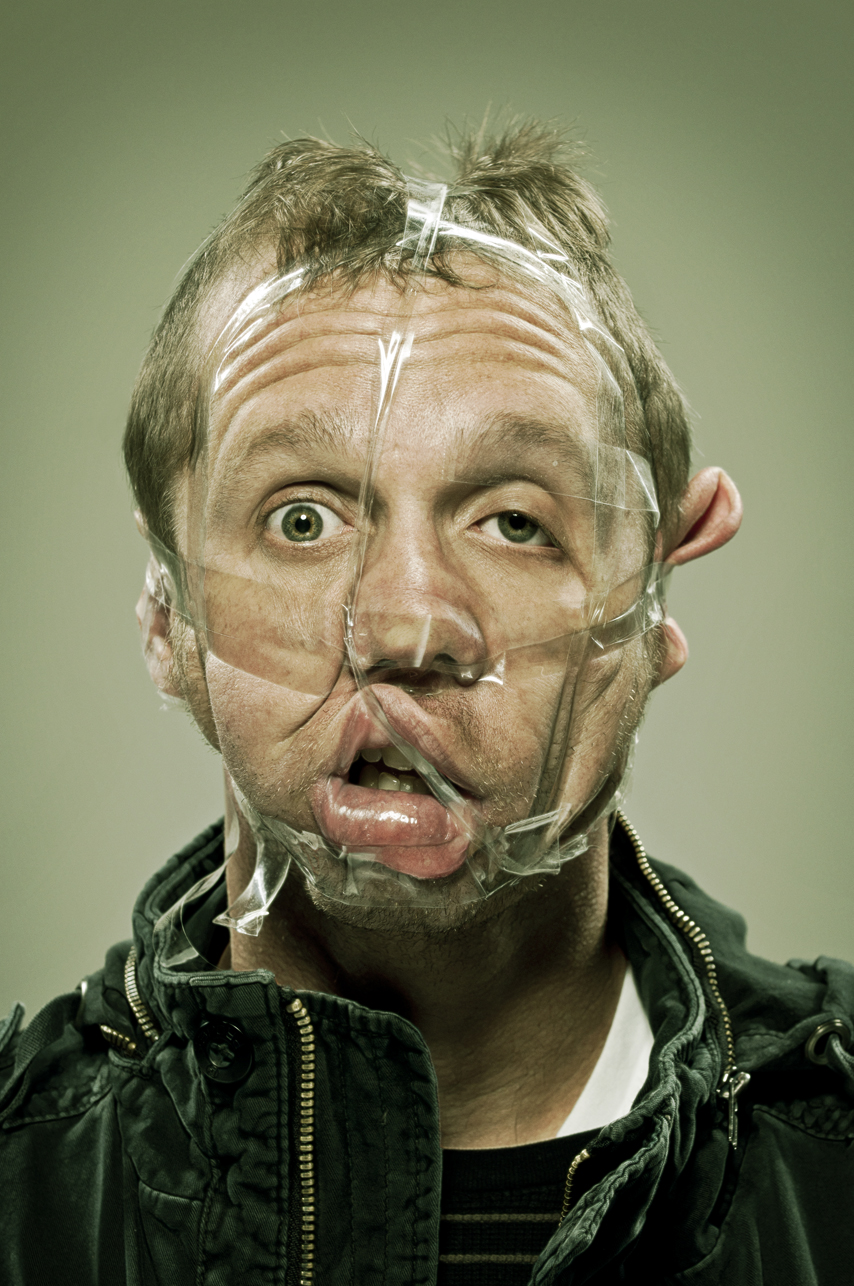
Face Of The Day

Stserling

Jakob Schiller unwraps a photo series:

Last Christmas, photographer Wes Naman and his assistant Joy Godfrey were wrapping presents in Naman’s photo studio when Godfrey randomly put a piece of scotch tape on her nose and pulled it into an awkward position. Naman followed suit by applying the tape to his lips. Seeing the silliness contained in a simple household item turned a light on in Naman’s head. Fast-forward one year and the idea has blossomed into a project he calls Scotch Tape, in which he uses this pliable plastic to completely cover and distort people into zombie-like caricatures of themselves.

When English Words Fail

Emily Elert explains using a linguistic graph:

Few of us use all–or even most–of the 3,000 English-language words available to us for describing our emotions, but even if we did, most of us would still experience feelings for which there are, apparently, no words. In some cases, though, words do exist to describe those nameless emotions–they're just not English words. Which is a shame, because–as today's infographic by design student Pei-Ying Lin demonstrates, they often define a feeling entirely familiar to us.

Megan Garber highlights some favorites:

You know that sorry state of affairs that is actually looking worse after a haircut? Or the urge to squeeze something that is unbearably cute? Or the euphoria you feel when you're first falling in love?

These are common things — so common that they're among the wonderfully delightful and excruciatingly banal experiences that bind us together as humans. And yet they are not so common, apparently, that the English language has found words to express them. The second-most-spoken language in the world, as a communications system, sometimes drops the ball when it comes to de-idiomizing experience — a fact that we are reminded of anew in the image above.

Go here for a similar Dish thread on words without an English equivalent.

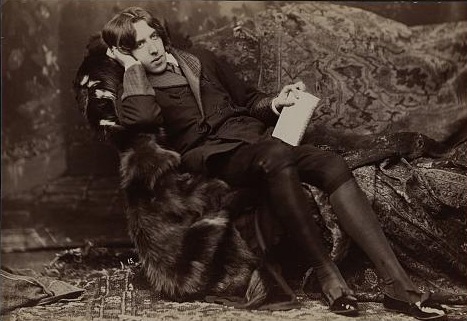
America Gone Wilde

Oscar_Wilde_(1854-1900)_in_New_York,_1882._Picture_by_Napoleon_Sarony_(1821-1896)_8a

Upon arrival in the States, Oscar Wilde reportedly quipped, "I have nothing to declare except my genius." The US tour proved excellent fodder for Wilde's wit:

Wilde ranged all about the country subsequently—west along the Great Lakes and on to California, back through the prairies and into Atlantic Canada, and then to the American South. He scattered mordant criticism but also genuine praise, often about the same things. Wilde declared, of Niagra Falls, "Every American Bride is taken there, and the sight of that tremendous waterfall must be one of the earliest, if not the keenest, disappointments in American married life" but also that the "majestic splendour and strength of the physical forces of nature” were "far beyond what I had seen in Europe." On Cincinnati: "I wonder that no criminal has ever pleaded the ugliness of your city as an excuse for his crimes." He found California "a very Italy without its art," though later he admired that "nature had exhausted her resources on the West and left nothing for the prairies."

(Portrait of Oscar Wilde in New York, 1882 by Napoleon Sarony via Wikimedia)

The Burdens Of A Book Club

As the only writer in her book club, Marcy Campbell plumbs the group for insight into today's literary market, including the many reasons members will reject a book:

I’m in the heads of these ladies, imagining the silent demerits they will offer to words like "heartbreaking," (too sad), "epic" (too long), "thought-provoking" (meh, could go either way). Any book that features the loss of a child is out, no debate. Spousal abuse, cruelty to animals, anything hinting at a conservative world-view (unless it’s written by someone who abandoned that world-view), nope, nope, and nope.

She fears that the group, mostly made up of tired young mothers, don't have the energy at the end of the day to tackle a serious book:

Is that a lame excuse? Have I, and our other club members, become lazy? Complacent? Has motherhood made us incapable of putting literary tragedy in its proper perspective? Or are we just…tired? Are we victims of the mentality that says we must do it all or die trying? (Books on this topic will almost always get the nod.)