A World Without Guns

Sam Harris wouldn't want to live in one:

A world without guns is one in which the most aggressive men can do more or less anything they want. It is a world in which a man with a knife can rape and murder a woman in the presence of a dozen witnesses, and none will find the courage to intervene. There have been cases of prison guards (who generally do not carry guns) helplessly standing by as one of their own was stabbed to death by a lone prisoner armed with an improvised blade. The hesitation of bystanders in these situations makes perfect sense—and "diffusion of responsibility" has little to do with it. The fantasies of many martial artists aside, to go unarmed against a person with a knife is to put oneself in very real peril, regardless of one’s training. The same can be said of attacks involving multiple assailants. A world without guns is a world in which no man, not even a member of Seal Team Six, can reasonably expect to prevail over more than one determined attacker at a time. A world without guns, therefore, is one in which the advantages of youth, size, strength, aggression, and sheer numbers are almost always decisive. Who could be nostalgic for such a world?

He follows up:

There are, of course, other ways to stop a person with a knife. You can use a chair, a baseball bat, or any weapon that gives you a range advantage. To do this successfully, however—especially against someone who is determined to kill you—you should really be someone who is trained to fight with weapons, not a randomly selected elementary school teacher. The only thing that will reliably give the average person a true advantage over a killer with a knife, is a gun.


Cool Ad Watch

Hairillusion-1

Michael Zhang double-takes:

To make the point that Garnier Fructis’ hair products are great for both women and men, advertising agency Publicis teamed up with photographers Billy & Hells for a series of creative advertising photographs. Upon first glance, each of the photographs appear to show a tough guy with a massively long beard. However, look a little closer and you’ll realize that things are not what they appeared to be.

How The Middle Kingdom Covers Us

Congressman Dana Rohrabacher claims that the Chinese government doesn't just intimidate American journalists, it also effectively uses its state media correspondents as spies in the USA:

Of the hundreds of Chinese nationals sent to the United States every year, some may be real reporters, but many function as intelligence officers; they report on what's happening in the United States on issues of concern to Chinese leaders — including the movements of Tibetan activists and Chinese dissidents — and write secret cables accessible only to a select few.

Furthermore "the Ministry of State Security [A Chinese ministry roughly equivalent to the CIA and FBI] also makes extensive use of the news media covers, sending agents abroad as correspondents for the state news agency Xinhua and as reporters for newspapers such as the People's Daily and China Youth Daily."

Geoengineering Our Survival, Ctd

Art-weather-620x349

James Temple lays out the debate surrounding "cloud brightening," a geoengineering strategy that may help combat rising global temperatures: 

It's clear that cloud brightening is possible. Satellites have observed "ship tracks," or whitened lines in marine clouds that large vessels have formed inadvertently by pumping out particles in their exhaust. Unknown is whether humans can do it purposely, on a large enough scale to matter, and without severely altering weather patterns elsewhere.

The World Economic Forum is pessimistic and included "rogue deployment of geoengineering" as an "emerging game changer" in its Global Risks 2013 report (pdf):

The problem is that incoming solar radiation drives the entire climate system, so reducing sunlight would fundamentally alter the way energy and water moves around the planet. Almost any change in weather and climate patterns is likely to create winners and losers, but determining causation and quantifying impacts on any given region or country would be a massive challenge.

They go on:

[T]his has led some geoengineering analysts to begin thinking about a corollary scenario, in which a country or small group of countries precipitates an international crisis by moving ahead with deployment or large-scale research independent of the global community. The global climate could, in effect, be hijacked by a rogue country or even a wealthy individual, with unpredictable costs to agriculture, infrastructure and global stability.

Previous Dish on geoengineering here, here, here and here.

(Image: The Australian Bureau of Meteorology recently added new colors to its weather forecasting chart to extend the range above 50 °C [122 °F]. Credit: Bureau of Meteorology via Sydney Morning Herald)

Netflix Originals Get More Original

Alyssa previews Arrested Development's reprise:

[T]he two most interesting things that Mitch Hurwitz, Arrested Development’s creator, explained about the Netflix episodes had nothing to do with what story they’d tell. Rather, he said first that the episodes would each focus on a different character, that they could be watched in no particular order, and that events in each episode would become clearer as viewers watched more of them. And second, he explained that some of them were different lengths, though they are all roughly thirty minutes long.

How she understands these creative choices:

Up until these announcements, it’s really seemed like Netflix was simply chasing broadcast television, whether picking up its scraps of cancelled shows or chasing cable’s tone. But if the network can make its bones by truly taking advantage of the things that make it different from the networks and cable, then it might be able to truly make itself a destination for creators and viewers, the way that cable’s lack of content restrictions has done for it over the last decade and a half.

The Origin Of The Piggy Bank

94141805

Megan Cohen looks back:

In [the Midde Ages], when the question of where to keep money arose, people didn’t typically have the option of a local bank. Instead, the answer oftentimes involved keeping their valuables in a vessel made of pygg. 

What was pygg, exactly? Pygg, a word with Old English origins, was a type of dense orange clay, popular in Western Europe for its use in the creation of a wide variety of containers, jars, and cups. The common name for these containers was "pygg jars." As the pygg jars were fairly ubiquitous, they were used for storing a variety of items, including money. 

(Photo: Children touch a giant model globe in the shape of a piggy bank, part of an art installation entitled 'Cool Globes,' about combating global warming and climate change in the Kongens Nytorv area in Copenhagen on December 8, 2009. By Adrian Dennis/AFP/Getty Images)

The Platinum Coin Option, Ctd

Ezra Klein is dead-set against it:

The argument against minting the platinum coin is simply this: It makes it harder to solve the actual problem facing our country. That problem is not the debt ceiling, per se, though it manifests itself most dangerously through the debt ceiling. It’s a Republican Party that has grown extreme enough to persuade itself that stratagems like threatening default are reasonable. It’s that our two-party political system breaks down when one of the two parties comes unmoored. Minting the coin doesn’t so much solve that problem as surrender to it.

The platinum coin is an attempt to delay a reckoning that we unfortunately need to have. It takes a debate that will properly focus on the GOP’s reckless threat to force the United States into default and refocuses it on a seemingly absurd power grab by the executive branch. It is of no solace that many of the intuitive arguments against the platinum coin can be calmly rebutted. It’s the wrong debate to be having.

The Daily Wrap

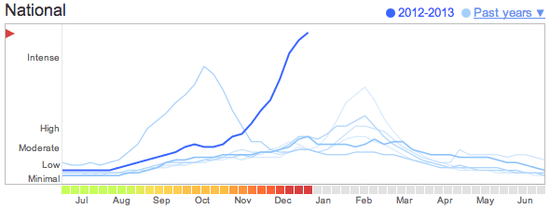
Google_Flu

Today on the Dish, Andrew questioned why it should matter if Hagel is in the "mainstream" of the Washington consensus, while having a chuckle over DC culture. He addressed the different sides of the administration’s Louie Giglio imbroglio, and reflected on the enigma of Nixon on the man’s would-be 100th birthday. Andrew also traded blows with Dreher and Frum over nanny-state drug policy, engaged with Jonathan Glick over how to run the pay-meter at the new Dish and surveyed reader thoughts on this week’s cage match between Piers Morgan and Alex Jones.

Elsewhere, the debate over the mega-coin rolled on, Adam Ozimek debunked the mythos of small business, and Ronald Bailey made the case for fracking.  We aired more thoughts on Brennan’s nomination, and parsed a poll that put Congress’s favorability ratings somewhere between poser-rock and STDs. We expressed concern over Obama’s lack of presidential pardons, and Jim Manzi dove even further into Drum’s lead/crime conundrum. Looking abroad, the Leveretts made their case for Iranian uranium enrichment, we asked whether a full withdrawal from Afghanistan is in the cards, and Armin Rosen exposed the moral hazard of U.S. aid to North Korea.

In assorted coverage, we checked in on scientists’ grasp of the human genome, took the country’s temperature during this nasty flu season, pushed away overbearing new "smart forks," and spotted some pushback against homophobia in the Boy Scouts. Michael Santos struggled to catch up with technology after serving time while the late Paul Fussell pointed out the significance of that college sticker on your rear window.

We also kept up with Canadian standup as Beck sprinkled his new album across the Internet. Elaine Blair marked the difference between romance in rom-coms and sitcoms, Ta-Nehisi and Marc Ambinder parted ways on Django Unchained and Mikl-Em reminded us that "Happy Birthday" isn’t public domain.  After gazing at an overcast Usheaia, Argentina in today’s VFYW, we witnessed some badass table tennis during the MHB, and paused for a poem by Bei Dao here

– B.J.

(Chart of current flu epidemic from Google's statistics)

A Rip Van Winkle Of The Internet Age

Released from prison in August 2012, Michael Santos describes the difficulties of adapting to the technological development that he missed:

I served more than 25 years in prison, and I haven't yet been free for five full months, so maybe others can understand my ignorance on the subject of technology. I can accept that volumes of basic information are beyond my ability to comprehend right now, but with everything I have to learn, I don't know whether I'll ever grasp all that I need to know. I don't have any idea what a "server" is, and I don't know much about how to make my content available to the people who need it.

He goes on:

I consider myself as having a responsibility, or duty, to help others understand prisons, the people they hold, and strategies for growing through confinement in ways that will help people emerge with values, skills, and resources that translate into success. Technology could really help me succeed, but since I don't understand how to use it effectively, I'm kind of in a lost world.

Mark Whitney praises the accomplishments of Santos, "the first and only prisoner in history to gradually earn his way from a maximum security cell block to a fenceless camp." Santos' personal website here, and a collection of his writings from prison here. Previous Dish on the difficulties of adapting to life outside of prison here.

Sitcom-Sized Love

Elaine Blair explores how sitcoms portray romance, noting that the shows "offer a salve for the bruises of urban single life":

Sitcoms rarely ask us to believe that any particular couple is, as they say, meant to be. Like romantic comedies, sitcoms might nurture and draw out a sense of chemistry between two characters while also putting obstacles in their way, setting us up for a long-deferred union. (Sam and Diane on Cheers, Ross and Rachel on Friends, for instance.) But romantic comedies traditionally end at the moment the obstacles are overcome and love is declared.

They leave us aglow with a sense of the couple’s felicity. In sitcoms, the story must go on well past the first round of obstacles. As often as not, couples break up and the characters have other affairs, and for good reason. Happy couplings are notoriously difficult to pull off; script writers, used to working in a mode of farce, struggle to find the right tone for domestic satisfaction (think of Niles and Daphne finally married on Frasier). Like any kind of comedy, a sitcom can have a marriage at its very end, but a marriage somewhere in the middle is narrative disaster. And since sitcoms are, effectively, comedies without end, it’s hard to write a marriage into the show in a way that encourages—rather than dashes—our illusions of its rightness.