Ramesh Ponnuru wants Republicans to largely ignore Obama:
Republicans can and should continue to stand for their principles on the many occasions when they conflict with Obama’s. What they shouldn’t do is conceive of their near-term political task as winning a series of confrontations with the president. Because they’re unlikely to win very often. Obama has inherent advantages in political debates with more than 200 House Republicans, and his re-election will only strengthen his hand, at least for now. The Republicans are better off sidelining Obama to the extent they can and fighting congressional Democrats — or, better yet, getting congressional Democrats to fight one another.
Evelyn Lamb wonders how to convey the results of complex scientific studies to the public:
Statistics are used and misused all over newspapers, magazines, and the Internet. And they’re necessary. Without them, science papers can’t accurately describe the size of an effect or the probability that it was due purely to chance, and reporters can’t let people know what a new study means. How can we, as bloggers, reporters, and editors, increase the quality of statistics reporting in the media? And what should the media consumer look out for when reading these stories?
Frank Swain points to the efforts of the “BenchPress project, which aims to develop science and statistical training for journalists”:
A common attitude within the science community seems to be that journalists reporting on science stories ought to be able to substitute risk factors and odds ratios as easily as epidemiologists do. That’s a facile argument to make, but journalists are also the least equipped to do this, both in terms of time and ability. It is important, however, that journalists understand how influential this kind of reframing can be, and how it can take control of the reporting line if left unbridled. …
As part of the [BenchPress] project, I’ve developed a network of a dozen volunteer speakers who regularly visit schools and newsrooms across the country to help future potential communicators and journalists get to grips with numbers. The passion of the volunteers—all working scientists—helps ensure that both junior and more senior journalists produce science news stories that are as robust and accurate as possible.
In your post about Mamet’s article, you reference Detroit being at the top of many crime lists. You know why? Because they’ve cut cops, that’s why. They now operate “virtual” precincts where actual physical police precincts are closed between 4:00pm and 8:00am. Only 2,731 new police officers were sworn in back in 2012, down from 4,001 in 2002. That’s a cut of almost one-third. Mamet is right in this regards about Detroit: “the police do not exist to protect the individual.” Because they barely have any cops left.
Another quips, “Mamet isn’t considered a great fiction writer for no reason.” Another:
I’ve found when people talk about Chicago and Washington, D.C., as justifications for more relaxed gun laws, they are missing the larger picture. While Chicago has many problems with crime and violence, the second largest city in Illinois, Aurora, has similar gun restrictions and in 2012 had zero homicides. So, more guns (or even fewer guns) doesn’t begin to be the answer. Guns are just a symptom of a larger ill that cannot be reigned in by force or threat.
Another:
I was a prosecutor in New Jersey, which at the time had among the strictest gun laws in the country. Guns used in crimes were routinely traced and in most instances did not come from gun shops or people’s houses in the region; the majority came from southern states along the I-95 corridor.
Andrew Beaujon describes an ambitious new campaign:
Chicago’s WBEZ wants its listeners to make more listeners. The agency Xi Chicago designed the $400,000 “2032 Membership Drive,” which “inspires interesting people to hook up with interesting people and make more interesting people, thereby creating the next generation of listeners.” … [T]he ads will appear in print, online, at train platforms and bus stops, on taxis and T-shirts, with these taglines:
– Do it. For Chicago.
– We want listeners tomorrow. Go make babies today.
– Hey Interesting People, get a room already. And then put a crib in it.
– To anyone NOT currently running a virtual farm: GoMakeBabies.com
– You’re an interesting person. Pass it on. Like, literally. Through your DNA.
“While I have the greatest respect for a great many of you, the days where I can in good conscience remain silent about the issues that set me apart from the rest of FReeperdom have past. For clarity, or perhaps catharsis, I’m not entirely certain which, I’ll lay them out on the table an call the ZOT™ down upon myself.
The racism: I just can’t handle it anymore. FR has become increasingly racist since President Obama took office, and enforcement has dropped. Now, not a single crime can be reported with an “amish” comment, and I’ve yet to see a post express embarrassment or shame when lo and behold sometimes the perpetrators turned out to be lily white.
Homosexuality: FR is on the wrong side of history on this one, and I’ll just leave it at that.
Mostly though, it’s the hate. More and more posts reference violent solutions to political disagreements. Some subtly couched, others make no pretense. I wouldn’t be surprised at all if I read in the morning paper that a FReeper murdered a federal bureaucrat or a federal judge,” – long-time Free Republic poster Melas, in his farewell “opus”.
“But there is not a single place in New York that serves a Croque McDo.” I would point out that there’s not a single place in New York that serves real French brie. Because of US customs laws, unpasteurized French cheese isn’t available in the US. Here, if you buy brie and leave it out for a couple of days, it looks the same. If you buy brie in France and leave it out for a couple of days, it looks much fuzzier.
Another sends the above video:
I don’t know if you’ve seen this, but here is a Pizza Hut commercial from 1997 featuring Gorbachev. It’s interesting how the expansion of this (at the time) quintessential eatery is associated with debates on the post-Soviet future of Russia. It’s also interesting how it became a marketing tactic.
Jonathan Evans mediates a debate going on in Denmark:
You see, the Danes fancy themselves especially advanced when it comes to matters of gender equality, and the country’s Board of Equal Treatment recently found that salons and barber shops charging different prices for men’s and women’s cuts are violating Danish law. The hairdressers and barbers, for their part, argue that the disparity is completely reasonable, because it tends to take longer to cut and style women’s hair. Some have suggested charging different rates for long, medium, and short hair as a fix, but others say that’s too open to interpretation.
We say, why not charge according to the total amount of time the cut takes?
Vivienne Walt reports that many of the city’s revered manuscripts were actually moved before the immolation of the Ahmed Baba Centre:
By phone from Bamako on Monday night, [presidential aide Mahmoud] Zouber told TIME, “They were put in a very safe place. I can guarantee you. The manuscripts are in total security.” In a second interview from Bamako, a preservationist who did not want to be named confirmed that the center’s collection had been hidden out of reach from the militants. Neither of those interviewed wanted the location of the manuscripts named in print, for fear that remnants of the al-Qaeda occupiers might return to destroy them.
Unfortunately, very few of the manuscripts had been copied electronically.
And since many of the areas of knowledge they cover—anatomy, erectile dysfunction, women’s rights, medicine, music—are domains traditionally despised by Islamists, the Ahmed Baba Centre had several times been ransacked by armed men, though no damage had yet been done to the manuscripts themselves.
Last spring, the magazine Jeune Afrique reported that curators and private collectors were already organizing themselves to conceal the most important documents. Families spontaneously followed course on their own accounts. According to some manuscript-conservation specialists, it is believed that these libraries bring “baraka” (“good luck”), and that dismantling them attracts misfortune. Besides, many of these texts (or jottings in the margins of the manuscripts) contain family secrets, correspondences, accounts, and diaries, owing to the fact that most of Timbuktu’s inhabitants, including its skilled-craftsman class, were literate since the fifteenth century.
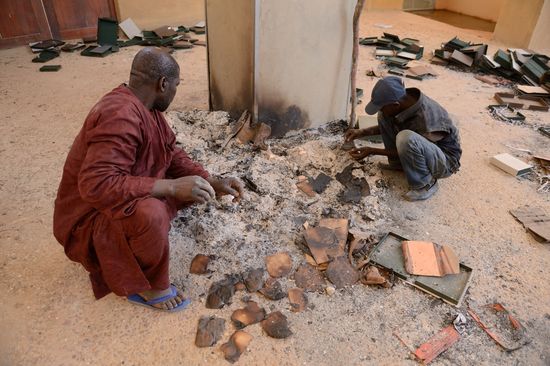
(Photo: Men recover burnt ancient manuscripts at the Ahmed Baba Centre for Documentation and Research in Timbuktu on January 29, 2013. French-led forces seized yesterday Mali’s fabled desert city of Timbuktu in a lightning advance north as fleeing Islamists torched a building housing priceless ancient manuscripts. Mayor Ousmane confirmed the fire at the Ahmed Baba Centre for Documentation and Research that housed between 60,000 and 100,000 manuscripts, according to Mali’s culture ministry. By Eric Feferberg/AFP/Getty Images)
A reader rejoices over news that the Boy Scouts of America is now strongly considering “leaving local sponsoring organizations free to decide for themselves whether to admit gay scouts”:
Our Scout Executive just made it official in our office, that the Boy Scouts of America will no longer prohibit open and avowed homosexuals from being leaders or receiving their Eagle Scout awards. I have felt left out of the discussion about homosexuality because, for me, coming out meant losing my affiliation with an organization of which I have been an active member for 30 of my 37 years. I don’t have to hide anymore.
Although everyone in my office knows about me and several of my co-workers who are gay as well, we always had to keep it a mystery to the higher officials in the organization. We have had to fight this on two fronts. On the one hand, we had to endure the slanders of many volunteers who felt that the Boy Scouts was a safe environment to deride others for their sexual orientations. On the other hand, we had to continually justify and support to our friends in the gay community, an organization for which we feel so deeply passionate.
I’ve always believed and loved all that the Boy Scouts meant to boys, with the exception of a single repugnant policy. My immediate superior is also gay and it hurt everyday listening to him justify to donors a policy that explicitly stated that the organization he was supporting deemed him to be immoral and unfit to lead youth.
I never wanted to leave the scouts and have never felt that the right thing to do was boycott or encourage others to give up on the organization. I have always believed that the way to beat the ban was to support the good that scouting does while consistently expressing my, and others’, opposition to the policy. We didn’t need lawsuits or threats to change. We just needed to ride the changing attitudes about our community to their fortunate and, as we always believed, inevitable outcome.
When I heard the news there were several people who I wanted to contact. My ex-wife had recently filed a custody suit against me because I continued to take my son to scouting, even though she was a lesbian and was, therefore, banned from being involved as well. Now she, as well as myself, can be involved with or son’s activities. Also on my list was you, as I have always found inspiration and comfort in your perspective and comments on these issues.
Recent Dish on the cultural shift in the Boy Scouts here.
Today on the Dish, Andrew declared the status of same sex couples to be an essential part of now-tangible immigration reform. He mulled over Gerald Scarfe’s controversial cartoon on Netanyahu, and demanded that Fox News (and MSNBC) accept the consequences of peddling propaganda. He and Chait rolled their eyes at Free Beacon’s latest nonsensical screed against Chris Hughes and TNR, wished the Palins all the best in the land of political obscurity, and sighed as Tom Tancredo went back on his promise to smoke, and, what’s more, inhale.
In other political coverage, we suspected that immigration reform will do the GOP itself more harm than good: Harry Enten observed that shifting Latino attitudes wouldn’t affect many too swing states, and Pareene measured serious potential for a rightwing revolt agains any reform at all. Debate broke out at The American Conservative over Obama’s foreign policy credentials as Drum summed up the root of the president’s pragmatism abroad. We sifted through the wreckage of Timbuktu’s library, destroyed by the Malian jihadists, Evan Osnos spied a gulag map on Google Maps, and we anticipated the next debate over women in the military.
Elsewhere, Erick Erickson shared some intriguing personal details as he departed CNN, Danny Hayes noted that the media improved its attention span after the Newtown shooting, while Joe Romm called out George Will for once again muddying climate data. We considered the prosecution of juvenile killers, in light of a tale of gruesome homicide, Naomi Rovnick pulled back the curtain on factory audits in China, and Antigua had a shot at sidestepping copyright.
In assorted news and views, Seth Fischer wrote a dispatch from a world of personal trauma, John H. Richardson appointed promiscuity as a new holy virtue, and Daniel Altman refuted Pixar’s vision of the End of History. Readers sounded off on setbacks to their youthful ambition, Wayne Curtis strapped on jackboots for a tutorial on goose-stepping, and we encountered Ed Kilgore’s alter ego, in name only (Andrew’s, too).
Alison Motluck pointed out a snag in the way we practice fertility medicine, Ta-Nehisi pointed to some unsettling facts about the NFL, and we continued to search for a signal on plans for better Amtrak Wifi. We stared out at a white Vista Verde Ranch in Colorado for the VFYW, met an incoming American in the Face of the Day, and set the millennial generation to music in the MHB. Finally, readers managed to spot Winooski, Vermont in the latest VFYW contest (to Andrew’s great delight).

 The Dish