The Decline Of Tinkering

Blue_Box_Jobs

Alec Foege mourns the loss of "making something genuinely new out of the things that already surround us":

For many generations in the postindustrial age, puttering around with the mechanical devices that surrounded us was practically a rite of passage, and for many, a way of life. It tethered us to our machines and reaffirmed our notions of modern civilization. Deeply probing how things worked also provided children and adults alike with endless hours of enjoyment. It saved enterprising souls hundreds if not thousands of dollars on repair bills. It also often resulted in new and startling discoveries that sometimes led to fresh innovations.

The first gadget Steve Jobs cobbled together while still in high school with his geeky older college buddy Steve Wozniak was a “blue box” that enabled free long-distance phone calls by duplicating the appropriate digital tones. Sure, the blue box was illegal, but that didn’t stop the mismatched pair of “phone phreaks” from selling a bunch of the units to college students and other intrepid pranksters. The blue box grew out of a simple love for playing around with gadgets and making them bend to the will of a few individuals.

(Photo: Blue Box at the Computer History Museum. Photo taken by RaD man. Image cropped by The Dish. Permission from RaD man under GFDL license via Wikipedia.)

The Dish Model, Ctd

Ann Friedman joins the discussion:

Whether or not the phrase "personal brand" grosses you out, it’s something any journalist who wants to be employed in another 10 years should be thinking about. Andrewmug Having a direct, dedicated following—a readership invested in you, not just the publication you’re primarily associated with—is like a career insurance policy. While there are many fine journalists who never bring even the lightest detail about their personal lives into their professional narrative—no tweets about their kids, no first-person anecdotal ledes, no opinion-tinged asides in reported features—they are an increasingly small group. I cringe every time I read a New York Times story in which the reporter awkwardly refers to herself as "a visitor." Really? You can’t just say "provided me with directions to her Craftsman bungalow"? Please. …

[J]ournalists were always a part of the story. Why not just own up to the fact that three-dimensional humans are doing this work?

All of the posts in the Dish Model thread can be read here. A reader sent the above photo:

My mother-in-law, after years of me talking about "Andrew" and her asking "Who?" and me responding "My favorite blogger", got the jump on you re: Dish merch.  I received a one-of-a-kind coffee mug for Christmas, replete with your face on it (courtesy of the George Stephanopoulos show).

Of course the Dish has grown to be much bigger than one blogger – four other staffers, two paid interns (new ones started this week: Doug Allen and Brendan James), a poetry savant and a million-strong readership, which provides about a third of our content.

The Dish Model, Ctd

PM Carpenter argues that being completely reliant on subscribers may restrict the Dish's editorial freedom:

Just know that with every strong opinion you write, you'll be risking half of your readership, and therefore, potentially, half of your subscription base. And when finances get tight, the temptation to retract one's opinionated claws might become irresistible. In short, you may find that corporate-free editorializing is far more tyrannical than being free from corporations might seem.

This has occurred to me. I lost a third of my readers in 2003 when I turned against the Iraq war. But somehow I think my lack of a filter is not related to its potential impact on my life, career or income. So I'll trust my own psychological tic. I wish it were an act of moral courage. But it's just who I am. And if you think I have no filter, you should meet my mother.

The Slowly Shrinking Prison Population

Incarceration_Changes

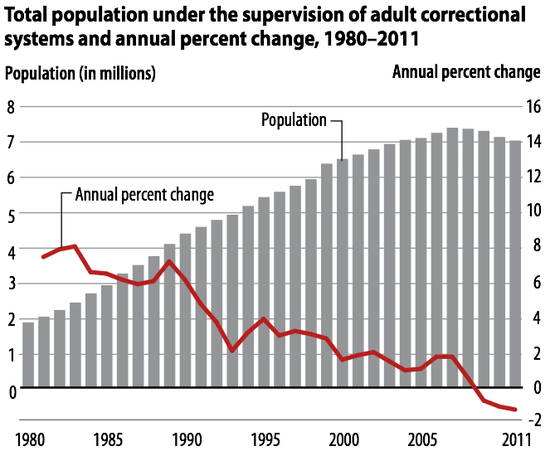
Keith Humphreys points out that the number of Americans in prison has gone down the past few years. One reason you don't hear about this more:

Issue advocates, funnily enough, have an interest in downplaying news that the problem they address is lessening. When the Non-Profit Center to Combat X (where X is anything from hate crimes to spitting on the sidewalk) gives a quote to a reporter about their issue, they will virtually always say that things have never been worse/the problem is exploding/the window to act is closing rapidly etc. It’s not that advocates truly want their problem of interest to get worse, but that their fundraising and profile will suffer if the general public knows that the problem they address is declining in severity.

Kevin Drum singles out one cause of the crime drop: lead.

(Chart from the BJS (pdf))

Covering The Middle Kingdom

Evan Osnos pushes for greater protection of American journalists covering Chinese politics. A slew of journalists, from the NYT to Al Jazeera, have been kicked out, delayed entry, or tangled in red tape:

That is a pattern of pressure that the United States government cannot ignore. These kinds of reports, as well as stories on the downfall of Bo Xilai, have become a vital part of the world’s understanding of China’s political strengths and weaknesses. It informs how the U.S. government understands the men on the other side of its most critical foreign-policy relationship. As Elizabeth M. Lynch, of the China Law & Policy blog, wrote this week, the U.S. has been quiet on the pressure facing American reporters. “In Melissa Chan’s case, the State Department, through a press person, just said that it was ‘disappointed’ with what happened. If ever you wanted to give the Chinese government a signal to continue to harass foreign reporters, such a tepid response was likely the way.”

Drunk With Brando

Douglas McCollam recounts how Truman Capote scored an intimate session with Marlon Brando, in order to write his famous New Yorker profile of the actor:

It was the subject of Brando’s mother that apparently came out as the interview stretched past 1 a.m. As Capote wrote in his piece, “I poured some vodka; Brando declined to join me. However, he subsequently reached for my glass, sipped from it, set it down between us, and suddenly said in an offhand way that nonetheless conveyed feeling, ‘My mother. She broke apart like a piece of porcelain. . . . My father was indifferent to me. Nothing I could do interested him, or pleased him. I’ve accepted that now. We’re friends now. We get along.’ ”

Brando then went on to describe how growing up he’d come home to an empty house and an empty icebox. “The telephone would ring. Somebody calling from the bar. And they’d say, ‘We’ve got a lady down here. You better come get her.’” Later, when Brando was on Broadway, his mother came to live with him in New York. “I thought if she loved me enough, trusted me enough, I thought then we can be together, in New York; we’ll live together and I’ll take care of her. . . . I tried so hard. But my love wasn’t enough. . . . And one day, I didn’t care anymore. She was there. In a room. Holding onto me. And I let her fall. Because I couldn’t take it any more—watch her breaking apart, in front of me, like a piece of porcelain. I stepped right over her. I walked right out. I was indifferent.”

… Never before had the inner psyche of a star of Brando’s magnitude been served up for public consumption, much less by a writer of Capote’s stature. This was something new.

Previous Dish on Capote and the book that ended his career, here.

The Dish Model, Ctd

Donation

Tyler Cowen worries that the new metered Dish foreshadows the end of "a golden age for the blogosphere":

I wish him well with it, but I also hope no one else tries too hard.  (Note by the way that Sullivan will allow a free RSS feed, with complete posts, and free links from other blogs, so this is hardly a full gate.)  In the limiting case, imagine a blogosphere where everything is gated for some price.  What could we at [Marginal Revolution] link to?

Razib Khan has similar concerns:

$19.99 is a pittance. But if I give Andrew Sullivan his due, who else should I “tip.” How about Tyler Cowen? Or Maria Popova? I consume more of Tyler’s content directly than Andrew’s, and Maria’s even more indirectly and in a diffuse fashion. In terms of media consumption I’m currently a subscriber to The New York Times, contribute to Wikipedia, try and support bloggers who I read and have fund drives, and also have a Netflix account. This isn’t much. But it starts to add up. The content universe of the internet is vast for the infovore, especially for one who relies a great deal on intermediating technologies to sift and filter the stream of content.

But this was always the case with old media. You paid for your New Yorker and New Republic and Wired and the Economist. And we paid more, relatively speaking, for each – because we were also paying for paper, print and physical distribution. Dan Gilmor proposes one possible solution:

One thing I'd bet on is alliances among bloggers where we can pay a lot less for a grab-bag of sites, on the theory that many more people will be willing to join that way, creating win-win-win situations. Again – and I can't use this word enough – the more experimenting and innovation the better.

Yglesias thinks along the same lines:

[I]f subscription models succeed, I'd expect them to evolve in the direction of big bundles. That might be because there are eight or nine giant content conglomerates selling subscriptions. Or it might be because of cross-marketing deals. Either way you'd get something that looks less like "the Internet" as we know it today and more like the adjacent series of walled gardens that CompuServe, Prodigy, AOL, etc. originally promoted as the vision of online existence.

At the Dish, we are not so much proud of our agnosticism as resigned to it. We do not know what the future will bring. What I do know is that this medium is still very young, in the grand scheme of things, and that the only way to survive is to experiment in line with what the web seems to be telling us it wants. That last thing is a little hard to gauge precisely: it's hitting a moving target as you are in transit as well. Which is why innovating this medium is as much art as science – and full of wrong turns and surprises. After a while, you relax and enjoy the ride. But I have to admit I was really anxious this past week; last night, as some of it sunk in, I couldn't sleep at all. One hour in the end. So I may be crashing soon …

Reagan’s Digest

Jordan Michael Smith recounts the history of Reader’s Digest:

Reagan was a lifetime reader of the Digest. He once used an article from the magazine to slur the nuclear freeze movement as being comprised partly of Soviet agents. It was terrifying to contemplate the most powerful man in the world getting foreign policy ideas from a pocket-sized general-interest family magazine, but Reagan was not alone. For decades, Reader’s Digest was the primary source of information and opinions about international affairs for tens of millions of Americans. The magazine did not just run any articles about foreign policy, however; the Digest had a clear right-wing perspective, which had a tremendous, though often ignored, influence during the Cold War.

I have fond memories of Reader's Digest – as a freelancer. One tiny excerpt of your prose in that little booklet and you were set for a month of rent. Back in the day when I was struggling to make ends meet in graduate school, it was 500 words for Reader's Digest that got me through. Now it's TinyPass.