Spot The Sponsored Content

A reader writes:

This discussion about blurring the lines of advertising and journalistic content reminded me of the House of Cards ad campaign on Politico. For weeks leading up to the Netflix premiere, the political news site had a pop-up ad for House of house-of-politicoCards plastered all over their site and app. Then they started running articles with interviews from the creator and Kevin Spacey that were also preceded by the same ad as well as the banner at the bottom of the page. Then the day prior to the show’s premier they did a follow-up story, again with the banner ad at the bottom of the article (see attached screenshot). Politico even gets a shout-out on the show when Zoe leaves the world of old media to take a job with the new media site Slugline: “Six months from now, Slugline will be what Politico was a year and a half ago. Everyone at Politico reads it because Slugline’s breaking stories before they are.”

Obviously I don’t know what the contractual agreement is between the two parties, but this stuff just reminds me of shit that the right-wing media pulls when they scare their audience about out-of-control inflation and economic doomsday scenarios during a segment that segues into commercials for gold and survival seed packs. I’m all for new revenue streams, but content created in conjunction with the advertisers can be a slippery slope. One only needs to look at the cozy relationship between the tobacco companies and cable networks during the ’50s to see how a myopic deference to advertisers can do the public a disservice.

A bleg to readers: email us with more examples you find of editorial content and advertising placed perilously close together.

Crying As Incontinence

Thomas Dixon tours the strange theories on tears proposed over the years:

[T]here is a traditional Yiddish phrase for crying that translates literally as ‘pissing from the eyes’. This old idea has been reinforced by modern science in the last century and a half. In recent decades, the most widely quoted theorist of tears has been the American biochemist William H Frey II who, since the 1980s, has been arguing that the metaphor of weeping as excretion should be taken quite literally. In an interview with The New York Times in 1982, Frey claimed that crying is ‘an exocrine process’ which, ‘like exhaling, urinating, defecating and sweating’ releases toxic substances from the body — in this case, so-called ‘stress hormones’.

It gets weirder:

In a couple of articles in the 1940s, the influential American Freudian Phyllis Greenacre put forward the view that neurotic weeping in women was to be understood as a displacement of urination. Involved in this theory was the idea of ‘body-phallus identification’ and the production of tears by women as an attempt to simulate male urination.

Outsourcing Paperwork

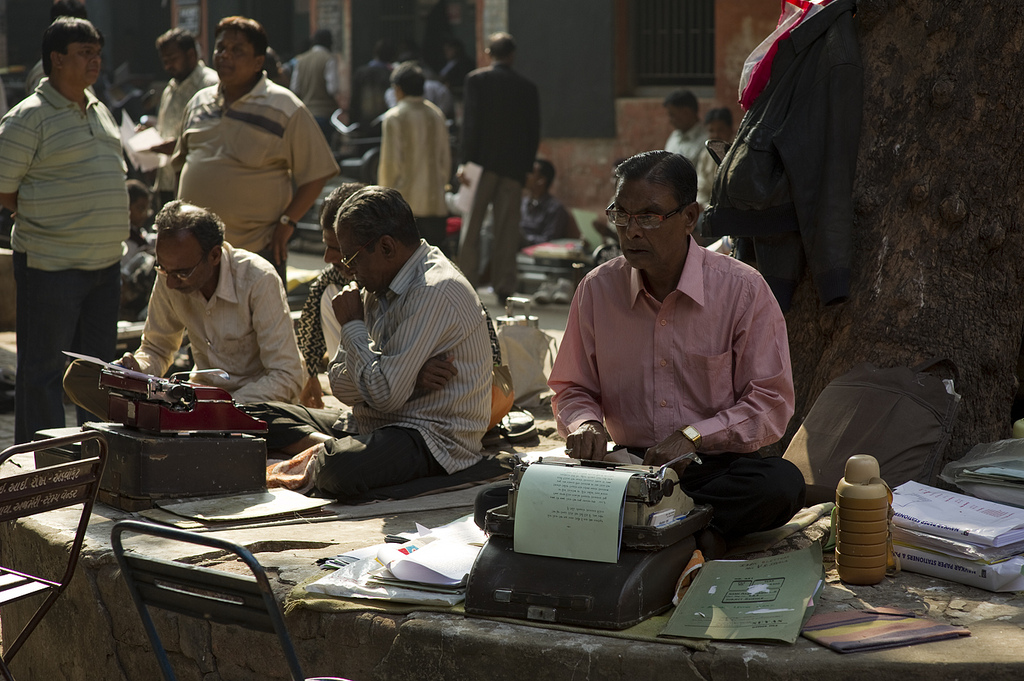
Erica Westly is fascinated by India’s typists-for-hire:

I suspect that the perversion of doing office work in the open air was part of the appeal. I also liked how the sidewalk stalls transformed what was normally an isolating profession into a social activity. Sidewalk typists interact with the community directly, and their work matters in an immediate sense. In India, which consistently ranks as one of the most bureaucratic countries in the world, paperwork is an unavoidable part of life. Even seemingly minor purchases and service requests, such as hiring an electrician, can involve filling out forms, sometimes in multiple languages. Most Indian typists can type in English and at least one official Indian language, of which there are more than 20 besides Hindi. Some of the typists’ customers are illiterate, but most simply lack the equipment and expertise to type up the forms they need themselves.

(Photo by Flickr user Padmanaba01)

Is Food Art? Ctd

William Deresiewicz argues that while food still can’t be considered an art form, it has avoided the “technologically assisted narcissism” he thinks has cheapened writing and photography:

Whereas food is not and almost certainly never will be easy. Technology can help—those blenders and slicers and so forth—but only up to a point. A decent cook can do a decent job, but great achievement still necessitates great skill. Food is molecules, not bits—which also means it can’t be digitally copied, shared, pirated, or sent across the Web. And that may be the secret of its status now. The more virtual our experience becomes, the more we value the tangible, the sensual, and the immediate. Food is very intimate; we put it in our bodies. It creates and affirms our intimacy with others. Not for nothing do families gather around the table, dates begin with dinner, and religions use food as the symbol of communion.

What A Nebula Really Looks Like

Sheer distance usually limits how vividly scientists can picture objects in space, but Michael Zhang spotlights an astrophotographer who found a way to bring the galaxy to life in a whole new way:

First, Metsavainio collects information about how far away an object is, and carefully studies the stars and structures in and around it. Then, he creates a volumetric model of his subject — usually a nebula, although he’s rendered at least one globular star cluster. Finally, he animates the 3-D rendering, providing viewers with a tantalizing taste of what it might be like to fly a starship through these enormous astronomical ornaments.

History’s Bestsellers

Gabe Habash spotlights a cool new project:

Matt Kahn has launched 100 Years, 94 Books, the ambitious project of reading and reviewing the Publishers Weekly‘s #1 bestselling books for each of the last 100 years, which, with some books hitting #1 more than once, totals 94 books. Kahn, a creative writing student at California State University, Northridge, began last week with 1913′s #1 book, The Inside of the Cup by Winston Churchill, and at the rate of one review a week, will finish (about two years from now) with 2013′s bestselling book, still to be decided by sales. Along with the review, Kahn will provide on his blog historical context “in an attempt to figure out just what made these particular books popular at that particular time.”

In an interview with Habash, Kahn explained the impetus for the project – a class on 20th century American novelists:

Before we began reading the first text for the course (The Sun Also Rises), the professor lectured on what constituted the literary canon. He pointed out that The Sun Also Rises was far from the most popular book in the year it was released. The bestselling book of 1926 was The Private Life of Helen of Troy.  I’ve always been interested in how society affects popular culture and vice-versa, so the idea for the blog developed from that lecture.

The Daily Wrap

The Pope Attends His Final Angelus Prayers Before His Retirement

Today on the Dish, Andrew mulled over legalized prostitution, hoped for a new era to emerge from the coming Papal Conclave, and updated readers on the status of the New Dish. He glimpsed the new generation of Journalism in Steve Brill’s health care essay and shook his head at the Republican management of the sequester.

In political coverage, we looked ahead to the fallout from the sequester and Josh Barro laid the blame for epistemic closure at the door of Republican think tanks. Felix Salmon was skeptical that the BuzzFeed model could scale, Jonah Peretti described the advertorial strategy while employees Jeff Greenspan and Mike Lacher aimed for ads that feel like editorials, and readers saw little to worry about. Overseas, Gianluigi Nuzzi wondered at tales of unquestioned cruelty from the Vatican.

In assorted coverage, Seth MacFarlane’s manatees failed to impress on Oscar night, Stefan Kanfer rebelled against recorded music, and Scott Adams bulked up with video games. Simon Park made us squirm at the thought of getting calls on our cells, Joshua Topolsky got an early glimpse at Google Glass, and France was unafraid of the dark. Eric Nusbaum weighed a bull’s cushy life against a grisly death, James Surowiecki dug into the black betting economy in American sports, and Howard Megdal noted parallels between Lena Dunham and Philip Roth.

Elsewhere, Gregory McNamee mapped out the grocery store while Nicola Twilley revealed rampant genetic modification in the produce aisle, Adam Clark Estes wasted nothing in addressing the food shortage, and Marlene Zuk pushed back against paleo nostalgia. Wayne Curtis recalled the golden age of the USPS, Jennifer Kabat exposed the perils of making snow, Beth Skwarecki couldn’t explain birth rate patterns, Shane Koyczan illustrated the haunting effects of bullying, and Amanda Marcotte debunked the myth of chatty women. FLOTUS busted a move in the MHB, we recognized the distant Rockies in the VFYW, and shared the sorrow of a mother mourning her child in the FOTD.

– D.A.

(Photo: A statue of a saint stands in St. Peter’s colonnade as Pope Benedict XVI delivers his last Angelus Blessing from the window of his private apartment to thousands of pilgrims gathered in Saint Peter’s Square on February 24, 2013 in Vatican City, Vatican. The Pontiff will hold his last weekly public audience on February 27, 2013 before he retires the following day. By Franco Origlia/Getty Images)

“We Are Not What We Were Called”

David Haglund applauds the anti-bullying poem seen above:

It’s a beautiful, powerful film. Find a few minutes and watch it, and learn more about the project at Koyczan’s website, where you will find the text of the poem. An MP3 of the poem is also available.

Last week, Emily Bazelon unpacked a new study from Duke that “provides the best evidence we’ve had thus far that bullying in childhood is linked to a higher risk of psychological disorders in adulthood.” The study followed 1,270 North Carolina children into adulthood:

Based on the findings, Copeland and his team divided their subjects into three groups: People who were victims as children, people who were bullies, and people who were both. The third group is known as bully-victims. These are the people who tend to have the most serious psychological problems as kids, and in the Duke study, they also showed up with higher levels of anxiety, depressive disorders, and suicidal thinking as adults. The people who had only experienced being victims were also at heightened risk for depression and anxiety. And the bullies were more likely to have an antisocial personality disorder.

The Snowmaker

In a wide-ranging investigation into the history of snow creation, Jennifer Kabat describes the dangers of the job:

Imagine being out in the cold; it’s six degrees. The wind chill is minus twenty; you’re on a 40-degree pitch; the only light is from your headlamp. You have a flashlight, but you need both hands on the vice grip to fight 250 pounds of pressure to close a valve. You’re battling the slope and the cold, not to mention the exhaustion of the wee hours. Accidents happen and injuries are common. A widow-maker falls on you – not the sort of hanging limb you’d normally get in the woods dangling from a tree that might blow down in the wind. This will be just overhead, just above the snow gun you’re adjusting, and encrusted in ice. Snow is often wettest closest to the gun, and the ice and snow caked to the branch weigh it down until it snaps. You won’t hear it break; not with the roar of the gun, and even if you did, you’d probably not have time to jump out of the way.

Why the job is so necessary:

There are 60 ski areas in New York, more than any other state in the country. They’re mostly located in poor rural communities where skiing is an economic engine worth over $ 1 billion during those few months of winter.

Adults Don’t Need A Night Light

3378601950_6017f06520_z

Paul Bogard cheersnew law in France that will force establishments to turn off their lighting displays after 1 am, starting this July:

The new law promises to reduce carbon emissions and save energy — the annual equivalent of 750,000 households’ worth. Most significant is its potential to turn the tide against light pollution by changing attitudes about our unnecessary overuse of light at night.

In almost every U.S. city, suburb and town, the streets, parking lots, gas stations, and commercial and public buildings are lit through the night. Over recent decades, the growth of this pollution has been relentless, yet slow enough that most of us haven’t noticed. Parking lots and gas stations, for example, are now often 10 times brighter than they were just 20 years ago, and light pollution continues to grow at 6 percent every year.

Josh Harkinson agrees with another of Bogard’s arguments – that light pollution doesn’t make us safer at night:

The data actually speaks more clearly about how light pollution makes us less safe.

A recent American Medical Association report (pdf) concludes that the disrupting effects of nighttime lighting on our bodies’ circadian rhythms may contribute to “obesity, diabetes, depression and mood disorders, and reproductive problems.” Moreover, artificial light causes our bodies to suppress the release of melatonin, elevating our risk of contracting cancer, and especially breast cancer.

Eight in ten kids born in the US today will never see the Milky Way, according to Bogard. Of course, we have it easy at night compared to songbirds, sea turtles, and countless other creatures whose mating and eating habits have been thrown off by our glare.

(Photo by Hussain Khorsheed)