Unfriending Terrorists

[tweet https://twitter.com/HSMPRESS1/status/299239666534731777 ]

Deana Kjuka highlights the rising use of social media by terrorist cells for propaganda and recruitment—and the increasing difficulty of shutting them down:

As terrorist groups seek to reach a broader global audience, their migration onto social networks has proven to be a challenge for the likes of Twitter and Facebook. While governments want social networks to clamp down on terrorist groups, Internet activists are calling for greater transparency into social-media companies’ rules and regulations.

J.M. Berger explores the debate in counterterrorism over how to handle social-savvy terrorists:

The first objection is that knocking terrorists offline “doesn’t work,” because when you eliminate one account, the terrorists just open up a new account under a different name — which is exactly what al-Shabab did after a little more than a week. And then, the theory goes, you’re back to square one. It’s a high-tech game of whack-a-mole.

The second objection is that forcing terrorists off the Internet destroys a valuable source of intelligence, because government, academic, and private sector researchers rely on these online operations for information about what distant groups are doing and who supports them. “The intelligence community took the position that you cannot take this stuff, you cannot take these sites, down,” intelligence historian Matthew Aid told Voice of America last year after a number of jihadist forums went offline. The argument was that more information was gained “by monitoring these sites than any possible advantage that could be derived from shutting them down. And the intelligence community prevailed on this point.”

(Above: A representative tweet from Al-Shabaab’s Twitter account)

A Book Greater Than The Sum Of Its Scraps

412783683_d70830538b_b

Reviewing Ellen Gruber Garvey’s Writing with Scissors: American Scrapbooks from the Civil War to the Harlem Renaissance, Christopher Benfey traces the history of the scrapbook in both its political and literary forms:

During the Civil War, Northern and Southern compilers of scrapbooks composed highly selective histories. Southerners combed the news for Confederate victories and sentimental accounts of happy darkies dreading the Northern invaders. The portrayal of black people changed overnight with the Emancipation Proclamation; liberated, they appeared in one popular poem as “brutal fiends, whose reeking knives / Would spare nor sex, nor youth, nor age.” Northern newspapers interspersed grim reportage of Shiloh and Chancellorsville with sappy poems that lamented boys killed in battle.

One legendary author excelled at the art and coined the term as we use it today:

Mark Twain was perhaps the king of American scrapbook culture. According to the OED, he was the first writer to use “scrapbook” as a verb, writing in 1881 about the origins of his book A Tramp Abroad, “I scrap-booked these reports during several months.” Prolific in inventing ways to lose money, especially in his attempts to predict how books would be published in the future (not, he found to his chagrin, with type fashioned from clay), Twain successfully marketed his own patented design for a more efficient scrapbook, outfitted with no-muss adhesive pages and an index awaiting entries.

(Photo by Nate Steiner)

Debating “Southernomics” Ctd

Samuel Goldman seeks a middle ground in the debate:

[Wendell] Cox and [Joel] Kotkin are right to reject stereotypes of the South as backwater good only for resource extraction and the supply of cheap labor. First of all, population growth in the South isn’t driven exclusively by low-skill immigration or monstrous families of slack-jawed yokels. Southern states are also destinations for an increasing number of well-educated. What’s more, the growth sectors are often high-tech. …

Yet Lind is right to point out the importance of “Whig” policies that promote infrastructure, education, and research. The road networks on which Southern sprawl depends isn’t supported by the free market. They’re built and maintained by the federal government. What’s more, growth in the South is being driven by its cities. And hotspots like Raleigh, Austin, and Houston have flourishing universities and STEM sectors that benefit from generous subsidies.

He summarizes his point:

So the South is enjoying impressive economic success. But it’s succeeding because its economic model is more “Northern” than it appears.

Charts Of The Day

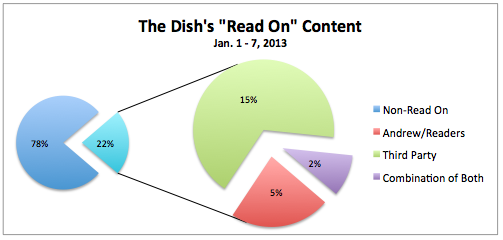
Jay Pinho has been tracking the Dish’s use of read-ons before and after we implemented the meter. A pre-meter snapshot:

before-meter

After the meter went up:

after-meter

Note that the percentage of posts that contain a read-on has stayed almost exactly the same. Pinho explains the difference:

[W]hereas 67.3% of all “Read On” sections before the meter contained mostly third-party content, now the plurality of “Read Ons” (44.0%) consist of content provided by Andrew and his readers (from analysis to letters to views from people’s windows). The proportion composed of third-party content has fallen to 40.0%, with the remaining 16.0% of all “Read On” sections comprised of material that contains both.

What this likely means is that Sullivan and his team have taken to heart the precautions of readers and commentators who noted that, to charge for content, the part that’s hidden to non-subscribers should tend to be more original — as opposed to a curation of third-party material.

Also, regarding third-party posts, almost all of their read-ons are inserted below a blogger’s link, thus publicizing his or her byline and the original piece for all Dish readers to see and visit, regardless of subscription. Pinho looks ahead:

I believe Sullivan mentioned recently that if the pace of subscribers didn’t pick up, he may “nudge” them towards paying their dues. This could happen in one of two ways. Either he could reduce the number of monthly “Read On” clicks it takes to trigger the meter (it’s currently at seven), or he could introduce more “Read On” posts as a percentage of his total posts. As an early subscriber, it doesn’t really matter to me which one he chooses. But so far at least, the content lying beyond the “Read On” button certainly seems to justify the annual fee.

The Perfect Admissions Essay

Phillip Lopate believes it should be rooted in doubt:

Ever since Michel de Montaigne, the founder of the modern essay, gave as a motto his befuddled “What do I know?” and put forth a vision of humanity as mentally wavering and inconstant, the essay has become a meadow inviting contradiction, paradox, irresolution and self-doubt. The essay’s job is to track consciousness; if you are fully aware of your mind you will find your thoughts doubling back, registering little peeps of ambivalence or disbelief.

Instead he thinks, “more often than not, the applicant is expected to put forward a confident presentation of self that is more like an advertisement, a smooth civic-minded con job, circumventing the essay’s gift for candid, robust self-doubt.” On a related note, an admissions officer discusses reading essays on the job:

You wouldn’t believe some of the essays kids write. Last year there was an essay about this girl’s sexual exploits, right down to this whole voyeuristic thing about her having sex on golf courses. Why would we want to read about that? We also get a lot of religious-themed essays on why you shouldn’t have sex before marriage. I also got what was basically a report on the negative effects of abortion. People write reports on global warming too. That’s not a personal statement!

The Top Of The Carbon Chain

One more reason to take care of the animal kingdom – extinction fuels climate change:

Predators are bigger animals at the top of the food chain and their diets are comprised of all the smaller animals and plants in the ecosystem, either directly or indirectly. As a result, the number of predators in an ecosystem regulates the numbers of all the plants and animals lower in the food chain. It’s these smaller animals and plants that play a big role in sequestering or emitting carbon.

Julia Whitty illustrates the process:

[T]he researchers experimented on three-tier food chains in experimental ponds, streams, and bromeliads in Canada and Costa Rica by removing or adding predators. Specifically by adding or removing three-spined stickleback fish (Gasterosteus aculeatus) and the invertebrate predators stoneflies (Hesperoperla pacifica) and damselflies (Mecistogaster modesta). When all the predators were removed the ecosystems emitted a whopping 93 percent more carbon dioxide to the atmosphere.

Prop 8 Goes To Washington

Lyle Denniston checks in on the Prop 8 battle. He analyzes the Olson-Boies pro-equality brief (above):

The two California same-sex couples’ fifty-four-page brief was a bold attempt to portray the constitutional idea of marriage equality as a victim of homophobia, and to persuade the Court not to settle for a California-only decision, or for one that moved gays and lesbians only a bit closer to marriage, but rather to give them a right to wed as fully as any other couple has, regardless of race, sex, or sexual orientation.

With such a sweeping approach, the brief took a considerable risk that it might be more than the Justices were ready to accept.  But it also has the potential virtue of making it easier for the Court to settle for a ruling for same-sex marriage on narrower grounds – as the Ninth Circuit Court had done in striking down Proposition 8 a year ago.

An excerpt from the brief:

Proponents accuse Plaintiffs (repeatedly) of “redefining marriage.” But it is Proponents who have imagined (not from any of this Court’s decisions) a cramped definition of marriage as a utilitarian incentive devised by and put into service by the State—society’s way of channeling heterosexual potential parents into “responsible procreation.” In their 65-page brief about marriage in California, Proponents do not even mention the word “love.” They seem to have no understanding of the privacy, liberty, and associational values that underlie this Court’s recognition of marriage as a fundamental, personal right. Ignoring over a century of this Court’s declarations regarding the emotional bonding, societal commitment, and cultural status expressed by the institution of marriage, Proponents actually go so far as to argue that, without the potential for procreation, marriage might not “even..exist[ ] at all” and “there would be no need of any institution concerned with sex.” (internal quotation marks omitted). Thus, under Proponents’ peculiar, litigation-inspired concept of marriage, same-sex couples have no need to be married and no cause to complain that they are excluded from the “most important relation in life.” Indeed, Proponents’ state-centric construct of marriage means that the State could constitutionally deny any infertile couple the right to marry, and could prohibit marriage altogether if it chose to pursue a society less committed to “responsible” procreation.

This, of course, reflects a complete “failure to appreciate the extent of the liberty at stake,” not to mention matters such as love, commitment, and intimacy that most Americans associate with marriage. As Proponents see it, marriage exists solely to serve society’s interest; it makes no sense to speak of an individual’s right to marry.

Also, various DOMA briefs are being filed today.

Rethinking College Rankings

In the wake of attempts by colleges to game the US News & World Report’s rankings [NYT], a new paper proposes a system that looks at the actual choices made by students. Eric Hoover has details:

[The] researchers propose a method of ranking colleges according to students’ “revealed preferences”—the institutions they choose to attend over others that have accepted them. Using survey data from a national sample of high-achieving students, the researchers determined the winners and losers of each applicant’s “matriculation tournament.” They then used those outcomes to rank about 100 selective colleges. (Harvard University topped the list, but you already knew that; the University of Notre Dame nearly cracked the top 10.)

This model enabled the researchers to approximate the odds that an applicant would choose one college over another. For instance, there was a 59-percent chance that a student considering only Harvard and the California Institute of Technology would choose Harvard. If the student were choosing between only Harvard and Wellesley College—10 spots below Harvard on the revealed-preferences list—there was a 93-percent chance that she would end up heading to Cambridge, Mass.