A reader passes along a “remarkably unremarkable” Kindle commercial:
Month: February 2013
Always On The Mend
Derek Beres criticizes modern spiritual fads that render us in a “perpetual state of healing,” never allowing us to come to terms with a broken world:
If we hold unattainable expectations of what the world ‘owes’ us, we’re bound to be disappointed. Americans currently consume two-thirds of the world’s supply of antidepressants, which are the most commonly prescribed drugs in the country. I’ve noticed a common theme among friends using such medications: it’s only for a little while, until things ‘outside’ get better.
This is how we treat healing—just a little more, and we’ll be alright. Until the next trauma, when we find that we need a whole new round of healing. We become addicted to healing instead of being healed, so we cannot be OK with not always being OK.
Tweeting Your Demise
before he died, he asked us to tweet: ‘Goodbye world the time has come, I had some fun’
— TonyNicklinson (@TonyNicklinson) August 22, 2012
Dr. Mark Taubert wonders if palliative care will soon include social media assistance:
Consider the following situation: a patient in a hospital ward posts ‘Dead’ in her/his online microblog status update. She/he is in the final stages of a terminal illness. She/he, or a relative/friend, posted this message using a smart phone device from her/his hospital bed. The ward receives phone calls from those who have read the status update. “Is she really dead?” The patient is very sick, but not dead. But it is, as it subsequently turns out, her/his last ever online status update.
This really happened, and similar stories are likely to recur. Our digital society now captures all life moments, from gestation to death.
Seen above is the final tweet from the Dish’s Face of the Year, who starved himself after being denied euthanasia.
A Cannabis Workers Union
Not as crazy as it sounds:
Though the image of straight-laced hard-working blue-collar labor collaborating with hippy stoners doesn’t quite seem to match up, it is actually a match made in heaven. Labor union memberships have been flagging for some time, and they are in desperate need of a growth industry to latch on to. Meanwhile, marijuana dispensaries have both a branding problem (lacking legitimacy) and a lobbying problem (inability to organize), both of which unions can be of great help.
(Hat tip: Drug WarRant)
Rapping Truth To Power
Pushing back against the idea that rappers frequently “glorify criminality”, Lisa Wade highlights a recent study that analyzed the lyrics of popular hip-hop songs:
[Criminologists Kevin] Steinmetz and [Howard] Henderson concluded that the main law enforcement-related themes in hip-hop are not pleasure and pride in aggressive and criminal acts, but the unfairness of the criminal justice system and the powerlessness felt by those targeted by it. Lyrics about law enforcement, for example, frequently portrayed cops as predators exercising an illegitimate power. Imprisonment, likewise, was blamed for weakening familial and community relationships and described a modern method of oppression.
The study’s authors concluded that “the overwhelming message in hip-hop wasn’t that the rappers disliked the idea of justice, but they disliked the way it was being implemented.” More insights from the authors via Meredith Mohr:
“[T]he music is maturing, evolving,” Henderson said. “Take Jay-Z for example. If you look at his lyrical content from 1990-2012, you see the evolution from talking about drug selling at the beginning of his career to now talking about meeting with the president, helping with the campaign. It’s a very different conversation. We never saw an artist go backwards. You only saw them mature as they age, and experience and their music changes with them.”
Part of this, Henderson said, is because the audience has also changed with the artists. “Jay-Z’s listenership has aged with him,” Henderson said. “Part of it is that artists recognize that if they go back and talk about that very animalistic behavior, their listeners are going to say, ‘hey listen, this is not what I want to hear,’ and they’re going to go somewhere else.
SOS In 140 Characters Or Less
In the wake of a natural disaster, it can be hard for relief workers to determine where help is needed most. But Ben Schiller looks at the improvements offered by “micro task” services:
Following last December’s Typhoon Pablo, in the Philippines, [the Digital Humanitarian Network] identified 20,000 relevant tweets, and then called on CrowdFlower to find volunteers to make the first assessment. The groups identified, one, messages with links to photos and video, and, two, messages that referred to damage that could be geo-tagged. From about 100 tweets, the UN Office for the Coordination of Humanitarian Affairs (OCHA) could then build a map plotting damaged houses and bridges, flooding, and so on.
“The entire project was carried out in less than 20 hours after OCHA’s request. This would not have been possible without the use of CrowdFlower as the first major filter of the 20,000-plus tweets,” says [DHN director of social innovation Patrick] Meier, who writes about the response here.
The Art World’s Rebel Darling
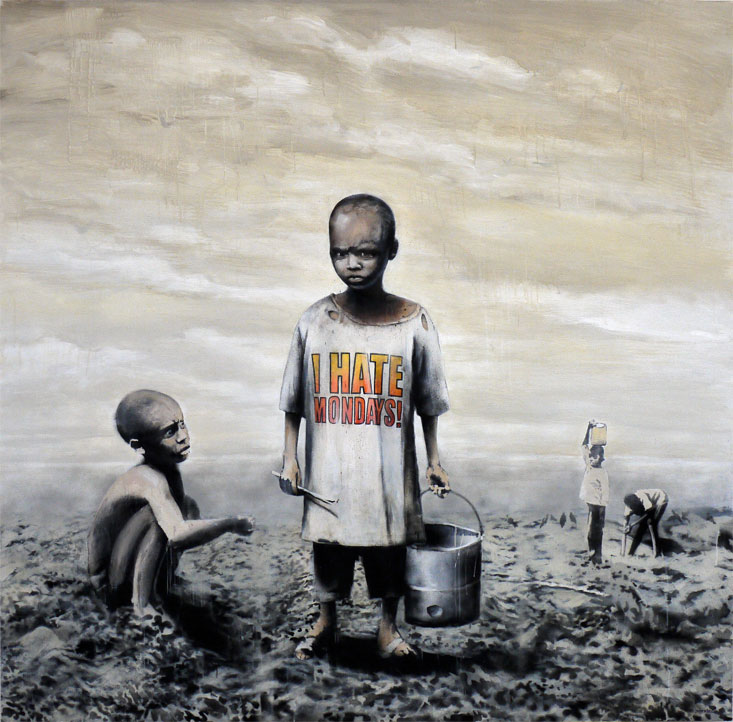
Will Ellsworth-Jones profiles the legendary street artist Banksy:
The riots in the Stokes Croft area of Bristol in spring 2011 offer a cautionary tale. The episode began after police raided protesters, who were opposed to the opening of a Tesco Metro supermarket and living as squatters in a nearby apartment. The authorities later said that they took action after receiving information that the group was making petrol bombs. Banksy’s response was to produce a £5 “commemorative souvenir poster” of a “Tesco Value Petrol Bomb,” its fuse alight. The proceeds, he stated on his website, were to go to the People’s Republic of Stokes Croft, a neighborhood-revival organization. Banksy’s generosity was not universally welcomed. Critics denounced the artist as a “Champagne Socialist.”
He has countered this kind of charge repeatedly, for instance, telling the New Yorker by e-mail: “I give away thousands of paintings for free. I don’t think it’s possible to make art about world poverty and trouser all the cash.” (On his website, he provides high-resolution images of his work for free downloading.)
“I love the way capitalism finds a place—even for its enemies. It’s definitely boom time in the discontent industry. I mean how many cakes does Michael Moore get through?”
China’s Culture Of Spying
Max Fisher summarizes a story that “chronicles the life and work of Qi Hong, a specialist in removing surveillance equipment who might do dozens of freelance jobs for government officials every week”:
Chinese officials have taken to hugging one another at every meeting — not a traditional Chinese practice — to pat down one another for bugs, Qi says that a government official from Shanxi province told him. Qi tells story after story of removing tiny, high-tech, professional spying devices from the offices and cars of officials. Some of them expected it, others didn’t. One speculated that the spying had been ordered by his mistress, wondering if she herself had been “planted” by a rival official. The ones who did not find spying equipment seemed to assumed it was only because the cameras or microphones were too sophisticated to be detected.
Fisher theorizes that the “culture of no-holds-barred spying that seems to have pervaded Chinese officialdom might also inform why some of those same officials have seemed so aggressive about spying on others — including foreigners.”
The Daily Wrap

Today on the Dish, Andrew cautiously ushered in a new season of sanity on the right, explained the Dish Model to Planet Money and the NYT, and contemplated the rigors of an overly-public life in the context of the British royal family. In our continuing “Sully and Hitch After Dark” series, the conversation turned to fundamentalists and the compulsory nature of religion.
Meanwhile, Matt Duss relayed the latest McCarthyite attacks on Hagel, and Rich Lowry issued a mea culpa while others remained silent, and Dan Friedman revealed that he had accidentally started the “Friends of Hamas” rumor mill to begin with. Frum shot down a claim about the rarity of gun accidents, Jack Shafer called for a smarter debate over infrastructure spending, Dolan gave a deposition, and George Packer pinned the blame for Walmart’s recent struggles on the payroll tax. We dug into the GOP’s attempts to saddle Obama with the sequester, projected the winners and losers when Americans start to feel its effects, weighed the influence of region on economic development, and put Rubio’s appeal to Hispanics in context. Looking abroad, we wondered if the Saudis would be next to go nuclear, dove into the details on China’s recent cyberattacks, and witnessed how sectarian violence in Pakistan led to some heartbreaking protests.
In assorted coverage, Alain de Botton explored the overlap between revolting and erotic, Patricia T. O’Conner and Stewart Kellarman decided to brazenly split their infinitives, readers debated the eating of horse meat, and we walked the line between ethics and insult on journalist gifts. Linda Besner delivered a verdict on the chicken-egg debate, Carl Zimmer found hope for sufferers of brain disease, and Ackerman cast light on the next generation of camouflage. Will Hermes interviewed a “Prince” of the indie music scene, Tom Jokinen revealed the top pick in the corpse draft, Daniel Burke profiled the antichrist throughout history, SNL previewed Djesus Uncrossed, and the Daily Mail claimed that beards lengthen lifespans.
In entertainment coverage, Movie theaters rolled out upscale offerings to compete with the couch, Ken Auletta heralded the demise of TV antennas, pay-per-view knocked boxing out of the mainstream, and a reader marveled at her 4 year-old daughter’s ability to understand COPS. Pizza stole the scene in the MHB, Arkansas froze over in our VFYW, and a panda panted for our FOTD.
– D.A.
(Photo: Pakistani Shiite Muslims gather around the coffins of relatives during a mass burial ceremony in Quetta on February 20, 2013. Mass burials for 89 victims of a bomb attack targeting Pakistani Shiite Muslims began after three days of nationwide protests at the government’s failure to tackle sectarian violence. By Banaras Khan/AFP/Getty Images)
Dolan Deposed Today
He was under oath today about his actions or lack of them as Archbishop of Milwaukee to do with the rape and sexual abuse of children by priests under his authority and before his time, alleged pay-offs to rapist priests to get them to resign – and in particular a shady scheme to minimize payments to victims of rape and abuse.
Dolan has recently said of the principal victims’ group, Survivors Network of those Abused by Priests: “SNAP has no credibility whatsoever.” And like Cardinal Mahony, recently proven as complicit in shielding child-rapists, he’ll be off soon to pick the next Pope.
 The Dish