The Daily Wrap

President Obama Delivers State Of The Union Address

Today on the Dish, Andrew spent the night live-blogging the State of the Union. Blog reax here, tweet reax here and meme of the night here. Earlier, he sighed at what might have been of Benedict XVI’s reign, and pressed further on the implications of a Pope stepping down. He also compared the outgoing pontiff with St. Gregory the Great, and took on readers’ criticism of his take on what lies next for Ratzinger. Later, Andrew unmasked the Dish’s cartoonist, Terry Colon, and our special teams, Chas Danner, and updated everyone on the first few days of the new indie Dish experiment.

In political news, James Inhofe wonderfully articulated the stance of the American Christianists looking to divinize our foreign policy, Sam Tanenhaus linked the far right with the doctrines of John C. Calhoun, and the Consumer Protection Bureau went to bat for college students. Enten raised his eyebrow at Rubio’s 2016 chances, while Larison claimed it’s still too early to call. Meanwhile, we charted the theft of human life caused by gun violence, Kate Sheppard revealed the climate-benefits of fewer work hours and The Economist took social mobility down a peg.

Then we took a tour of the high seas with actual pirates as William Prochnau, Osnos reported the cost of anti-corruption to China’s economy, and Laura Parker found little evidence for the mythical “secure border.” Finally, we bummed out that the correction of the day wasn’t genuine news for the Alaskan Esther as Megan McCloskey corrected Phil Bronstein’s veteran-insurance blunder in Esquire.

In assorted news and views, we sampled deep-friend deep-space scallops, Alex Knapp unearthed more evidence at the scene of dinosaurs’ demise and Nicola Twilley made the case for cheap, fence-free animal herding. Paula Marantz Cohen praised literature-as-textbooks and Kelley Vlahos shook her head at thee persistence of must-cringe TV. Oriana Aragón and Rebecca Dyer explained the urge to squeeze that kitten to death, and posted more views from your blizzard here.

For another tricky VFYW contest, we breathed the open air of Castillo San Cristobal in San Juan, Puerto Rico and reconsidered the benefits of joining the Super Adventure Club for the MHB before we looked over Ojai, California in the VFYW.

–B.J.

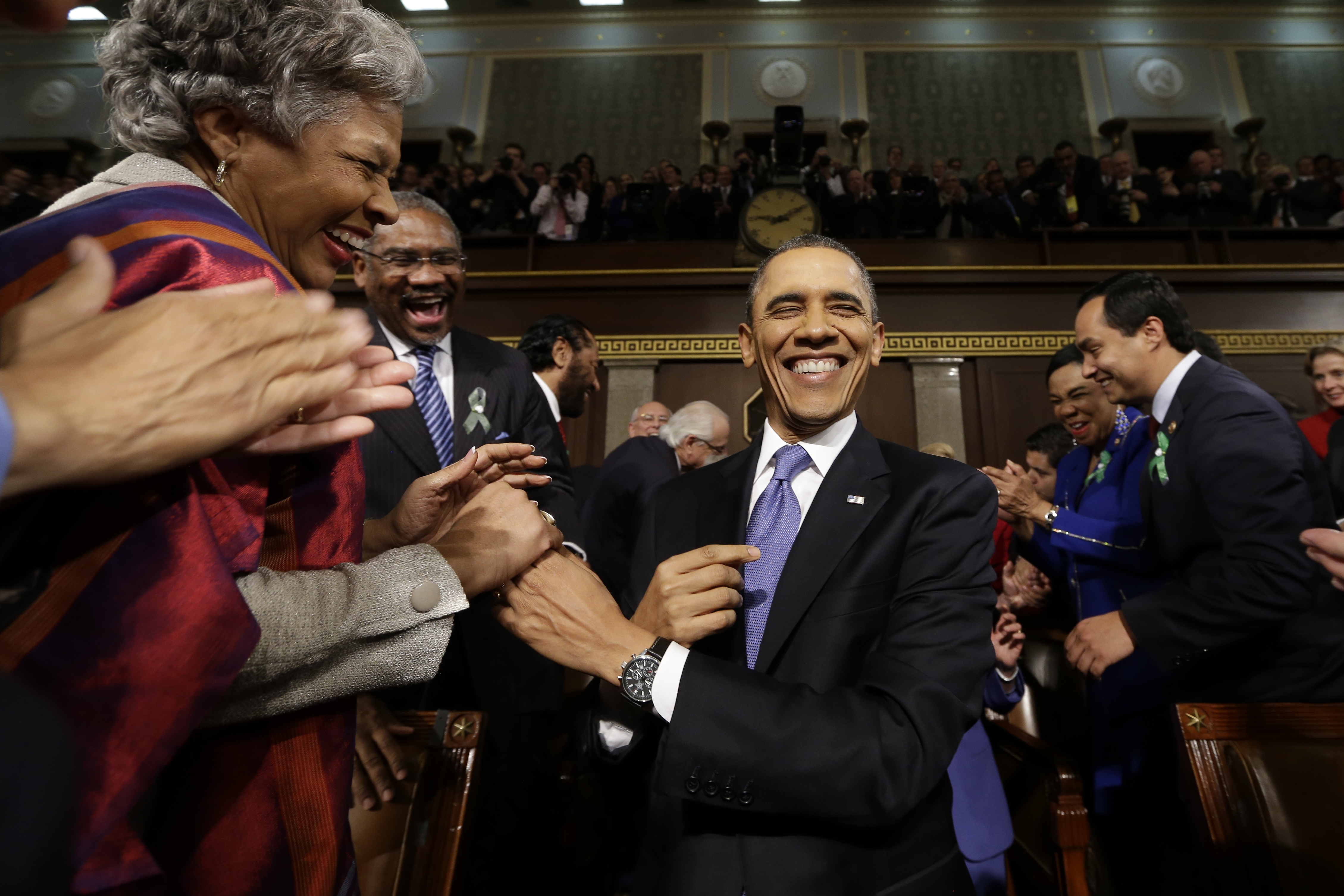
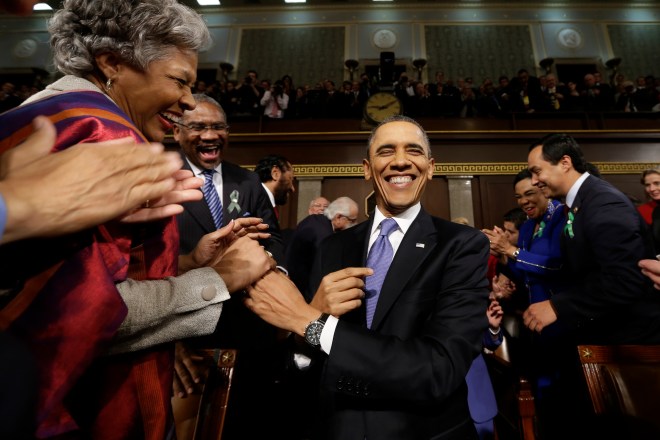
(Photo by Charles Dharapak-Pool/Getty Images)

SOTU: Blog Reax

Ezra Klein was struck by the ambition of Obama’s agenda:

It’s often the case that candidates are more ambitious than presidents. But Obama’s second term is showing precisely the reverse progression. The speech went much further than Obama’s 2012 Democratic convention speech. There, his address was notable mainly for how modest the policy proposals were. Here, his speech was notable for the sweeping nature of the proposed changes. Obama’s agenda hasn’t been this bold since 2009.

How R.M. at DiA understood the speech:

The president’s speech felt like something out of the Roosevelt administration (Franklin), full as it was with progressive policy proposals–not exactly suited to our current paralytic times. So I’m going to propose that he has an eye on 2014. “Here are a bunch of proposals that you’ll probably like–universal pre-school, higher minimum wage, etc–and that Republicans will never pass,” he seemed to be saying. “Do you want to reward such obstructionism?”

Tomasky’s view:

A very strong speech, better that most, an A-. The writing was prose, except for the “they deserve a vote flourish at the end,” which was powerful, but the structure was very effective. I really liked the way he opened by diving right into the sequester (as I suggested!). The words weren’t exactly the ones I’d have chosen, but it was good that he said–early, when everyone was still watching–that the Republicans are going to be the ones to blame if these cuts kick in.

Will Wilkinson doubts the speech mattered much:

Mr Obama will have gratified progressives by calling for action on climate change, and pleading emotionally for a vote on gun control measures, but there’s little reason to think he gained any ground on these divisive issues. It will be interesting to see how Republicans respond to Mr Obama’s proposal for universal preschool, as well as to see whether this new expence will actually survive as a priority for the president during negotiations over fiscal belt-tightening.

Sprung sensed Obama’s confidence:

Obama’s repeated plea to the nation tonight was to face reality: his tone was relentless reasonability. He spoke with a distilled fluency of a man who has been articulating the same values and proposing essentially the same policies (excepting gun control) for six years on the national stage and now speaks with the knowledge that through several permutations and waves of oppositional hysteria he has still has (or has regained) a majority with him on the big stuff.  And so he argued, not only as if he were himself convinced but convinced that we are convinced …

Kilgore’s reaction:

I thought speech clever in how he handled challenge to GOP; very Clintonian in policy offerings (and better than past SOTUs); and pretty good at taking advantage of areas where public opinion pretty much already on his side. Minimum wage increase good example: Republican pols and business leaders hate it, public loves it.

Dylan Matthews analyzes Obama’s proposal to bump the minimum wage to $9.00:

According to a 2007 study by the CBO, an increase in the minimum wage to $7.25, like that eventually passed that year, would increase wages by $11 billion, of which $1.6 billion went to poor families. By contrast, increasing the Earned Income Tax Credit for large families (as happened in the stimulus bill) and for single people would cost $2.4 billion, of which $1.4 billion would go to poor families. The EITC option costs one fifth as much to society but does about as much good for poor families. That suggests that if you want to help families escape poverty, wage subsidies are a more cost-effective option than the minimum wage.

Keith Hennessey thinks the minimum wage hike is unwise:

A minimum wage increase precludes employers from hiring, or from continuing to employ, those workers whose productive value to the firm is worth less than the new minimum wage. Like any price ceiling or price floor a minimum wage restricts supply, and an increase in the minimum wage restricts supply more. Raise the minimum wage and you will eliminate jobs for the lowest-skilled workers in America.

Adam Ozimek suggests an alternative to Obama’s minimum wage proposal:

I think on balance the evidence suggests [raising the minimum wage] does cause unemployment, and I don’t support it. But I recognize the evidence is mixed, and this is why I think what Obama should propose is a randomized minimum wage. Let the policy be designed by the Alan Krueger, the head of his Council of Economic Advisors, and one of the pioneering researchers on the impact of the minimum wage. The higher minimum wage can be set to sunset in 8 years conditional on what the experiment has shown about the impact of the policy.

Yglesias wants more details on the universal pre-K proposal:

People who consider themselves skeptics of K-12 education “reform” sometimes fall into a trap of thinking that preschool is like some kind of magic wand. But in fact the research on preschools is very similar to the research on K-12 schools. On both levels, some schools are excellent and make an enormous difference in kids’ lives but there are also a lot of middling-to-poor institutions that are adding little educational value. We have some intriguing examples of amazing preschools, but little experience with bringing them up to mass scale—the exact same problem we have with K-12.

And Howard Gleckman wanted more fiscal seriousness:

The fiscal goal he described is the same one he’s had for months: By his count $1.5 trillion in new deficit reduction over 10 years that would stabilize the debt at slightly below current levels—a far cry from balance.

Ambers’ bottom line:

[B]y not proposing a new “Grand Bargain” tonight, Obama has effectively foreclosed on the idea. Forever.

Meme Of The Night

Screen Shot 2013-02-12 at 11.34.19 PM

https://twitter.com/jetpack/status/301537193908903937

SOTU: Tweet Reax

US-POLITICS-STATE OF THE UNION-OBAMA

(There is a glitch in the formatting of the tweets after the jump, so click here to view the whole reax in the proper format.)

GIF of the exploding fist-bump here.

(Top photo: Rock musician and gun rights activist Ted Nugent listens to US President Barack Obama deliver his State of the Union address before a joint session of Congress on February 12, 2013 at the US Capitol in Washington. By Mandel Ngan/AFP/Getty Images)

Live-Blogging The State Of The Union

President Obama Delivers State Of The Union Address

10.12 pm. Now we’re really into Reagan territory. The 102 year-old is pretty damn amazing. And, yes, it is a national scandal that she had to wait six hours to vote. Then a heroic cop. “That’s just the way we’re made.” I have to say that even to these jaundiced ears, that peroration moved me. The passion, the reason, the sincerity: this was an invigorated president, trying to shift the mood away from zero-sum partisanship to non-zero-sum citizenship. It’s what we always hoped from him, and I think it places the Republicans in a horrible bind. Are they going to prevent a vote on guns? Are they going to refuse Bowles-Simpson Medicare reform? Are they willing to force a sequester rather than cooperate with this popular president? Does the Speaker not appreciate a 102 year-old getting to vote? Why did he stay seated? I have a feeling that moment will strike people.

Meep meep.

10.08 pm. He’s ending on Newtown. Ticking off the majority’s support for background checks, citing the support of the police for ending weapons of grotesque destruction. A thousand gun-deaths since Newtown. And then the emotional power/blackmail of the parents of a little girl culled by a gun. “They deserve a vote” is a great line.

10.05 pm. “Families, gay and straight.” The confidence with which he now routinely includes gay people among his public statements is truly remarkable. It’s as if he’s been liberated to champion this civil rights movement, which he has done more than any president to advance and legitimize.

10.02 pm. A personal note of thanks for using the words Rangoon and Burma. Then the Arab Spring: it will be messy, we cannot control events, but we should back freedom. Pretty much: stay out of the way. A minor note on Israel: emphasizing security and a “just peace.”

9.54 pm. This is now the goal of the Afghanistan war: destroying the “core of al Qaeda.” But the promise is the withdrawal. The leaked 34,000 troop withdrawal was correct. Again, this was, remember, why he was elected – because he resisted the pro-war consensus in Washington. He’s ruling out ground invasions. And then a vague commitment for greater Congressional control and scrutiny – with no judicial element. Somewhat disappointing. And he sure sounds like he’s not backing down on drone warfare – or unilateral presidential war-making.

9.51 pm. I wasn’t aware – and should have been – that the minimum wage for a family of four is $14,000. But I’m surprised by the unapologetic liberalism there. Does he believe that raising the minimum wage would have no impact on jobs growth? Does he believe it would actually increase employment and growth?

9.48 pm. A tough line on immigration reform. But the real ovation came from expanding legal immigration. Still, the rhetoric again was not partisan, and included GOP talking points.

9.41 pm. People have been talking about Obama’s new swagger and self-confidence. I can see that in this speech, but I don’t see an aggressive partisan attack. He has consistently mentioned bipartisan initiatives; he has endorsed major tax reform as a way to avoid the sequester; he’s now onto one of the most critical issues in America today: the lack of good pre-K education.

9.38 pm. So he’s for more energy investment but with added research into cleaner emissions. And then what strikes me as pretty banal but has become somewhat partisan: rebuilding bridges and roads and infrastructure and Internet.

9.35 pm. I’m genuinely surprised that he’s put climate change so early and so emphatically. Tow valentines to McCain, I note. One a handshake at the start and now a tip to McCain’s previous proposal for cap and trade. I wish I believed it could truly work.

9.34 pm. Now he’s emphasizing investments in science. He’s speaking as if the crisis is over and morning in America is coming. By the way, the green ribbons are in honor of Sandy Hook. Lame.

9.33 pm. This is an optimistic speech, gaining momentum as it goes along. Then a nod to Clinton: not a bigger government, but a smarter one.

9.30 pm. Deficit reduction is important – just not as important as investing in the middle class. Krugman must be happy.

9.28 pm. He’s on a roll now, lambasting the fiscal brinksmanship of the last several years.

9.24 pm. He’s backing the Bowles-Simpson commission’s goals on Medicare over the next decade – that strikes me as a big concession.

And then he says “we must keep the promises we’ve already made.” I’m getting a little whiplash. But now we’re getting to comprehensive, bipartisan tax reform. Is this a late modification of Bowles-Simpson – with more populism and energy?

9.22 pm. And we’re right into the sequester – “a really bad idea”. But he prefers it to cutting entitlements while leaving the Pentagon alone. A pretty lame adjective for the fiscal crisis in Medicare: modest adjustments.

9.20 pm. Biden stands up for “country before party”. Boehner stays in his chair.

9.19 pm. “A rising, thriving middle class”: that’s becoming the theme of his presidency. Notice too the little inclusion of gay love.

9.16 pm. A unifying start, quoting Kennedy, and then a reminder of why he became president in the first place: ending the Bush-Cheney wars.

9.15 pm. What is that weird ribbon on Biden’s lapel?

Chart Of The Day II

A WaPo poll tested the popularity of various policies when Obama’s name is and isn’t attached to them. The results:

Obama_Poll

Waldman’s reaction:

[H]ow should Obama interpret this information? The answer is that there isn’t much he can do about it. The Postarticle suggests, tongue in [cheek] I’m assuming, that he shouldn’t mention that he supports a path to citizenship in his State of the Union address. But it isn’t like we’re going to have a big debate about immigration reform in which the President is able to keep his position a secret. That’s the thing about being in charge—for better or worse, voters are going to know where you stand, and the more attention an issue gets—in other words, the closer it gets to being resolved with new legislation—the more that’s true.

The State Of The Linguistics

The Guardian charted the reading levels of all State of The Union speeches and found that the “linguistic standard of the presidential address has declined.”  Nathan Yau offers on explanation:

My guess is this has to do with changes in how we write and talk more than anything else. Lee Drutman and Dan Drinkard for the Sunlight Foundation ran a more rigorous analysis on Congressional records back in May, and the declining trend is similar.

Is Rubio The Frontrunner? Ctd

Enten doubted it. Larison’s perspective:

It’s true that most Republicans will be even more willing to tolerate a relative moderate candidate in the 2016 cycle than they were this time, but being perceived as the relative moderate often depends on the other candidates in the field. On paper, McCain wasn’t that much of a moderate compared to his rivals, but he was perceived that way and encouraged people to think of him as such. If Jeb Bush chooses not to run, Rubio would be his obvious replacement and would likely reap the benefits of Bush’s connections. None of that means that Rubio will be the next nominee or even that he should be considered the favorite at this point, but there are fewer obstacles between him and the nomination than Enten thinks.

The Legacy Of The Twitter Revolutions

[tweet https://twitter.com/jihankazerooni/status/301376068441473024 ]

Last week, Marc Lynch struggled to unravel the continuing impact of social media on the Arab Spring:

[N]egatives such as sectarianism, fear, and hatred spread as rapidly on social media as do more positive ideas. The success of the Tunisian revolution inspired Arabs everywhere to believe that victory was possible, and Egypt’s success convinced many that victory was inevitable. But the reverse also proved true. The bloodbath in Syria, like the horrors of Iraq in the mid-2000s, had a chilling effect on popular mobilization. By midway through 2011, it was already clear that the end of the story did not have to be partying in Tahrir Square — it might be butchered women and children littering the streets and massive dispossession and grief. The sectarian hatred and division fueled by the Syrian bloodshed flowed through social media just as effectively as the unifying message of the early Arab Spring.

Brian Ulrich’s perspective:

As a historian, I am struck by how often changes in the information environment appear in explanations for revolutions.  What I know of the French Revolution comes from basic reading and conversations with a colleague in order to teach my world history survey, but there is definitely the idea that in the mid-1700’s a critical mass of literate urban dwellers began reading and spreading information contained in pamphlets, a culture which took an increasingly political turn in the aftermath of the debacle of the Seven Years’ War, and that King Louis XVI was simply unable to effectively engage with or manage the newfangled “public opinion.”  Juan Cole wrote of something similar in Egypt’s 1881 Urabi Revolt.  When I think of Iran’s Tobacco Revolt and Constitutional Revolution, I think in part of the telegraph and the spread of ideas and information via labor migration.  I have no idea if similar developments figure in the contemporary developments in China, Russia, and Mexico.  None of these situations, however, led quickly and easily to a happy and united community under a new political framework, an expectation much of the public has had of the Arab Spring that probably owes more to memories of the transitions of the fall of communism than the longer history of popular uprisings.

In a follow-up post gathering responses, Lynch clarifies his stance:

I believe that the underlying transformation of the Arab public sphere enabled by the radical, rapid spread of new information technology represents the single most enduring and profound change of the last decade. It is one of the primary obstacles to the return of traditional Arab authoritarianism, and to the emergence of a new Islamist domination.  The effects of that structural change, like those of any structural change, are complex and unpredictable, and can’t be reduced to reassuring narratives of “democratization” or frightening narratives of “state collapse.”  The new information environment empowers politics, which do tend to be messy and contentious and unsatisfying.  That’s good, but it doesn’t guarantee any particular outcome.