A Heart Attack Early Warning System, Ctd

Ezra Klein responds to the new technology that may be able to predict heart attacks:

Consider how dramatically these devices will change medicine. Right now, the medical industry is fundamentally reactive. Something goes wrong, and we go to them to fix it. This will make medicine fundamentally proactive. They will see something going wrong, and they will intervene to stop it. It’s like “Minority Report” for health care.

This is why I don’t put much stock in projections of health-care spending that run 30 or 50 or 75 years into the future. Will biometric devices in constant communication with the cloud make medicine more or less expensive? Will driverless cars prolong life in a way that saves money or costs it? Will the advances in preventive technology make medicine so effective that we’re glad to devote 40 percent of gross domestic product to it? Who knows?

How Graphic Should War Coverage Be? Ctd

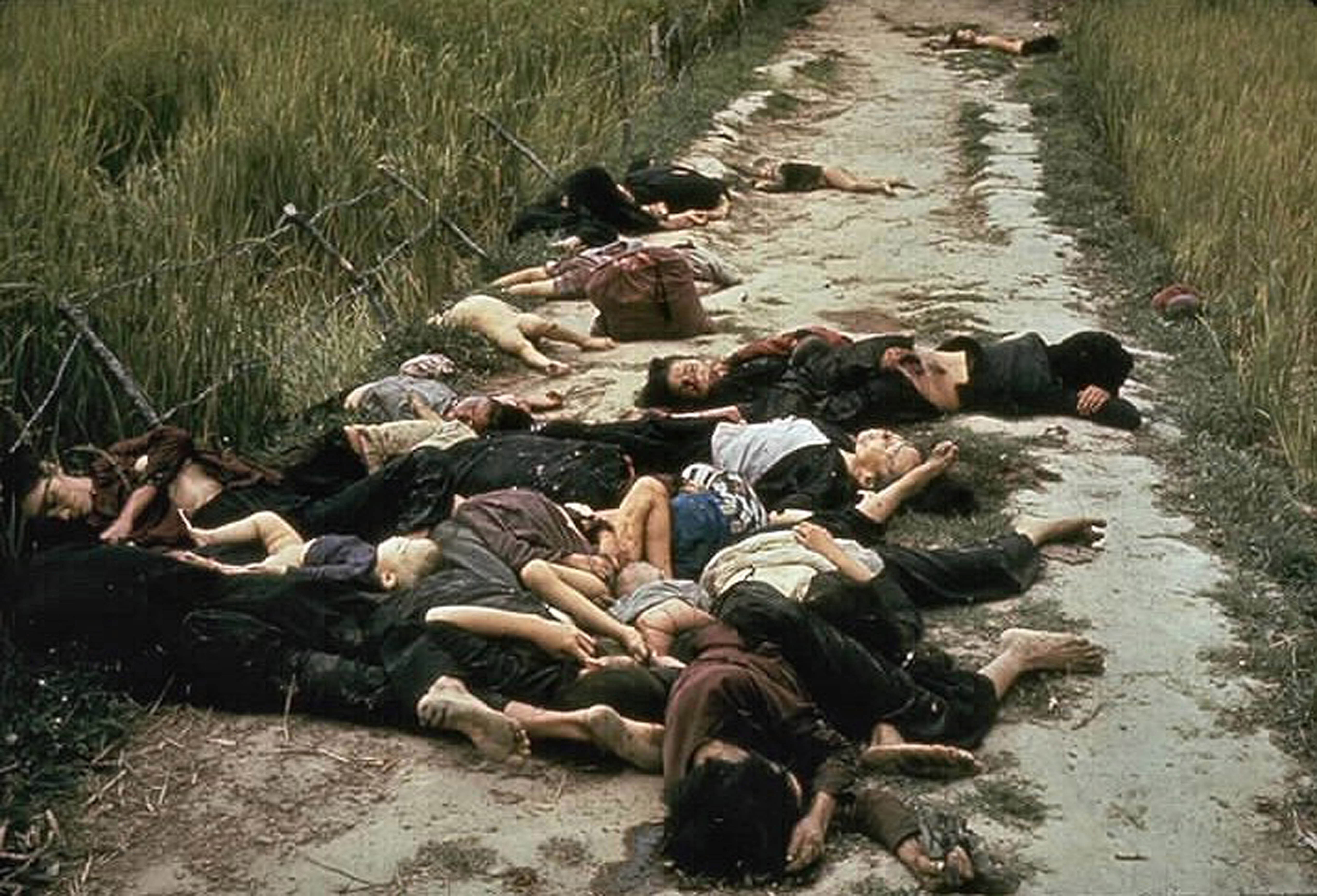
The My Lai Massacre, the mass murder of 347 to 504 unarmed citizens of the Republic of Vietnam (South Vietnam), almost entirely civilians and the majority of them women and children, perpetrated by US Army forces on March 16 1968. Bodies of some of the vi

A reader writes:

I’m sorry I missed the recent discussion about war photos. My contribution: I remember my eighth grade history teacher, in 1971, showing us photos her husband had taken as part of an American force that liberated a concentration camp in World War II. “These aren’t the worst,” she told us, “I can’t show you those. They are too terrible.” The photos she showed us were among the worst I’ve ever seen.

In April, 1979, shortly after W. Eugene Smith’s death, Popular Photography published some of his photos, including a few from the Pacific theater in World War II. It was the first time I had seen them, and I remember this one vividly. It’s hard to see how Smith’s photo from 70 years ago is so different from any of the photos you have posted. It was originally published in Life Magazine on August 28, 1944.

The iconic photo by AP photographer Nick Ut, of nine year old Kim Phuc, naked, running away from her village, her body burning from napalm, was published on the front page of the New York Times on June 9, 1972. The front page. Today they’ve gone so far off track they can’t even bring themselves to talk about torture.

Life Magazine and the New York Times didn’t shy away from publishing those photos, and neither should you. The alternative is that the only evidence of the Iraq war in twenty years will be photos of cheering Iraqis tearing down statues of Saddam.

Photos like these should disturb us, and shake us to our core, and give us nightmares, and the next time someone tries to drag us off to war, we should get out these photos and look at them and remind ourselves just how much war really costs, and remember that whatever we’re going to war about had better be so goddamn important that we can look at those photos and say, “Yes, even this will be worth it.”

Please, keep posting photos. Yes, they’re disturbing, but this is too important.

Another quotes Christian Caryl:

You can search the seven years of US broadcast news from Iraq almost in vain for images of dead US soldiers, or the grotesque effects of a suicide bombing on buildings or bodies, or the corpses of Iraqi families who had been riddled with bullets by nervous young Americans manning nighttime checkpoints.

Caryl isn’t wrong, but there’s a context here: Virtually every time a news organization published those photos, there was a massive and abusive pushback from readers and viewers, who saw every graphic photo as a simple case of exploitation. At the time the Iraq War started, I was a reporter in Connecticut. One of the local newspapers (not mine) published a full front page story on fighting, with a prominent photo of an American soldier being carried off in a stretcher after being wounded.

It was a difficult image to see, but there was nothing crass or tasteless about it. Yet readers in Connecticut – not exactly a hotbed of support for George W. Bush – reacted violently. The newspaper was accused of being unpatriotic; of exploiting a solider’s death; of throwing the corpse of a son or father on its front cover to sell newspapers (it actually wasn’t clear if the solider was dead), etc., etc. No voices were raised in support of the decision.

In a perfect world, a media outlet would simply ignore the criticisms and move forward, but that sort of violent reaction is going to take its toll on the people who decide what will be on the front page each day. Combine that with the 9/11 fear you and I both felt, a polarized public united only in its hatred of the media and a shaky bottom line for many outlets, and I can see why editors might be leery about publishing those images. Was it cowardly? Probably – but as Caryl writes, “Some outstanding (news) coverage resulted nonetheless, but little of it seems to have been absorbed by the public at large.”

I don’t excuse the failures of the media leading up to the invasion, but public opinion can sometimes be an immovable object. Journalism isn’t even close to an unstoppable force.

More Dish debate on the subject here and here.

(Photo: The My Lai Massacre was the mass murder of 347 to 504 unarmed citizens of the Republic of Vietnam, almost entirely civilians and the majority of them women and children, perpetrated by US Army forces on March 16 1968. Here are the bodies of some of the victims lying along a road. By Universal History Archive/Getty Images)

Sexism In Silicon Valley

Google software engineer Julie Pagano describes the “death by 1000 paper cuts” that comes from being a woman in the tech industry:

The cuts started early. I’m discouraged and humiliated in math classes throughout my school years to the point where I still get anxious doing math in front of others despite being good at it in private.  A high school teacher tells me that I shouldn’t go to college for engineering, but instead something nurturing (you know, what women are good for). My college classes have next to no women in them. A professor makes creepy comments about “geeky girls” during class. One of my few female classmates tells me she’s just doing this to prove her father wrong. …

Every time I try to push to make things better, I am guaranteed a patronizing response from someone. If I had a dollar for every time someone suggested that some demographics just aren’t biologically predisposed to be good at programming (even though research does not support this argument), I’d be rich.

Meanwhile, at the PyCon developers conference last week, an industry-wide firestorm ensued after a tech professional named Adria Richards shamed two men sitting behind her for making inappropriate comments during a presentation, which resulted in both her and one of the men being fired. Sarah Milstein has details:

[D]uring a keynote session, Adria heard some guys behind her making jokes that involved sexual language. The PyCon code of conduct states clearly, “Sexual language…is not appropriate for any conference venue.” Adria was bothered by the jokes, and referring to the code, she tweeted to the conference organizers, asking for help. They pulled aside the guys, who [apologized], and returned to the conference. Subsequently, PlayHaven, the guys’ employer and a sponsor of the conference, fired one of them. Adria then received a stream of virulent attacks and threats online. Her employer, SendGrid, was later subject to DDoS attacks demanding that she be fired, and they did so.

Matt Buchanan cites the incident as an example of the “biggest problem in technology”.

Children Deserve A Family

Yesterday, Scalia questioned whether gays adopting children is harmful to the children:

This embed is invalid


Ezra Klein pushes back, pointing out that “400,00 children are living in the United States without permanent families” and that more “than 100,000 of these children are, right now, eligible for adoption”:

On average, these children will be in foster care for three years before being adopted. Twenty percent will be in foster care for more than five years.

Foster parents are, in most cases, genuine heroes. But being in the foster-care system is not easy for children, or good for them. A world in which more of these children can go to loving, stable forever homes faster is a better world.

The idea that there is something so wrong with same-sex households that it would be preferable for these children to go two or four or six years without permanent parents — an idea, again, that has little to no evidence behind it, and that is in fact contradicted by most of the evidence — bespeaks a homophobia so deep that it is hard for me to believe it could persist long among people who actually know any children in the foster system, and who actually know many gay couples.

The Meter Cometh

In Britain, both the Telegraph and the Sun have just announced they are moving to a freemium model, like the NYT (and the Dish):

Its publisher, Telegraph Media Group, will allow telegraph.co.uk users free access to 20 online articles a month. After that, readers will be charged £1.99 a month (or £20 a year) for access to further online content and to the Telegraph’s smartphone apps.

Sounds familiar. So does the rationale:

News International’s chief executive Mike Darcey said the free website was threatening the circulation and revenues of the tabloid, and will go behind a paywall in the second half of 2013 in a radical rethink about offering readers content free of charge. “This decision comes from a deep-seated belief that it is just untenable to have 2.4 million paying 40p for the Sun at the same time as a bunch of other people are getting it for free.”

Felix Salmon ponders the trend.

Who Won The Argument? II

US-JUSTICE-GAY-MARRIAGE

The arguments today (pdf) were, for the first fifty minutes, way above my pay-grade, but helpfully elucidated below. But the question of the relationship between the federal government and state governments in the definition of civil marriage is a vital one. Can these two be separated? Which one defers to the other? And why?

The core argument in defense of DOMA is that the federal government needs uniformity. Where over a thousand federal laws affect civil marriage, an American citizen needs some consistency across the states. And in 1996, as Hawaii was considering marriage equality for the first time, Mr Clement argues that this was uppermost in the minds of DOMA supporters:

MR CLEMENT: Congress in 1996 at that point says, the States are about to experiment with changing this, but the one thing we know is all these Federal statutes were passed with the traditional definition in mind. And if rational basis is the test, it has to be rational for Congress then to say, well, we are going to reaffirm what this word has always meant for purposes of Federal law … when the Federal Government gets involved in the issue of marriage, it has a particularly acute interest in uniform treatment of people across State lines.

I’m sure that was exactly what Dick Morris was concerned about, aren’t you? But Justice Breyer, it seems to me, has a pretty good response:

JUSTICE BREYER: You would say it would be the same thing if the State passed a law — Congress passes a law which says, well, there’s some States -­ they all used to require 18 as the age of consent. Now, a lot of them have gone to 17. So if you’re 17 when you get married, then no tax deduction, no medical, no nothing.

And yet the Feds have no problem just accepting this lack of uniformity – and accepted it in inter-racial marriage for decades, merely deferring to the states. To put it more bluntly:

JUSTICE SOTOMAYOR: But what gives the Federal Government the right to be concerned at all at what the definition of marriage is? Sort of going in a circle. You’re saying — you’re saying, we can create this special category — men and women — because the States have an interest in traditional marriage that they’re trying to protect. How do you get the Federal Government to have the right to create categories of that type based on an interest that’s not there, but based on an interest that belongs to the States?

MR. CLEMENT: Well, at least two — two responses to that, Justice Sotomayor. First is that one interest that supports the Federal Government’s definition of this term is whatever Federal interest justifies the underlying statute in which it appears. So, in every one of these statutes that affected, by assumption, there’s some Article I Section 8 authority -­

JUSTICE SOTOMAYOR: So they can create a class they don’t like — here, homosexuals — or a class that they consider is suspect in the marriage category, and they can create that class and decide benefits on that basis when they themselves have no interest in the actual institution of marriage as married. The states control that.

Indeed they do. But it’s Kagan who scores the winning goal on this question, it seems to me:

JUSTICE KAGAN: Mr. Clement, for the most part and historically, the only uniformity that the Federal Government has pursued is that it’s uniformly recognized the marriages that are recognized by the State. So, this was a real difference in the uniformity that the Federal Government was pursuing. And it suggests that maybe something — maybe Congress had something different in mind than uniformity.

So we have a whole series of cases which suggest the following: Which suggest that when Congress targets a group that is not everybody’s favorite group in the world, that we look at those cases with some -­ even if they’re not suspect — with some rigor to say, do we really think that Congress was doing this for uniformity reasons, or do we think that Congress’s judgment was infected by dislike, by fear, by animus, and so forth? … What happened in 1996 — and I’m going to quote from the House Report here — is that “Congress decided to reflect an honor of collective moral judgment and to express moral disapproval of homosexuality.” Is that what happened in 1996?

MR. CLEMENT: Does the House Report say that? Of course, the House Report says that. And if that’s enough to invalidate the statute, then you should invalidate the statute. But that has never been your approach, especially under rational basis or even rational basis-plus, if that is what you are suggesting.

Busted. The language of the House Report declares that DOMA was explicitly about expressing moral disapproval. But deploying such moral disapproval toward homosexuals was rendered illegitimate by Lawrence vs Texas, as expressed by Scalia’s spluttering, prescient dissent. It seems to me that Kennedy is going to have a hard time repudiating his previous ruling.

But then comes an interesting question – about federal institutions or federal officials or servicemembers being treated differently from state to state:

JUSTICE ALITO: Can I take you back to the example that you began with, where a member of the military is injured. So let’s say three soldiers are injured and they are all in same-sex relationships, and in each instance the other partner in this relationship wants to visit the soldier in a hospital.

First is a spouse in a State that allows same-sex marriage, the second is a domestic partner in a State that an allows that but not same-sex marriage, the third is in an equally committed loving relationship in a State that doesn’t involve either. Now, your argument is that under Federal law the first would be admitted, should be admitted, but the other two would be kept out?

Alito asks this of solicitor general Verrilli, who resorts to an equal protection argument, rather than a federalist one. That seemed a dodge to me. What didn’t was his dismissal of the alleged interest of the federal government in uniformity across all the states:

GENERAL VERRILLI: [T]here is no uniformity advantage to Section 3 of DOMA as opposed to the traditional rule. There are no genuine administrative benefits to DOMA. If anything, Section 3 of DOMA makes Federal administration more difficult, because now the Federal Government has to look behind valid state marriage licenses and see whether they are about State marriages that are out of compliance with DOMA.

It’s easier, in other words, to retain the uniformity of recognizing any marriages a state deems valid and lawful, as was always the case before 1996. Then the kicker:

GENERAL VERRILLI: I think the House report makes this glaringly clear, is that DOMA was not enacted for any purpose of uniformity, administration, caution, pausing, any of that. It was enacted to exclude same-sex married, lawfully married couples from Federal benefit regimes based on a conclusion that was driven by moral disapproval. It is quite clear in black and white in the pages of the House report which we cite on page 38 of our brief -­ Whatever the explanation, whether it’s animus, whether it’s that — more subtle, more unthinking, more reflective kind of discrimination, Section 3 is discrimination.

In other words, you don’t have to be a bigot to discriminate. You could simply be trying, as Bill Clinton was when he signed DOMA, to get re-elected. Clinton wasn’t a bigot; he was just a callow pol. But when the House itself declares in its contemporaneous report that it is passing this to register moral disapproval toward an entire class of people, Scalia’s Lawrence dissent becomes more slaient. Yes, Lawrence did remove any constitutional basis for moral disapproval of a class of people in the law. End of story.

End of DOMA? My own impression of the arguments was that DOMA can survive this court only on the procedural grounds I don’t claim to fully understand. The best argument for it was Alito’s concern about soldiers or federal officials across state lines. But these grotesque discrepancies were allowed for in the case of race for over a century, and are still allowed for differences in age limits, consanguinity rules, etc. A unique federal definition of civil marriage both trumps the rights of states to determine this matter as they always have in this country, and was explicitly defended at the time on unconstitutional grounds of moral disapproval. What’s left?

What’s left is Edie Windsor’s lawyer and this eloquent, moving and powerful statement:

MS KAPLAN: No one has identified in this case, and I don’t think we’ve heard it in the argument from my friend, any legitimate difference between married gay couples on the one hand and straight married couples on the other that can possibly explain the sweeping, undifferentiated and categorical discrimination of DOMA, Section 3 of DOMA.

And no one has identified any legitimate Federal interest that is being served by Congress’s decision, for the first time in our nation’s history to undermine the determinations of the sovereign States with respect to eligibility for marriage. I would respectfully contend that this is because there is none…

It’s been a long, long journey, but you can see the mountaintop from here.

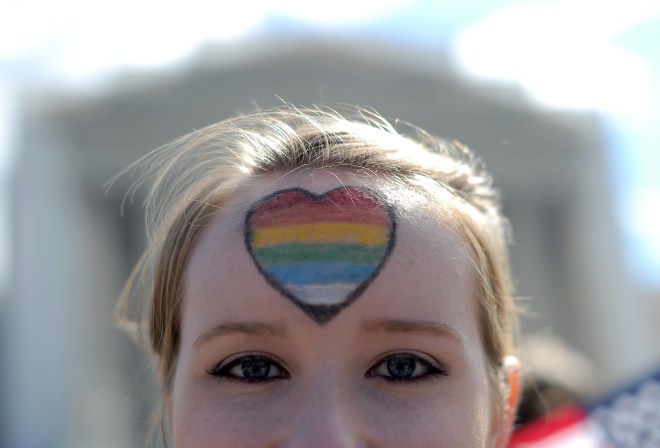
(Photo: A same-sex marriage supporter has her forehead painted with rainbow colors as she joins demonstration in front of the Supreme Court on March 27, 2013 in Washington, DC. By Jewel Samad/Getty.)
Portman, Cheney and Hillary

Molly Redden surveys other politicians who have been pressured on marriage equality by their children:

The three eldest Huntsman sisters—Mary Anne, Liddy, and Abby—all publicly supported same-sex marriage before their father, Jon Huntsman. But they seized on the fact that he endorsed civil unions for gay couples in 2009, Abby told me, and pushed him to go further. “We had conversations about it with my dad all the time,” she said. “He was more than ready to go there.” When he finally wrote an op-ed for the American Conservative in mid-February saying that he supported gay marriage, Abby helped him write it.

Barbara Pierce Bush, one of George W. Bush’s twin daughters, filmed a short spot in favor of a 2011 marriage equality bill in New York State. Her mother, faced with the opportunity to do the same, chickened out, asking that supportive statements she’d made about same-sex marriage be pulled from a pro-marriage-equality ad. (Meanwhile, George W. Bush has given no signals that he’s moving on the issue.) And while being a Republican and marriage equality advocate can be a real bitch—her words—Meghan McCain has pushed the issue tirelessly as a writer and speaker. She apparently won over her mother, who appeared in a pro-same sex marriage photo shoot in 2010; John McCain, however, remains opposed.

For the record, I don’t think this means that these people are somehow only moved by an issue when their own family is affected. Any generational change like this requires parents to be persuaded by children. Portman is not to be criticized for this. He’s a human being. And the most powerful advocate of any idea is another human being you know and love.

Who’s Next?

Kilgore notes that, after a series of conversions, there are only nine Democratic senators who have yet to voice their support for marriage equality:

According to Zack Ford’s count at ThinkProgress, the Democratic senators who have not announced support for marriage equality are Carper, Casey, Donnelly, Heitkamp, Johnson, Landrieu, Manchin, Nelson and Pryor. Johnson announced yesterday he is retiring. So the only Dem senators up in 2014 who are holdouts are Landrieu and Pryor.

Josh Voorhees looks at the senators who have recently come out in favor of equality:

Of the four most recent conversions, Hagan and Warner face reelection next year, while McCaskill and Tester are fresh off winning another six-year term last fall. Hagan’s announcement remains the most politically daring given it was only last year that North Carolina voters easily passed an amendment banning gay marriages and civil unions in the state (although she was already on record on opposing that amendment, so it’s unlikely she’d have been able to avoid the topic on the campaign trail).

Face Of The Day

Supreme Court Hears Arguments On California's Prop 8 And Defense Of Marriage Act

Edith Windsor, 83, acknowledges her supporters as she leaves the Supreme Court on March 27, 2013. The Supreme Court heard oral arguments in the case ‘Edith Schlain Windsor, in Her Capacity as Executor of the Estate of Thea Clara Spyer, Petitioner v. United States,’ which challenges the constitutionality of the Defense of Marriage Act (DOMA), the second case about same-sex marriage this week. By Chip Somodevilla/Getty Images.