Watching The Prop 8 Debate

The New Yorker has done a nice job matching up parts of yesterday’s audio with the only visuals we have, drawings:

This embed is invalid


How EJ Graff answers Scalia’s question:

Scalia is right to ask when, exactly, our marriages became a constitutional right. It became a constitutional right with the combination of Griswold v. Connecticut and Eisenstadt v. Baird, which allowed heterosexuals to snip the link between sex and babies by legalizing contraception, and Lawrence v. Texas, which Scalia rightly predicted would lead directly to same-sex marriage.

It became a constitutional right when thousands upon thousands of us started coming out to our families and having weddings, thereby enlisting cousins and nephews and sisters-in-law and stepfathers and neighbors to our side. It became a constitutional right as we told our myriad stories of love and commitment, of bereaved widowhood or denied military benefits, of unfair treatment and happy families. It became a constitutional right when you all realized you had nothing to fear from me and my gal.

My response?

The answer is surely that these forms of discrimination became unconstitutional once the collective consciousness of Americans recognized that the discrimination was unjust – and sometimes before. When Loving vs Virginia was decided, there was far more popular support for maintaining anti-miscegenation laws than there is now from keeping gays out of legal marriage. And once you’ve opened up equal protection beyond race, your only reliable guide is public consciousness and consensus. This is anathema to Scalia. But a constitution that cannot adapt to the constantly-changing society it regulates is, in the words of Scalia himself, “dead, dead, dead.”

The Agony Of Aleppo

This embed is invalid

The rivers are full of corpses. Increasingly, children tend to the wounded. But even child doctors are getting scarcer:

Three days after we filmed 11-year-old Yussef Mohamed treating an injured soldier he was killed by a government shell. Another young victim of Syria’s descent into civil war.

I know this video is 12 minutes’ long. But the coverage of this story has been so limited in the US, all I can say is that it matters. We may not be able to stop this in any effective way. But we can choose not to look away. And we can better understand the strategy behind the mass murder of so many civilians.

Dissents Of The Day

voting

A reader quotes me:

“The end result would be 17 states with marriage equality recognized by the feds, and the debate could then continue democratically as it should state by state.” So you think rights should be voted on? Since when is it ever a good idea to leave the rights of a minority up to the whims of the majority? As Thomas Jefferson said in his 1st Inaugural: “Bear in mind this sacred principle, that though the will of the majority is in all cases to prevail, that will, to be rightful, must be reasonable; that the minority possess their equal rights, which equal laws must protect, and to violate would be oppression.”

Another writes:

I’ve been following your coverage of the same sex marriage debate fairly closely, and I  must say that I simply don’t understand why you want a gradual approach to the issue. If you believe that same sex marriage is a right, which I do, why in the world do you think that it shouldn’t be given to everyone in EVERY state NOW? Earlier today you quoted MLK, linking, rightly I think, the current push for gay rights to the earlier movement for African American civil rights. I think MLK would be horrified by your gradualism. From his “I Have A Dream” speech:

We have also come to this hallowed spot to remind America of the fierce urgency of Now. This is no time to engage in the luxury of cooling off or to take the tranquilizing drug of gradualism. Now is the time to make real the promises of democracy.

He did not lead a movement that sought to overturn racial discrimination gradually; he wanted an end to segregation and discrimination immediately throughout the country. And I don’t believe that you should demand anything less on gay rights now. More to the point, I don’t believe that same-sex marriage rights should be limited to the coasts for the next decade plus while the rest of the country comes around. I’m glad that the right to marry whomever you please is spreading, but I believe that my gay brother in Alabama, my close lesbian friend in Georgia, and countless others in the South and the middle of the country should have the same right that you enjoy in New York and Massachusetts and DC.

Would a sweeping expansion of same sex marriage across the country cause a backlash? Probably. But is it worth weathering that backlash to ensure that everyone in this country has the right to marry the person they love? Absolutely.

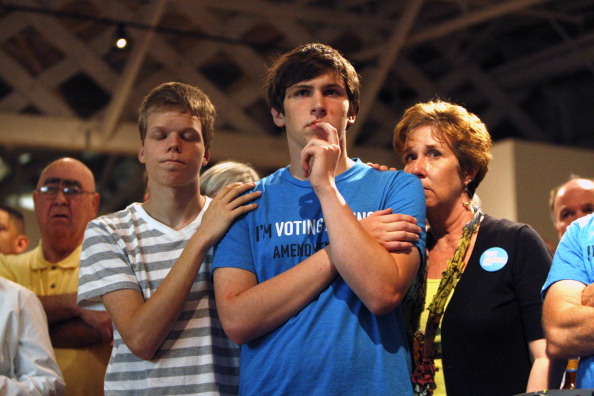
(Photo: Seth Keel, center, is consoled by his boyfriend Ian Chambers, left, and his mother Jill Hinton, during a concession speech during an Amendment One opposition party on Tuesday, May 8, 2012, at The Stockroom in downtown Raleigh, North Carolina. Voters approved the constitutional amendment 61% to 39% to define marriage solely as a union between a man and a woman, and civil unions and potentially other types of domestic partnerships will no longer be recognized legally by the state. By Travis Long/Raleigh News & Observer/MCT via Getty Images.)

Not There Yet

Dale Carpenter’s take-away from yesterday:

I could see a split decision, with three Justices willing to uphold Prop 8 on the merits (Scalia, Thomas, and Alito), at least four Justices (Roberts, Sotomayor, Kagan, and Breyer) and possibly six (add Kennedy and Ginsburg) voting to dismiss the case on some variant of jurisdictional grounds, and/or four willing to strike down Prop 8 on the merits if pushed to do so (Sotomayor, Kagan, Breyer, and Ginsburg). That means that we’ll most likely get a jurisdictional decision, with no clear win or loss for the ultimate cause, a vacated Ninth Circuit decision, and some large questions about the scope and effect of the District Court’s order.

David Boaz dismantles Jim DeMint’s latest burst of unreason here.

Calling A Hotel Home

Homeless Family Placed In Hotel After Eviction

Monica Potts profiles families living in a Denver-area Ramada Inn:

When families in Jefferson County, which encompasses Denver’s western suburbs, lost their home in the recession, they flooded a market that had the lowest number of rental vacancies in ten years. … Unable to find another home and unable to find space in the county’s shelters, which hold fewer than 100 beds, the new poor disappeared into the suburban landscape wherever they could find a roof. With nowhere else to go, they turned the Ramada Inn into an impromptu [single room occupancy].

Charles Pierce fumes:

There is a useful trope still floating around that goes, “If X were happening to middle-class white people, we’d have a revolution.” Well, X is happening to middle-class white people and, I guarantee you, a substantial number of other middle-class white people, no matter how tenuous their own personal economic circumstances are, will blame the people living in the Ramada Inn for what happened to them.

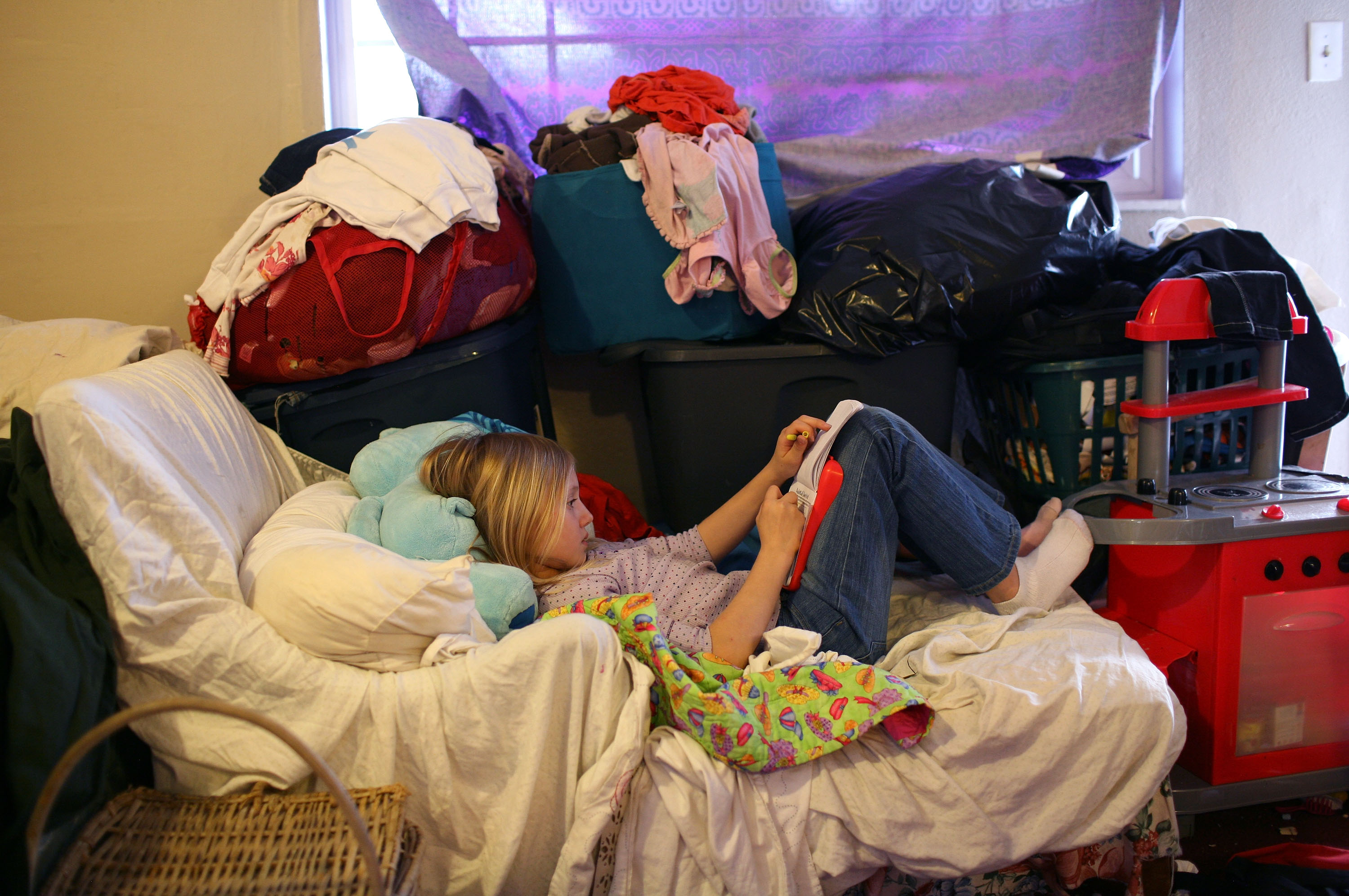
(Photo: Izabella Nance, 7, works on a crossword puzzle in her motel room at the Old Town Inn March 5, 2009 in West Sacramento, California. Brittney Nance and her family were evicted from the house they were renting after her husband, Steve Nance, lost his job. The couple and their three children are living in a budget motel while they save enough money for deposit on a new rental home but are finding it difficult as they pay nearly $1200 a month for the motel room. All five live in a small studio sized room with most of their belongings. By Justin Sullivan/Getty Images)

The Dark Age Of Journalism

warning-1

Finally, a handful of journalists are beginning to tell the truth about the accelerating fusion of journalism with advertising:

One could say, “Oh, magazines. That industry has always been a brothel.” Which is true – although not of the news and public policy segments. And one could say, “Tut tut. TV was whoring itself to audiences long before anyone ever uttered the words ‘click bait.'” Which is also true.

The problem is, it is decreasingly useful to separate these industries by medium. Text, audio and video are rapidly converging. As journalism brands grow to look more like one another, we are seeing unmistakable signs of publishers slouching toward an ethical lowest common denominator.

Anyone who cares deeply about quality, independent journalism should pray for paywalls and other subscription models to take hold. Because in the world of the smart and the desperate, desperate always has the last word.

I was particularly taken by the remarks of this commenter, rebutting the argument that all this change is inevitable. It isn’t. And the change is not a new way for journalism; it’s euthanizing its critical, independent role in a democratic society:

You don’t think it matters that the industry that is responsible for the dissemination of information is increasingly ceding editorial control to PR firms simply to stay afloat?

Democracy is a market in which politicians design policies to get votes. Like any market, it relies on information and signals being reliably transmitted from producer to consumer and vice versa. In a situation where the producer can effectively block the signals that actually their policies are designed simply to siphon wealth from everyone else into the pockets of the rich, what do you think happens to that market? Yep, that’s right, you get a choice between red, blue and yellow versions of producers all with the same agenda.

We are reaching a point at which there will be many fewer actual media companies, and more and more companies which learn to mimic what used to be journalism in order to sell their products. We’ve gone from advertizing supporting journalism to journalism supporting corporate propaganda. At the rate we’re going, as the line between church and state is deliberately blurred by desperate media companies, we may end up with a handful of actual independent online magazines and newspapers and a vast industry of corporate propaganda designed to look like the real thing. If we’re lucky.

(Photo: one of Tom Scott’s Journalism Warning Labels)

Syria’s Spillover Effects

Dexter Filkins checks in on Lebanon, which recently had its Prime Minister resign:

As the civil war in Syria has carried on, it has dragged more and more of Lebanon along with it. Terrified that it will lose its supply lines, Hezbollah has not been content to sit on the sidelines and watch Assad fall; its leaders have been sending fighters into Syria to fight for the Assad regime, actions that are supposed to be secret but that are widely known in Lebanon. That, in turn, has severely strained Hezbollah’s relations with other Lebanese, especially its Sunnis, who accuse Hezbollah of killing their brethren across the border. At least four hundred thousand Syrian refugees, most of them Sunnis, have gathered in Lebanon. The peace has held in Lebanon, but the Sunni anger is swelling.