Veterans Have Never Had It So Good?

Rajiv Srinivasan claims that “our veterans today are in a far better place than they ever have been in any time in American history in terms of their healthcare and education benefits”:

There is a hawk-like manner in which our constituency — regardless of party affiliation — defends military benefits at seemingly all costs. For example, most of our pension and healthcare age targets were set in the 1950s when the life expectancy was significantly lower, as were healthcare costs. Yet to this day, military healthcare premiums haven’t risen since 1995 and a soldier who enlists at age 18 can still receive half his base pay for the rest of his life at age 38, during the prime of his working years.

My point is not necessarily that this is excessive; but simply that we can acknowledge that this country has made significant strides in veteran care where many previous generations of veterans have been forgotten. This certainly doesn’t mean the veteran social contract has been met. But rather, our societal focus must shift to areas that are often unable to be legislated—emotional stability; a sense of ownership in the community; a realization of purpose outside of the service.

Earlier Dish on veteran care here.
Turning Reddit Into TV

The link-sharing community has launched “Explain Like I’m 5”:

The series, an educational comedy, consists of three episodes based on one of Reddit’s user created forums (subreddits) of the same name, where users (Redditors) strive to answer each other’s questions on complex subjects as simply and straightforwardly as possible. “It was more inspired by the content in the thread posts than actually quoting them or using them directly,” Erik Martin, Reddit’s general manager, told The Verge in a phone interview.

Brian Merchant is a fan:

It is, I must say, rather adorable. It warmed even mine own cold, Internet-hardened heart. And it may prove to be a brilliant move for the property—Condé Nast has long prided itself for keeping its hands off the web’s most popular link dump, but it seems to have awoken to the notion there are tons of memes and whole subreddits ripe for the content-mining. Google ponied up the cash for the series (Reddit won’t say how much) and it debuted on YouTube.

They have also recorded episodes on existentialism and the volatility of the stock market.

The Messy House Stigma

Jessica Grose’s theory about why women still do the lion’s share of housecleaning:

I suspect that women are more driven to keep a clean house because they know they—before their male partners—will be judged for having a dirty one.

When I lived with two female roommates, I was much more of a slob. None of us was particularly responsible for the emotional tone of that apartment—no single one of us was more likely to be shunned for the state of our bathroom. But when I got married, the dust bunnies hopping across our floor started seeming like a personal affront. Although it was my husband’s father coming over, I was the one who insisted we clean. I was worried I would be judged for the beef jerky wrappers (on both aesthetic and gustatory grounds), despite the fact that my father-in-law has never once made a peep about the state of our abode. Somewhere lodged within me was the message that it was my responsibility.

What The Hell Just Happened In Cyprus? Ctd

CYPRUS-ECONOMY-FINANCE-EU

The Cypriot legislature has rejected the EU’s bailout deal, which would have levied a tax on savings accounts to prevent bank insolvency. The crisis has taken a Hollywood twist:

It’ll be days before banks open back up, and even then, it’s unclear if Cypriots will be able to make withdrawls. Money is so tight that the British government airlifted 1 million euros, about $1.3 million, to the tiny Mediterranean nation. That’s a lot of cash, so much that the Royal Air Force used its biggest plane, the Voyager, for the task. But this is no charity mission, and that money is not Mother England’s way of giving its one-time protectorate some milk money. (Cyprus is still a member of the Commonwealth.) It’s actually for the British soldiers stationed there, who might otherwise miss a paycheck due to the clusterfuck that is Cypriot financial system right now.

Felix Salmon runs down the options available now. He thinks Cyprus leaving the EU would be the worst result:

If you think that taxing deposits is a bad precedent, just wait until you see what happens when the world learns that a country can leave the eurozone after all.

So a lot of people are going to spend a lot of effort trying to avoid it. And judging by recent European history, some last-minute deal will manage to get cobbled together somehow. But this whole situation is horribly messy — it reminds me of the Argentine political chaos in March 2001, a few months before the country finally defaulted.

The big problem here is that there’s no overarching strategy on the part of the EU. An interviewer from Greek TV asked me yesterday whether the agreement with Cyprus represented an important change in the Eurogroup’s attitude towards peripheral countries. I had to say that it didn’t, just because that would imply that the Eurogroup has an attitude towards peripheral countries, which can change. Instead, it’s all tactic and no strategy, and the tactic is a dreadful one: wait until the last possible minute, and then do whatever’s most politically expedient at the time. It’ll probably work, somehow, in Cyprus. But it won’t work forever.

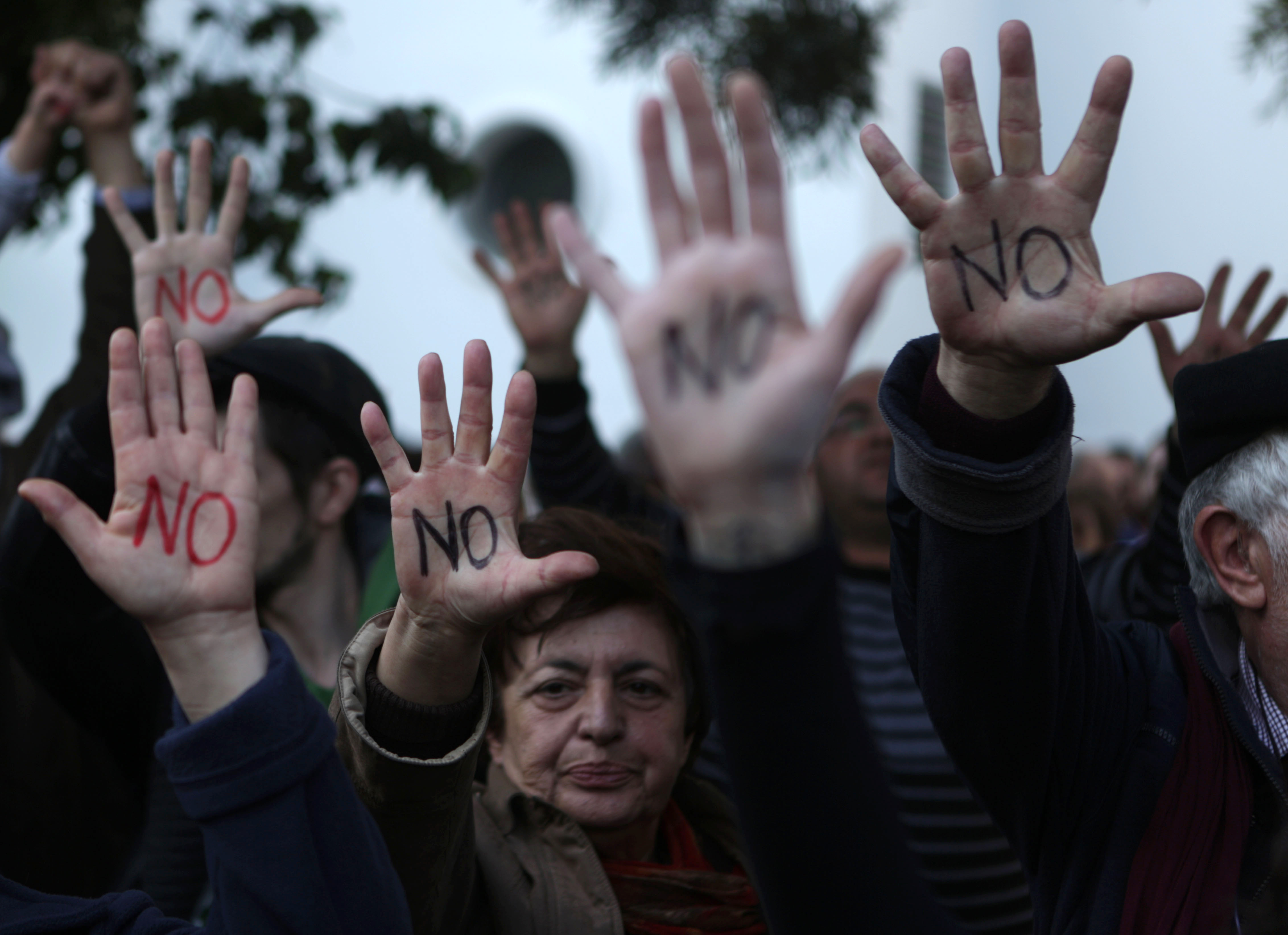
(Photo: Cypriots show their palms reading ‘No’ during a protest against an EU bailout deal outside the parliament in Nicosia on March 18, 2013. By Patrick Baz/AFP/Getty Images)

What Is Rand Paul’s Ceiling?

Nate Cohn doubts the young Senator can win the youth vote:

Despite the big political risks, Paul’s libertarianism doesn’t offer the GOP many benefits in return. While some might interpret his strength among younger voters as a sign that the GOP could benefit from a more libertarian tone, 59 percent of young voters believe that the government “should do more.” Young voters are libertarian on cultural issues, but Paul is pro-life and against gay marriage. Even if young voters were libertarian on economic issues, the GOP’s small-government message attracts many of the same voters persuaded by economic libertarianism, without the cost of questionable ideas like ending the Fed. If Paul’s proposals for restraint abroad and marijuana at home would help Republicans, the party would be best served by attaching those proposals to a more traditional conservative, not Rand Paul.

Larison counters:

 The question isn’t whether a Republican candidate could win the Millennial vote, which seems unrealistic at this point, but whether there is someone in the party who stands a good chance of reducing the gap from 20+ points to something closer to 5 or 10. Would someone like Paul be able to reduce the gap? Maybe. Paul seems to be the only one who is interested in making the effort, and none of his possible 2016 rivals seems to have the first clue what Millennials prefer.

The Daily Wrap

Today on the Dish, Andrew pondered the Iraq War’s impact on American hegemony, glimpsed a second-best salvation for the GOP in activist judges, and was powerless to resist his beagles’ charms. In political coverage, Douthat preferred justice to humility in the Catholic hierarchy and conservatives raced to get their marriage equality endorsements in under the wire. While Chait revised his odds for immigration reform, Joe Romm raged against the idea of “reversible” climate change.

On the 10th anniversary of the Iraq invasion, we wondered whether the Arab Spring would have swept up Iraq, and parsed the current support for the Iraq War. We gathered stories from the ground and reflected upon the human toll of the Iraq War in the FOTD. While Frum and Greenwald debated Halabi, a war criminal tweeted, the US stopped training Iraqi police despite continuing civilian casualties, and Iraqi refugees chose between a rock and a hard place.

In assorted coverage, Orlando Cruz KO’ed expectations for an out boxer, readers took another look at taking names, and Sarah Marshall deflated America’s ego. Freddie deBoer traveled the long road home, Douglas Rushkoff maintained eye contact, and dog runners helped pudgy pooches slim down, while time crunches forced parents to make tough decisions and “Likes” replaced applause. Libraries faced a budget crunch, Evgeny Morozov praised imperfection, and a reader tired of our sponsored content coverage as Derek Thompson delivered some bad news for newspapers.

Elsewhere, vinyl wasn’t worth it for Jason Heller, Rob Thomas filled in the details on the Veronica Mars movie, Ursus Wehrli balanced order and chaos. As we tasted the “pie-in-the-sky”, reputation proved to be an important asset in the sharing economy, and App Academy invested in its students. As we reached back in the archives for our first hathos-filled MHB, recycling mesmerized in today’s MHB, we visited Austria in the VFYW, and arrived at Victoria Station in the VFYW contest.

D.A.

The Iraq War Isn’t Over

Civilian Deaths

For Iraqis:

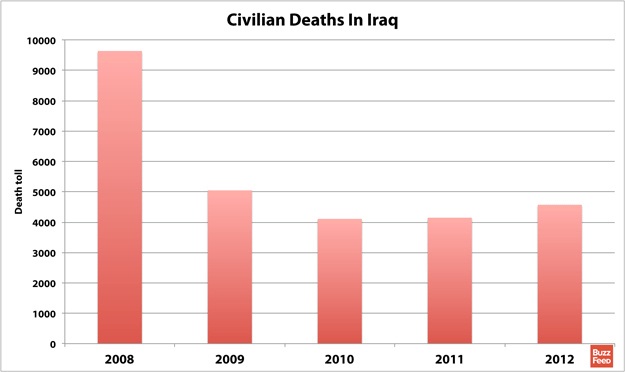
Tuesday marks the ten-year anniversary of the Iraq War, and while that war officially ended for the United States in December of 2011, life for Iraqi civilians — while better than it was at the bloody height of the insurgency — is still something short of peace. 4,573 Iraqi citizens were killed in 2012, up from 4,147 in 2011.

Just today:

Insurgents sent a bloody message on the eve of the 10th anniversary of the U.S.-led invasion, carrying out a wave of bombings across the country Tuesday that killed at least 65 people in the deadliest day in Iraq this year. The nearly 20 attacks, most of them in and around Baghdad, demonstrated in stark terms how dangerously divided Iraq remains more than a year after American troops withdrew. More than 240 people were reported wounded. It was Iraq’s bloodiest day since Sept. 9, when an onslaught of bombings and shootings killed 92.

The End Of Nation Building

Iraqi police are no longer getting US training:

It was the last major non-military project of the war of choice the U.S. launched 10 years ago: an ambitious, expensive post-withdrawal effort to strengthen the Iraqi police. But quietly, the Obama administration has pulled the plug on the much-criticized training program, leaving some 400,000 Iraqi cops without U.S. mentorship.

The State Department confirms to Danger Room that it pulled its final adviser out of the project, called the Police Development Program, on March 1. The move kills the training effort less than two years after the Pentagon handed it over, and after State spent at least $700 million on it.

Iraq War Vantage Points

Nada Bokos, a CIA analyst in the lead-up to the war, recalls how, at “the CIA’s Iraq Branch in the Counterterrorism Center, we didn’t think Saddam had any substantial ties to al-Qaida”:

On Sunday, March 16, 2003, I watched Cheney on “Meet The Press” contradict our assessment publicly. “We know that he [Saddam] has a long-standing relationship with various terrorist groups,” Cheney said, “including the al-Qaeda organization.” I was basically watching Cheney field-test arguments that we would have to anticipate — and rebut — at CIA. Except instead of asking us questions behind closed doors, Cheney was asserting to the public as fact something that we found to be anything but. I found myself yelling at the TV like I was contesting a ref’s blown call in a football game.

Meanwhile, George Packer recalls reporting in Iraq and the friends he had in the country:

Spending a lot of time in Iraq did not make you more keenly aware of America’s larger strategic interests. It rendered you less likely to ask the essential questions about the inception of the war. It was in some ways a narrow, blinkered position. People who had no personal connection to Iraq, however well- or ill-informed, were readier to think that it was all inevitable—that the past decade was a footnote to the main event—that the tenth anniversary of the war would look exactly like this.

Faces Of The Day

People Pay Their Respects To The Country's War Dead At Arlington National Cemetery's Section 60

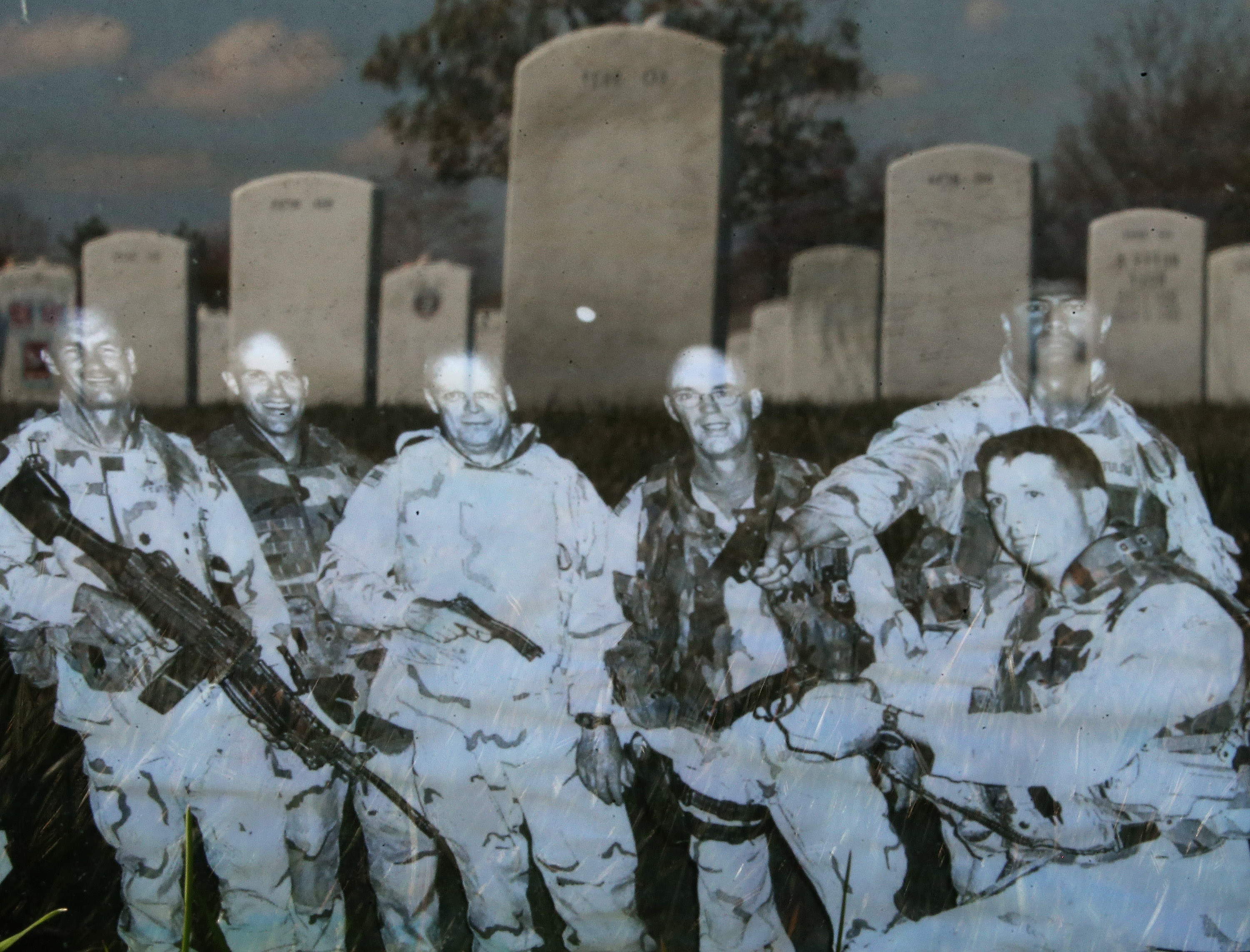
Headstones are reflected in a photograph that is leaning against the headstone for Iraq war casualty U.S. Army Master Sgt. Tulsa Tulaga Tuliau on the 10th anniversary of the beginning of the war in Iraq at Arlington National Cemetery March 19, 2013 in Arlington, Virginia. Tuliau was killed when an improvised explosive device detonated near his Humvee during combat operations near Rustimayah, Iraq on September 26, 2005. By Chip Somodevilla/Getty Images.