Gender Neutral Gaming

A father reprogrammed the vintage game Donkey Kong so his daughter could enjoy playing as a heroine rather than a certain stout, moustached plumber:

Mika happens to be a competent developer, and after a few late-night hours spent hacking the NES version of Nintendo’s classic, he accomplished the role reversal his daughter had wished for. Mario was now under Donkey Kong’s control, and Pauline was tasked with rescuing the plumber in distress.

The Community Katrina Washed Away

Lydia DePillis checks in on the Lower Ninth Ward:

If the Lower Ninth has any chance at becoming a livable community, new people are going to have to move in. But the young people who flooded the city after the waters receded are still finding plenty of room in the hipper neighborhoods, like the Marigny and the Bywater, that retained more of their historic housing stock. And the city seems determined to maintain the Lower Ninth’s structural disadvantage in this regard: Although a 2009 analysis of residential market potential showed that only about 20 percent of the existing demand was for single-family detached homes, that’s how the neighborhood has seen itself, and how it wants to remain. Even when a developer proposed the kind of dense, multifamily project that would attract the kind of amenities everybody says they want, residents howled in protest.

Crowdsourcing On Steroids

This embed is invalid


A reader writes:

Because of your interest in fan-based funding and the independence of the new Dish, I thought you might find the Veronica Mars movie kickstarter project interesting. [Yesterday] morning it had about 30,000 dollars, right now it has about 1.7 million dollars. And this isn’t some indie movie; it’s a real Hollywood production.

As of now it’s passed $2.5 million, in just 24 hours since launch. The project’s goal was $2 million.

Executing Teens

Along with Iran, Saudi Arabia and Sudan, Yemen is one of the only nations that puts minors to death. Tik Root explains the story of Mohammed Haza, who last weekend was executed by firing squad:

In 1999, Mohammed shot an intruder at his home in the central Yemeni city of Tiaz. The man later died of his wounds. Various judges, including the one who made the initial ruling, determined that the killing was self-defense and that Mohammed was underage at the time of the crime. Ignoring these concerns, an appeals court eventually sentenced him to death.

Root notes that “since 1994, Yemen’s penal code has prohibited executing anyone under 18, while at the same time referring those over the age of 15 to adult courts.” However, the country’s 22% birth registration rate means many fall through the cracks to death row:

Experts say that both the age verification process and Yemeni courts are plagued by unprofessionalism, bias, and corruption. According to [a] HRW report, age certification is conducted using questionable methods and inadequately trained staff. “Forensic doctors” rely on wrist or arm x-rays to make their determinations, a technique that has a margin of error of up to two years in either direction. In poverty stricken Yemen, the fact that “bone-age assessments may be influenced by factors including socio-economic background and nutrition,” further compounds concerns over the accuracy of the tests.

Francis: Another Mediocre Novelty?

800px-The_Denial_of_Saint_Peter-Caravaggio_(1610)

That’s Dougherty’s concern – and the possibility that Francis was actually the candidate of the old guard in the Curia:

A contentious reading of Pope Francis’ rise is that Benedict’s enemies have triumphed completely. It is unusual for a one-time rival in a previous election to triumph in a future one. And there is almost no path to Bergoglio’s election without support from curial Italians, combined with a Latin American bloc. Low-level conspiracy theories already flourish in Italy that Benedict’s resignation was the result of a curia determined to undermine his reforms. This election will only intensify that speculation. An older pope who does not know which curial offices and officers need the ax, will be even easier to ignore than Benedict.

The more I read about his role during the dirty war of the 1970s, the queasier I get. This is not an encouraging detail about a priest under Bergoglio’s authority who was convicted of seven homicides and 40 torture sessions:

Father von Wernich was allowed to continue to celebrate Mass in prison, and in 2010, a church official said that “at the appropriate time, von Wernich’s situation will have to be resolved in accordance with canonical law.” But Cardinal Bergoglio never issued a formal apology on behalf of the church, or commented directly on the case, and during his tenure the bishops’ conference was similarly silent.

Only in November 2012, a year after Cardinal Bergoglio had stepped down as head of the bishops’ conference, did the group address the issue of its role during the dictatorship.

We need a Pope unafraid of airing the dirtiest of laundry. But if Bergoglio kept silent in the face of government assassins and torturers, and didn’t de-frock a torturer-murderer priest, why would he be vigilant about child rape? This line from Dougherty struck a chord about the current turbulence:

Benedict’s papacy, which focused on “continuity,” seems like the exception to an epoch of stunning and unsettling change, which—as we know—usually heralds collapse.

(Painting: St Peter’s denial of knowing Jesus, by Caravaggio.)

The Daily Wrap

The Conclave Of Cardinals Have Elected A New Pope To Lead The World's Catholics

Today on the Dish, Andrew greeted the new Pope in real time, and looked forward to seeing his marriage equality learning curve. At home, he flunked Paul Ryan’s budget, called out Republicans for taking obstructionism too far, and knew hope for marijuana legalization as a result of the progress on marriage equality, which continued its advancement down under. Elsewhere, he drew parallels between anti-semitism and homophobia and protested comparisons to Stalin or Hitler.

In politics, we wearied of Paul Ryan’s schtick as Derek Thompson broke down his budget, Kevin McCarthy took points off for Obama’s professorial attitude, and Rand Paul hearkened back to the “big tent” days of the GOP. Max Fisher noted ambiguity in the UN report on a murdered Gaza child, the Falklands opted to stay British. As the Conclave ended, Philip Ball cleared up the Vatican’s smoke coloring as we pulled back the curtain on the seconds before the announcement and rounded up Twitter’s reactions. Meanwhile, Garry Wills looked forward to a Pope who was “ordinary and ignorable” and Massimo Gatto deconstructed the Pope Emeritus’ ruby slippers.

In assorted coverage, Anna Clarke uncovered USPS-enabled discrimination, Robin Hanson lost sleep over couples’ bed arrangements, and Rebecca Willis blacklisted Manet from being an Impressionist. Judy Stone disputed the rationale behind employer drug tests and the drug war slowed, while Ben Goldacre pulled back the curtain on publication bias in pharmaceutical studies. Dr. Suess sucked on the silver screen, Margaret Talbot found practical advice for the trans population on YouTube, and video sites tested out some new revenue models.

We deliberated over juror questions, readers fleshed out the debate on the origins of racism, the UFC fought homophobia, and the internet revealed its charitable side. SubPop held auditions to complete the Postal Service, the VFYW looked down on Hong Kong and we listened in on the Pope’s first address in the FOTD.

D.A.

(Photo by L’Osservatore Romano/Getty Images)

Face Of The Day

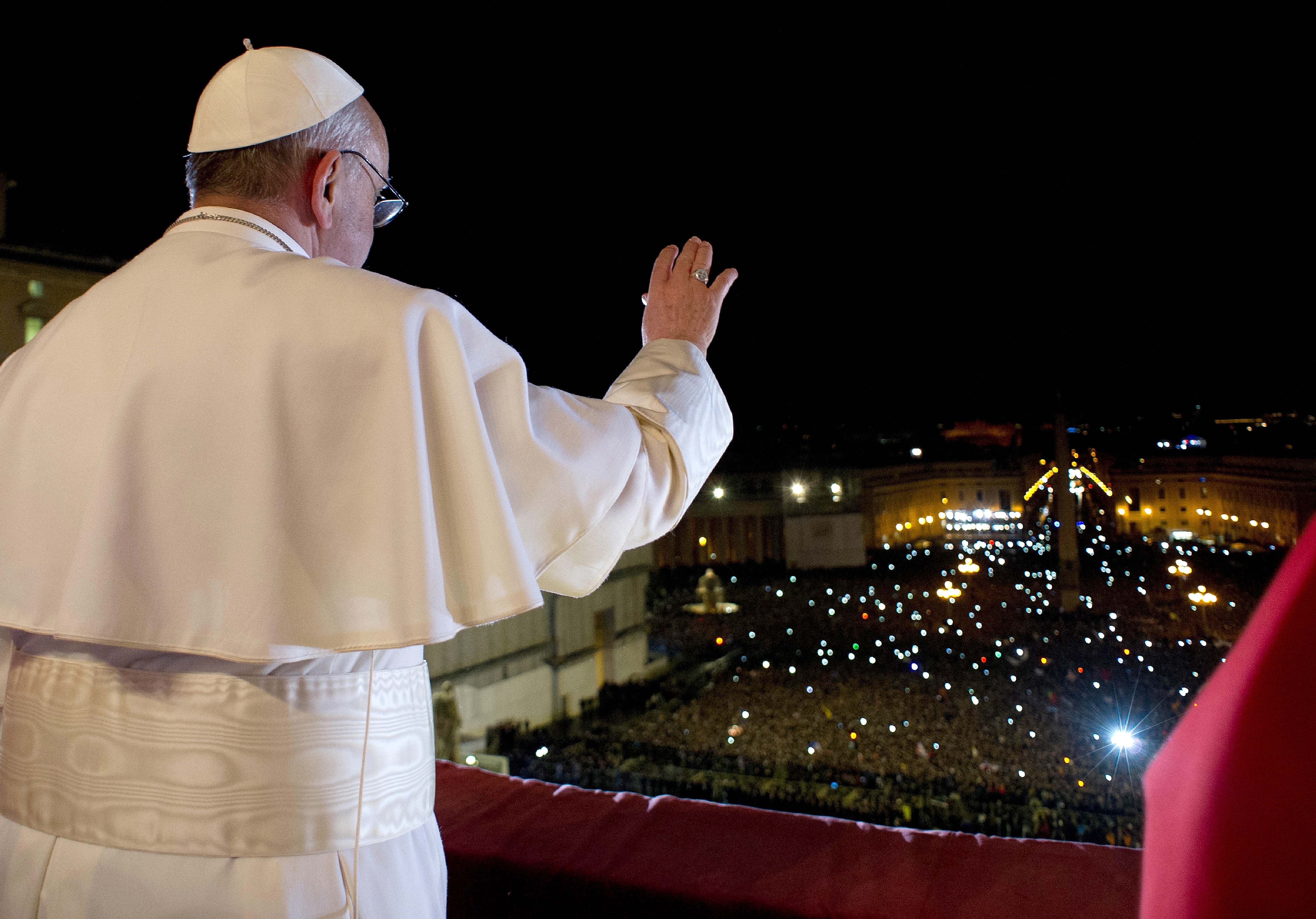
The Conclave Of Cardinals Have Elected A New Pope To Lead The World's Catholics

People stand in St. Peter’s Square as they listen to newly elected Pope Cardinal Jorge Mario Bergoglio of Argentina, who will take the name Pope Francis on March 13, 2013 in Vatican City, Vatican. Cardinal Jorge Mario Bergoglio was elected as the 266th Pontiff and will lead the world’s 1.2 billion Catholics. By Spencer Platt/Getty Images.

Our Collective Sleeping Delusion

Robin Hanson ponders research finding that couples sleep better in separate beds:

Why do we choose to sleep together, and claim that we sleep better that way, when in fact we sleep worse? This seems an obvious example of signaling aided by self-deception. It looks bad to your spouse to want to sleep apart. In the recent movie Hope Springs, sleeping apart is seen as a big sign of an unhealthy relation; most of us have internalized this association. So to be able to send the right sincere signal, we deceive ourselves into thinking we sleep better.

When The Internet Opens Its Wallet

Max Sidorov’s campaign to give bullied bus-monitor Karen Klein a vacation, sparked by a distressing YouTube video, raised $700,000 last year. In response, Seth Stevenson worries that the Internet is misdirecting charitable donations:

Charities have always used poignant, individual stories to play on people’s emotions and open up their wallets. But the idea was that you should donate to the charity, not to the individual sad sack with the most heart-wrenching video or the most prominent link on Reddit. Likewise, political and social causes have long used the specter of bad behavior to lobby for new laws and policies—but rarely to round up an angry mob that tracks down specific offenders. It seems we’ve decided it’s more fun (and much easier) to collaborate in making one person happy or unhappy than it is to work together to change the underlying context.

Felix Salmon counters:

[Surely] the real reason why so much money flowed to Karen Klein [was that the] people who gave her money felt really good about doing so. They weren’t trying to change the world, they were just making themselves feel good, and helping out a victim of bullying at the same time. It’s the story of most successful Kickstarter campaigns, too: the feeling-good-about-giving part is much more important than the ostensible commercial transaction.

The internet is the greatest disintermediating force the world has ever known, and it’s going to have to change the way that charities campaign — at least with respect to the ones who like to use individual stories as a way of raising collective funds. That worked much better when you couldn’t help the individual directly. Nowadays, as a charity, you either need to give people the belief that they are helping the individual (as Kiva does, for example). Otherwise, you risk being disintermediated entirely by the likes of Max Sidorov.