
Charting The Unknown

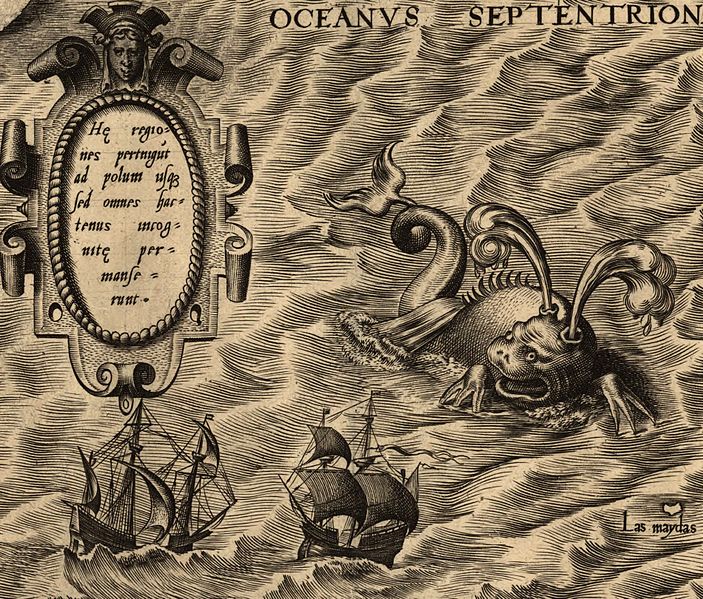
Frank Jacobs debunks the myth that “mapmakers of yore, frustrated by the world beyond their ken, marked the blank spaces on their maps with the legend Here be monsters”:

It’s a pleasing hypothesis. For to label a cartographic vacuum with the stuff of nightmares solves two problems at once. It explains why the fringes of contemporary knowledge didn’t match the outer limits of the entire world – monsters were keeping us out! And, by being equal parts fantastic and horrific, those monsters symbolise our fascination with the known unknowns just out of our reach. What keeps us out is also what draws us in.

Unfortunately, the theory suffers from an all too common trifecta: it’s neat, plausible and wrong. No map dating from the Age of Discovery (or before) is emblazoned with the slogan Here be monsters, nor with its variant: Here be dragons. At least not in English, or any other vernacular language. But there is one (if only just one) example in Latin: h[i]c sunt dracones, placed over the eastern shore of what is barely recognisable as Asia, on the so-called Lenox Globe.

(Above: Detail of the map Americae 1562 (the Americas) by Diego Gutiérrez and Hieronymus Cock (engraver) via LoC and Wikimedia)

Peak Satellite?

Tim De Chant fears the likelihood that “sometime in 2016, for the first time in over 50 years, the U.S. won’t have a polar orbiting weather satellite”:

Currently, the U.S. has 24 Earth-observing satellites in orbit. Their missions are widely varied, covering more than just weather. There are satellites that monitor tropical rainfall (key in our understanding and prediction of hurricanes), keep an eye on land-use change (important for urban development and habitat conservation), and observe the ice sheets that cover Greenland and Antarctica (an indicator of sea level rise). …

In 2007, the National Research Council issued a report on the overall status of the U.S. Earth observation system. What they found wasn’t promising.

“The extraordinary U.S. foundation of global observations is at great risk,” they wrote. Today, more than five years later, the situation hasn’t improved. Of the 15 satellite missions reviewed for that report, “I believe two of those are actually on track,” says Dennis Lettenmaier, a hydrogeologist at the University of Washington and member of the NRC committee. Budget shortfalls have jeopardized nearly every program. “Notionally, at least, there was enough money to do all those things, so it wasn’t supposed to be about there not being enough money,” he says. That changed when the economy soured. When NASA started running short on funds, it went looking for programs to cut. Satellites that were many years away from launch got the ax. “NASA basically just dropped them all,” Lettenmaier says.

The Weekend Wrap

screen-shot-2013-03-05-at-6-04-25-pm

This weekend on the Dish, we provided our usual eclectic coverage of religious, books, and cultural coverage. In matter of faith, doubt, and philosophy, Conor Williams pondered the miracles that come from love, J.L. Wall examined an exception to the decline of the religious novel, and Kerry Howley imagined a conversation between Schopenhauer and Joel Osteen. Christian Wiman ruminated on the parables of Jesus, Jerry Saltz praised Piero della Francesca’s artistic vision, and Stefany Anne Golberg visited the Shaker Heritage Society in New York. Alan Jacobs remembered Walker Percy’s Lost in the Cosmos, readers debated arguments against polygamy, Robert Zarestksy argued that Isaiah Berlin thought like a fox, and Kiley Hamlin asked why we judge each other.

In literary coverage, W.H. Auden critiqued the gluttony of reading, Amit Majmudar found that contemporary fiction fears sentimentality, and John Fram described writing a bad book for money. John Jeremiah Sullivan movingly recalled his father’s love, Jason Resnikoff traced the evolution of the word “indescribable,” and Carmel Lobello provided a Scrabble player’s dream. Claire Barliant highlighted a library of unborrowed books, Cynthia L. Haven explored how Polish-born poet Czesław Miłosz’s became a Californian, and Mark Levine mused on what former Poet Laureate Philip Levine was like in the seminar room. Mark Oppenheimer gave tips on freelancing in the digital age, Julian Baggini held that encyclopedias always were relics, and Simon Akam mourned the distinctly American transformation of a butchered pun. Read Saturday’s poem here and Sunday’s here.

In assorted news and views, Maggie Koerth-Baker compared gun violence to climate change, Marc Tracy showed where Moneyball is bankrupt, and Chip Scanlan emphasized the power of silence for journalists conducting interviews. There proved to be an app for STD diagnosis, Conner Habib critiqued Alain de Botton’s views on sex, and Rose Surnow detailed the market for paying for cuddling. Marina Galperina gazed at webcam performers who pose like they’re in a classic work of art, Niall Connolly delved into the history and enduring popularity of “voguing,” Tom Junod looked back at Dazed and Confused, and Megan Garber cast a light on moon towers.

MHBs here and here, FOTDs here and here, VFYWs here and here, and the latest window contest here.

– M.S.

(Image: Detail of Piero della Francesca’s “Virgin and Child Enthroned with Four Angels”)
“Technology Breeds Crime”

Frank Abagnale, the former conman played by Leonardo DiCaprio in Catch Me If You Can and who now works as a security consultant, explains how forgery has only gotten easier:

To forge a cheque 50 years ago, you needed a Heidelberg printed press, you had to be a skilled printer, know how to do colour separations, negatives, type-setting… those presses were 90 feet long and 18 feet high. There was a lot of work involved in creating a cheque. Today, you open a laptop.

If you are going to forge a British Airways cheque, you go to their website, capture the corporate logo and put it in the top right corner. You then put a jet taking off in the background and make a really fancy four-colour cheque in 15 minutes on your computer. You then go down to an office supply store, buy security cheque paper and put it in your colour printer.

Fifty years ago, information was hard to come by. When you created a cheque you had no way of knowing where in reality British Airways’ bank was, who was authorised to sign their cheques and you didn’t know their account number. Today you can call any corporation in the world and tell them you are getting ready to wire them money and they will tell you the bank, the wiring number, the account number. You can then ask for a copy of the annual report and on page three are the signatures of the chairman of the board, the CEO and the treasurer. It’s all on white glossy paper with black ink — scanner ready art. You then just print it onto the cheque.

Hearing With Your Eyes

Rachel Kolb, who reads lips, describes it as an “inherently tenuous mode of communication”:

Even the most skilled lipreaders in English, I have read, can discern an average of 30 percent of what is being said. I believe this figure to be true. There are people with whom I catch almost every word—people I know well, or who take care to speak at a reasonable rate, or whose faces are just easier on the eyes (for lack of a better phrase). But there are also people whom I cannot understand at all. On average, 30 percent is a reasonable number.

But 30 percent is also rather unreasonable. How does one have a meaningful conversation at 30 percent? It is like functioning at 30 percent of normal oxygen, or eating 30 percent of recommended calories—possible to subsist, but difficult to feel at your best and all but impossible to excel. Often I stick with contained discussion topics because they maximize the number of words I will understand. They make the conversation feel safe. “How are you?” “How’s school?” “Did you have a nice night?” Because I can anticipate that the other person will say “Fine, how are you?” or “Good,” I am at lower risk for communication failure.

Update from a reader:

There was a lot that I recognized in Kolb’s article.  I am deaf but lipread very well.  My husband and daughter are hearing and probably 95% of my interactions are with hearing people. My lipreading (which I call speechreading, which seems more accurate since I’m looking at much more than lips) is good enough that people frequently don’t realize that I’m deaf.

The main thing I wanted to comment on re: Kolb’s article is her seeming rejection of the Deaf community.  Why not be bi-cultural?

I have found that I need regular injections of effortless communication via sign language to be a truly effective speech reader.  Speechreading requires a level of relaxation and ease, and before I learned ASL and became part of the Deaf culture/ community, I would regularly have meltdowns where the sheer EFFORT got to me.  Where I became just too frustrated to sit back and let it all wash over me and make sense of it all.  Once I became fluent in ASL and started regularly socializing with other Deaf people, those meltdowns stopped.  Interacting with Deaf people became my recharging time, and I then was a much more effective speech reader overall.

Now I have my daily interactions (spoken, with occasional ASL) with my husband and daughter; my daughter’s (hearing) friends; my (hearing) friends and extended (hearing) community; and all of the regular everyday interactions we must have with grocery clerks and the like.  And then I also meet up with Deaf friends at regular intervals to just relax and communicate without a second thought.

I understand her fear that you must choose one community or the other, but that’s not the case.  With her background, she must know ASL.  There are plenty of interesting Deaf people out there, and she doesn’t need to limit herself to frustrating, effortful interactions.  By the same token, she doesn’t have to limit herself to the Deaf community.  You can be a part of both worlds.

What Is The Internet Worth?

The Economist explains why it’s hard to calculate:

Measuring the economic impact of all the ways the internet has changed people’s lives is devilishly difficult because so much of it has no price. It is easier to quantify the losses Wikipedia has inflicted on encyclopedia publishers than the benefits it has generated for users … This problem is an old one in economics. GDP measures monetary transactions, not welfare. Consider someone who would pay $50 for the latest Harry Potter novel but only has to pay $20. The $30 difference represents a non-monetary benefit called “consumer surplus”. The amount of internet activity that actually shows up in GDP—Google’s ad sales, for example—significantly understates its contribution to welfare by excluding the consumer surplus that accrues to Google’s users.

Some researchers tried to measure it using leisure time as an indicator:

Erik Brynjolfsson and Joo Hee Oh of the Massachusetts Institute of Technology note that between 2002 and 2011, the amount of leisure time Americans spent on the internet rose from 3 to 5.8 hours per week. The authors conclude that in so far as consumers must have valued their time on the internet more than the alternatives, this increase must reflect a growing consumer surplus from the internet, which they value at $564 billion in 2011, or $2,600 per user. Had this growth in surplus been included in GDP, it would have raised economic growth since 2002 by 0.39 percentage points on average.

But What If Three People Love Each Other?

This embed is invalid


A reader writes:

I have a question for you and I hope you will consider your answer and its implications carefully. I have read quite a bit of testimony and argument on the same-sex marriage issue, and so often when the concept of bigamy or polygamy is equated with it, same-sex marriage proponents balk. The argument that challengers try to expose is that if people should be able to choose their spouse, why can’t free consenting adults choose a plural marriage?

Naturally, a far higher percentage of the American public opposes and would never practice polygamy than oppose or would never practice same-sex marriage, officially or unofficially. But same-sex marriage proponents never have a good answer for that challenge, instead relying on “it’s not the same issue”.

I’m not suggesting that same-sex marriage proponents do not have the better side of the argument already; they do. I’m not surprised that out of expediency proponents choose to deflect the inconvenient polygamy argument. Replacing “one man and one woman” with “one person and another person” as a definition of marriage or union is not really much of an improvement in perfecting our laws. It’s just as legitimate to attack the “one” portion of that rule as the “man” and “woman” portion. Any arbitrary definition restricting a routine contractual arrangement among consenting parties restricts everyone’s freedom. But note also that in most states polygamy is a CRIME by itself, not just an unrecognized contractual arrangement.

So consider this scenario: A gay man marries a woman because they want to have and raise a child in wedlock and because, apart from sexual reasons, they see marriage as a comfortable life arrangement. Then the gay man also wants to make a life commitment with another man and his wife is not opposed. Should that man have to divorce his wife of many years simply to be married to someone else? In other words, if all three parties consent to the union of the three of them, shouldn’t they have that right AND have that union receive equal protection under the law?

Note that under this scenario, if they did form that consensual union, they would have broken the law and be exposed to criminal sanctions. My overall point is that you can’t logically support same-sex marriage and oppose consensual polygamy.

Another offers an excellent counterpoint:

There is a solid reason for restricting marriage to two-partner relationships, and it’s not simply that it flies in the face of monogamy or that it might leave some men without wives.  The reason is based in civil law.  If a husband were to have more than one wife, how would it be determined which wife would receive the federal benefits associated with marriage?  Who gets the Social Security survivor benefits, for example?  How are pension benefits distributed?

Even if one were to say these benefits should be distributed equally among the wives, there are still aspects of marriage that cannot be effectively shared.  Say for example that the husband in our imaginary polygamous marriage has contracted a rare disease that has incapacitated him and for which there are two or more treatment options, with different associated risks and potential outcomes.  Who gets to decide which path to follow if two wives disagree?

Where Design And Dogma Meet

design-dogma

Stefany Anne Golberg visited the Shaker Heritage Society in Colonie, New York. She mulls one of their inventions – the flat-bottom broom:

Flattening the broom’s bottom seems like a small innovation. But before this the broom was little more than a bundle of twigs that moved dirt around the house. Flattening the bottom made the broom so efficient it’s hard to now imagine the broom any other way. The flat-bottom of the broom is as integral to the act of sweeping as it was integral to Shaker doctrine. Sweeping encapsulated the alienation of household labor. It was a solitary act, somewhat futile, usually done by women. So the Shakers turned the broom, literally and figuratively, upside down. By streamlining and improving daily chores, for both men and women, work could be more joyful, more expressive of the community. Leisure time would be increased. Cleanliness (next to godliness) was improved. The Shakers could be more self-sufficient, thus further insulated from the political and religious pressures of the outside world. In other words, to create new ways of living, the Shakers had to create new ways of working.

(Photo of brooms at the Hancock Shaker Village in Hancock, Massachusetts, by Flickr user dbking)

Filling Silence With Scoops

Chip Scanlan emphasizes the power of silence for journalists conducting interviews:

The 1976 movie “All the President’s Men” focuses on two Washington Post reporters investigating corruption in the Nixon White House. At one point, Bob Woodward, played by Robert Redford, is on the phone with a Nixon fundraiser. Woodward asks how his $25,000 check ended up in the Watergate money trail. It’s a dangerous question, and you see Woodward ask it and then remain silent for several agonizing moments, until the man on the other end of the phone finally blurts out incriminating information.

The moral:  Shut your mouth. Wait. People hate silence and rush to fill it. Ask your question. Let them talk. If you have to, count to 10. Make eye contact, smile, nod, but don’t speak. You’ll be amazed at the riches that follow. “Silence opens the door to hearing dialogue, rare and valuable in breaking stories,” says Brady Dennis of The Washington Post.

A Poem For Sunday

liquor

“Poetics” by August Kleinzahler:

I have loved the air outside Shop-Rite Liquor
on summer evenings
better than the Marin hills at dusk
lavender and gold
stretching miles to the sea.

At the junction, up from the synagogue
a weeknight, necessarily
and with my father—
a sale on German beer.

Air full of living dust:
bus exhaust, airborne grains of pizza crust
wounded crystals
appearing, disappearing
among streetlights and unsuccessful neon.

(From Sleeping It Off in Rapid City: Poems, New and Selected © 2008 by August Kleinzahler. Reprinted by permission of Farrar, Straus, and Giroux. Photo by Flickr user guy schmidt)