Faces Of The Day

Claire O’Neill admires the work of British photographer Bill Brandt, who captured “World War II-era social documentary, street scenes in England, where he lived, editorial portraits, [and] abstract female nudes”:

The Museum of Modern Art has taken on the task of distilling Brandt’s lifetime oeuvre into a comprehensive retrospective, which opened Wednesday. The exhibition’s catalog describes him as “the artist who defined the potential of photographic modernism in England for much of the twentieth century.” In that catalog, in the chapter about portraiture, Brandt himself is quoted as having said: “The photographer has to wait until something between dreaming and action occurs in the expression of the face.”

(Northumbrian Miner at His Evening Meal, 1937 by Bill Brandt. Courtesy of The Museum of Modern Art, John Parkinson III Fund. © 2012 Bill Brandt Archive Ltd.)
Going Soft On Sex

Conner Habib criticizes Alain de Botton’s How To Think More about Sex for “bemoaning all the problems that come with sex and sexual freedom”:

For de Botton, sex is not a giving capacity; it isn’t valuable in and of itself, and it doesn’t add to life through its own merits. Instead, sex is a means to an end. One end is procreation. The other — more thoroughly examined in the book — is the temporary relief from loneliness. The result is — and Alain de Botton doesn’t seem to have noticed this — that How To Think More about Sex is a book that is far more about loneliness and alienation than about sex itself. Because alienation is the book’s main concern, and because de Botton tells us that we all feel alienated by sex, the book is permeated by and never quite shakes the feeling of Original Sin; in other words, he assumes we all start from a fallen place, since we are born into loneliness. He asks us to reconsider our alienation, and believes that it can even be seen as a triumph. But his way of going about this is by demonizing sex.

When he writes about the ordeal of impotence, for instance, he tries to convince us that impotence is “an achievement of the ethical imagination,” because it excuses us from the imposition of initiating sex. Impotence is a gift of civilization that can stop us from giving in to the “free flow of animal impulses.”

Previous Dish on de Botton’s book here.

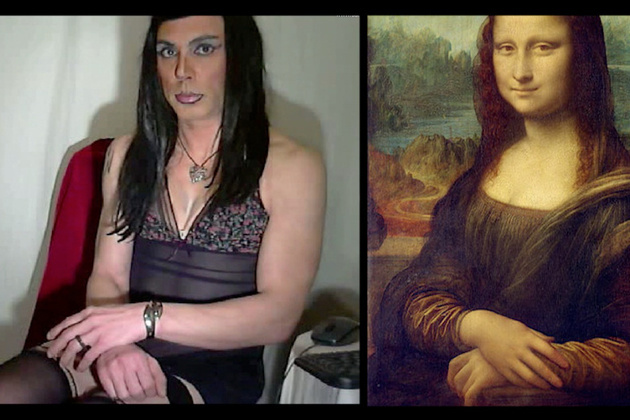
Webcamming The Classics

venus

Marina Galperina highlights a poignant (and unembeddable) NSFW project, Webcam Venus, from Addie Wagenknecht and Pablo Garcia, who asked webcam performers to pose like works of classic art:

The work brilliantly accentuates and blurs the line between pornography and fine art, “lowbrow” internet phenomena and culture of the elite, erotic fantasy then and erotic fantasy now. Hardcore is hardcore, but let’s not pretend that Egon Schiele never told his models, “bend over and touch yourself.”

There’s An App For That?

STD Triage is a particularly novel advancement in medical apps:

If you’re worried that one-night stand left you with more than just an empty bed in the morning, you can fire up the STD Triage app, snap one overview photo and one close-up, include a few notes about your symptoms, and send a report off to iDoc24′s dermatologists, who are currently practicing in different parts of Europe. The first doctor to respond will evaluate your symptoms and photos and send back a few possible diagnoses and recommendations for treatment. You pay $10 to get their answer. “We give about 70 percent of the patients pharmaceutical treatment advice,” says Börve. “But we also always tell them if their symptoms don’t change or get worse to see their doctor.” The other 30 percent are told to see a doctor, and the app shows a map of STD clinics nearby.

Previous Dish on medical apps here.

Mental Health Break

Dan Colman applauds:

When Leonard Cohen wrote “Hallelujah” back in 1984, the world didn’t take immediate notice. And the song only began its journey toward becoming a classic when it was later recorded by John Cale and Jeff Buckley. Now, it’s one of the more widely covered songs out there. Rufus Wainwright, k.d. lang, Bono, Willie Nelson, Alexandra Burke – they’ve all paid homage to the song. So have lesser-known musicians too, like this street musician, Petr Spatina, who recorded a version with crystal glass. Be sure to watch it all the way through.

Writing A Bad Book For The Money

John Fram abandoned his “very gay, very avant-garde debut novel” to write a werewolf romance thriller:

I have learned the meaning of self-loathing and it is writing a sentence that you know is sloppy and starting another sentence. I feel like I am harming not just my (future) reputation but also harming the English language as a whole. I am contributing to the white noise of publishing. I am pouring out more words to distract readers from the things that are actually worth reading. What am I doing? Some day I will die. Some day every day reader will die and I will have on my last conscience the fact that there are readers out there who wasted what little time they had on this awful book.

And the fruits of that soul-sucking labor?

The Last of His Kind made me $42.49 in the U.S. (and India) and $20.80 in Europe. After the $19.99 for my virtual book tour (which led to no noticeable increase in sales), the book made me a total of $43.40. If we are to estimate that I worked on LoHK for at least 10 hours a week—and doesn’t that seem low? Don’t you remember, John, those mornings when you would wake up at 5:00 a.m. and work until you had to go to your day job at one in the afternoon?—that means I invested about 240 hours into the book. According to the free market, I am worth $0.18 an hour as a writer.

A Poem For Saturday

meadowlark

“Meadowlark Country” by Amy Clampitt:

Speaking of the skylark in a New England classroom—
nonbird, upward-twirler, Old World hyperbole—
I thought how the likewise ground-nesting
Western meadowlark, rather than soar unsupported
out over the cattle range at daybreak, takes up
its post on a fencepost. I heard them out there,
once, by the hundreds, one after another:
a liquid millennium arising from the still
eastward-looking venue of the dark—

like the still-evolving venue of the young, the faces
eastward-looking, bright with a mute,
estranged, ancestral puzzlement.

(From The Collected Poems of Amy Clampitt © 1997 by the Estate of Amy Clampitt. Used by permission of Alfred A. Knopf, a division of Random House, Inc. Photo by Flickr user Dominic Sherony)

What Novelists Leave Out

Amit Majmudar argues that, in contemporary literature, nothing is held back as much as sentimentality:

“Good” artists instinctively exclude elements of what they know to be part of real life if they feel it may be “bad,” artistically speaking. The prudish Victorians regarded sexual language in fiction that way. Charles Dickens, obviously, knew that people have sex, but he would never spell such a thing out in a novel, even though he knew dirty language was part of real life (especially among the lowlifes he sometimes wrote about, like Fagin and company). It was “bad.” It may have been “bad” in a different sense—as in indecent, improper—but it was “bad” artistically as well, in that his sense of his audience kept him from being too graphic or explicit, either in scenes or dialogue. Meanwhile, Dickens was at liberty to engineer a scene in which, say, a tuberculosis-stricken orphan switches places at the guillotine with a virginal seamstress…Today, you can put all sorts of explicit sexual references in fiction, and the average critic won’t chide you for immorality or indecency; sentimentality will get you panned every time.

The critical temperament of an age shapes an age’s creativity not just in the supply-demand way, motivating writers to produce what is praised and valued by critics and readers. The critical temperament actually blocks off areas of life to create a portrayal of the world that fits its idea of the world. So a prudish era like the Victorian will target immorality—and a cynical or ironic era like ours will target sentimentality.

Show Us Your Tittles

And other obscure words you probably don’t know:

Relatedly, Carmel Lobello compiled a list of “uncommon or obsolete words that we think may have died early.” For example:

Lunting: Walking while smoking a pipe

Groak: To silently watch someone while they are eating, hoping to be invited to join them

Jirble: To pour out (a liquid) with an unsteady hand: as, he jirbles out a dram

Quote For The Day

“Again, while it is a great blessing that a man no longer has to be rich in order to enjoy the masterpieces of the past, for paperbacks, first-rate color reproductions, and stereo-phonograph records have made them available to all but the very poor, this ease of access, if misused — and we do misuse it — can become a curse. We are all of us tempted to read more books, look at more pictures, listen to more music than we can possibly absorb, and the result of such gluttony is not a cultured mind but a consuming one; what it reads, looks at, listens to is immediately forgotten, leaving no more traces behind than yesterday’s newspaper,” – W.H. Auden, Secondary Worlds (1967).