Gambling On Syria

The US is giving $60 million [NYT], but not weapons, to the Syrian rebels just as the EU is set to provide military training. Jon Lee Anderson views this as a calculated bet:

Syria’s diverse armed opposition is too engaged in war with the Syrian regime to be truly assessed, monitored, and somehow “made safe” in exchange for U.S. support, and that seems unlikely to change soon. This is a hydra-headed war, a bit like a high-stakes poker game, and the best Washington can likely do is take a deep breath and sit down at the table to try its hand, hoping to make some profit by doing so and not lose the family farm in the process.

Paul Mutter also checks in on Syria:

According to Syria Comment’s Joshua Landis, one of the main reasons the US government continues to demonstrate great reticence in openly backing any rebel force diplomatically, let alone militarily is because “the sort of received wisdom in Washington today is that Syria is going to become Somalia because all of these groups are going to end up in an extended civil conflict once they get through Assad.” Landis explains that “the main groups from the Islamic front [rivals to the FSA, and likely the preferential recipients of aid from the Gulf states] are trying to find [more] common ground, and these Salafists are willing to push aside Jahbat al-Nusra” despite a burst of initial support for it when it was designated a terrorist organization by the US. The foreign fighters’ haughty disdain for their Syrian brothers-in-arms, it appears, are playing a large part in the increasingly negative response to their presence in Syria.

The Beltway calculus is, he says, that “to pick an effective winner in Syria, you need to be able to pick an Islamist” and the White House does not think it can sell anyone in Syria that way to justify a more direct role.

Michael Weiss argues the policy of “non-lethal” aid an illusion, since smaller states and regional allies are already funding the opposition, possibly with America’s backing:

[Weapons] have apparently been purchased by Saudi princes and delivered to Jordan for distribution into Daraa, though they’ve lately been popping up all over the country, including, alas, in the hands of Ahrar al-Sham. Croatian newspaper Jutarnji List, reported that four cargo shipments were documented on December 14th and 23rd, January 6th, and February 18th. That fine publication even went to the trouble of producing a photograph of a Jordanian transport aircraft sitting on the tarmac at Zagreb’s Pleso airport. Croatia’s foreign ministry vehemently denies conducting business with any sheikhs for the purpose of any Arab revolution, yet sources tell me that prior to authorizing these arms sales, Croatian diplomats toured Washington asking US officials for their permission to do exactly that. They evidently got it. So, in effect, Washington is already involved in exactly the kind of “militarization” of the opposition it publicly claims to abjure as it still holds out for a “peaceful” transition of power.

Alia Brahimi takes this strategy as confirmation that the US has given up on any chance for negotiation or diplomacy with Russia and China:

Perhaps the US now fears that the radical Islamist flag is rising in Syria, with or without US intervention. Thus, the attempt to shore up more democratically inclined/”US-friendly” fighters is as much aimed at ensuring that US interests are secured in a proxy war, as it is at toppling Assad. This, more than anything, represents a firm acknowledgement that the future of Syria will be settled on the battlefield.

(Video: EA captions: “Residents of al-Raqqa topple statue of late President Hafez al-Assad on Monday”)

Covering Up Climate Change, Ctd

Drum searches for lessons over the shuttering of the NYT’s Green blog and Environment desk:

Obviously the Times editors are going to come in for plenty of criticism over this, and that’s fine. They deserve it. But let’s face it: the reason they did this is almost certainly that the blog wasn’t getting much traffic (and, therefore, not generating much advertising revenue). So a more constructive question is: Why do readers—even the well-educated, left-leaning readers of the Times—find environmental news so boring? Is it because we all write about it badly? Is it something inherent in the subject itself? Is it because most people think we don’t really have any big environmental problems anymore aside from climate change? Or is it because it’s just such a damn bummer to read endlessly about all the stuff we should stop doing because, somehow, it will end up destroying a rain forest somewhere?

Who Is Making The Argument Matters

Partisan Cues

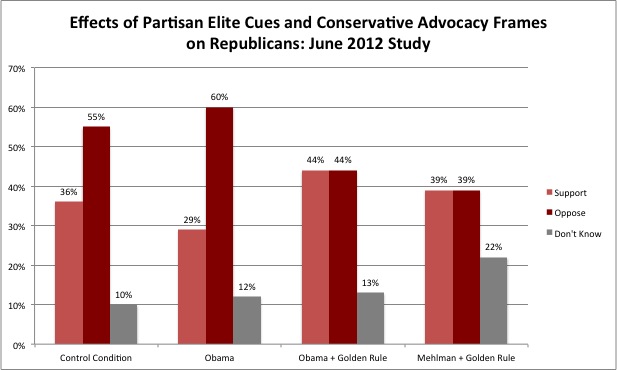
Ashley Koning and David Redlawsk studied whether the conservative case for marriage equality is effective. They “find no evidence that the conservative advocacy frames alone influence Republican support at the mass level.” But:

When we show that [former RNC Chairman Ken] Mehlman supports same-sex marriage and does so for reasons consistent with his partisanship and ideology, it appears to give Republicans “permission” to be more inclined to do the same – or to at least considerably reduce their opposition in exchange for increased indecision. This result suggests that as more Republican elites “come out” in support for the issue, their personal endorsements of the “conservative case” for same-sex marriage may have the potential to change the game among Republicans, who are otherwise lagging greatly as overall attitudes rapidly move in a more supportive direction. As Mehlman states, he fights for same-sex marriage “because [he is] a conservativ[e], not in spite of it.” And that’s likely to be the key to attitude change among conservatives as Mehlman and others lead by example to show that the values underlying same-sex marriage are ones that their fellow partisans already have.

The Dish Model, Ctd

NPR ran a five minute segment on it on All Things Considered yesterday. Check it out. And don’t forget to subscribe [tinypass_offer text=”here”]. It’s total access to the Dish, infinite scroll, infinite search, every post in full. The alternative is a lot of advertizing, less white space, and less time for us to focus on the journalism rather than the business. The more you look around the web and its economic models, the more I feel convinced that we need to start a movement in the direction of actual subscriptions for actual blogazines/blogs/news-sites. The Internet offered us a million different voices. But if they are all tied to corporate dollars, sponsored content and desperation for pageviews, they may all end up in the same noisy, confusing commercial maelstrom. We’re trying to jump-start a saner, calmer, stabler model. And we cannot do it without you.

A nickel a day. Help sustain quality online journalism the old-fashioned way. Subscribe [tinypass_offer text=”here”].

Green Shoots On The Right, Ctd

Spring Snowstorm Hits Northern Scotland

In the wake of Douthat’s column [NYT] noting that “today’s Republicans are more likely to channel Ayn Rand than Thomas Aquinas,” Matt K. Lewis pushes back against the trend of radical individualism, which he sees more as a result of reflexive anti-Obamaism than of sound moral reasoning:

Our founders believed self-imposed responsibility was essential to the preservation of freedom. An immoral majority will eventually discover that they can vote “themselves largess from the public treasury.” But a nation’s elite must also be moral — which is to say, not greedy. As Ed Morrissey noted, “Any society with a large class of exploited poor will have no end of social difficulties and instability, the costs of which in a properly ordered system would far exceed the assistance extended.” That’s the invisible hand at work.

Compassion isn’t just right. It’s also a matter of self-preservation.

But is compassion the right word? Why not “one-nation” conservatism instead? Or inclusive conservatism? Morrissey maintains that the pragmatism is the key to the conservative future:

Instead of reaching back to the past and “compassionate conservatism,” though, Republicans need to start considering an advent of practical conservatism. In practical terms, the entitlement programs we have cannot be dismantled, as Randian purists would prefer. Medicare, Medicaid, and Social Security are too popular for repeal, and more importantly, deliver a level of living standards on which millions of Americans rely — standards that would plummet in these programs’ absence. Instead of denying that, practical conservatism would embrace that — because on the trajectory of current policy, these programs will utterly collapse at some point. There is, after all, nothing compassionate about a default, or about sticking succeeding generations with the bill for benefits we enjoy in the present. …

The “Catholic center” still exists, ready to be claimed. Republicans need to learn from the past, and the present, to grasp that opportunity.

Justin Green cautions:

Morrissey should be careful to distinguish between Social Security, which only needs modest reforms, and Medicare/Medicaid, which will bring serious problems in the medium term. The GOP will give itself credibility by shoring up the program that works and seriously attempting to fix the one that doesn’t.

(Photo: Getty Images)

“Sleep Well My Love”

A deeply poignant letter from WWII veteran Brian Keith to Dave, a fellow soldier he fell in love with stationed in North Africa in 1943. These are the blurred memories of an all-American affair in wartime:

Two lieutenants who were smart enough to know the score, but not smart enough to realize that we wanted to be alone. A screwball piano player — competition — miserable days and lonely nights. The cold, windy night we crawled through the window of a GI theatre and fell asleep on a cot backstage, locked in each other’s arms — the shock when we awoke and realized that miraculously we hadn’t been discovered. A fast drive to a cliff above the sea — pictures taken, and a stop amid the purple grapes and cool leaves of a vineyard.

Later this month, I’ve been honored with an invite to West Point’s gay group. There are times when I cannot truly comprehend the change my generation has lived through. So instead of comprehending, I’m just trying to live it – for all those who, for centuries, couldn’t. And for all those in the future who are already looking back and not understanding any of it. We fought for their insouciance. It hurts at times that they do not know or remember or stop to think what it was like in decades past. But that obliviousness is also a sign of greater and greater integration.

Which was the point, wasn’t it?

“Never Forget That They Were All Wrong” Ctd

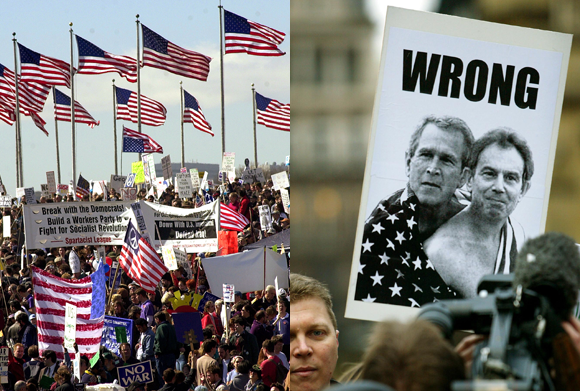
iraq-protest

A reader writes:

Thanks for posting Ta-Nehisi’s statement “they were all wrong”. That post and the subsequent one from Dreher revealed something to me. I was at the protests they talk about in NY and another in DC. Such reductionism makes me sad, that reasonable voices remember those protests only for its wacky elements when the anti-war movement was both larger and more reasonable than either of these two recall. It’s the equivalent of saying that all the Tea Partiers are racist because of the handful that shout and wave ridiculous signs. Sure, loud radicals exist, but the media didn’t tune out the whole Tea Party just because of a few wacky looking chanters.

Unfortunately, the same can’t be said about the anti-war protesters. I attended the protest in DC in March 2003. I remember being told there were 100,000 people, and while that’s likely an over-estimate, it was still the largest anti-war protest since the Vietnam War. It was on the weekend but wasn’t covered in the WaPo until the following Wednesday, and it wasn’t covered in the NYT at all. It wasn’t just that “every ‘sensible’ and ‘serious’ person,” as TNC put it, were wrong, but there was no public airing of the reasonable sentiment that the anti-war people were trying to express. We were all radicals, dismissed for the 0.01% carrying “Free Mumia” signs.

A participant at another rally that year:

In January of 2003 I marched on Washington along with several hundred thousand others, all of us already convinced that initiating a war of choice against Iraq was the wrong thing to do. What struck me most about that crowd was how normal, how middle-America most of the people looked. There we some drum-circlers, to be sure, but the vast majority of the people there looked like anyone’s cousins, siblings, grandparents. So when TNC reminds us that “the radicals with their drum circles and their wild hair were right”, I would remind him that many, many “sensible” and “serious” Americans were right, too. We just weren’t listened to.

Another:

Contrary to what Dreher says about those of us against the invasion of Iraq, I never carried a sign equating Bush with Hitler, I was never hysterical, and I was never impossible to talk with UNTIL I was called a treasonous bitch who hated, or at the very least, failed to support, our troops.

No, I was sick to my stomach because I knew what the result would be. And, all I could say was that because I did support our troops, I did not support an invasion of Iraq. I simply could not accept our men and women getting blown up on a pretext of WMD.

Several more excellent emails below:

What always amazed me about the run-up to the Iraq War was the context in which it was discussed. The question was always, “What if they have WMDs?” in which case the inevitable answer would be, “We have to go in.” At no point did I hear any pundit or advisor or government official or anyone anywhere say, “The question isnt’ whether or not they have them. They do. The question is, Does that mean attacking is the best option?”

Frankly, I, like everyone else, assumed Saddam had them, but at no point did that ever make me assume that he was likely to use them. And I don’t think myself particularly astute. Nor was I emotionally detached. I lived in New York during 9-11 and I remember that day vividly. But none of that ever made me conclude that it was likely that he would use those weapons. Thus, I thought the way Bush was allowed to frame the debate around does he/does he not have them enabled him to rush to war with fewer detractors. I’m not saying he wouldn’t have gone to war. I’m just saying the way he framed the debate made it easier.

Another:

The Iraq War still confounds me. In the run-up to the war, I was 17. We invaded one month before my 18th birthday. And yet I knew, 100%, that it was the wrong thing to do to invade Iraq. How could I be right and so many adults be wrong?

It wasn’t a question of knowledge. I had access to much less information than those who were in power. It was a question of values. As much as I was castigated at this time for this view, I believe strongly that military force should only be used when absolutely necessary to defend oneself. I also believed strongly in deference to international authority, not American unilateralism. I knew there were no weapons of mass destruction, because the U.N. inspectors said there were none, and it was the height of arrogance to denounce their conclusions and insist there were WMD anyway.

At the time, I was a pretty lone voice against the war, except for my dad and my 11th grade history teacher. It’s strange to me that public opinion came around to my view, but only after the war took longer than anticipated. No one seemed to consider that invading a country that hadn’t done anything was inherently wrong AND ALSO anti-Christian. I’m a devout Orthodox Christian, and what I hated most about the Bush years was how the Christian message of love and forgiveness was co-opted into something ugly.

Another:

I live in Philadelphia. During the period leading up to the Iraq War, our local paper, the Philadelphia Inquirer, was owned by The McClatchy Company. We had a whole separate narrative of the war build-up. Thanks to McClatchy, we knew that the Judith Miller et al. line from the New York Times was wrong, that there was no threat from WMDs, that the war was a huge mistake. Reading both papers each day, the Inquirer and the Times, was an out-of -body experience because the reporting was 180 degrees different. From Wikipedia:

In 2008, McClatchy’s bureau chief in Washington, D.C., John Walcott, was the first recipient of the I.F. Stone Medal for Journalistic Independence, awarded by the Nieman Foundation for Journalism. In accepting the award, Walcott commented on McClatchy’s reporting during the period preceding the Iraq War:

Why, in a nutshell, was our reporting different from so much other reporting? One important reason was that we sought out the dissidents, and we listened to them, instead of serving as stenographers to high-ranking [Bush administration] officials and Iraqi exiles.

Another:

At the time, there were many incredibly well-reasoned voices that were simply drowned out by the drumbeats of war. For example, a group of 33 of the country’s leading international relation scholars all paid for a full page op-ed out of their own pocket to make the simple case that the war was a mistake. And perhaps we should all take time to remember how prophetic Barack Obama’s words on the topic were at the time. And by now, I think it’s pretty clear that President Obama is hardly a radical.

The decision to invade Iraq shouldn’t be remembered as a debate between the experts and the radicals. It was just the case that many of those in favor of war wanted to characterize the opposition as radicals, regardless of the truth.

One more:

Thank you for your recent series on the build up to the Iraq War, 10 years on. I lived in NYC from 1995 to 2006. Those of us who lived and worked in the city remember the horrors of 9/11, the way it profoundly affected every aspect of life in the city. Like a lot of young people in NYC, I moved the from middle America, and also remember the strange solemnity with which outsiders would ask me about 9/11. I didn’t work in the WTC, and wasn’t a first responder. I just dealt with the aftermath – a few scary things I actually saw that day, but more importantly, the real fear in the city then. Anthrax, the plane crash in the Rockaways, armed soldiers in the subways and streets, the terror scares and the terror drills.

We in NYC felt that we were a target, and we were because of the real and symbolic importance of the city. But in 2002 and early 2003, in the buildup to the Iraq War, I was furious that we were a target illuminated and made bigger by a cynical push for war – that the invasion was inevitable, that the US participation in international diplomacy was a ruse because we were steamrolling all opposition. Middle America was told in part that this was a revenge war for 9/11, and why should the GOP care about blowback attacks on New York – we didn’t vote for Bush anyhow.

The justification for war seemed transparently ridiculous, WMD and 9/11 were deliberately conflated, and the GOP and media sycophants were calling for some sort of patriotic national unity, hardening back to Kate Smith and WW2. I was furious at this unjustifiable war, based on unproven assertions and obvious propaganda, which was somehow tied to what we went through in NYC? No thank you.

So I protested, like many hundreds of thousands of my fellow New Yorkers. We were derided as fellow travelers, anti-Semites. ANSWER, a group I knew nothing about nor cared nothing for, were held up as proof that we were fools and suckers. The rage I felt at the Bush administration – and their Democratic Party enablers – was inextinguishable.

My anger now still burns. The war was evil and stupid, yet there are plenty of powerful people who somehow seen to want to justify it still. My own post 9/11 fears, shared by many of us, were probably unwarranted. Nothing significant happened in NYC, partly through good intelligence and international cooperation, partly through luck, and partly, tragically, through softer targets elsewhere in the world. The things I didn’t foresee were so much worse: the devastation of Iraq from the insurgency, the loss of life and limb of so many American troops. Protesting that war was the morally right thing for me to do, even if it was just to show the rest of America that here were some New Yorkers who didn’t want the US to fight that war for their sakes.

(Top left photo: Thousands of demonstrators gather near the Washington Monument before marching to the White House on March 15, 2003 in Washington, DC. A large anti-war demonstration organized by International ANSWER was held in protest of the possible war with Iraq. By Stefan Zaklin/Getty Images. Top right photo: A protester holds aloft a placard picturing a shirtless British Prime Minister Tony Blair (R) wrapped in a US flag in the arms of US President George Bush, 21 January 2003, during a protest outside the Houses of Parliament in London to lobby MP against a possible US and British-led war in Iraq. By Adrian Dennis/AFP/Getty Images)

Rand Paul’s Very Long, Totally Awesome Speech: Reax

Friedersdorf provides cliff notes on Paul’s filibuster. Jordan Bloom live-blogged the 13-hour speech. Can someone get him some help? Beinart applauds Paul:

Unlike those Washington conservatives who only object to centralized government power when the government is trying to regulate business or help the poor, Paul is reminding his fellow Republicans that the power to wage war is the most dangerous government power of all. He’s reminding Democrats that no president can be trusted with the unrestrained power to kill, not even one you like. And he’s reminding Americans that senators can still stand on principle, even when it costs them their sleep. Not bad for one day’s, and night’s, work.

Ackerman adds:

It would be foolish to presume that Paul’s moment in the spotlight heralds a new Senate willingness to roll back the expanses of the post-9/11 security apparatus. Rubio, for instance, stopped short of endorsing any of Paul’s substantive criticisms of the war. But Paul did manage to shift what political scientists call the Overton Window — the acceptable center of gravity of discussion. Rep. Mike Rogers (R-Michigan), the hawkish chairman of the House intelligence committee, put out a statement that started out subliminally criticizing Paul but ultimately backing him on the central point.

Michael Crowley thinks Paul’s worries about killing Americans on US soil are overblown:

[I]t’s worth remembering how narrow, and perhaps even academic this issue is. Only one American–the now-deceased Anwar al-Awlaki–has been targeted for drone execution. Three others have been what they call “collateral damage” in attacks on other targets. None of those actions occurred on American soil. Rand Paul has every right to press this question. But it’s almost an academic exercise when compared to the more relevant questions of how reliant we should be on drone strikes against non-U.S. citizens in foreign countries. And it has very little do with John Brennan’s ability to run the CIA, an agency that is quite clearly barred from operating within the United States

Matt Steinglass wishes other civil liberties and executive power issues would get their time in the spotlight:

For Americans to get exercised about government abuse of power, the victims have to be Americans in America, and it’s not enough to picture the lumbering behemoth of cloddish national-security organisations damaging people’s lives for reasons of venality or bureaucratic inertia. We need to imagine a ruthless, deliberate conspiracy, and the crime has to be murder. This distracts us from, as Sinead O’Connor would put it, fighting the real evil. The real domestic victims of our growing police state are namesakes condemned to eternal no-fly lists and whistleblowers subjected to techniques of psychic disintegration. The victims of drone strikes are mainly residents of Afghanistan, Pakistan, Yemen and Somalia. There are unlikely to be any victims of drone strikes in America, but we shouldn’t let that distract us from fighting the steady encroachment of the anti-terrorist security state, here and abroad.

Kleiman is confused:

If Holder were claiming for the President the authority to decide, in non-exigent circumstances where arrest is practicable, that some citizen is merely better dead, that would be an outrage. (Though I’ve got a little list … .) But can someone point me to where Holder has made such a claim? So I’m trying to figure out the jump from “people – even citizens – making war on the United States may lawfully be killed by military means, even inside the country” to “The President claims the right to kill anyone he dislikes.”

Josh Marshall praises the talking filibuster:

[It] is significantly self-correcting. A minority that is doing constant filibusters of everything — and by that I mean, visible filibusters — is going to take a public hit pretty quickly. There’s also a cost just in terms exertion for the senators in question. How often do you want to do these marathons? You’re really only going to do it if it’s very important to you and you feel like it’s very important to your constituents as well. And if that’s the case then I think there’s a good to be served by letting one or more likely a group of Senators slow things down in just this way.

Avlon is on the same page:

Paul deserves respect for advancing a serious, principled, substantive debate. This is what filibusters are supposed to be—and one of the lessons learned might be the necessity of real filibuster reform that requires senators to take the floor rather than hiding behind the passing of paper. In addition, it has provided a happy reminder that the word filibuster itself is a Dutch word for “pirate”—fitting because there is something renegade about the capturing of the Senate floor in such a solitary stand.

Jonathan Bernstein pushes back:

I have nothing at all against what Rand Paul is doing today, and I think it’s fine that Senate rules allow it. But don’t be fooled into thinking that this is the Senate at its best; the Senate at it’s best is doing real legislating and real oversight, not making speeches. And to the extent that Paul is reinforcing the romantic notion that talking filibusters are some sort of ideal, it’s hurting the prospects for solid, effective Senate reform. Which remains, alas, badly needed.

Sarah Binder sees other negatives:

[L]et’s not lose sight of the target of Rand’s filibuster: The head of the CIA. Although the chief spook is not technically in the president’s cabinet, the position certainly falls within the ranks of nominations that have typically been protected from filibusters. Granted, that norm was trampled with the Hagel filibuster for Secretary of Defense. But rather than seeing the potential upside of today’s talking filibuster, I can’t help but see the downside: In an age of intense policy and political differences between the parties, no corner of Senate business is immune to filibusters.

And Kornacki thinks Paul is more politically formidable than his father:

It’s unclear where the intraparty ceiling is for Rand Paul, but it’s undoubtedly higher than it was for Ron Paul. This says something about the GOP and its Obama-era embrace of anti-government absolutism. But it says just as much about Paul’s desire to play a consequential role in his party and in national politics. If he does run for president in 2016, he’ll be taken a lot more seriously than his father was, and for good reason.

Let Us Now Praise Rand Paul

Senators Discuss Balanced Budget Amendment

For two things, basically: for insisting that utterly unchecked executive power be confronted where the Founders meant it to be: in the Congress. After Eric Holder’s pathetic, insulting, incoherent and downright stupid letter, the only option was to grind Brennan’s nomination to a halt. On a matter like the president’s insistence that he have the right to kill another US citizen without due process, this is what the filibuster is for, even if it prevents nothing in the end. It’s designed to register dissent strong enough to merit a physical endurance worthy of the cause.

You have a fundamental constitutional issue here; and a clear Senate response that helps highlight and bring to broader public attention the scandal that is Eric Holder’s contempt for core constitutional values, laced with derision and sarcasm and ignorance. Take it away, Conor!

Any thinking person can see that Holder’s letter is non-responsive, evasive, and deliberately manipulative in its sly reassurances, right down to the rhetorically powerful but substantively nonsensical invocation of 9/11. (Being more subtle about it than Rudy Giuliani doesn’t make it right.) To credulously accept this sort of response, on an issue as important as this one, is behavior unfit for any citizen of a free country, where safeguarding the rule of law is a civic responsibility.

This is a righteous cause for a classic filibuster. And this is a core political issue. Now look at the GOP’s current routine use of the filibuster the same day:

[Mitch McConnell] blocked the nomination of Caitlin Halligan to the D.C. circuit court by filing a piece of paper.

The first is a mark of conviction; the second of cynicism. I prefer the freshman’s approach to the Minority Leader’s myself.

(Photo: U.S. Sen. Rand Paul (R-KY) listens as colleagues speak during a press conference by Republican senators on a balanced budget amendment at the U.S. Capitol June 29, 2011 in Washington, DC. Republicans are urging their Democratic colleagues to support a balanced budget amendment. By Win McNamee/Getty Images.)