How Did Cheney Get Iraq So Wrong?

Frum’s answer:

How could they have been so cocksure in the face of so much contrary opinion from seemingly well qualified people? They had good reason for their self-confidence. Over the previous quarter century, the group around George W. Bush – famously nick-named “the Vulcans” – had joined battles over the Cold War and over the Gulf War against many of the same people who would later oppose the Iraq War. The Vulcans had proved right; their opponents had proved wrong.

And those of us who followed and supported the Vulcans fully expected that history would repeat itself in Iraq: boldness would win.

I remember vividly a conversation I had in my gym’s locker room with a Republican friend just before the war started. I had begun to worry – with the Turks balking, Rumsfeld posturing and the war plan nebulous and quite possibly under-manned. His response was simple (paraphrasing from memory): our military is so great these days they can accomplish anything. That tells you the impact of the post-Cold War triumphalism that had slowly replaced strategic thinking in our late-imperial phase. For my part, I remember reassuring a non-political skeptic the following (same paraphrase) on the eve of the war: You wait. We’ll find bunkers crammed with chemical weapons and possibly nuclear weapons that could end up in al Qaeda’s hands and in our cities. I promise you they’re there.

I trusted Colin Powell. I’d never seen a military intervention fail, except in Somalia. I’d seen new democracies spring from barren soil in post-Soviet Europe. Saddam was a monster and could never be removed peacefully. I became convinced by my own conviction. Here is my late April 2003 post clinging to the idea that Saddam and al Qaeda were in contact (a shady story in the Sunday Telegraph):

We know that Saddam had elaborate designs to make chemical and biological weapons. No serious person doubts that – although whether he tried to destroy evidence before the war, how extensive it was, what exactly it amounted to, are still questions in search of good answers. (But we’re getting warmer, it seems.) So what does a free country do when confronted with an enemy state, with WMDs, that we strongly suspect is in league with terrorists like al Qaeda, but cannot prove without invading? It’s tough. My view is that, after 9/11, we have little option but to launch a pre-emptive strike and hope for retroactive justification. But I understand why people demand proof before such action. This new finding – and I bet there will be more like it – strengthens my position, I think. The threat was not the weapons as such; it was the regime, its capacity to make and use such weapons and its potential or actual alliance with al Qaeda.

Looking back, the key phrase in the following sentence is pretty clear:

My view is that, after 9/11, we have little option but to launch a pre-emptive strike and hope for retroactive justification.

I’m not excusing my confirmation bias, my broad brush against opponents of the war (although I refuse to accept that they were all skeptical of the WMDs’ existence; many were just anti-Bush and anti-war), or my violation of just war doctrine. But the truth is: 9/11 worked. It terrorized me and it terrorized a lot of people. When you are in a state of terror, the odds of future terror seem much greater and the risks of inaction graver. Yes, I was excitable and over-reacted. The only solace is that I was a pillar of calm and prudence compared with the people running the country.

Must The GOP Change?

TO GO WITH AFP STORY By Otto Bakano -- T

Frank Rich (remember him?) thinks the status quo is likely to persist:

These days, the GOP has no new Reagan as yet waiting in the wings. It faces a demographic cliff that may take far longer than two years to scale, no matter how many blind mountain climbers deliver pep talks—especially if Republicans in Congress can’t even mobilize on immigration reform this year. But the party controls far more of American governance, federal and local, than it did after Goldwater’s defeat …  A cosmetic face-lift would fool no one. Its current leaders are more faithful than ever—more faithful than Nixon, Ford, and both George Bushes ever were—to the principles laid down by Goldwater and Reagan. In the end, the party’s best bet may be not to do something but just stand there until history cycles back to it once more.

PM Carpenter counters:

The least convincing aspect of Rich’s scenario is that in the immediate post-Goldwater era the GOP had essentially the same American electorate to cycle back to in four years or 16. Today’s GOP won’t. By 2020, even Texas will have turned a rather deep purple through browning, and other one-time GOP strongholds, such as Virginia and even Georgia, are bluing, demographically, by the day.

And it does seem to me that on immigration reform and marriage equality, there has been an adjustment to public opinion and demographic reality.

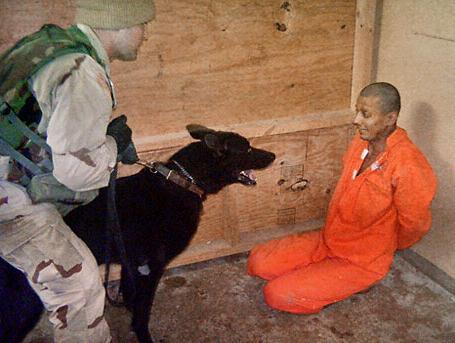
Release The Torture Report!

Abu_Ghraib_56

Jane Mayer notes that the government has produced the definitive report on the Bush-Cheney torture program. It was a long process to get to the truth and past the CIA’s self-serving bullshit, so effectively conveyed to Mark Boal and Kathryn Bigelow. You and I paid for this:

Working often seven days a week in catacomb-like basement offices, they have culled through some six million pages of nearly indecipherable internal intelligence documents in search of the truth. From this research, they have compiled a six-thousand-plus-page report with something like thirty-five thousand footnotes. To make it more digestible, they have boiled this down to a three-hundred-page summary…

More to the point, in his hearings for CIA director, John Brennan, formerly ambiguous about the war crimes of some of his CIA colleagues, we discovered this:

Brennan had claimed publicly in 2007 that the C.I.A.’s treatment of terror suspects had produced valuable intelligence, and perhaps even saved lives. But after reading the report, Brennan acknowledged under oath that he now doubts this.

In response to a question from Saxby Chambliss, the Republican vice-chairman of the Intelligence Committee, Brennan said, “I must tell you, Senator, that reading this report from the committee raises questions about the information that I was given at the time, the impression I had at the time.”

The only logical inference from this is that the CIA lied to Congress and even perhaps the Bush-Cheney administration about the nature of the evidence produced by using the torture methods of the Gestapo and the Chinese Communists.

But, of course, the CIA is somehow a separate government all itself and now is busy redacting, editing and presumably pruning the Senate Intelligence Committee’s report. Senator Feinstein gave the CIA six months to finish the job. The deadline has passed.

It seems to me that the pro-torture case or the anti-torture case would be greatly enhanced by a deeper and better understanding of what actually happened under the rogue vice-presidency of Dick Cheney. There will never be a more definitive report than this one. There should be no question that it be released immediately – to us, the general public, so we may better understand the scale, nature and results of torture, and thereby assess the public defenses of the torturers.

Why is this report not available yet? Why is the CIA allowed to see, let alone, doctor the Senate Intelligence Committee report? And where is the president? He promised us a more transparent presidency. Yet on the gravest matter imaginable – the evidence that senior government officials authorized war crimes – a comprehensive report is still bottled up and kept from us. The US has already taken a huge blow to its moral standing because of the psychotic ego of Dick Cheney. The only way to try to reverse this is at least to be honest about what this country did. And the principles it betrayed. And the bad intelligence it may or may not have acquired.

Why, in other words, have we been debating a movie “based on true events” when we have the truth to debate … and our own government is withholding it from us?

Busting The Daily Caller

This is a pretty definitive exposure of a total fabrication in the Daily Caller. But along with its sister propaganda sheet, Breitbart, what defines this new form of hackery is not that it makes shit up, but that even when it is busted, it keeps up the Baghdad Bob routine. Its imperviousness to truth even when it is presented with it. The detachment from reality – the strongest feature of today’s degenerate Republicanism – is embedded in its own fabricated media. That’s partly why they were living in never-never-land even on election day last November. Another piece detailing the Caller being a party to a con, concludes, after ABC News destroyed the lies:

The ABC News story isn’t a game changer; it’s a game ender.

Not if you live in what’s left of Tucker Carlson’s brain.

Quote For The Day

“Chávez is very close to the climactic moment when he will announce that he is a poached egg and that he requires a very large piece of buttered toast so that he can lie down and take a soothing nap,” – Hitch, eerily republished today in Slate.

It’s a hilarious piece. He doesn’t mean to take down Sean Penn – but what are you gonna do?

Congress Evolves On Marriage

DOMAs

We recently marveled at the dramatic shift in public opinion in California over the past few decades. Ian Thompson notes a similar shift in Congress:

On Friday, 212 members of Congress, 172 representatives and 40 senators, filed an historic brief in support of Edie Windsor’s challenge to the discriminatory and unconstitutional so-called Defense of Marriage Act’s (DOMA) exclusion of married same-sex couples from marriage-based federal responsibilities and rights. This amicus brief stands in dramatic contrast to the overwhelming support for DOMA when it was passed by Congress in 1996. DOMA passed the House with 342 votes (with 67 members voting no) and the Senate with 85 votes (14 members voted no). Obviously much has changed in the years since DOMA was signed into law by President Clinton, most notably the fact that gay people could not marry anywhere in the country (or world) in 1996 and today can do so in nine states as well as the District of Columbia.

And how did marriage equality affect civil marriage and divorce in the last decade as it became reality in several states and was on the front-burner of public discussion? Between 2000 and 2009, divorce rates dropped nationally from 4.1 percent to 3.4 percent. The lowest divorce rate? 2.2 percent – in the state that first legislated marriage equality, Massachusetts. This argument is essentially over as an empirical and civil matter.

(Above: President of the Senate Joe Biden, Senate Majority Leader Harry Reid, and Senate Judiciary Chairman Pat Leahy all voted in favor of DOMA in 1996. The latter just two signed the aforementioned amicus brief while Biden is now an outspoken supporter of marriage equality. Portraits taken from their respective Wiki pages.)

Illustrating Inequality

The above video on wealth inequality in America, despite being a few months old, has suddenly racked up millions of new views this week. Daniel Luzer attempts to understand the public’s poor estimation of the existing wealth distribution:

Part of the reason Americans don’t understand class might be because true inequity is so excessive that we might well characterize it as unfathomable. That’s because one cannot show in any reasonable format, whether in print or on the web, both the wide distribution of people who have virtually no money, and the amount of money possessed by a very, very small portion of rich people.

Steven Mazie questions the video’s conclusion that “all we need to do is wake up and realize that the reality in this country is not at all what we think it is”:

If the 2.2 million+ viewers of the video were to expand, Gangnam style, to all 311 million Americans and everyone finally saw with clear eyes just how vast wealth inequality truly is in their country, things would change, right? Maybe, but I seriously doubt it. Even leaving aside Republican resistance to measures that could dent the wealth gap, many Americans would likely remain opposed to measures that would be necessary to seriously address the problem.

What Iraq Can Teach Us

UNs

Millman hopes we won’t repeat our mistakes:

From the end of the Gulf War through to the very eve of the Iraq War, there was almost no serious discussion about our goals for relations with Iraq. The assumption was that there could be no goals with the existing regime, and our goal, even before 1998, was for the Saddam Hussein regime to fall. What our other goals might be were not even in the frame until that was achieved. As a consequence, war looked not so much like a “choice” as an “option” – the only one certain to achieve our primary goal – and all other “options” were evaluated in terms of the trade-off between lower cost and lower-likelihood of success.

That’s why it’s so vital that the conversation about Iran be reframed. Our goal should be normal, peaceful relations with Iran – whatever its regime.

Our new discussion thread on the Iraq War is here.

(Left photo: U.S. Secretary of State Colin Powell holds a vial representing the small amount of Anthrax that closed the U.S. Senate last year during his address to the UN Security Council February 5, 2003 in New York City. Powell was making a presentation attempting to convince the world that Iraq is deliberately hiding weapons of mass destruction. By Mario Tama/Getty Images.  Right photo: Benjamin Netanyahu, Prime Minister of Israel, while attending the United Nations General Assembly on September 27, 2012, points to a red line he drew on a graphic of a bomb meant to represent Iran’s nuclear program. By Mario Tama/Getty Images)

ADHD’s Other Deficit

A recent paper looks at how the disorder correlates with future earnings:

The employment reduction is between 10 and 14 percentage points, the earnings reduction is approximately 33%, and the increase in social assistance is 15 points, figures that are larger than many estimates of the Black people/White people earnings gap and the gender earnings gap.

Austin Frakt analyzes:

Needless to say, these are huge effects. It makes me wonder whether, to the extent it is over-diagnosed, ADHD is serving as a proxy for characteristics predictive of poor labor market outcomes. That is, Johnny is looking like he’s not succeeding in school (itself suggesting reduced earnings and employment potential), but maybe an ADHD diagnosis and the associated meds will help him. But maybe they actually don’t help much. Alternatively, maybe there is a self-fulfilling stigma to the diagnosis. Of course the straight-forward interpretation that ADHD is legitimately bad for your future is perfectly fine.