Map Of The Day

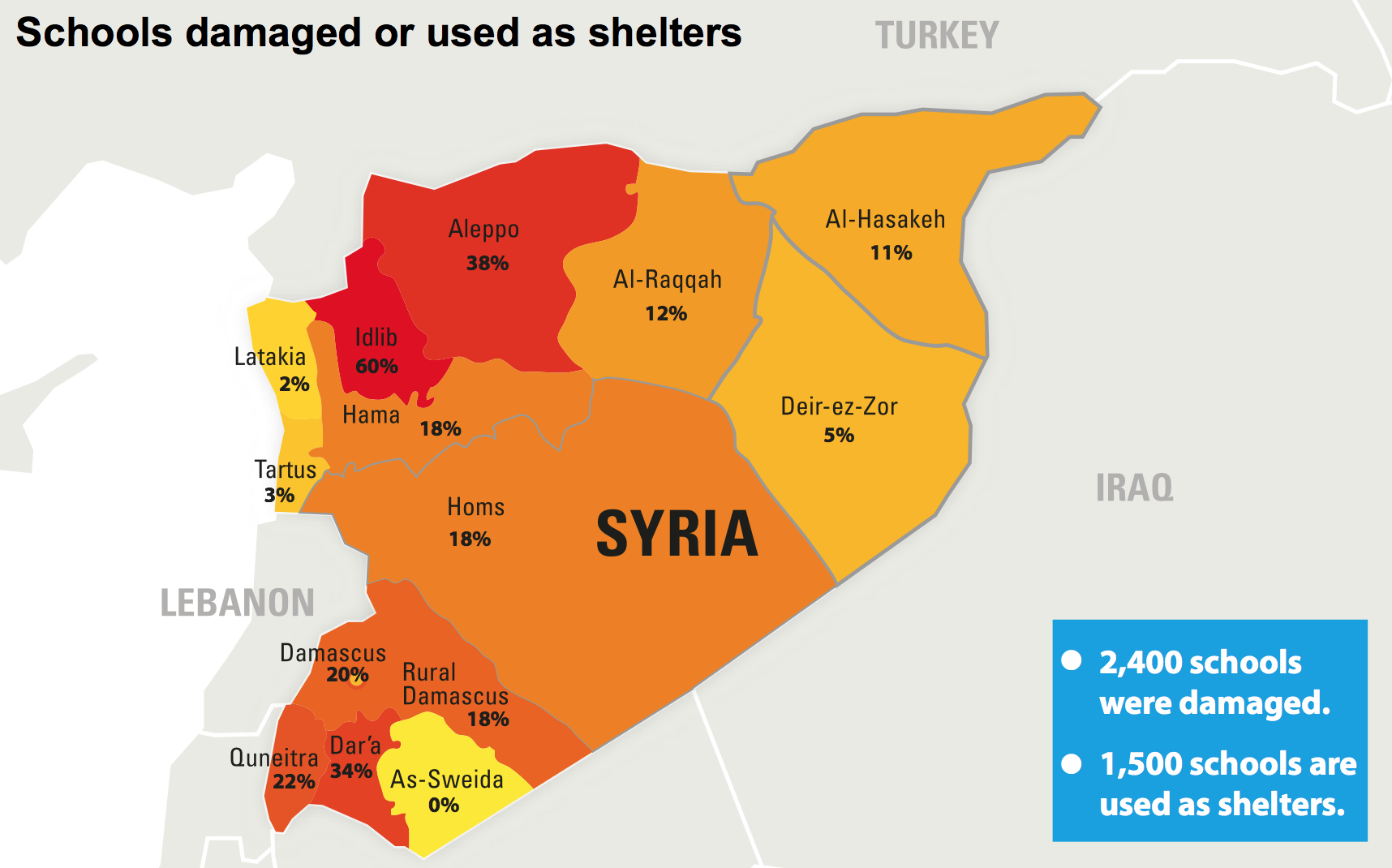
A recent UNICEF report (pdf) finds that Syrian schools are in dismal shape:

Syria Schools

Some key details from the report:

[A]ttendance rates have plummeted — down to 6% in some areas. UNICEF blames insecurity, lack of teachers and resources, and damaged buildings, along with the pressure to drop out and earn an income or get married early.

Peak After Peak

Vince Beiser paints an ugly picture for fossil fuel fighters such as McKibben:

The widely circulated fears of a few years ago that we were approaching “peak oil” have turned out to be completely wrong. From the Arctic to Africa, nanoengineered materials, underwater robots, side-scanning 3-D sonar, specially engineered lubricants, and myriad other advances are opening up titanic new supplies of fossil fuels, many of them in unexpected places—Brazil, Australia, and, perhaps most significantly, North America. “Contrary to what most people believe,” declares a recent study from the Harvard Kennedy School, “oil supply capacity is growing worldwide at such an unprecedented level that it might outpace consumption.” …

[T]he problem has never been exactly about supply; it’s always been about our ability to profitably tap that supply.

We human beings have consumed, over our entire history, about a trillion barrels of oil. The U.S. Geological Survey estimates there is still seven to eight times that much left in the ground. The oil that’s left is just more difficult, and therefore more expensive, to get to. But that sets the invisible hand of the market into motion. Every time known reserves start looking tight, the price goes up, which incentivizes investment in research and development, which yields more sophisticated technologies, which unearth new supplies—often in places we’d scarcely even thought to look before.

Frum points to the next emerging market:

Mexican oil production has been declining over the past decade, mostly because of under-investment and mismanagement by the state oil monopoly, Pemex. … In October, Pemex announced discovery of a big new field in the Gulf of Mexico. Newly elected Mexican President Enrique Pena Nieto is urging his country to amend its constitution to allow foreign investment in Mexican oil fields. Experts assess that opening the Mexican oil industry to global investment will revive Mexican oil production and boost Mexico’s economic growth by potentially 2 points a year. Nieto’s PRI party — the very party that nationalized Mexican oil 80 years ago — is expected to vote this weekend to approve the new policy.

Fighting Mold With Jell-O

Tom-in-front-of-gelatin-molds-from-our-Glistening-and-Jiggly-Contest-1024x883

Hunter Oatman-Stanford interviewed Ruth Clark about her website The Mid-Century Menu, where she recreates recipes from the 1950s. A cool discovery:

We’ve done a lot of different Jell-O stuff and noticed that freshness is basically extended when you encase things in Jell-O. We’ve done cakes covered with gelatin that the cake would still be moist after a week and a half. We made sandwiches with gelatin, so open-faced sandwiches and then you’re supposed to pour flavored gelatin over the top, which was supposed to be like mayo. I thought it was going to be disastrous. [Husband] Tom wolfed them down. He’s like, “These are really good and the bread isn’t soggy.” I’m like, “Are you kidding me?” It was like two days later, and they were still edible.

I don’t know if being frugal and using up leftovers was part of the Jell-O trend, putting them in gelatin and then trying to force them down that way. But that’s my theory.

(Photo of Ruth Clark’s husband about to dig into the herb-glazed open-faced sandwiches and other gelatin contest delights.)

“Never Forget That They Were All Wrong” Ctd

Dreher, who supported the Iraq war, recalls the run-up to war:

I covered a big antiwar march in Manhattan in the spring of 2002, and the radicals were a disgusting bunch. “Bush = Hitler” signs, and so forth. As foul as it was, the event was a pleasant thing to see, in a way, because it made me feel more secure in the rightness of the war the US was about to undertake. And it shouldn’t be forgotten in those days that some antiwar people were nasty and hysterical, and impossible to talk to.

For all that … they were right about the only question that counted — Should the US launch a war on Iraq? — and my side was wrong. I was wrong. I had allowed myself to be swayed by emotion, even as I spited the emotional hysteria of the antiwar crowd.

TNC’s earlier reflections here.

The Most Superstitious City On Earth

Hong Kong, according to Ben Carlson:

Here it’s completely normal to shell out for a lucky phone number from a night-market hawker. Tycoons pay millions for license plates with auspicious digits. People spurn secondhand goods because they may be infected with the prior owner’s bad luck. Around Chinese New Year, which just ended, all the shops hire a lion dance troupe to come in and chase out the last year’s bad fortune. Numbers, colors, fruits, clocks, and flowers all have a certain reputation for good or ill, often because they sound like other words. Everyone hates the number 4 because it sounds like the word for “death.” Sixes, eights, and nines are prized because they sound, respectively, like “success,” “fortune,” and “long-lasting.” (It was no accident the Beijing Olympics began at 8:08:08 p.m. on the 8th day of the 8th month of 2008.)

Update from a reader:

I can’t believe Carlson didn’t mention the most prominent piece of Hong Kong superstition: The Repulse Bay, one of the most famous buildings in HK, has a giant hole in the middle, which I was told allowed the dragons in the hills to see the bay. (Though Wikipedia says it’s just for Feng Shui.)

(Photo: Lucky charms at Wong-Tai-Sin Temple by Flickr user Raisa H)

What Cameras Can’t Capture

Madhavankutty Pillai argues that it is “easy to make a good movie of an ordinary or even bad novel” but that translating great novels onto the big screen remains elusive:

A novel’s quality often does not matter to its movie adaptation because cinema works at the surface level—there is no sophisticated way to depict thought as thought. … A good movie can be made of an ordinary book as long as there are strong plot points or a grand theme or potential for spectacle. In Life of Pi, Ang Lee’s visual grandeur compensates for the book’s clumsiness. Ironically, the reverse is also true—great novels are often not fodder for great cinema. There have been many movie versions of Crime and Punishment, but who remembers any of them? It is a work that hinges on inner monologue, which cinema cannot depict. Remove that and you have just the skin without the soul.

Big Data Meets Punk Rock

Evgeny Morozov adds his voice to the chorus questioning Big Data’s effect on creativity:

Last December, the Global Times, China’s English-language tabloid, ran a story on the local punk band Bear Warrior, which found an ingenious way to measure the audience response to their songs. Its lead singer is a graduate student majoring in precision instruments at a university in Beijing, so he designed a device—”POGO Thermometer”—that measures the intensity of the audience’s dancing through a series of sensors embedded in the floor carpet in the music hall. The signals are then transmitted to a central computer where they are closely analyzed in order to improve future performances. According to the Global Times, the band found that fans “started moving their bodies when the drums kicked in, and they danced the most energetically when he sang higher notes.” As its lead singer put it, “the data helps us understand how we can improve our performance to make the audience respond to our music like we intend.”

Perhaps, it would help improve their performance, but when did punk music become so nice? Making the audience happy is something for management consultants—not punk musicians!—to obsess about. The Sex Pistols would have only one use for that carpet and, rest assured, it wouldn’t involve sensors of any kind.

The Dish recently looked at Netflix’s data-driven creativity here.

Israel’s “Freedom Riders”

Two Palestinian activists sit inside as

That’s a reminiscent photograph, isn’t it – of a disenfranchised minority, now forced to ride not at the back of the bus but in a completely segregated one? I mentioned last night that Israel’s Ministry of Transportation introduced separate buses for Palestinians and Jewish settlers traveling between Israel and the West Bank, after the latter complained to the government that Arab passengers were a threat. Oren Ziv reports and provides photos of the scenes yesterday:

Such measures may be shocking to those unaware that in East Jerusalem and the West Bank, separate-but-unequal bus lines already exist, as detailed by Mya Guarnieri. But, as with the many forms of de facto discrimination in Israel and the occupied Palestinian territories, these buses are not legally segregated. So predictably, Israel’s transportation minister insists that, even with the new bus lines, “Palestinians entering Israel will able to ride on every public transportation line, including existing lines in Judea and Samaria [Israeli terms for the West Bank occupied Palestinian territories]“.

A simple poignant anecdote:

Back on the 210 bus to Eyal, Middle Eastern music was playing to a half-full bus of middle aged men who fit a profile that is classified as a low security risk. “It’s ironic,” notes Mussa Mohammed, a tile layer from Nablus. “Inside Israel we are free to ride the buses and train, but on the way back to our homes in the West Bank we are separated out.”

Jake Wallis Simons is wary of the word “apartheid” and tries to place the move in context of Israel’s balancing act between combating terror and protecting civil rights:

The question, as with my experience at Ben Gurion airport, is where one draws the line. In Israel, this matter is debated frequently and officially by moral philosophers and religious figures, particularly when it comes to military operations. They get it wrong sometimes, and spectacularly so. But often, on a day-to-day basis, they get it right.

Nevertheless, it has to be noted that the timing is strange. Apart from the blast on the bus in Tel Aviv during the last Gaza offensive, there hadn’t been a suicide attack on Israel’s bus network for six and a half years, which is a striking figure given that 29,000 Palestinians commute to Israel daily.

Anna Lekas Miller calls it is symptomatic of an already “separate but equal” system:

[S]egregation between Israeli and Palestinian passengers on public transportation is hardly new. In Jerusalem, the “Central” bus station operates buses connecting Jerusalem to Tel Aviv, Haifa, the Dead Sea and several Israeli settlements throughout the West Bank. These buses do not have to stop at checkpoints—as the passengers are Israeli citizens, soldiers and settlers. Some of these buses—the settler buses—are heavily subsidized by the Israeli government, and thus often travel the city half empty. It’s easy for these buses to have a set schedule. The bus station itself is indoors, air-conditioned and even equipped with a Kosher McDonalds.

Aeyal Gross compares the new policy to a 2009 move to bar Palestinians from using a key highway in Israel, which Israel’s courts struck down as illegal:

Differing circumstances aside, the policy reversed by the High Court in the case of Route 443 is similar to the Transportation Ministry’s new policy regarding certain bus lines, insofar as both involve the development of a means of transportation for the citizens of the occupying state and its separation from the local population. This violates the rules of international law whereby occupation is a temporary situation only, and the occupying power must administer the territory for the benefit of the local population.

In this sense the bus issue is only one more component of Israel’s de facto annexation of the territories, an annexation accompanied by the creation of a regime of segregation – which is of course unequal – between Jews and Palestinians.

Corey Robin juxtaposes the Haaretz report with the text of Plessy v. Ferguson.

(Photo: Two Palestinian activists sit inside as Israeli bus as it rides between a bus stop outside the West Bank Jewish settlement of Migron, near Ramallah, and a checkpoint leading to Jerusalem, on November 15, 2011. Palestinian ‘Freedom Riders’ reenacted US civil rights movement’s boarding of segregated buses in the American south by riding Israeli settler buses to Jerusalem. Several Israeli transportation companies operate dozens of lines that run through the occupied West Bank and east Jerusalem, many of them subsidized by the state. While it is not officially forbidden for Palestinians to use Israeli public transportation in the West Bank, these lines are effectively segregated, since many of them pass through Jewish-only settlements, to which Palestinian entry is prohibited by a military decree. By Ahmad Gharabli/AFP/Getty Images.)
The “Nasty Party” Stigma Returns

Alex Massie worries that most Brits now see the relatively moderate Tory party as “pretty right-wing”:

tumblr_mgdtu6dVxJ1qg8c5yo1_500The people may be wrong but that’s what they think. And why wouldn’t they? The Tories have been very good at telling the country what they don’t like but rather less good at telling us what they do like. … They’re against foreign judges, foreign workers and foreign students. They’re against people on benefits or in receipt of tax credits and they’re against “free” university education. Worst of all, perhaps, they’re against taxing millionaires and remain blind to the damage cutting the top rate of tax for the very richest Britons has done them. Then, though a little unfairly, they’re seen as being against gay people’s desire to marry each other and, more generally, they’re seen as being against (or at least uncomfortable with) much of modern British life.

And he believes these positions are obscuring the party’s accomplishments:

[T]he government has some good stories to tell. Recent setbacks notwithstanding, there’s a good story to be told about education reform. The same is true of employment growth and even, if the framing is done properly, of welfare reform. But we don’t hear very much of these things and nor do we hear much talk of what the government is actually doing. Instead the party bangs on and on and on about what it is against but only rarely about what it is for.

The Economist pegs the party’s recent rightward shift as a strategy to win a crucial election in a battleground borough:

[David Cameron] would be well advised to consider the party’s dark night of the soul in the early 2000s. In the eminently winnable 2005 election (a time when, polling suggests, Britons were both more exercised about Europe and less socially liberal than they are now), the Conservative Party ran an UKIPish campaign under the slogan “are you thinking what we’re thinking?” Back then the answer from electorally-decisive voters was: “err, no”. The same, it seems, was true in Eastleigh yesterday. The party should be wary of making the same mistake in 2015.

(Image from the tumblr of English teenager Rachel Dawn, who titles it “British politics in a nutshell”)