A Clapper For The Millennials

The new Myo looks amazing:

Kottke is also impressed:

Wearable computing is heating up. Jawbone and Nike are vying for your wrists, Google and Lat Ware want your face, Fitbit owns the hips, and Apple might want to make your shoes smarter. But one of the most intriguing demos I’ve seen, if the footage in the video is to be believed, is the Myo gesture control armband.

How it works:

The Myo actually reads the electrical activity in your muscles, rather than relying on a camera. This seems like a pretty smart approach, as the Myo can decipher complex finger gestures, flicks and rotations without requiring line-of-sight. That suddenly opens up a new world of interactivity that doesn’t require the user be sitting in front of a camera-equipped computer, or dancing around in front of a Kinect.

The bands sold over 10,000 units during its first two days of pre-order.

Your Life, Pocket-Sized

A recent document (pdf) from an immigration case details the information that police pulled from an iPhone. Chris Soghoian worries about the fact that “[i]ntrusive cell phone searches are becoming ever easier for law enforcement officers to conduct”:

Before the age of smartphones, it was impossible for police to gather this much private information about a person’s communications, historical movements, and private life during an arrest. Our pockets and bags simply aren’t big enough to carry paper records revealing that much data. … The fact that we now carry this much private, sensitive information around with us means that the government is able to get this information, too.

The type of data stored on a smartphone can paint a near-complete picture of even the most private details of someone’s personal life. Call history, voicemails, text messages and photographs can provide a catalogue of how—and with whom—a person spends his or her time, exposing everything from intimate photographs to 2 AM text messages. Web browsing history may include Google searches for Alcoholics Anonymous or local gay bars. Apps can expose what you’re reading and listening to. Location information might uncover a visit to an abortion clinic, a political protest, or a psychiatrist.

(Hat tip: Timothy B. Lee)

Which Jobs Will Robots Take?

Boston Dynamics’ BigDog learns how to throw:

Free Exchange argues that the increasing sophistication of robots isn’t necessarily a threat to workers:

At airline check-in counters, say, computers are displacing employees from mundane tasks like printing boarding passes. That makes it easier for the humans to respond to unexpected problems like cancelled flights or changed itineraries.

Machines serve as both a substitute for, and a complement to, labour in other industries. Watson is initially assisting doctors to make cancer-treatment decisions, by providing options along with the associated degrees of confidence; it may eventually replace doctors in some diagnostic work. In other cases, robots may raise demand for doctors’ services. A recent article in the Journal of the American Medical Association notes that though robotically assisted surgeries do not necessarily bring better results than minimally invasive human-only surgeries, it is much easier for doctors to learn and master robotically assisted techniques. Robot-aided surgery could therefore make some procedures cheaper and more widely available.

Avent follows up:

Automation will claim ever more productive tasks, including, perhaps, in skilled professions accustomed to being spared the disruptive impacts of technological change. But for the foreseeable future, the human advantage in cognitive flexibility and interpersonal interactions will be fairly secure. For workers across the spectrum of educational attainment, those abilities will be a prime source of value to employers.

Should Trans Surgery Be Covered? Ctd

A reader writes:

A big thank you for posting about the issue of trans surgery insurance coverage and the medical need for it. My younger sister is trans (MTF), and like a lot of trans folk of her generation, was able to come out (relatively) young – 21 – and what a difference that makes! Several of the transgender people in my church waited until retirement, or late middle age, and they would be the first to say how hard it is to accommodate oneself to living in a different body, both physical and hormonal, after years of passing as the gender that one really isn’t. My sister has been lucky in her insurance coverage through her job as a first responder. She gets great coverage for the hormones she must take for the rest of her life. However, her surgery (facial surgery and breast augmentation) were not covered; she paid for them out of savings and from a small inheritance. Using her savings for this definitely set her back for a time – she otherwise might have extended her education, or bought a home, as I did with my inheritance. Still, it was the best thing she ever did. She is so easy in her body, so softly feminine, just lovely. She’s also engaged to be married now – if only we can get Prop 8 overturned here in California and DOMA on the federal level, so they can be legally married. (Ironically, they probably could be married legally in Texas, which doesn’t recognize her gender change.)

Another notes that all uninsured transgender residents of San Francisco get coverage. Another asks, “So a new vagina is covered, but Lasik isn’t?”

Faces Of The Day

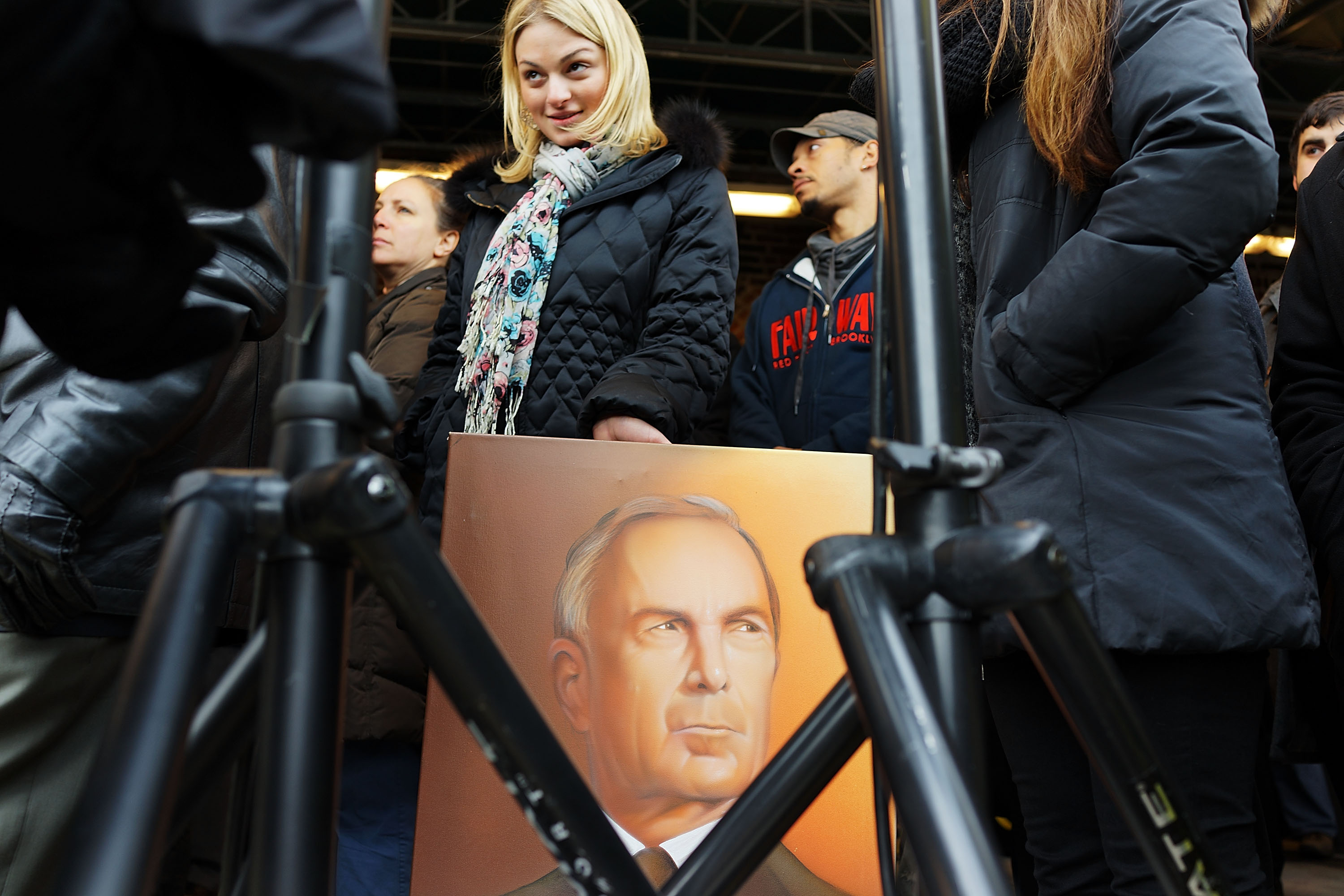
Grocery Store Flooded And Damaged By Superstorm Sandy Reopens 4 Months Later

An aide holds a portrait of New York City Mayor Michael Bloomberg that was given to him as a gift during ceremonies at the newly re-opened Fairway Market on the waterfront in Brooklyn’s Red Hook neighborhood on March 1, 2013. Fairway, which quickly became a popular shopping destination and an anchor in the struggling community of Red Hook, was closed following severe flooding during Hurricane Sandy on October 29, 2012. Like the rest of Red Hook, Fairway has struggled to quickly re-open in a neighborhood that lost dozens of businesses during the storm. The re-opening, which included a ceremony and ribbon cutting featuring Bloomberg and Miss America, is being viewed as Red Hook’s official comeback. By Spencer Platt/Getty Images.

Giving Up Gluten, Ctd

A reader writes:

Thanks for shedding light on the complexities of gluten today. As a restaurant owner, I have found this fad to be problematic in an unexpected way. I have seen requests for gluten-free items go through the roof in the last few years. When these items are ordered, often there is gluten in items that we know about but that the guest may not, so waitstaff returns to the table to alert the guest. Nine out of ten times, the reply is that “A little bit of gluten is ok.”  When this happens often enough, it reduces the importance of gluten-specific requests to your kitchen staff. The next order that comes along, they might not take the care that they should. A little bit of gluten was ok for the last 10 orders with this request, so why not this one? This puts people who have Celiac’s in great danger, even when they make the gluten-free request. People with Celiac’s typically know exactly what ingredients they cannot have and where these ingredients hide. That’s really the best way to operate, as it will make you far less likely to get something you’re not supposed to.

A reader with Celiac’s writes:

I lived with real and severe “fibromyalgia” symptoms for years while rheumatologists, allergists, internists, osteopaths, and orthopods tried to resolve my pain.

My joints hurt, I had generalized pain, depression, fog, fatigue.  Each specialist did their battery of tests and declared that whatever my problem was, it wasn’t in their purview.  All agreed it was “something auto-immune”.  One quickly prescribed an anti-depressant marketed by Eli Lilly to basically stop me from feeling the pain.  Others told me take vitamins to make up for shockingly low levels of some nutrients.  I tried yoga, exercise, tai chi, weight training …

Finally my internist – on information Darshak Sanghavi would certainly reject – said I should try eliminating wheat.  I thought I’d try it for three weeks, then go back to eating wheat to prove the theory.  But then every single symptom went away completely.  Someday, I’ll try eating a pizza, but only when I have time to lie in bed the next day.  It hasn’t happened yet, and it doesn’t even look good any more.

The same here. I was covered in hives and rashes and constantly itching and nothing worked and a few weeks later, it was all gone. I’m one of those guilty ones asking about flour, because it’s not as if I’ll suddenly have a seizure. I’ll be clearer in future. I have lost about 15 pounds, by the way – but that might have also been launching the new blog.
“Sponsored Content” Now Infiltrating Fark

Jeff Bercovici has the goods. Bottom-line: Buzzfeed is using “featured partner links” on Fark to direct traffic to its “sponsored content.” I love this quote from Buzzfeed’s spokesperson:

We’re working with a number of sites, including Fark, to extend our content-driven social advertising to third party sites.

So now it’s “content-driven social advertising”. The damage these people do to the English language is as great as their undermining of ethical distinctions between advertising and writing. Unless you look very closely at the small print, you’ll soon be getting links and posts you may think are journalism – with the Atlantic and Buzzfeed and others branding the page. But all you’re reading is corporate propaganda. Just keep your eyes open.

Replacing Medicaid With Obamacare, Ctd

In Arkansas, Democratic Governor Mike Beebe has negotiated a new breed of Medicaid expansion with HHS under which the Medicaid-eligible population will get federal money to buy private insurance in the Obamacare marketplaces. David Ramsey explains the reason for the creative arrangement:

“My main objective is to make this legislature as comfortable as I can make them,” [Beebe] said. “With a three fourths vote requirement in both houses, that’s a steep, steep burden….If the majority would prefer to go this way to get this done, I’m happy with that. If they want to go the other way, I live with that as well. The cost to the taxpayer for the first three years in the state of Arkansas is going to be the same.”

Beebe said that for some legislators, subsidizing folks to buy private insurance was preferable to directly covering people through a government program for “philosophical” reasons.

Sarah Kliff looks ahead:

The benefit of this approach seems pretty clear: The Arkansas legislature can say they’re moving Medicaid recipients into private coverage, rather than expanding a cash-strapped entitlement program. But will it sway other states on the fence? There is one possible downside they might want to consider, that this approach will likely be more expensive over time. That’s due to the fact that a private insurance plan tends to be more expensive than Medicaid. The Congressional Budget Office estimates the difference between the two, for an individual, is $3,000.

Kevin Drum thinks it might address an issue with the standard Medicaid expansion:

If you’re at 130 percent of the poverty level this year, you qualify for Medicaid. If you get a raise and go up to 140 percent next year, you no longer qualify and instead have to navigate the exchanges. If your hours are cut back and you fall to 130 percent again the year after that, it’s back to Medicaid.

How big a deal is this? That’s hard to say. But it’s not a made-up issue, and it’s possible that the Arkansas approach could legitimately be better. What’s more, I’m OK with allowing states to experiment within limits. It’s the only way to find out whether or not the exchanges really are more expensive, and whether or not the Medicaid ping-pong really is a serious problem.

Previous Dish on the Medicaid expansion here and here.