John Cassidy imagines the public reaction if the Boston bombers had instead used assault rifles:
Well, for one thing, the brothers would probably have killed a lot more than three people at the marathon. AR-15s can fire up to forty-five rounds a minute, and at close range they can tear apart a human body. If the Tsarnaevs had started firing near the finish line, they might easily have killed dozens of spectators and runners before fleeing or being shot by the police.
The second thing that would have been different is the initial public reaction. Most Americans associate bomb attacks with terrorists. When they hear of mass shootings, they tend to think of sociopaths and unbalanced post-adolescents.
The reason he thinks this mental exercise is useful:
My point is about perceptions and reality, and how the former can shape the latter. The Tsarnaevs did have at least one gun—evidently a pistol, rather than the mini-arsenal originally reported—which they apparently used to kill an M.I.T. police officer, but that wasn’t what kept an entire city locked indoors: it was the fact that there were “terrorists,” who had carried out a bombing, on the loose. As I pointed out the other day, numerically speaking, terrorism, especially homegrown terrorism, is a minor threat to public safety and public health. It pales in comparison to gun violence.
“What hurts me—not physically, but metaphorically, rhetorically, to (she taps her heart)—is the disdain some have for this man, a good, wonderful family man and someone who put down the bottle and picked up, —how do I say this?—God. His God. All of our God, even if you believe in another one. How can you not want to wrap you soul around that story? It’s something Democrats—how do I say this?—don’t have. Maybe their arms are too small, maybe—how do I say this?—they don’t see the soul in which to hug. All I know is they’re afraid—they seem to be afraid, I should say, uh–wow, this is hard, because I don’t really know— to show love. It’s a kinder, gentler love they’re lacking. And it makes me—how do I say this?—sad. And I grieve.”
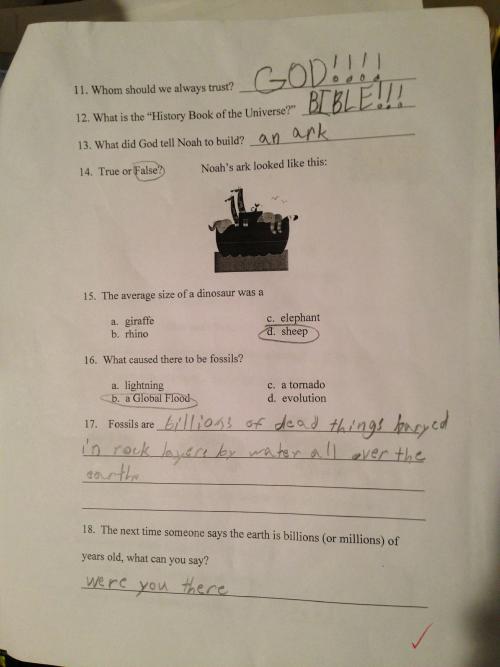
Above is the first page of a “science” test reportedly give to a fourth grade class at a Christian school in South Carolina. After receiving an email from a man claiming to be the father of the student, Snopes has rated the story as “probably true.”
Robert Beckhusen investigates the psychological shifts underlying extremist behavior:
First, the would-be extremist “splits” the world into a rigid division between good and evil as a bulwark against feelings of — real or perceived — helplessness. Unfortunately, there are any number of ready-made ideologies which can serve to encourage this splitting. Next, the extremist constructs a double life that enables him to design, plan and carry out an attack in a “deadly calm state” characterized by single-minded determination.
Only a tiny few ever make it to this stage, but this “deadly calm” means it’s probably too late. “When you are on a mission with a gun or a bomb, you are not just creating another self, you are acting out a role like in a Rambo movie,” Griffin says. They appear outwardly normal to friends, associates and family members. But inside, the extremist believes himself to be preparing for a heroic mission that entails committing acts of violence that are anything but heroic.
Ryan Avent analyzes today’s GDP report, which came in under expectations:
Worringly, today’s figures reflect very little impact from the “sequester”—automatic spending cuts that only recently began to take effect and which may hack off a further 0.6 percentage points from GDP growth this year.
The main source of fiscal pain in the first three months of the year was instead a series of tax changes that took effect at the beginning of 2013 as part of the “fiscal cliff”. Marginal income tax rates rose on top earners at that time. Perhaps more important, a stimulative cut in the payroll tax was allowed to expire, delivering a direct blow to workers’ take-home pay. Despite this, personal consumption spending held up in the first quarter, growing at a 3.2% annual pace. That encouraging performance suggests that household deleveraging may have many families feeling more financially secure and ready to spend. That, in combination with continued contributions from residential construction, hints at the potential for healthy domestic demand growth, if only the government would relax the pace of deficit reduction.
The report should scratch any thought that our economy is heading into “escape velocity” and breaking into a higher, self-reinforcing trajectory of growth. That had appeared to be the case in the first couple of months of the year. But it just isn’t so. We’re muddling along at basically the same pace we’ve been at for nearly four straight years of this dismal recovery, with growth too slow to make up the lost economic ground from the 2008-2009 recession.
[G]rowth by this measure is down a bit over the last six months, with the economy growing slightly below its trend growth rate of around 2%. If this underlying pace of growth persists, it will be very difficult to generate the jobs needed to “legitimately” bring down unemployment rate (meaning through job growth, not through people leaving the labor force).
Recent video claiming to show victims of a chemical weapons attack in Syria:
The Obama administration has some evidence that chemical weapons are being used in Syria. Jeffrey Goldberg – surprise! – calls for intervention:
There are no good choices — good outcomes in Syria are impossible to imagine. But if it is proved to a certainty that Assad is trying to kill his people with chemical weapons, then Obama may have no choice but to act, not only because he has put the country’s credibility on the line (Iran and North Korea are undoubtedly watching closely), but also because the alternative — allowing human beings to be murdered by a monstrous regime using the world’s most devilish weapons, when he has the power to stop it — is not a moral option for a moral man.
The US has the power to stop a lot of things with military power. That doesn’t mean it is in our national interest to do so. And that phrase – “a monstrous regime using the world’s most devilish weapons” – rings a bell, doesn’t it? Does Jeffrey really want the US directly involved on one side in a Muslim sectarian war that is now metastasizing into “Iraq”? How many more Tamerlan Tsarnaevs does he want to produce?
Alas, along with Obama’s ill-advised public disavowal of containment of an Iranian nuclear capacity, the president has only himself to blame for boxing himself in on this. But that box may be larger than McCain, Butters and the usual neocon chorus will allow, as Max Fisher explains:
The two times that Obama personally articulated his administration’s red line, he used pretty vague language on what happens if Syria uses chemical weapons. The first time, in August, he said, “That would change my calculus. That would change my equation.” The second time, in March, he said “we will not tolerate” chemical weapons use and “the world is watching, we will hold you accountable.”
So, in the first comment, Obama only said that he would change how he thought about Syria and, in the second and more recent statement, seemed to shift from talking about how the U.S. would respond to how “the world” would respond. And if “the world” means the United Nations Security Council, which authorizes any multilateral military action such as the 2011 military intervention in Libya, then that’s not much of a threat. Both Russia and China have the ability – and a demonstrated willingness – to veto any UN action on Syria. There’s little indication that either state has changed its calculus on Syria just because of the U.S.’s red line.
By all means, go to the Security Council and see if military aid of this kind can be backed by the Russians and Chinese. I am extremely wary of providing the increasingly Islamist Syrian opposition with any weapons at all. Eli Lake says there are more like me in the administration:
But it appears that, for now at least, Obama’s cabinet is divided on whether to further arm the Syrian opposition. Last week, Secretary of State John Kerry told Congress that the United States was working with other actors in the Middle East to funnel guns to members of the opposition. The same day he said that however, Gen. Martin Dempsey, the chairman of the joint chiefs of staff, said he did not have confidence the United States could identify the right people in the Syrian opposition. One element of the opposition is believed to be closely tied to al Qaeda under the banner of a group called al Nusra. In December the State Department designated al Nusra as a foreign terrorist organization.
Michael Crowley likewise finds that Obama’s options are limited:
So long as American, and possibly Israeli, national security is not directly threatened, there’s no political will for American boots on the ground. Securing Syria’s chemical weapons sites could require 100,000 troops of them. Limited airstrikes against responsible forces and commanders is a more plausible option, but would require credible information about exactly who oversaw and carried out the chemical attacks. (A direct strike on Syria’s embattled dictator, Bashar al-Assad, is almost surely out of the question.) No wonder Obama never spelled out the consequences of crossing his ‘red line.’
Why, exactly, did Obama announce the “red line” in the first place if he wasn’t serious about it? Ninety percent of the arguments coming from the McCains and Grahams of the world right now is that he’s obliged to intervene simply to protect U.S. credibility and show the world that when the president issues an ultimatum, he means it. If O hadn’t declared the “red line” — which he didn’t have to do formally, given the taboo that already exists for WMD — he’d have more room to maneuver now.
I wish he hadn’t said that as well. But I also know why I supported Obama against McCain in 2008. Because McCain would already have American soldiers knee-deep in Afghanistan, Iraq, Libya and Syria by now.
Amber displays a painting of a bee on her nose as she joins bee campaigners on Parliament Square on April 26, 2013 in London, England. Over a hundred campaigners including British fashion designers Dame Vivienne Westwood and Katharine Hamnett gathered on Parliament Square, some dressed as beekeepers, to urge British Secretary of State for the Environment Food and Rural Affairs, Owen Paterson, to not block EU proposals to suspend the use of bee killing pesticides. By Dan Kitwood/Getty Images.
The short version is that late last night it took a break from its regular schedule of lacking 60 votes to shampoo the chamber carpet and unanimously passed a bill that will provide the FAA unique flexibility under sequestration — and thus halt the furloughs that have been causing travel delays around the country. Today the House will follow suit, and the White House has made it clear President Obama intends to sign it. Great if you fly. Bad, bad news if you’re on head start or rely on meals on wheels or otherwise aren’t a Priority Pass holder.
Noam Scheiber gives Democrats a piece of his mind:
[I]f the political case for holding firm on the FAA furloughs was solid, the moral case was overwhelming. Consider where we stand with the sequester:
As my colleague Jonathan Cohn pointed out Thursday, the cuts have been hurting a lot of vulnerable Americans for several weeks now thanks to their effects on programs like Head Start, Meals on Wheels, and unemployment insurance. As of this week, the cuts were also nicking a lot of non-vulnerable Americans by forcing them to watch an extra loop of Headline News at Hartsfield International. At the risk of revealing my warped moral sensibilities, this strikes me as roughly in line with what you’d want in a set of budget cuts. If the political class insists on sacrifice, the sacrifice should, at the very least, be distributed among both poor and affluent. (Of course, it would be even better if they disproportionately affected the affluent, but let’s not get crazy.) This is just a basic principle of justice.
One of the more striking things about the charges against Dzhokar Tsarnaev is the use of a “weapon of mass destruction.” Legally, that’s certainly valid, given the current definition in the US criminal law with respect to terrorism:
any “destructive device” defined as any explosive, incendiary, or poison gas – bomb, grenade, rocket having a propellant charge of more than four ounces, missile having an explosive or incendiary charge of more than one-quarter ounce, mine, or device similar to any of the devices described in the preceding clauses
any weapon that is designed or intended to cause death or serious bodily injury through the release, dissemination, or impact of toxic or poisonous chemicals, or their precursors
any weapon involving a biological agent, toxin, or vector any weapon that is designed to release radiation or radioactivity at a level dangerous to human life
That includes a pressure-cooker Internet-recipe bomb that killed 3 people and injured many more. But why is a version of an AR-15, as used by Adam Lanza, that killed 28 human beings, not treated the same way? Why was that act not treated as a suicide bombing would be? If something that kills three people is responsible for “mass destruction”, why not a military weapon that can kill 28 and end in suicide? The AR-15 can be adapted to have a hundred bullets in a Beta C-Mag magazine. Here’s a fantastically phallic drawing of how many bullets can be fired:
You could kill dozens of people with those large, bullet-packed balls – and a terrorist could murder and maim many more human beings than were killed and injured in Boston. But it isn’t legally or technically a weapon of “mass” destruction. In fact, having one is a constitutional right.
[O]ne of the little-noticed provisions of Obamacare, which was passed three years ago this week, requires that non-profit hospitals, as a condition of keeping their tax exempt status, must adhere to rules to be promulgated by the IRS that would, among other things, not allow them to send bill collectors or lawyers after patients except under certain conditions.
Those conditions include that the patients first be informed through aggressive outreach efforts of the availability of financial aid for patients unable to afford the bills and, more important, that for patients whose incomes are below certain levels, hospitals can only dun them or sue them for the discounted amounts they usually charge insurance companies, rather than the far higher chargemaster prices.
In theory, the IRS, which is a unit of the Obama Administration’s Treasury Department, could have promulgated those regulations at any time after March 23, 2010, the day Obamacare was signed into law. But the first draft of the rules was not issued until two and a half years later – last summer. And then the American Hospital Association’s lobbyists pushed back, calling the proposed rules “too prescriptive.” (To me, if anything, they seemed not prescriptive enough.) Since then, nothing has happened. No final rules have been published. That means that three years after the Obamacare signing ceremony in the White House there is still no protection from hospital lawyers and bill collectors for the patients least able to pay.
Yesterday, Brill talked about how the US healthcare system compares to the rest of the developed world. Before that, he discussed hospital profits and why our medical costs are so exorbitant. You can also go here, here and here to read the Dish’s coverage of his must-read Time cover-story, “Bitter Pill: Why Medical Bills Are Killing Us”. Ask Anything archive here.





 The Dish