What Did Jesus Look Like?

Edward J. Blum examines the depictions of Jesus’ race throughout the ages:

Because of America’s history and its contemporary demographics, there is almost no way to depict Bible characters without causing alarm. To call Jesus ‘black’ signals political values that are associated with the radical left. In 2008, President Obama’s pastor Jeremiah Wright almost cost him the Democratic nomination because of his claims that ‘Jesus was a poor black man’. However, to present Jesus as white in a society where African-Americans, Asian-Americans, and Latino Americans make up increasing numbers of the population is quickly understood as a code for a conservative worldview. Little wonder, then, that some Americans are choosing to describe Jesus as ‘brown’ as a way to avoid the white-black binary. If one attends an anti-conservative rally in the US, for instance, one is likely to find a poster that reads: ‘Obama is not a brown-skinned, anti-war socialist who gives away free health care. You’re thinking of Jesus.’

What MLK said on the subject:

In 1957, Martin Luther King Jr’s advice column in Ebony magazine received a letter that asked: ‘Why did God make Jesus white, when the majority of peoples in the world are non-white?’ King answered with the essence of his political and religious philosophy. He denied that the colour of one’s skin determined the content of one’s character, and for King there was no better example than Christ. ‘The colour of Jesus’ skin is of little or no consequence,’ King reassured his readers, because skin colour ‘is a biological quality which has nothing to do with the intrinsic value of the personality’. Jesus transcended race, and he mattered ‘not in His colour, but in His unique God-consciousness and His willingness to surrender His will to God’s will. He was the son of God, not because of His external biological makeup, but because of His internal spiritual commitment.’
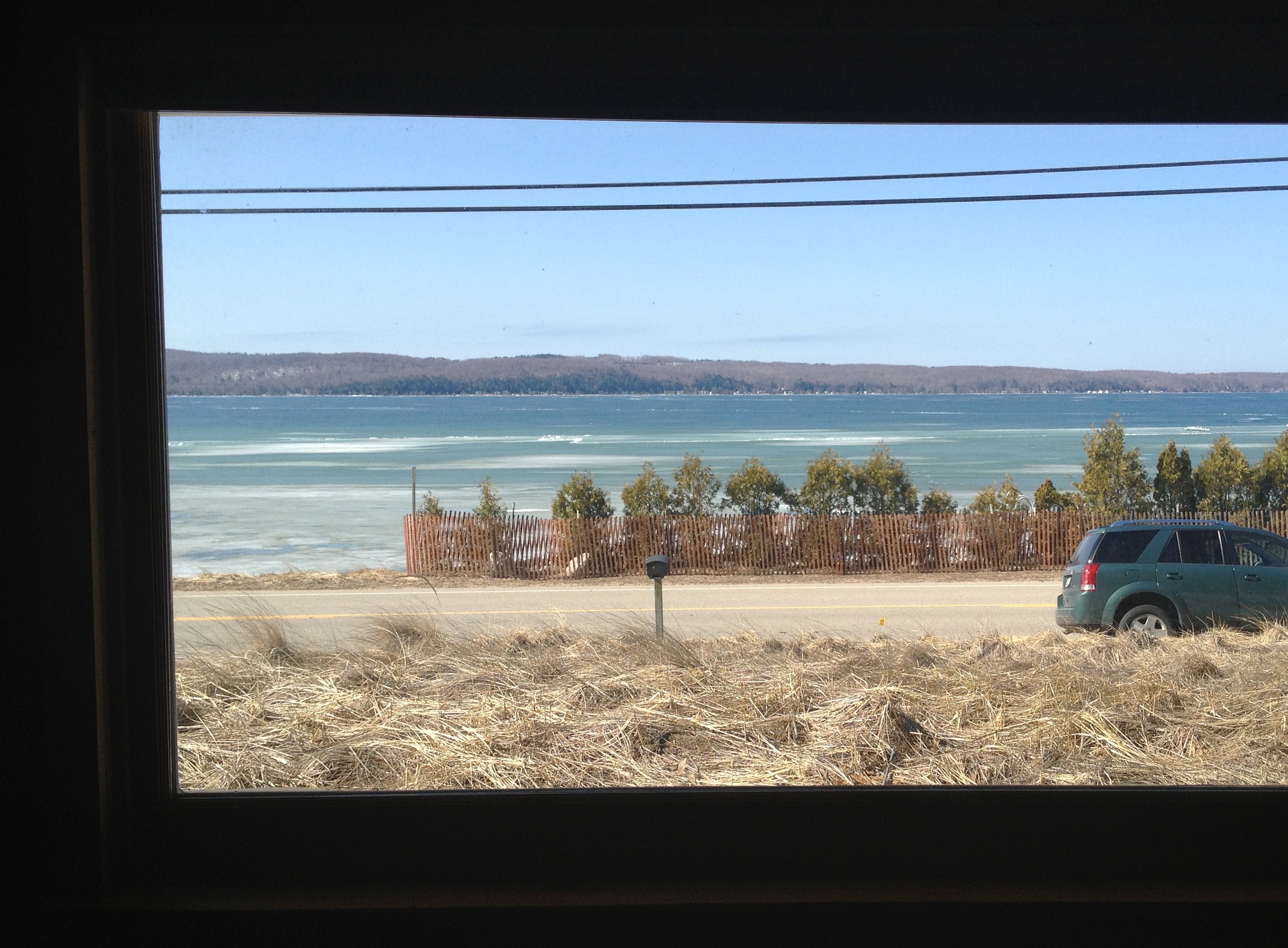

The View From Your Window

IMG_0237

Beulah, Michigan, 10.44 am.

Our reader adds:

Actually this is the view from my dad’s window. Technically it is my window now, though it will never feel that way. My dad unexpectedly passed away on April 11. It has been devastating. When I was there this past weekend, it felt like the spring did not want to come because it knew my dad was not there to fish on the lake or work in his garden. As you can see from the picture, there is still ice on the lake.

My dad was only 70, and is gone far too soon. Here is a link to his obituary.

“A Deeper Kind Of Truth”

In a profile of Christian Wiman, Tom Bartlett unpacks the poet’s complex faith:

Wiman believes that our souls survive our deaths but finds the usual descriptions of heaven absurd. He gets bored in church. He is uncomfortable on his knees. He is uninterested in the noisy, noxious dispute between full-throated fundamentalism and the “clock-minded logic” of the New Atheists. “It’s just not the God I’m wrestling with,” he tells me. “[The atheists] want to prove—what?—that Noah’s ark didn’t happen? That there wasn’t really a garden and a talking snake? Fine.”

For Christians, the resurrection is the climax of the Bible, the hinge that holds it all together. When asked if he believes that the son of God, the Word made flesh, was actually crucified and placed in a tomb only to rise again after three earthbound days, Wiman glances up at the ceiling of the perfectly quiet conference room in the stylish offices he will soon vacate. His eyes close behind his rectangular glasses. It’s probably unfair to ask a poet and a conflicted Christian, a man who writes carefully and slowly and wonderfully, to opine off the cuff about a topic so weighty. He does believe it, he says, though not in the same way he believes in evolution or in the fact that the earth revolves around the sun. It is a different sort of belief, a deeper kind of truth. Finally, he finds the words: “I try to live toward it.”

Read John Williams’ Q&A with Wiman here. Recent Dish coverage of Wiman here.

Face Of The Day

About Face BEST 008

Sage Sohier describes the impetus for her project About Face, portraits of people with facial paralysis caused by either Bell’s palsy, tumors, strokes, accidents, or congenital nerve damage:

Most people I photograph are acutely aware of their imperfections and try to minimize them. Some have confided in me that, in their attempt to look more normal, they strive for impassivity and repress their smiles. They worry that this effort is altering who they are emotionally and affecting how other people respond to them. While most of us assume that our expressions convey our emotions, it seems that the inverse can also be true: our emotions can, in some ways, be influenced by our facial expressions.

(“8-Year Old Girl with Brown Hair” from the show About Face, at the Foley Gallery in New York, April 17 – May 24.)

The Geography Of The Good Life

Damon Linker, in an otherwise glowing review of Rod Dreher’s The Little Way of Ruthie Leming, admits this hesitation about the book’s message:

If you already live in the heartland, the message is to stay. If you come from the heartland and have left, the message is to return. But what if you’re one of the tens of millions of people who can’t stay in or go home to the heartland because your home — your roots — are in the BosWash corridor of the Northeast or the urbanized areas of the West Coast? …

If he’s a consistent localist, he should tell me to put down roots and immerse myself in community where I am — or perhaps in my “hometowns” of New York City and Fairfield County, Conn. But is this even possible in a place where paying my mortgage and other bills requires that my wife and I — like my equally striving neighbors — devote ourselves to high-stress work during nearly every waking hour of our days? If I were independently wealthy, perhaps the good life that Dreher describes would be a possibility in the Philadelphia suburbs. But alas…

Dreher’s response:

[M]aybe the lesson is that the good life is not possible in the Philadelphia suburbs, or any place where in order to keep your head above water, your job has to own you and your wife, and it keeps you from building relationships. There are trade-offs in all things, and no perfect solution, geographical or otherwise. Thing is, life is short, and choices have to be made. It’s not that people living in these workaholic suburbs are bad, not at all; it’s that the culture they (we) live in defines the Good in such a way that choosing to “do the right thing” ends up hollowing out your life, leaving you vulnerable in ways you may not see until tragedy strikes.

The life Ruthie lived is a compelling alternative, the witness of which changed my heart. And like the Good Book says, “Where your treasure is, there will your heart be also.”

Watch Rod’s Ask Anything videos here, hereherehere and here.

Carl Sagan’s Highdeas

He wrote in 1969:

I do not consider myself a religious person in the usual sense, but there is a religious aspect to some highs. The heightened sensitivity in all areas gives me a feeling of communion with my surroundings, both animate and inanimate. Sometimes a kind of existential perception of the absurd comes over me and I see with awful certainty the hypocrisies and posturing of myself and my fellow men. And at other times, there is a different sense of the absurd, a playful and whimsical awareness. Both of these senses of the absurd can be communicated, and some of the most rewarding highs I’ve had have been in sharing talk and perceptions and humor.

Cannabis brings us an awareness that we spend a lifetime being trained to overlook and forget and put out of our minds. A sense of what the world is really like can be maddening; cannabis has brought me some feelings for what it is like to be crazy, and how we use that word ‘crazy’ to avoid thinking about things that are too painful for us. In the Soviet Union political dissidents are routinely placed in insane asylums. The same kind of thing, a little more subtle perhaps, occurs here: ‘did you hear what Lenny Bruce said yesterday? He must be crazy.’ When high on cannabis I discovered that there’s somebody inside in those people we call mad.

(Hat tip: The Longform Guide to Weed. Photo of Earth at twilight from NASA.)

The Allure Of War

Craig Hubert interviewed Sebastian Junger about his new documentary:

I wanted to create a platform where [Tim Hetherington]’s work can live and be seen and appreciated. I also wanted to continue what interested Tim, about young men in war and, it’s kind of politically incorrect to say this, why war is so compelling and even attractive to young men. That is true in this society, in many societies around the world. It’s not just a massive manipulation by the military industrial complex, it really is a very ancient thing. I wanted to understand that and Tim did as well.

From another interview:

“I think everyone who goes to war goes to war for very personal reasons,” [Junger] says.

“Sometimes it’s dressed up as patriotism and duty or, for journalists, it’s sometimes dressed up as ‘these stories must be told’ or horrible situations must be documented. All those things are true on paper, but I don’t think anyone risks their life for completely noble reasons. They do it because they have a powerful personal motivation. I think war is seen by many people as transformative – it will turn you into a man, it will turn you into a caring human being – whatever it is, there is a very strong personal component. It’s also a glamorous, romantic, admired job.

Jada Yuan tracks Junger’s own journey:

“When Tim got killed” has become Junger’s line in the sand; it’s the day he decided he was done with combat reporting for good. Junger was supposed to be with Hetherington in Libya but had to stay home. At first he couldn’t shake the idea that if he’d been there, he might have been able to stop the bleeding. Now he knows he probably would have had to watch his friend die. He’d never been taught how to fashion a camera-strap tourniquet, nor had Tim, nor have hardly any of the freelancers who make up the majority of the frontline reporting corps. Last year, Junger started a foundation called RISC (Reporters Instructed in Saving Colleagues) to provide free medical training for experienced freelance combat journalists. “It’s a way to minimize the number of Tims in the world,” he says.

A Guide To Mid-Century Dating

Maria Popova digs up a 1949 questionnaire from Esquire that provides not-so-timeless advice for dating and romance. A sampling of the tips offered to ladies:

Do you knit when you are having a cozy, fireside evening with a man?

For some reason, men hate to see a woman doing anything with her hands when talking to her. Undivided attention is best.

Do you either play bridge or dance really well?

If not, take steps to correct this at once. You’re better off if you do both well, but one talent is mandatory.

For the men:

Would you dine a girl expensively and not buy her flowers, or economize on the place and bring her at least a gardenia?

Most women would prefer having flowers and less to eat.

Facebook Regret

Emily McManus points to “one of the most entertaining academic papers ever written” (pdf):

Our research reveals several possible causes of why users make posts that they later regret: (1) they want to be perceived in favorable ways, (2) they do not think about their reason for posting or the consequences of their posts, (3) they misjudge the culture and norms within their social circles, (4) they are in a “hot” state of high emotion when posting, or under the influence of drugs or alcohol, (5) their postings are seen by an unintended audience, (6) they do not foresee how their posts could be perceived by people within their intended audience, and (7) they misunderstand or misuse the Facebook platform. Some reported incidents had serious repercussions, such as breaking up relationships or job losses.

One of many anecdotes cited:

Sometimes, people accidentally post sexual content. One survey2 respondent said, “I accidentally posted a video of my husband and I having sex . . . I didn’t mean to post it, I had accidentally clicked on the video of my daughter taking her first steps and on that video and they both uploaded together . . . I didn’t know I had posted it until the day after, when I logged on again, and saw all the comments from all of our friends and family, and my husbands coworkers (he’s in the army).”