Choosing A Special Needs Child, Ctd

A reader writes:

I’m hydrocephalic, and the condition was able to be treated at birth through a shunt. (I was born in 1976). Let your reader know that the condition is fairly “fixable” now in certain instances, if detected early. My mother spent many years in fear that a specific painkiller she took during pregnancy contributed to my condition, but it really appears to have been a one-off in our case; my three siblings are unaffected. I have to say that I was unaware that hydrocephalus could be carried genetically in this manner, but it makes sense. However, I don’t know what my parents would have done had modern technology been available, or indeed what I myself would have done in this instance. It’s a personal decision, and I imagine the severity of what the doctor detects will dictate what counsel is given to the parents.

Another addresses Andrew Soloman’s piece:

I am a pediatric intensive care physician who took care of a child with trisomy 18 who ultimately died, and I want to share my perspective on the issue of caring for a child with severe genetic defects. Trisomy 18 is quite different from trisomy 21 (Down Syndrome) and, in general, has a very grim prognosis. With this chromosomal abnormality, multiple organ systems can be involved (neurologic, cardiac and digestive tract commonly) and until relatively recently most institutions did not recommend intervention. Moreover, in children in whom interventions are performed, most will still die before reaching one year of life.

The child who I helped take care of had a malformed brain with hydrocephalus and also had seizures.

The suck-and-swallow mechanism was not intact so the child had to be tube-fed. There was also a heart defect that required surgery with cardiopulmonary bypass. The child had a malformed airway and had to have a tracheostomy placed to undergo the surgery. The digestive tract was malformed, the stomach was so small that it couldn’t hold very large volumes and therefore the child had to be fed small amounts continuously for 24 hours per day.

The mother for this child received good prenatal care. She was counseled about the trisomy 18 diagnosis and opted to carry the child to term. Once the child was born, she was a strong advocate for her child and wanted every medical intervention performed that could potentially prolong life. The child spent its entire life, 3 months, in an ICU.

After the heart surgery and tracheostomy placement, the child couldn’t be separated from a mechanical ventilator and was dependent on a breathing machine. There were complications after the heart surgery that required placement of a pacemaker. In adults, pacemakers are hardly noticeable. In a 5-lb child, the device takes up half the abdomen. This became a serious problem. As a result of her small stomach and inability to tolerate adequate caloric intake, she was malnourished, had inadequate fat stores and the device began to erode through her skin.

At times we supplemented her with IV nutrition with central venous lines. These IVs that go into large vessels have significant risk associated with them, including infection and serious blood clots. As a result we don’t leave them into too long. This meant were constantly sticking this child with needles trying to get IVs in superficial veins.  In addition, we also had to draw blood for labs to monitor responses to therapies. IV placement and phlebotomy can be challenging in otherwise normal children much less one who is this ill.

I have no doubt this child suffered. A lot. We provided drugs to help alleviate pain and anxiety. This child became dependent on opiates and benzodiazepines. In light of all the other medical problems, this was relatively small one. However, if the child wasn’t sedated, the child was miserable.  And if we tried to reduce the medications, the child had symptoms of withdrawal.

The mother never left the bedside. She was clearly bonded with her child and the child was definitely soothed when the mother was there. Because the child was frequently unstable, the mother did not get to hold the child very often. The mother learned how to take care of the tracheostomy, the feeding tube. You couldn’t ask for a more attentive parent.

There were costs of her devotion, however. The family lived some distance from the hospital and this mother had two other toddler-aged healthy children who she didn’t see very much because she was always in the hospital. While she and her husband agreed to carry the child to term, they were on very different pages regarding which medical interventions to pursue and for how long. There were financial hardships including getting to and from the hospital, childcare, etc. The child ultimately ended up acquiring a serious pneumonia and cardiovascular instability and sepsis. The mother decided to compassionately stop medical interventions and we disconnected the child from the ventilator and the mother held her dying child.

In this case, the mother chose to take this on. Even in light of all the bad news we physicians bombarded her with, she pressed on.  She joined an online support group of mothers of children with trisomy 18 children. She told us many times that we, the medical team, couldn’t take her hope away. I agree with her. I didn’t want to take her hope away. That isn’t my role nor do I want it to be. I can’t provide false hope either. The struggle I had, and continue to have, is did I do the best I could in treating and advocating for this patient? This child spent its entire life in an ICU, drugged, unable to be held for much of the time, hooked to machinery, being poked and prodded with needles.

From a medical decision-making standpoint, we do not operate in a patriarchal system. The presumption is that parents, unusual circumstances not withstanding, will make decisions in the best interest of their child. Children, almost universally, cannot have advanced directives, and with babies, the point is moot. I have no doubt that the mother believed she was acting in the best interest of her child and I also believe the medical team addressed suffering and quality of life with this mother.  While medical futility applies in a very small number of cases, we wrestle with the moral and ethics of medical interventions all of the time.

The legislation being proposed in North Dakota could have very real costs, in every sense. I’ve provided only one example; there are many more like this. Not everyone will have the resources that the mother I describe above, as limited as her resources were. Divorces are very common in families who have children with serious medical conditions. There is also a very serious economic toll both to the individual family and the healthcare system at large.

Of course all of that pales in comparison to the emotional and physical pain and suffering that a patient and family go through when caring for a baby with a devastating and terminal diagnosis. It is one thing for families (or a mother) to chose to take this on; it’s quite another to force them.


“Why I Might Become A Gay Republican” Ctd

Many readers are pushing back against this one:

That email made my blood boil. It amazes me how people can complain that they made too much money, and blame their lack of planning (and budgeting) on the government. While it does sound like his niece is gaming the system, and that’s unfortunate, it seems unrelated to his issues. But the implication that his tax burden was over $160,000 was really what pushed me over the edge. It seems to me like either he didn’t have nearly that much saved, and therefore couldn’t afford the surrogacy in the first place, or he’s making enough money to be paying that much in taxes, in which case he has no place complaining. What happened to personal responsibility? Or does that only apply to poor people?

Another:

I have a few friends and co-workers who for whatever reason equate bad welfare programs with the Democratic party and seem almost reflexively to believe that somehow being a Republican will miraculously solve the problems. They come up with some stupid anecdotal situation and presto, the government takes my money and gives it to those less deserving. The overall effectiveness of a system can’t be quantified by knowing someone who benefits more than an individual believes they should. And while the Democrats could do a lot better, the Republican party has shown zero ability or inclination to govern or work on the actual issues.

Another notes:

Your angry gay potential Republican misses a very important point: if DOMA were not the law of the land and he were married to his partner, then under federal law his taxes would be much lower. And it’s the GOP that is fighting that.

Another argues that social programs are not the reason for the gay reader’s high taxes:

With arguments like “I’m angry because my huge tax bill is going to pay for this type of stuff, when actually I really need the money,” this reader may not vote Republican, but he sure thinks like one. Apparently your reader hasn’t been paying much attention to politics, as the programs he thinks his “huge tax bill” is paying for have been cut over and over again in the last few years. His tax bill has gone up to pay for debt reduction, because our government has decided that is the highest priority for our nation (even the increase on taxes for incomes over $400K wasn’t used to pay for any new spending, only debt reduction). It’s likely that the reason he underestimated how large it would be (which is his own fault) is because of the bipartisan agreement at the end of 2012 to allow the 2% payroll tax cut to expire, which was done strictly for debt reduction purposes, not to pay for any social programs for single mothers. Oh and those programs? They are actually helping to feed his niece’s children, which I think he would agree is a good thing.

Another offers advice for those with high tax bills:

I was hoping you could pass on this link. While I can’t say if he might qualify, the IRS has a number of programs available for those having trouble paying their taxes in full. And you don’t even have to pay that CPA in a cheap suit on the late night ads!

Despite their reputation in popular culture, the IRS is one of the most incredible groups of individuals I’ve had the pleasure of working with. Any organization of 100,000 mostly underpaid and overworked employees is bound to have some bad apples. But overwhelmingly it is made up of dedicated middle-class workers who go to extraordinary lengths to help taxpayers navigate – amidst a sea of fear, misinformation and outright criminals – their largest and most complicated financial transaction every year.

The last thing I’ll say is that if your reader and his partner really want to add another child, there are tons of children in the adoption system that would be overjoyed to join their family. There’s even a big tax credit for it.

A Mushroom Cloud In Texas: Tweet Reax

Details of the devastation:

A fertilizer plant explosion in the town of West, north of Waco, has killed as many as 70 people and injured hundreds, according to an estimate from West EMS Director Dr. George Smith.

Meanwhile, the residents of the town of 2,700 are being asked to evacuate due to ammonia fumes after the explosion of West Fertilizer. The plant is located at 1471 Jerry Mashek Drive, just off Interstate 35. School buses and ambulances are being used to evacuate residents from the area.

Bill Keller, Still Flailing

Inside the New York Times

[Re-posted from earlier today.]

There was something almost poignant about a post yesterday by former NYT executive editor Bill Keller. It’s his way of explaining why he decided the Times could not use the plain word ‘torture’ to describe torture – when it was conducted by the Bush administration. He conflates the issue with the other t-word, terrorism, as if there were some kind of analogy. There isn’t. What happened in Benghazi was an act of terror, as Obama said the following day. What happened in Boston was an act of terror. The only circumspection about the word should be in the immediate aftermath of explosions when it seems to me prudent not to jump to conclusions. So the fire at the JFK Library Monday was not an act of terror.

The most it can take to reach the conclusion about terror is a few days. Yet the New York Times has refused to use the word ‘torture’ for years in its news pages and is still avoiding it. Keller was behind that decision. Future historians of the press will note how the most powerful single journalistic institution in the country simply caved to government and partisan pressure – even on the use of the English language.

Keller denies this. He says the avoidance of the word was because there was an ongoing debate about the legal meaning of torture, and therefore the NYT should have stayed neutral.

The editors (I was one at the time) argued that what constituted torture was still a matter of debate, that this issue was not just linguistic but legal and had not yet been resolved by a court, and that the word was commonly applied to such a range of practices as to be imprecise. We contended that the best approach was to describe the techniques as fully as possible and let readers draw their own conclusions.

Keller writes that the issue of what torture is “had not yet been resolved by a court”. Really?

Let us take, for example, a torture technique both Bush and Cheney have openly bragged about authorizing: waterboarding. Has no court adjudicated the matter? I refer Keller to page 371 of the Constitution Project report, which details countless examples of US courts finding waterboarding unequivocally to be torture:

In the early 20th century, U.S. Army Captain Elwin Glenn was court-martialed for administering the “water cure” to civilians during the combat operations in the Philippines. Japanese military personnel were convicted of war crimes by the International Military Tribunal for the Far East for using the “water treatment” method on POWs. And several lower-ranking soldiers were convicted of waterboarding, a war crime, in the years following the war.

Several state courts have decided cases involving waterboarding as well. In White v. State, the Mississippi Supreme Court threw out a 1922 murder conviction because the defendant’s confession had been obtained using the “water cure.” In that case, men held the appellant down while one stood on him and the other poured water into his nose in order to gain a confession. The court described this treatment as “barbarous” and “brutal treatment,” “causing pain and horror.”

In Cavazos v. State, the Texas Court of Criminal Appeals similarly reversed a murder conviction where officers had extracted a confession by coercive means, including the water cure. The Cavazos court found in 1942 that the trial judge had improperly admitted a confession that was “obtained by force and physical and mental torture.”

Four decades after Cavazos, four Texas law-enforcement officers who had waterboarded suspects were convicted of “violating and conspiring to violate the civil rights of prisoners in their custody.” The defendants, a sheriff and three deputies, had “draped a towel over each man’s face and pour[ed] water over it until the men gagged.” While not considering the nature of the treatment itself on appeal, the U.S. Court of Appeals for the Fifth Circuit in 1984 repeatedly described the actions of the sheriff and deputies as “torture.”

While all of the above cases were decided prior to Convention Against Torture’s ratification, U.S. courts have held that waterboarding is a form of torture after the U.S.’s ratification as well. For example, in In re Estate of Ferdinand E. Marcos Human Rights Litigation, the U.S. District Court for the District Court of Hawaii specifically listed waterboarding (or “water cure”) as one form of torture practiced by the Marcos regime, which used such techniques against political dissidents who then brought their claims in U.S. courts when seeking asylum. The U.S. Court of Appeals for the Ninth Circuit subsequently supported this finding.

The Marcos regime used waterboarding against political dissidents while it was in control of the Philippines, and it was the basis of many claims by victims in the ensuing litigation in American courts.

To repeat: Keller writes in his post that the issue of whether waterboarding was torture “had not yet been resolved by a court.” It had – and in no single case had there been any equivocation at all. Waterboarding was explicitly defined as torture by the Bush State Department and the Convention Against Torture. It is a war crime – or the law and the English language mean nothing. The same is true for a litany of other authorized abuses – which have clear, legal and regulatory status as torture. Will the former editor of the Times correct a factual error?

At any time during his position as NYT executive editor, Mr Keller could also have looked up the legal definition, which is not in dispute:

[A]n act committed by a person acting under the color of law specifically intended to inflict severe physical or mental pain or suffering (other than pain or suffering incidental to lawful sanctions) upon another person within his custody or physical control.

So allow me to remind Mr Keller of what his own newspaper, among others, reported about what was authorized by the president himself:

using dogs to terrorize prisoners; stripping detainees naked and hooding them; isolating people in windowless cells for weeks and even months on end; freezing prisoners to near-death and reviving them and repeating the hypothermia; contorting prisoners into stress positions that create unbearable pain in the muscles and joints; cramming prisoners into upright coffins in painful positions with minimal air; near-drowning, on a waterboard, of human beings—in one case 183 times—even after they have cooperated with interrogators.

And in many cases – it was many of the above combined – and several confirmed cases of being tortured to death. How can anyone not see that these techniques clearly “inflict severe physical or mental pain or suffering” on people completely under the government’s control? There is not now and never has been a debate about this.

So why Keller’s bizarre refusal to call it by its proper name? The reason is simple. Keller knew that publishing the word torture with respect to president Bush and his administration was a factual allegation of war crimes. Such an accusation would have caused all the usual suspects to deride the NYT as a left-liberal rag, with a partisan agenda. There would have been huge partisan political blowback. It might also have prevented NYT reporters from getting access to anyone in the Bush administration. Keller basically admits as much:

Now that I reside in the opinion zone, I use the word “torture” without hesitation, but I still believe that editors in the news pages should be a little slow to preempt the judgment of readers, or to use language that carries a suggestion of political posture.

Does the nonpartisan report made public today mean that what is “torture” in the Opinion pages can now be “torture” in the news pages? Has the noun shed some of its partisan freight? Watch that space.

“Language that carries a suggestion of political posture.” But what if that language is the plain truth?

Let me just say that I have a different view of the Fourth Estate than Keller does. I believe that a newspaper should report what it can in plain English, without regard to anyone else’s views on the matter, and whatever the positions of the political parties. It should publish what it deems to be true by its own methods and conclusions.

Keller, in contrast, believes a newspaper should not publish the truth if one political party has decided – arbitrarily and in accord with its own legal self-interests – that there is a “debate” about it. It’s an almost classic Fallowsian “false equivalence” moment. There is, for example, a debate about evolution. Does the NYT use a euphemism because the theory of natural selection is fiercely opposed by a large number of Americans? Does it routinely refer to “the theory of natural selection which many Americans dispute”. Of course not. They can report on polarizing issues in plain English in most cases. But not when something as profound as a president committing war crimes is concerned. Not, in other words, when you really need an independent and free press.

He also writes: “the word was commonly applied to such a range of practices as to be imprecise.” But that reveals a deep misunderstanding of the laws against torture. They are broadly drawn because that was the entire point: to rule out of bounds anything even approaching torture or cruel and inhuman conduct. In 2003, president Bush made the following statement:

I call on all governments to join with the United States and the community of law-abiding nations in prohibiting, investigating, and prosecuting all acts of torture and in undertaking to prevent other cruel and unusual punishment. I call on all nations to speak out against torture in all its forms and to make ending torture an essential part of their diplomacy.

There you have the president himself defining torture as broadly and clearly as the statute. And yet Keller was incapable of doing the same – out of fear of seeming biased.

To take another specific example of the US government taking this approach to torture, look at the asylum cases decided by the Justice Department and the immigration services under the Department of Homeland Security. You can examine the rules here. There is simply no doubt that an asylum-seeker who had evidence of being waterboarded by a foreign government would be granted asylum by the US. Because he had been tortured. Or imagine if an American soldier were captured by Iran and water-boarded. Would the New York Times refuse to say he was tortured? Seriously?

Keller knew the truth and his newspaper did sterling work in uncovering it. But he refused to tell the legal truth in plain English because he couldn’t take the political whirlwind that would ensue. He’s now searching for an excuse to decide that the issue was once vague but now clear and so we can all move along quietly please.

I’m sorry, but no. Keller needs to take responsibility for a key failure of nerve at a vital moment in the history of basic human rights. In this he is sadly like the president: against torture, except when it might mean serious political headwinds. History will condemn them both – but nothing is more damaging to the reputation of a newspaper than cowardice and equivocation in the face of such glaringly obvious facts.

(Photo: Inside the ‘page one meeting’ with New York Times Editor Bill Keller, May, 2008 in New York City. There are two daily meeting one at 10:30am and the other at 4pm to discuss what stories will be used on the front page of the paper, with the section editors and senior editors. By Jonathan Torgovnik/Edit by Getty Images.)

The Daily Wrap

Today on the Dish, Andrew tore into Bill Keller’s latest excuses for refusing to print the word ‘torture,’ reluctantly voiced potential support for Hillary in 2016, and sighed at the ongoing clout of the gun lobby. He speculated on the political intrigue behind the immigration bill, paused to listen to New Zealand’s parliament erupt into song over marriage equality, gave credit to the military men who helped fellow runners in Boston. He also talked blogging on a GigaOM panel with Andrew Ross Sorkin and Maria Popova.

We tried to keep track of today’s media derp over Boston, Alexis set vigilante investigators on Reddit straight, and we awed at the strength of those injured in the bombing and the hospitals that took them in. Later, we gathered reflections on the proper reaction to this kind of terrorism while Greenwald pleaded for more global empathy.

In other political coverage, a gay reader seriously considered throwing in with the GOP, Yglesias made a second pass over the flawed Reinhart-Rogoff report and Susan Porter doubted the effectiveness of anti-bully laws. Washington residents said yes to pot legalization as we took a trip to the marijuana farmer’s market. We tipped our hats to the news crew that won this year’s Pulitzer for national reporting, took note of Lady Thatcher’s funeral proceedings, and Jerry Coyne disapproved of patenting genomes. Daniel Pipes actually recommended we fund mass murderer Bashar al-Assad while Ford Vox encouraged a hi-tech check on health care acquired infections.

In assorted coverage, a reader and eyewitness to the Boston bombing shared a flash of levity from that day, while another shared sorrow. Readers asked Rod Dreher about the toll of cancer treatment, Thane Rosenbaum said a good word for revenge, and Tara Clancy tore it up at the Moth. Cowen ran a thought experiment if our lights went out in middle age, we scanned the Louvre for secrets and leafed through Woody Guthrie’s sole attempt at fiction.

Elsewhere, we got up close and personal in a sketchy Cool Ad Watch and remembered an old folk remedy for bed bugs. Finally, we visited Lothersdale, England in the VFYW, witnessed the power of lighting in the MHB, and stared down the barrel of a gun at the Face of the Day.

–B.J.

The Sound Of Equality, Ctd

A reader writes:

Thanks for posting the clip of NZ parliament following the passage of the marriage equality bill! As a New Zealander living in the US, I’m tremendously proud to be a Kiwi today.  The scene in parliament you posted, the speeches – wonderful. I would love it if you could also post the MP Maurice Williamson’s excellent speech for your readers. It’s making news all over the place and rightly so, as he humorously reassures the anti- equality folk that life will go onthat. He also tweeted a photo of the “big gay rainbow” over his electorate this morning.

Williamson’s epic speech seen above. Another Kiwi writes:

I’m a 17-year-old New Zealander studying in Dunedin. I’ve been reading the Dish nearly every day for about four years now.  I live in a residential college dorm, and everyone came down to the common room to watch the vote. Everyone was on Facebook and Twitter and texting, connecting with friends in other parts of the country, saying “are you watching this?” And when the bill passed and everyone in Parliament started singing, we started singing, too.

Earlier this year, I was following your Millennial Voters thread with interest. In terms of young peoples’ attitude towards marriage equality, I think you rather understated the case. There is no one my age that I know who is not strongly in favour of it. Young adults, at least in NZ, tend to view gay rights as almost a non-issue – so obviously right as to not even merit debate. Unless something truly bizarre happens, in 30 years, there will be few people left who will oppose marriage equality at all.

Kia kaha, Andrew; stand strong. The world keeps getting better.

Processing The Pain

Boston Deals With Aftermath Of Marathon Explosions

A reader writes:

Your recent post on vengeance prompted this email. My Facebook wall has been telling me that I should “fight darkness with light” (and I agree); that I should use this attack to extend my circle of empathy to overseas massacres occurring against people who are unlike me (I also agree); that I should focus on the people who helped instead of the person who committed the massacre (and I remain in agreement). And yet I don’t just feel “sadness,” I actually feel hate. I hate the man who did this, about whom I need to know nothing else than the fact that he did this.

I’m sensing this is inexpressible in the current circumstances. Saying this on Facebook would not only be useless (like most Facebook postings), but could mark me as the barbarian in my peace-loving group of academic friends. And yet I look at my little son, with whom I wanted to attend the Chicago marathon this fall, and I feel that I would not “forgive” someone who killed or maimed him – I would want to rip his body apart. The only reason I would not do it is because I do find violence physically disgusting, and because I’d put myself in jail. But hate I would feel, and I do feel now. Impotent hate – hate that will not turn to action. But real, visceral hate.

I’m telling this to you “secretly” to see if there is any way to contextualize this feeling. Religion would not help – I’m an atheist and find no comfort in transcendent matters (other than art and “humanity talk,” which often works, but not today).

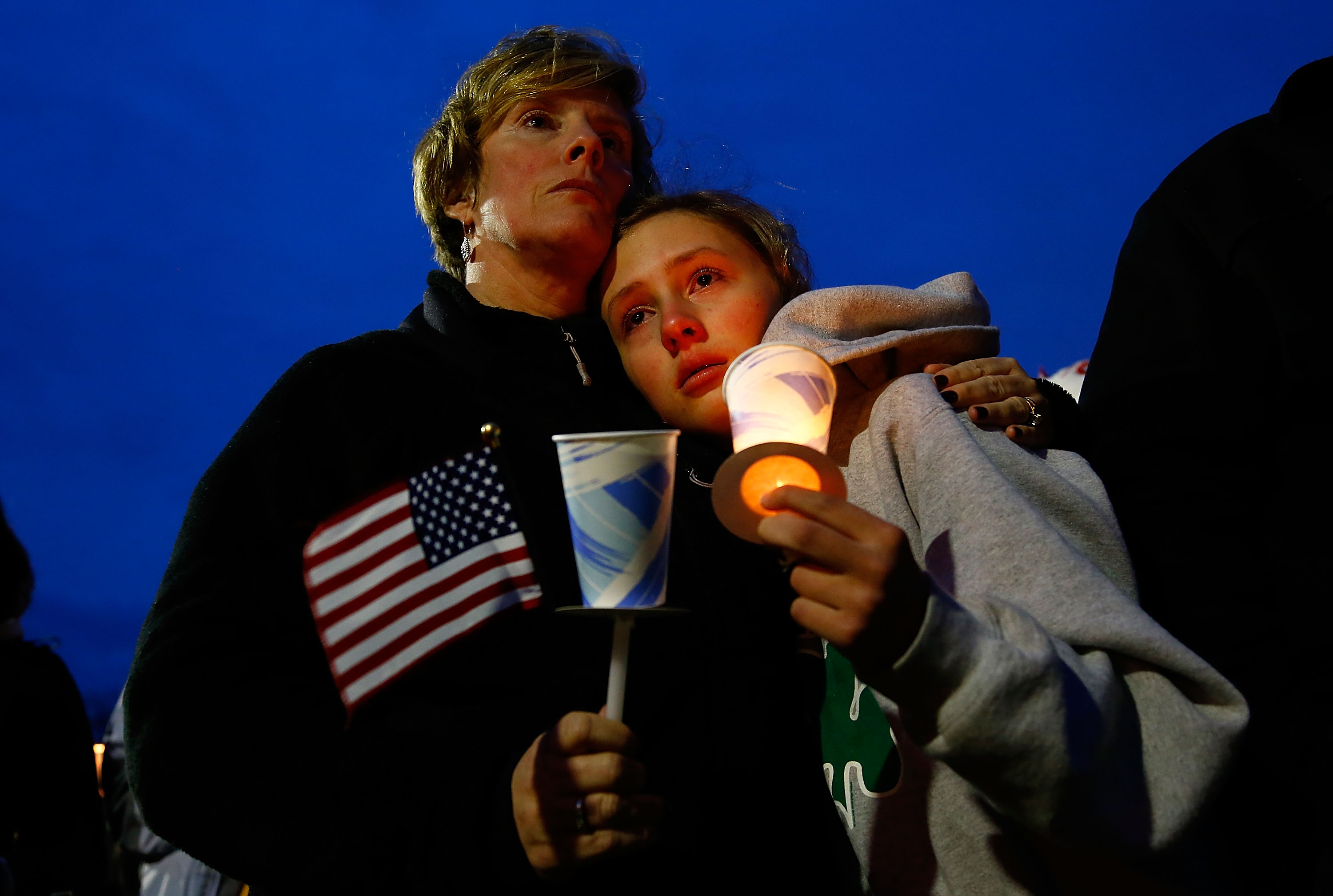
(Photo: A young girl cries with her mother during the vigil for eight-year-old Martin Richard, from Dorchester, who was killed by an explosion near the finish line of the Boston Marathon on April 16, 2013. The twin bombings resulted in the deaths of three people and hospitalized at least 128. By Jared Wickerham/Getty Images)

Face Of The Day

AFGHANISTAN-UNREST-US

An Afghan soldier belonging to the Field Artillery Division of the Afghan National Army (ANA), Kandak 6, checks the barrel of the D30 Howitzer gun prior to a test fire during a training session of ANA soldiers at Forward Base Honaker Miracle at Watahpur District in Kunar province on April 17, 2013. Budget cuts and war fatigue in Western capitals mean the 100,000 soldiers left serving in NATO’s International Security Assistance Force are packing up and taking off as the mission prepares to close next year. By Manjunath Kiran/AFP/Getty Images.

What If Life Ended At Forty?

Tyler Cowen entertains the idea:

I predict many people would become much stricter in their morals and more religious, and they will have children quite early. Other people would attempt to maintain a collegiate lifestyle through their death at age forty.  There would be a polarization of outcomes and approaches to life.  Old age as an equalizer, and as an enforcer of responsible savings behavior, would be gone. The likelihood of warfare would rise, if only because the sage elderly won’t be around and male hormones will run rampant.