How Do You Outlaw Evil?

by Patrick Appel

California Lawmakers Push To Tax And Regulate Ammunition Sales

Even though he admits that gun massacres are “statistically rare,” Gopnik wants to do much more to prevent them. Money quote:

Though, from a cold-blooded accounting point of view, we might be able to survive many more 9/11s, the shiver that one feels writing that sentence reveals its falseness. The nation might survive it, but we would not, in the sense that our belief in ourselves, our feeling for our country, our core sense of optimism about the future, would collapse with repeated terrorist attacks. And so it is with gun massacres, whether in Aurora or Newtown or the next place. Our sense of what is an acceptable and unacceptable risk for any citizen, let alone child, to endure, our sense of possible futures to consider—above all, our sense, to borrow a phrase from the President, of who we are, what we stand for, the picture of our civilization we want to look at ourselves and present to the world—all of that is very much at stake even if the odds of any given child being killed are, blessedly, small. Laws should be designed to stop likely evils; it’s true, not every possible evil. But some possible evils are evil enough to call for laws just by their demonstrated possibility. There are a few things a society just can’t bear, and watching its own kids killed in the classroom, even every once in a while, is one of them.

(Photo: Rounds of .223 rifle ammuntion sits on the counter at Sportsmans Arms on April 2, 2013 in Petaluma, California. In the wake of the Newtown, Connecticut school massacare, California State lawmakers are introducing several bills that propose taxing and regulating sales of ammunition. Another bill is aimed to require a background check and annual permit fee to purchase any ammunition. By Justin Sullivan/Getty Images)

“Watching The Lights Go Out”

by Doug Allen

David Hilfiker, diagnosed with a “progressive cognitive impairment” which is “almost certainly Alzheimer’s” in September 2012, is blogging the deterioration of his capacities:

Friday I decided to walk the family dog and join my grandchildren at the nearby park.  The dog sometimes slips out of her collar and needs a simple harness to keep her on-leash.  But after at least ten minutes of confusion, trying unsuccessfully to figure out how to put the harness on, I had to settle for the collar, stuff the harness in my pocket and, after I’d reached the park, ask my 8-year-old granddaughter Madeline to put the harness on.

But Hilfiker says he doesn’t feel any shame about his confusion:

I’ve been through this [kind of helplessness] before: I suffered from a severe depression for decades before I realized the cause was an organic brain disease. During that period, I was ashamed of my inability to enjoy life; I considered a character defect that I should have been able to overcome.  After I understood that the cause of my depression was an unavoidable chemical imbalance in my brain, however, the shame disappeared.  I was still helpless, but I didn’t have to “try harder” to get over it.

It’s the same thing now.  I’m not embarrassed when I can’t remember ever meeting a person with whom I had a long conversation recently.  I’m not frustrated when I can’t fix a simple problem with my file drawers.  My helplessness is unavoidable.  I am not going to get better no matter what I do; my capacities will decline further.  This is not my fault.

So I don’t fight my inabilities.  I can accept this part of myself as real.  The sadness continues but not so much the pain of helplessness.

Marriage Equality Strengthens Marriage

by Patrick Appel

A reader writes:

All of the responses to your post about the stigma of cheap weddings pretty much underline the point Noah Millman was making in his response to Ross Douthat’s column. Douthat asked proponents of marriage equality to own up to the fact that the rise in interest in same-sex marriage has coincided on a timeline with the “decline” of marriage in our society and to admit that there might be some connection, whether it is apparent or not.

I believe the exact opposite. At a time when so many societal factors, including economics are making marriage less and less popular, the fight for marriage equality is one of the few things that actually promotes the benefits of marital bliss.

Two of your commenters point out that the typical wedding doesn’t cost $27,000, but actually costs $15,000. And what does that say to the larger point? That marriage is so inconsequential to so many heterosexuals that a price tag of $15,000 (not $27,000) is enough to dissuade them from tying the knot. And keep in mind that’s not the minimum cost of getting married… that’s just the cost of having a wedding that keeps up with the Joneses. And again, that price tag isn’t just dissuading people from having a big wedding… it’s keeping them from getting married altogether, something you could do at City Hall for a minimal cost.

That’s part of the bigger point. For a lot of people, getting married is as much about the wedding as it is about declaring your eternal love. It’s about dieting down to your best weight ever, buying an expensive outfit you’ll never wear again and inviting all your friends to witness it in the hopes they’ll talk about, tweet about it, envy you for it and shower you with enough gifts to offset the cost of throwing the party in the first place.

Weddings and marriage are all about stigmas, and once large parts of society removed the stigma of living together and raising children without the party and without the paper, similarly large segments of society just opted out of the whole thing. Once we stopped stigmatizing divorce and went from a society that wouldn’t elect a divorced President to one that doesn’t blink at having morality preached to it by a thrice-divorced man, divorce rates shot up too.

At a time when the sanctity and status of marriage appear to be at an all time low, the fight for marriage equality is reminding us that marriage can still be a beautiful and treasured institution. Suggesting that it is part of the problem is akin to noting that every time there is a fire, fire trucks show up and maybe if we got rid of the trucks, we’d have a lot fewer fires.

Andrew Sprung recently made related points:

Gay activists, or simply the rising visibility of gay couples, have made marriage cool again. They’ve raised its value in my eyes, or rather made me a little more conscious of its value, which is pretty much the same thing.  And I think that the drive for gay marriage has raised the institution’s value materially by making the whole society think hard about what it’s really about.

The west has valorized marriage for true love, as the free choice of two people who decide they’re right for each other, for more than a century. That ideal was getting a little worn around the edges, pecked at by perspectives from biology, and psychology, and probability, and economics, and political ideology — and by postmodern skepticism generally. In real terms, too, the institution as we knew it has eroded, thanks first to divorce and then by advancing tide of out-of-wedlock births.

Gay marriage is not going to change that, or arrest change in this ever-changing but indestructible human institution. But it has made the enduring reality of individual choice and the eternal viability of lifelong commitment and the value and utility of two-parent families a bit clearer.

Map Of The Day

by Patrick Appel

Female Morality Rates

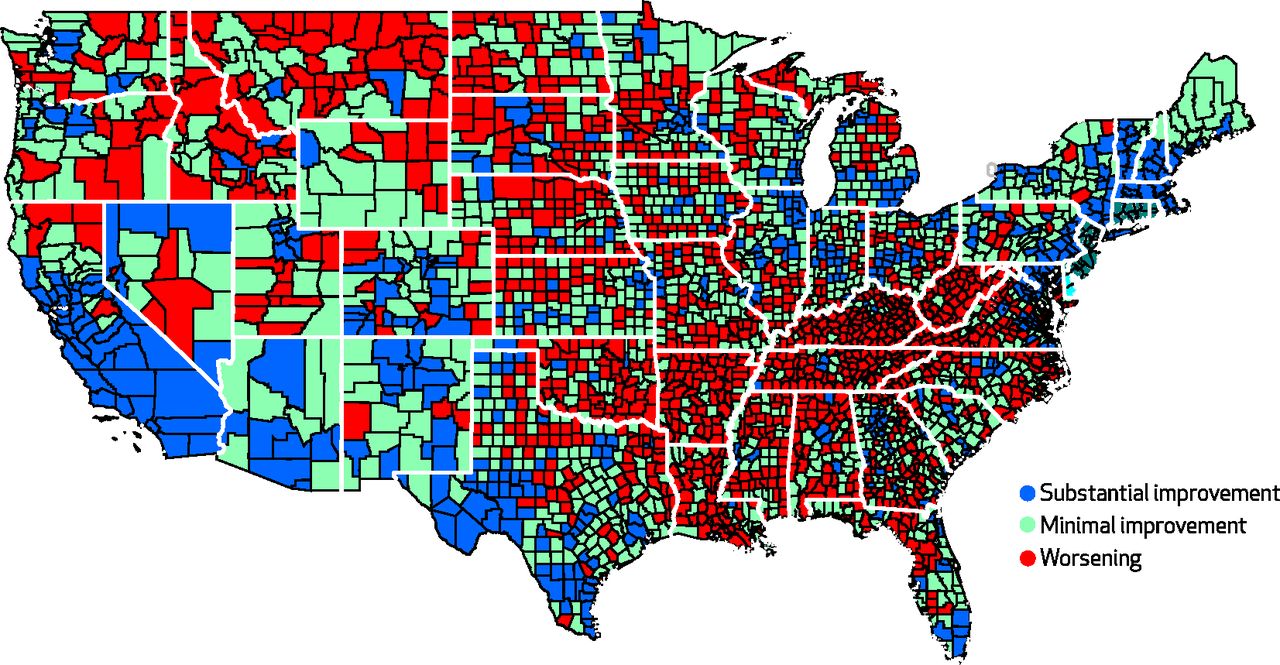
Bill Gardner flags an article [paywalled] that found “female mortality rates increased in 42.8% of counties (male mortality rates increased in only 3.4%).” The geographic breakdown of female mortality rates is mapped above:

This trend is amazing in a historical context. Overall US life expectancy had been increasing steadily over the decades. Before seeing data like these, I had the simple view that increasing life expectancy was part of a general increase in human well-being, powered by the steady growth in economic well-being. In fact, US GDP per capita increased from $24,400 in 1992 to $44,600 in 2006 (in current US $). This is a huge shot for the average American (although it was less for the median American). But a large subgroup of women was apparently left behind.

Ask Josh Fox Anything

by Chris Bodenner

This embed is invalid

[Re-posted from yesterday with several more questions suggested by readers to ask Fox.  It takes less than a minute to vote your preference if you have the time.]

From his Wiki page:

Josh Fox is an American film director and environmental activist, best known for his Oscar-nominated 2010 documentary, Gasland. In addition to this film, he is one of the most prominent public critics of hydraulic fracturing, also known as fracking. In February 2012 he was arrested during a U.S. House of Representatives subcommittee hearing on hydraulic fracturing when he attempted to videotape the proceedings.

Gasland 2 is premiering soon at the Tribeca Film Festival and will air on HBO over the summer. From a recent interview with Josh:

[EnergyWire]: In New York, there’s a moratorium against high-volume horizontal fracking, and efforts to end the moratorium have been slowed, partly by vocal activists like you. Do think “Gasland” is directly responsible for slowing down or blocking fracking in New York and sparking the anti-fracking movement there?

JF: They’re concurrent. I saw an industry white paper on this that shows when “Gasland” came out, there was a big spike and that attention never left the media. “Gasland” brought something to a high level of media attention that might not have been that way before, but what it also did was it showed people from different areas that they had the same issues. It’s a comparative study. It brought people out of their isolation. When you had the media hone in on that film in 32 countries, where 50 million people watched it, that’s incredible to me. I started out doing the film as an exercise for my neighbors [in Pennsylvania]. It was a prayer that we would get into [the Sundance Film Festival].

EW: In our pregame interview, you suggested Democrats and CPAC — the Conservative Political Action Committee — have the same policy on fracking. Could you elaborate?

JF: I wouldn’t say it’s exactly the same policy, but I do think there’s been an embrace on both sides of the aisle. And I don’t think that was done with good science, I don’t think that was done with sound information. The gas industry has this myth that gas is better than coal, but they know it’s no better because of methane leakage problems.

To submit a question for Josh, simply enter it into the Urtak survey after answering all of the existing questions (ignore the “YES or NO question” aspect and simply enter any open-ended question). To vote, click “Yes” if you have a strong interest in seeing Josh answer the question or “No” if you don’t particularly care. Thanks for your help.

Battling Big Soda

by Doug Allen

Amy Fairchild weighs the arguments for and against Bloomberg’s suspended soda ban:

From the glass-half-empty perspective, the policy is a drop in the bucket of what would be required to solve the obesity problem. Setting limits on just a single behavior, in the face of all the other unhealthy choices we must avoid (fried foods, excessive portions, carbohydrates galore), can hardly be expected to turn the obesity tide. Moreover, because the ban contains all kinds of loopholes — it doesn’t set limits on refills, for instance, and it excludes (“on suspect grounds”) “other beverages that have significantly higher concentrations of sugar sweeteners and/or calories” — the charge that it is “arbitrary and capricious” may strike opponents as more descriptive than acerbic. (1)

But from the glass-half-full point of view, the ban is not about attacking individual choice but rather about limiting corporate damage. If we see supersized drinks not in terms of the individual’s freedom to be foolish but instead as a kind of industrial pollution that is super-concentrated in impoverished neighborhoods, (2) limits on drink size become a far different kind of regulatory measure. The target is not the individual: it is the beverage industry, corporate America.

I’ll admit, I have a much more favorable view of this particular act of Bloomberg “nannyism” than Andrew does.Part of that comes from growing up with a pediatric endocrinologist in the house: I spent a lot of my own childhood hearing about children struggling with obesity. I also view this policy as more of a Sunstein/Thaler-style “nudge” than a real ban. If you really need 64 ounces of soda, you’d be able to get it, either through refills or another purchase. In fact, contra Fairchild, I think the refill loophole is a plus as it helps to make this a much softer form of paternalism.

I think that the climbing obesity rates, especially among children, are problematic enough that they merit some sort of action. If the ban is ever reinstated by the courts, it may well prove to be ineffective at reducing caloric intake, at which point I would argue for its repeal. But I think we have to start somewhere, and this seems like a reasonable first step.

Stuck With Hamas

by Brendan James

PALESTINIAN-ISRAEL-FUNERAL-HAMAS

Maysoon Zayid eviscerates Hamas and stresses that their policies of religious persecution and gender-segregation are not what Palestinians are fighting for:

I’m sick to death of hearing that ignorant mantra, “Hamas was democratically elected.” The operative word is “was.” Their term has been up for four years. They are no longer democratically elected; they are warlords, and the Palestinian Authority has gifted them free rein. … Hamas claims to be fighting for freedom while invoking laws that oppress women and religious minorities. As Palestinians, we are striving for equality, not more oppression.

In 2006, I hung out with The Carter Center as they monitored the Palestinian elections. Nobody thought Hamas would win. Hamas did not think Hamas could win. The lion’s share of folks I spoke to who were voting for them were not actually voting for Hamas but against Fatah. They had gotten sick of the blatant corruption and inaction of the Palestinian Authority. They wanted to teach them a lesson. While Fatah was accused of stealing from the people, Hamas provided impeccable social services to the downtrodden. The idea was to put the fear of God in Fatah so they would straighten up, but instead Hamas won—and so did Israel.

Zayid conveys a larger point often lost in the coverage of this conflict: Hamas is not popular in Palestine. They are has-beens and opportunists. Occasionally they receive a boost in support when Israel strikes or the party leadership scores a release of prisoners, but generally they’re a huge disappointment. (A recent poll of both the West Bank and Gaza shows Hamas with support around 12% with Fatah, hardly beloved, around 36%.) If a national government came together and ushered in fresh elections, Hamas could lose serious clout.

On the other hand, Hussein Ibish warns that recently reconfirmed Hamas leader Khaled Mashal may use any reconciliation between Hamas and Fatah as cover to maneuver his way to the head of the PLO:

[I]t’s important not to underestimate the harm this could cause to the Palestinian national movement. Hamas’ policies are strictly inconsistent with those of the PLO, and contradict its treaty obligations. If Hamas joined the PLO with its current policies unchanged, let alone usurped it, the international standing of the PLO – one of the most important achievements of the Palestinian national movement, the value of which no one really questions – would be placed in dire jeopardy.

Palestinians want and need national unity. But the terms are crucial. If such unity in effect means abandoning the positions that underscore the PLO’s standing at the United Nations and other multilateral institutions, and diplomatic relations with well over 100 countries, the price will be exorbitant and disproportionate.

Time I spent kicking around the West Bank originally convinced me that the US and Israel are simply not doing enough to incentivize the formation of a unity government, whose elections would spit Hamas out of the PA soon after it brought them in. After all, the first incarnation of the Arab Spring that cropped up in Palestine was a wave of protests calling for ‘unity’ between Ramallah and Gaza City (which Hamas chose to handle with billy clubs). What if Palestinians got their national unity? The US could bite the bullet, encourage the merger, let Hamas in, watch them shrink into a minority party, and let Fatah lead and handle future negotiations.

But now, considering Mashal’s scheming and some good counterarguments by Michael Koplow in the aftermath of the latest Gaza mini-war, it’s not so obvious it would be that easy to dethrone Hamas. They have a lot of guns, for one thing. And maybe that’s the only thing that really matters.

(Photo: A Hamas militant takes part in the funeral procession. By Mahmud Hams/AFP/Getty Images)

Climate Misdirection

by Doug Allen

John Friedman tires of it:

Everyone — even the most ardent climate change deniers — actually knows that air pollution is bad. I accept that for many the question of rising global temperatures and changing weather patterns remains a question. But rather than continue to debate and discuss whether or not we should be reducing environmental pollution because of the threat of rising global temperatures, can we please all agree to stop arguing in favor of pollution? …

Much as a magician distracts his audience from what they are doing with one hand by getting them to focus on the other, those who loudly and publicly remain skeptical about the impact of these pollutants on the environment at a macro-level never, cannot, and do not attempt to argue the well-established fact that what we are pumping into our atmosphere is altering the chemical composition of the air we breathe (changing the climate) and is now the seventh-leading cause of death in the world.

A Poem For Friday

by Matthew Sitman

Poetry_Out_Loud_MN_finals_27

Alice Quinn, executive director of the Poetry Society of America and the Dish’s amazing poetry editor – she brings you the poems we feature every week – has shared the news that Robert Bly will be presented with the Poetry Society’s highest award, the Frost Medal, at the Society’s annual awards ceremony in their home at the National Arts Club on Gramercy Park in New York City tonight. Details about the ceremony, which is open to the public, can be found here.

To celebrate, we’ve decided to highlight Bly’s poetry this weekend. All three poems will be taken from his most recent book, Talking into the Ear of a Donkey, published by W.W.Norton & Company. Here’s the first of Bly’s poems we’ll be sharing, “The Teapot”:

That morning I heard water being poured into a teapot.
The sound was an ordinary, daily, cluffy sound.
But all at once, I knew you loved me.
An unheard-of-thing, love audible in water falling.

The citation for Bly’s award was written by his fellow poet, Billy Collins, and should provide a sense of the man and his work:

From rural Minnesota to the U.S.Navy, to Harvard, to Iowa, then to Norway on a Fullbright, then New York and back to Minnesota—these were a few of the stops in the travels of the younger Robert Bly, and whatever else he discovered along the way, he learned then to listen to poetic voices not yet clearly heard in America such as Vallejo, Trakl, Kabir, and Rumi. Thus began Bly’s mission to expand the vocabulary, the tonal range, and the imaginative freedom of American poetry by mixing into it the sounds and techniques of other countries and cultures. Jiminez, Neruda, Machado and others would not be so commonly recognized here today were it not for Bly’s enthusiasm for the good these writers could do to enrich our poetry, to correct “the wrong turn,” as he put it, our native poetry had taken before it found itself in a bloodless dead end.

But Bly’s  most persuasive urgings for a more exciting and direct poetry are found in his own poems, beginning in 1962 with Silence in the Snowy Fields. By example, he showed so many poets how to jump from the small into a mystery, how to shuttle quickly between the inner and outer world, how to leap over the fence of logic into strange new fields. So many of us watched with our reading lips moving and our mouths open as he hopped from a teapot to the assurance of love, from the touch of a son’s or daughter’s hand on his shoulder to ‘shining fish turning in the deep sea.’

The Frost Medal celebrates the many roles of Robert Bly—protester, anthologist, translator, myth-maker, story-teller, chimer, image-maker, champion of the father, and citizen of the world inside this world. But what gladdens every alert poet is the good news that their teacher, their liberator is being honored once again.

(From Talking into the Ear of a Donkey © 2011 by Robert Bly. Reprinted with permission of W.W.Norton & Company. Photo of Bly in 2009 by Nic McPhee, via Wikimedia Commons)