14 Bald Eagles Who Are Still Outraged Over Benghazi

by Chas Danner

The NRCC is going listicle for its new website:

The committee spent hours poring over BuzzFeed’s site map and layout, studying how readers arrived at its landing pages and bounced from one article to the next. Unsurprisingly, a ton of traffic came from social media — but a lot of it also seemed to come from the site’s sidebar, said Lansing. So the NRCC’s redesign includes a list of recent and popular posts. Other changes include shorter posts, fewer menu items and a heavy helping of what now passes for social currency on the Web: snark. The new site comes a few months into the beginning of a broader strategy to capture more of the social Web’s attention. To that end, the NRCC has begun dropping blog posts with headlines like “13 Animals That Are Really Bummed on Obamacare’s Third Birthday.”

Pareene pounces:

If an audience exists for a BuzzFeed of the right, BuzzFeed will happily be the BuzzFeed of the right, because capitalism. In fact, they are already producing cheap viral crap for conservatives to like on Facebook. Recent attempts include What It Feels Like Being a Conservative on the Internet, which went viral but was deemed “fail” by the BuzzFeed community, and “7 Things Democrats Would Have Freaked Out About if Bush Had Done Them,” which was voted both “win” and “fail.” The author of that latter piece, Benny Johnson, was hired (from Glenn Beck’s the Blaze) basically explicitly to create viral conservative content.

Waldman is underwhelmed:

So let’s head on over to the NRCC web site and prepare to be amazed. Up top of the site, we’ve got…an opportunity to co-sign the Ryan budget. Skapow! Are you feeling buzzed?!? Below that there is “8 of Our Favorite Martin Luther King, Jr. Quotes,” which does show that the brain trust at the RNC figured out the list thing. But it’s not exactly jumping out of your computer and grabbing you by the lapels.

Ask Dreher Anything

by Chris Bodenner

This embed is invalid

Long-time readers of the Dish know Dreher well. But for everyone else:

Rod Dreher was a conservative editorial writer and a columnist for The Dallas Morning News, but departed that newspaper in late 2009 to affiliate with the John Templeton Foundation. He wrote a blog previously called “Crunchy Con” at beliefnet.com, then simply called “Rod Dreher” with an emphasis on cultural rather than political topics. … Raised a Methodist, he later converted to Roman Catholicism in 1993. He wrote widely in the Catholic press, but covering the Roman Catholic Church’s child sex abuse scandal, starting in 2002, led him to question his Catholicism, and on October 12, 2006, he announced his conversion to Eastern Orthodoxy.

You can follow Rod’s writing at his blog at the American Conservative. He also has a new book out, The Little Way of Ruthie Leming: A Southern Girl, a Small Town, and the Secret of a Good Life:

[The book] follows Rod Dreher, a Philadelphia journalist, back to his hometown of St. Francisville, Louisiana (pop. 1,700) in the wake of his younger sister Ruthie’s death. When she was diagnosed at age 40 with a virulent form of cancer in 2010, Dreher was moved by the way the community he had left behind rallied around his dying sister, a schoolteacher. He was also struck by the grace and courage with which his sister dealt with the disease that eventually took her life. In Louisiana for Ruthie’s funeral in the fall of 2011, Dreher began to wonder whether the ordinary life Ruthie led in their country town was in fact a path of hidden grandeur, even spiritual greatness, concealed within the modest life of a mother and teacher. In order to explore this revelation, Dreher and his wife decided to leave Philadelphia, move home to help with family responsibilities and have their three children grow up amidst the rituals that had defined his family for five generations – Mardi Gras, L.S.U. football games, and deer hunting.

Some praise for the book:

“If you are not prepared to cry, to learn, and to have your heart cracked open even a little bit by a true story of love, surrender, sacrifice, and family, then please do not read this book. Otherwise, do your soul a favor, and listen carefully to the unforgettable lessons of Ruthie Leming.” — Elizabeth Gilbert, author of Eat, Pray, Love

“The Little Way of Ruthie Leming is Steel Magnolias for a new generation.” -Sela Ward, Emmy Award-winning actress and author of Homesick

To submit a question for Rod, simply enter it into the above Urtak survey after answering all of the existing questions (ignore the “YES or NO question” aspect and simply enter any open-ended question). To vote, click “Yes” if you have a strong interest in seeing him answer the question or “No” if you don’t particularly care. View the results here. Thanks for your help.

Cool Ad Watch

by Chris Bodenner

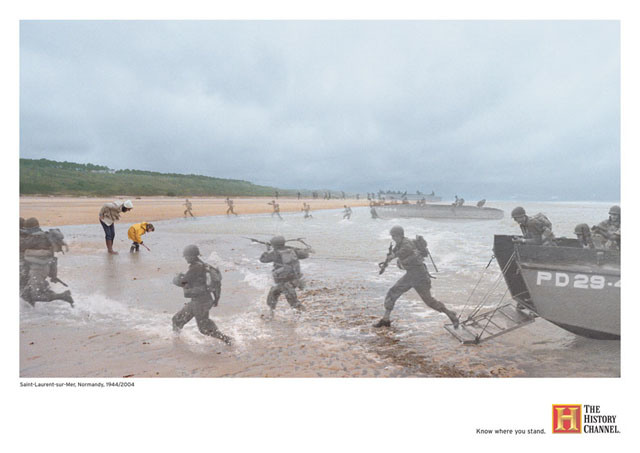
seth-taras_history_know_normandys

EDW Lynch has details:

Photographer Seth Taras created then and now composites out of famous photos of momentous historical events for the 2004 “Know Where You Stand” ad campaign for the History Channel. The campaign was orchestrated by the Ground Zero ad agency and included four tv spots.

Hydrogen Resurgent?

by Doug Allen

Stephen Webster points to new hydrogen fuel research:

Researchers at Virginia Tech announced Thursday that their latest breakthrough in hydrogen extraction technology could lead to widespread adoption of the substance as a fuel due to its ease of availability in virtually all plant matter, a reservoir previously impossible to tap. The new process, described by a study in the April issue of the scientific journal Angewandte Chemie, uses a cocktail of 13 enzymes to strip plant matter of xylose, a sugar that exists in plant cells. The resulting hydrogen is of an such a “high purity” that researchers said they were able to approach 100 percent extraction, opening up a potential market for a much cheaper source of hydrogen than anything available today. …

The rise of such an alternative fuel could seriously disrupt the pollution-producing industries that run on oil and natural gas, and potentially spark a new industrial emphasis on growing plants with high levels of xylose in their cells. The environmental benefits of that potential future are twofold: the plants absorb carbon dioxide from the atmosphere, helping in small part to address the climate crisis, and the resulting portable fuel only outputs water when burned.

Less than ten years ago, hydrogen fuel cell vehicles (HFCVs) were touted as the solution to the transportation sectors fossil fuel woes. The electric car was dead, while Governor Schwarzenegger announced the development of a statewide hydrogen refueling infrastructure to help spur the hydrogen car’s transition to a commercially available vehicle. At the time, I wrote my undergraduate honors thesis on the costs and benefits of Schwarzenegger’s plan, arguing that the high cost of both the cars themselves and the pathways for producing hydrogen fuel made it unclear that the future for HFCVs was any brighter than that for electric vehicles.

Hydrogen technology failed to improve, while advancements in batteries resurrected hopes for the electric car. Now there’s an electric car commercially available (though it’s not cheap) and hydrogen has largely faded from the alternative fuel discussion.

This newest finding is a step in the right direction, but I’m not ready to call it a “gamechanger” for the transportation sector yet. The experience in the early ’00s showed that there’s a significant difference between technologies that seem nearly ready for market (like the HFCV) and technologies that can actually be brought to market (like the Tesla Roadster). I look forward to tests of this new technology on a larger scale, and declines in the cost of HFCVs themselves, but I’m not holding my breath.

The Stigma Against Cheap Weddings, Ctd

by Patrick Appel

Readers’ stories of their small, simple weddings continue to trickle in. The contrast with how wedding celebrations are typically depicted in pop culture is striking. There is nothing inherently wrong with big weddings (my own wedding, which I loved, wasn’t particularly small), but there is something perverse about how our culture focuses more attention on having an ideal wedding, which lasts a day, than on having an ideal marriage, which lasts a lifetime. Another reader shares:

Our family has a long history of avoiding big weddings. My husband’s grandparents ran off to New York City back in the 1920s and got married quietly at the Little Church Around the Corner. My parents were married back in the 1950s in my grandmother’s living room with no more than half a dozen participants (including the minister). Around the same time, my husband’s parents were married in a church with two friends of the bride in attendance as legal witnesses. In each of these cases, the decision to go small was based largely on family dynamics—the mother of the bride objected to the groom—but each of these marriages lasted for many decades until the death of one of the spouses. (And no, nobody was pregnant, in case you were wondering.)

So when my husband and I got married almost 26 years ago, we continued the family tradition and had an extremely small wedding of our own, saving a lot of money and stress in the process.

We gathered at the Justice of the Peace’s tiny office right across the street from the courthouse. The wedding party consisted of ourselves and four immediate family members. I wore a largely white summer dress, and my husband wore his suit. The Justice of the Peace was a veteran lawyer who clearly had done this many times before and played his part to perfection, even changing into a special suit coat for the occasion. That evening, we invited a dozen close friends and immediate family members to dinner and champagne at our favorite Afghan restaurant, followed by homemade cake and present opening at our apartment. I don’t remember how much all of this cost, but it was well under five hundred dollars. Everyone had a great time. And we’re still happily married today.

We sometimes joke about doing it all over again in a more scenic location like a beach or park, and I would definitely have invested a little more money in the wedding rings and gotten solid gold bands instead of bottom-of-the-line gold-plated ones. (Mine was so cheap and so light weight that it fell off my finger a few years later and got eaten by a lawn mower.) But we have no regrets about the size and scope of the wedding.

The funny thing is that even today, most people are shocked when I share this story with them. They simply cannot wrap their brains around the idea that a couple could possibly get legally and happily married with fewer than 200 people in attendance. Perhaps it’s time for us ultra-small wedding supporters to come out of the closet and let people know that it is possible to get—and stay—married without spending a lot of money.

Another reader’s story:

We held our wedding and reception in a community center located in a lovely historic building which cost us a quarter of what we might have spent to rent a generic room in a hotel. We had a potluck reception; rather than our friends and family looking down on us for not spending $50 or $75 a head for banquet food, they loved the chance to be part of the day and it added to the community spirit of the celebration. The food was great and the atmosphere festive. Be true to yourselves and trust those who love you to be happy for you. And if you think someone is going to judge you for how much you are spending on your wedding, is it really worth having them there?

Another reader:

After more than twenty years together, my wife and I found ourselves in Iowa (just after marriage equality arrived there) visiting friends, and got married in a simple ceremony with a magistrate. Our friends and family were irate: how could you have gotten married and not invited us?? So that fall, we had a blow-out wedding for almost 200 of our closest friends and family. I made the invitations myself. Generous friends with a big house and yard hosted, and we also set up a tent outside with tables and chairs for extra room. We asked for no gifts, but made the event pot-luck for local people (we asked out-of-towners to donate to our church’s food and clothing cupboard). We bought wine and beer, and a friend served as bartender. Another friend served as DJ. A couple of family members footed the bill for flowers, and another friend arranged them. Yet another friend took photos. Our church choir, which my wife directs, sang. The food was amazing, the music super danceable, and many folks declared it “the best wedding ever.” We spent about $5000 — for a wedding for 200, that included food and drinks!

Another:

It seems crazy to me that so many people let the intensely intimate act of committing one’s life and love to another person get overshadowed, or consumed, by so many distractions – how much to spend per guest, the politics of guest lists, selfish parents who insist in hijacking the ceremony for their own ends, etc. My wife and I ‘eloped’, but not in a sneaky way. We told (we did not ask) our families, friends and work colleagues we were doing it that way well in advance. We were married in New Orleans before a judge and 2 witnesses. Our wedding day was completely calm, stress-free and focused on each other. We had multiple celebrations with various family members over the next several weeks that were likewise intimate and memorable. Six months later we hosted a big party with a very relaxed guest list – we cared a lot less about who to include and not include for a cocktail party than we would have had it been an invitation to a wedding.

This was definitely not an economically driven decision. This was the way we wanted to do it. I would highly recommend foregoing the traditional wedding for a private exchange of vows and a party later for any couple. Who gives a rat’s ass what other people think about how you do it? It’s your moment as a couple, nobody else’s.
A No Good, Very Bad Jobs Report

by Patrick Appel

Jobs Report

Neil Irwin summarizes today’s report:

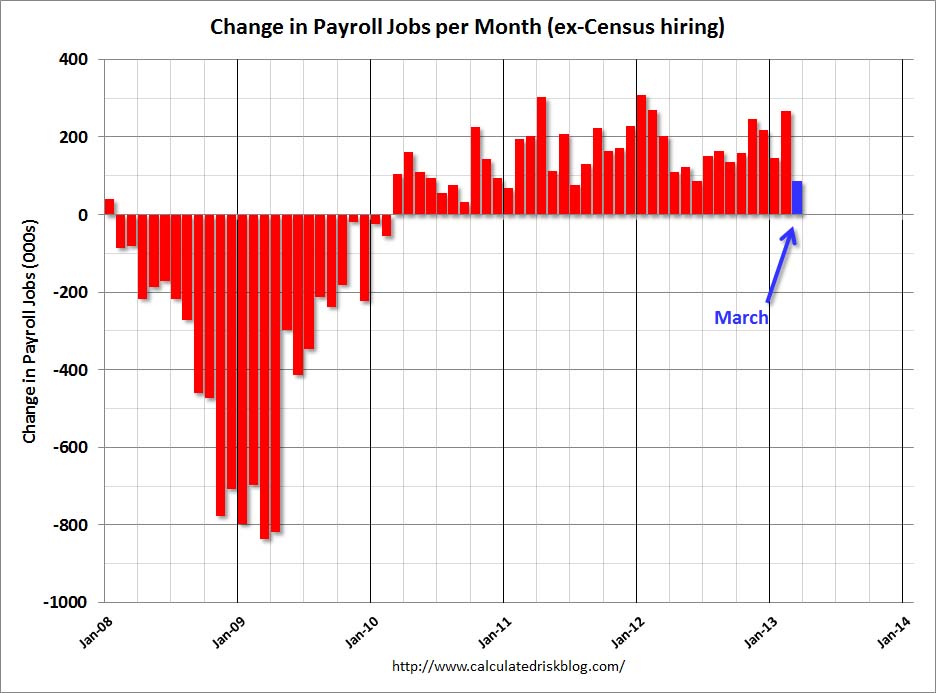
The 88,000 net jobs added in March, if that or a similar figure holds up through revisions, is a tragedy: Nearly four years into the economic recovery, with the unemployment rate still close to 8 percent, the nation recorded a month in which too few jobs were added to keep up with the growing American workforce (that number is more like 125,000). The headline read that the unemployment rate fell to 7.6 percent from 7.7 percent, but it was almost entirely for bad reasons. A whopping 496,000 people dropped out of the labor force, and 206,000 fewer people reported having a job, meaning that the proportion of Americans currently working actually ticked down, not up.

Kevin Drum makes the numbers look even worse:

The American economy added 88,000 new jobs last month, but about 90,000 of those jobs were needed just to keep up with population growth, so net job growth was actually slightly negative at -2,000 jobs. That’s terrible. It’s yet another spring swoon, but even earlier than usual. Ever since the end of the Great Recession we’ve been stuck in an odd pattern where employment growth looks promising in winter and then falls off a cliff in spring, but usually the dropoff doesn’t happen until April or May. We’re early this year.

Ryan Avent’s perspective:

[T]o some extent, this report simply drags expectations back to where they were early in the year, when it was anticipated that fiscal policy would meaningfully slow growth in the first half of the year but allow for an improvement later on. If surprisingly good numbers led some to believe that the American economy could shake cuts off without any effect, then perhaps they were a bit overoptimistic. Hopefully just a bit.

Tomasky fears that the worst is yet to come:

The sequester is not in these March numbers, the pros say. Too early. So that doesn’t necessarily augur well for April. Or May. There are going to be more job losses, particularly in the public sector. Good, you say? Question: How many public-sector jobs have been shed in the last three years? Answer is 648,000. That’s 18,000 every month. I don’t think this has ever happened since the birth of the welfare state, not under any Republican president or Democratic one.

Derek Thompson compares the stock market to the jobs market:

On Tuesday, the S&P 500 and the Dow closed at nominal all-time highs. Three days later, the Bureau of Labor Statistics reported that the economy added a shockingly low 88,000 jobs in March. How bad is 88K? Well, put it this way, we’re theoretically in the midst of an accelerating recovery, and 88K new jobs per month won’t get us back to full employment for another 20 years, or more. I suspect that this will be one of the defining national stories of 2013, and beyond: The big, sustained, and accelerating gap between the working opportunities of most Americans and the profits produced at the top.

And Krugman asks why Washington is focused on budget cuts.

(Chart from Calculated Risk)

The Tweeting Jihadi Expat

by Doug Allen

Omar Hammami, “the most prominent American jihadi left alive,” has established a prolific presence on Twitter under the @abumamerican handle. In an extensive profile of Hammami, Spencer Ackerman describes the development of an unlikely dynamic:

Hammami engages with American security professionals who ask him about his current views on jihad, and he jumps into their discussions of counterterrorism. There’s a notable absence of rancor, and even some constructive criticism, however inadvertent. When Hammami criticized State Department initiatives at confronting extremists like him online, he said those efforts came across as tin-eared. [Extremism analyst J.M.] Berger and Hammami have an extended, public colloquy about the justification and the efficacy of using violence to pursue jihad. All this comes leavened with Star Wars references. Berger wonders if this sort of collegial jihadi-counterterrorist dialogue is “the wave of future, when everyone’s on Twitter.”

Jihadis and their American opposites have engaged each other over the Internet for years, notes Will McCants, a former State Department terrorism adviser. But usually those efforts are tentative and rarely substantial — let alone fun. What’s happening with Hammami is something new.

A Different Sort Of Adulterer?

by Patrick Appel

Noah Millman compares Mark Sanford to other politicians who cheated on their wives:

We are willing to forgive our politicians for a multitude of private sins, because really what we care about is that we come first. They can treat their spouses and children abominably if we know that at the end of the day all they really care about is winning. Because to win they have to do what we want. Or at least convince us that they have.

But a man who might throw it all away because he’s convinced he’s finally found his soul mate? That doesn’t sound like an alpha dog people are going to want to follow slavishly. Nor does it sound like somebody ruthlessly determined to stay on the right side of his constituents. It sounds like somebody who can be overcome by emotion. It sounds almost . . . human.

Nate Cohn thinks that Sanford could cost the GOP an easy seat.

The Dawn Of Pawn

by Chas Danner

An example of early-style Staunton Chess Set

Jimmy Stamp traces the design-origins of the modern chess set:

Prior to 1849, there was no such thing as a “normal chess set.” At least not like we think of it today. Over the centuries that chess had been played, innumerable varieties of sets of pieces were created, with regional differences in designation and appearance. As the game proliferated throughout southern Europe in the early 11th century, the rules began to evolve, the movement of the pieces were formalized, and the pieces themselves were drastically transformed from their origins in 6th century India. Originally conceived of as a field of battle, the symbolic meaning of the game changed as it gained popularity in Europe, and the pieces became stand-ins for a royal court instead of an army. Thus, the original chessmen, known as counselor, infantry, cavalry, elephants, and chariots, became the queen, pawn, knight, bishop, and rook, respectively. By the 19th century, chess clubs and competitions began to appear all around the world, it became necessary to use a standardized set that would enable players from different cultures to compete without getting confused.

That set would come about because of Howard Staunton, a London chess player and promoter who introduced and popularized the design that is now ubiquitous throughout the world:

According to the most widely told origin story, the Staunton set was designed by architect Nathan Cook, who looked at a variety of popular chess sets and distilled their common traits while also, more importantly, looking at the city around him. Victorian London’s Neoclassical architecture had been influenced by a renewed interest in the ruins of ancient Greece and Rome, which captured the popular imagination after the rediscovery of Pompeii in the 18th century. The work of architects like Christopher Wren,William ChambersJohn Soane, and many others inspired the column-like, tripartite division of king, queen, and bishop. A row of Staunton pawns evokes Italianate balustrades enclosing of stairways and balconies.

(Photo: An example of early-style Staunton Chess Set. By Frank A. Camaratta, Jr./ The House of Staunton, Inc. via Wikimedia Commons)