It Takes A Village

by Patrick Appel

Mark Oppenheimer reflects on the aspects of parenting he outsources to others:

Parenting has made me painfully aware of all the skills I don’t have, all that I won’t be able to pass on to my children. Before the children arrived, the future was full of possibilities for the dad I would be: the one who would teach them to play guitar, to garden, to turn table legs with a lathe. All I had to do was learn how to play guitar, to garden, and to turn table legs with a lathe. Also to chant Torah, change the oil, and throw a football with a perfect spiral. And there was plenty of time for all of that.

But then the girls arrived, in short order, all three of them. I found skills I never knew I had, like holding an infant on my forearm, her head in my palm. I once changed a cloth diaper so deftly that my friend Derek was startled to realize it was cloth. “You did that just like a regular diaper!” he said. That was one of my proudest moments. I’ve been known to take all three girls—ages two, four, and six—to the supermarket together, pilfering only one banana and one plastic carton of blackberries to keep them in line. (Shamed by the empty carton and the empty peel, I paid up.) But for all the skills I never expected I’d have, there are more that I know I’ll never acquire.

The Bitcoin Bubble

by Patrick Appel

Bitcoin_Market_Cap

Felix Salmon worries about it:

If millions of people started using bitcoins on a regular basis, the soaring value of bitcoins would actually be disastrous. You’ve heard of hyperinflation: this would be hyperdeflation. Take a gold bar valued at $600,000. At $60 per bitcoin, the value of that bar is 10,000 BTC. But then assume that bitcoins rise in value to $600 apiece, and then to $6,000, and then to $60,000 — as would have to happen if the fixed number of bitcoins was being used to store hundreds of billions of dollars in value. Then the value of the gold bar would plunge, in bitcoin terms — to 1,000 BTC and then 100 BTC and finally just 10 BTC. The same thing would happen to all other goods and services in the world, including your own salary. Everything would be constantly going down in price, if you thought in bitcoin terms.

Inflation is bad, but deflation is worse. The reason is that in a deflationary environment, no one spends money — because whatever you want to buy is sure to become cheaper in a few days or weeks. People hoard their cash, and spend it only begrudgingly, on absolute necessities. And they certainly don’t spend it on hiring people — no matter how productive their employees might be, they’d still be better off just holding on to that money and not paying anybody anything.

The result is an economy which would simply grind to a halt, with massive unemployment and almost no economic activity.

The Gitmo Hunger Strike

by Zoe Pollock

Last weekend Amy Davidson crunched the numbers on it and found that “there are six times as many [Gitmo] prisoners on hunger strikes as there are those who have actual charges lodged against them.” Olga Khazan is pessimistic that the strike will accomplish anything:

Nearly 70 percent of hunger strikes occur in prison, and government entities are the target of the vast majority of them, according to research by Stephen J. Scanlan, an associate professor of sociology at Ohio University, who examined hunger strikes over the past century. Few (6 percent) of hunger strikers die. Rather, about three-quarters of these protests are called off voluntarily — usually because demands have been met, at least to some extent. What’s more, Scanlan found that nearly 76 percent of strikers get at least some of what they want. …

However, hunger strikes are most effective when the protesters’ predicament presents an obvious solution, something Guantanamo doesn’t necessarily have. President Obama pledged years ago to close the facility, but now that the detainees are banned from the U.S. and can’t be sent back to their home countries out of fears that they’ll join back up with terrorist groups, they’re effectively living in a geographic and legal limbo.

Reality Check

by Patrick Appel

Marijuana_Majority

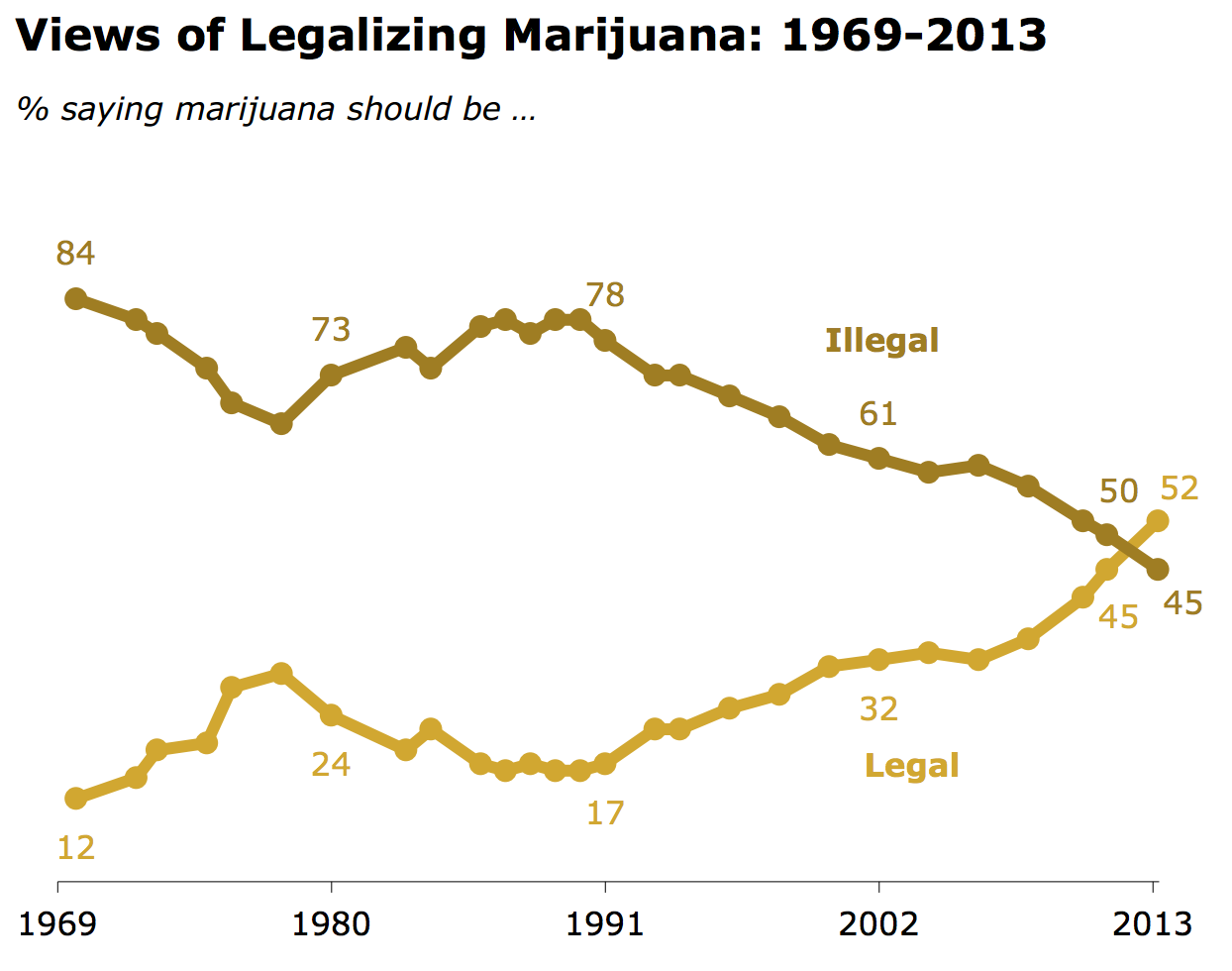
Pew’s latest finds increasing support for marijuana legalization:

There are partisan differences over legalizing marijuana use and whether smoking marijuana is morally wrong. But Republicans and Democrats have similar views on enforcing marijuana laws: 57% of Republicans and 59% of Democrats say that the federal government should not enforce federal marijuana laws in states that permit its use. Substantial majorities of both Republicans (67%) and Democrats (71%) also say federal enforcement of marijuana laws is not worth the cost.

Immigration Reform Is More Popular Than The GOP

by Patrick Appel

After reviewing public opinion on immigration reform, Harry Enten finds that “overwhelmingly majority of Americans now believe that people who came to this country illegally should not be forced to leave it.” He thinks that opposing reform could hurt Republicans:

The real problem for the Republican party is that its brand is currently in the can. With favorable numbers in the low 30s, the GOP is seen as out-of-step with Americans on many issues.

That’s why you’re seeing Democrats jumping out to a large lead on the House ballot for 2014. The latest Quinnipiac poll puts Democrats up by 8pt, more than enough for them to take back the House. Voters are, at this point, not willing to vote for the party that opposes what they believe in. What Republicans don’t need, then, is another issue – that is, immigration – that contributes to notion that they’re out-of-touch with the way most Americans feel.

Opposing immigration reform would be yet another instance of GOP “obstructionism”, which is what most people see as the Republicans’ biggest fault.

The Fracking Divide

By Doug Allen

UKRAINE ECOLOGY-GAS-PROTEST

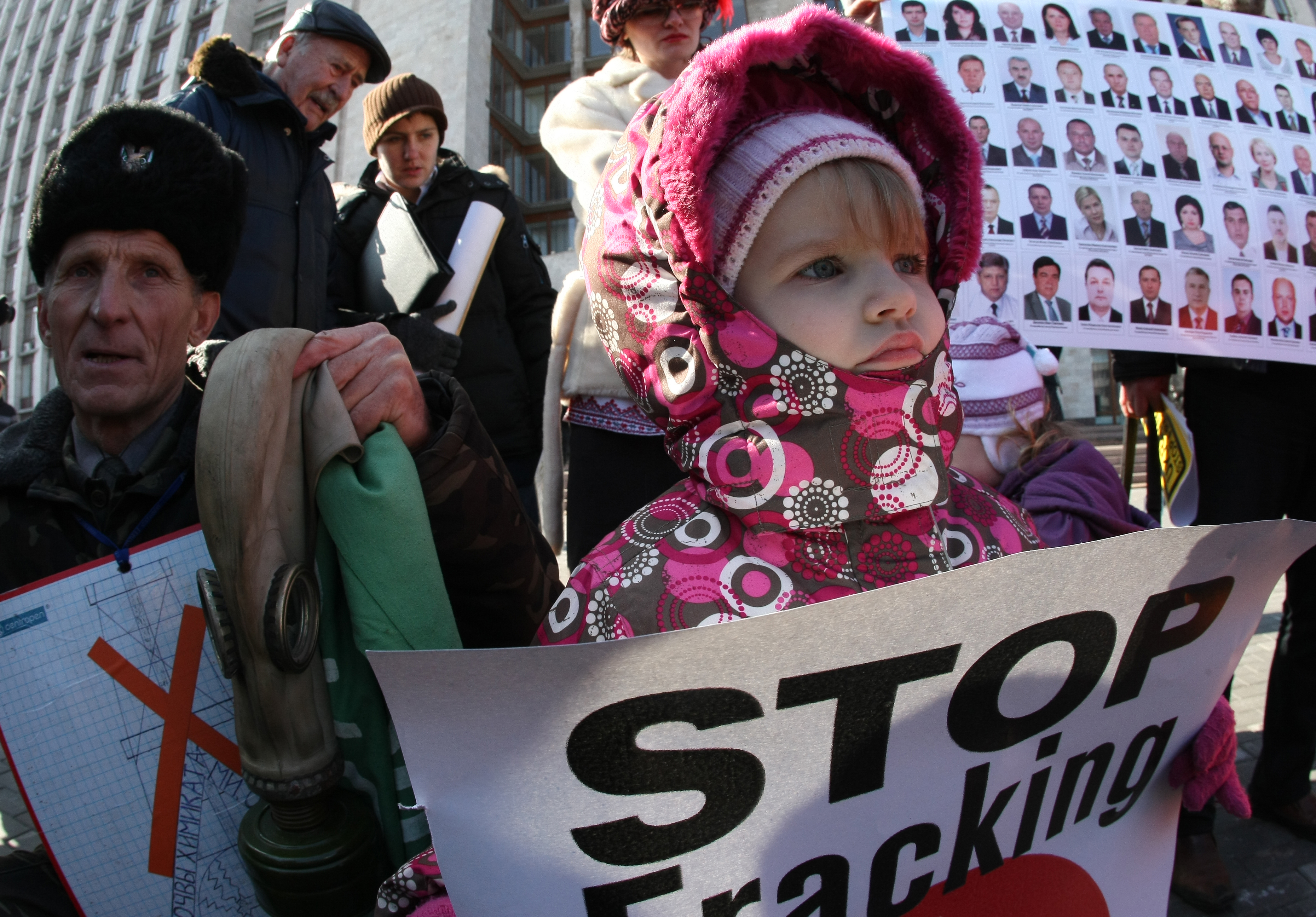
Kevin Drum thinks the recent Citigroup report that sees natural gas as a major ally for renewable deployment will cause some tension among environmentalists:

If this analysis is correct, it’s going to provide some major heartburn for environmentalists. Fracking, for all its dangers, may turn out to be the least of our various fossil fuel evils.

Jason Mark focuses in on how this issue is dividing green advocates:

[S]ince the fracking boom began in earnest, a larger, anti-fracking grassroots has emerged. … Some homeowners had their wells contaminated with flammable methane. Places like Ohio and Arkansas that weren’t used to seismic activity started to experience earthquakes when underground wastewater injections stimulated geologic faults. Today, the movement against gas fracking has become a cause célèbre (Yoko Ono and Mark Ruffalo have an “Artists Against Fracking” group) and is one of the most invigorating issues among grassroots environmentalists. …

[Ted] Nordhaus and [Michael] Shellenberger [of the Breakthrough Institute] have a nearly opposite worry: that the intensity from [anti-fracking] partisans like [Sandra] Steingraber and [Maura] Stephens has forced some big green groups to retreat from gas. The World Resources Institute, a D.C.-based environmental research organization, is an example of that shift. As recently as early 2012, the organization was expressing qualified enthusiasm for gas as a “potential game changer” that “should be part of America’s low-carbon energy mix.” But when asked recently to comment on the gas controversy, Jennifer Morgan, director of the institute’s climate and energy program, chose her words carefully. “It’s an extremely fraught and tough discussion,” Morgan told me. “I think we recognize both the risks—and the risks are significant—and the potential opportunity.”

I’m pretty firmly in the Nordhaus/Shellenberger camp on this one. Among the resources that can provide the operational support needed for high levels of renewable penetration in our energy mix, I think natural gas strikes the best balance between cost and environmental impact. It would take major advances in energy storage or “clean coal” technologies to convince me otherwise.

This does not mean that we shouldn’t worry about the problems caused by natural gas extraction and transport. There is evidence [pdf] from the Marcellus Shale formation that natural gas wells were contaminating local groundwater resources, but the study’s authors were unable to determine whether the leakage was due to unplanned fractures or leaky well-casings. It seems to me that the latter is solvable through better industry standards and/or regulation, while the former is a more fundamental problem. Studies from Arkansas [pdf] and Wyoming are similarly inconclusive about the link between fracking and water contamination.

The other major uncertainty surrounding the environmental impact of natural gas is the effect of methane leakages, or “fugitive methane emissions” along the delivery chain. These leakages are especially problematic since methane is a much more “powerful” greenhouse gas, with 25 times [pdf] the heat-trapping ability over 100 years of CO2. Michael Obeiter and James Bradbury explain the implications:

At the point of combustion, natural gas is roughly half as carbon-intensive as coal. However, this comparison fails to account for upstream fugitive methane emissions. When used for electric power generation, natural gas is typically much more efficient than coal, but natural gas is not a more energy efficient fuel option for all uses—for example, in the case of vehicles. Also, if fugitive methane emissions exceed 3 percent of total gas production, natural gas’s climate advantage over coal disappears over a 20-year time horizon.

The critical question is: Given the current extent of U.S. natural gas production—and the fact that production is projected to expand by more than 50 percent in the coming decades—are we doing everything we can to ensure that emissions are as low as is technologically and economically feasible? The answer to that question today is clearly “no.”

Clearly, there is more information to be gathered about the environmental impact of extracting natural gas and using it for electricity generation, and I look forward to the conclusion of a currently running EPA study to fill in some of the gaps in our knowledge. Even before the conclusion of this study, however, I would like to see the EPA start looking into ways to eliminate leakages where it is “technologically and economically feasible,” whether below the surface or above. But until I see more convincing evidence indicating that fracking cannot be done safely and cleanly, I think natural gas will continue to be an important part of any long-term strategy to reduce emissions.

(Photo: Alexander Khudoteply/AFP/Getty Images)

“Collars for Dollars”

by Brendan James

Harry Levine explains the incentives in law enforcement that produce so many marijuana arrests:

Police work can be dangerous. Ordinary patrol and narcotics police like the marijuana arrests because they are relatively safe and easy. If an officer stops and searches 10 or 15 young people, one or two of them will likely have a bit of marijuana. All police have arrest quotas and often they can earn much-desired overtime pay by making a marijuana arrest toward the end of a shift. In New York City, arresting people for petty offenses for overtime pay is called “collars for dollars.” Every cop in the city knows that expression. From the officers’ point of view, people possessing marijuana are highly desirable arrestees. As one veteran lieutenant said, people whose only crime is marijuana possession are “clean,” meaning physically clean. Unlike junkies or winos, people arrested for marijuana don’t have HIV, hepatitis, or even body lice. They are unlikely to throw up on the officer or in the police car or van. Frequently they are on the way to a party or a date, and if they have smoked a little, they may be relaxed and amiable. Marijuana arrests are a quality of life issue – for the police.

By the by, here in NYC under Mayor Bloomberg, the police round up more pot smokers every year than the total number of arrests under Koch and Dinkins combined.

Ask Andrew Anything: What Made You Turn Against The Iraq War?

by Chris Bodenner
[vimeo http://www.vimeo.com/63292312 w=580&h=326]

The article about missing WMDs that Andrew refers to, “So Where Are They?”, is here. A key passage:

The third explanation is that our intelligence was radically wrong – or politically manipulated for effect. It certainly wouldn’t be the first time that U.S. and British intelligence got things wrong, although in many cases, such as North Korea or India, they have erred in the direction of complacency. Or it could be that the range of possibilities discovered by intelligence was presented by the politicians in the worst possible light so as to win public support. I’ve no doubt that was partly the case. That’s what politicians do. They make a case based on evidence. Others were free to make alternative cases, and they did. Currently, we simply don’t know what happened either in intelligence gathering or the political use of the data. But we should. After a decent period of time to gather all the possible evidence, there should indeed be a thorough inquiry into whether and how the case for Saddam’s imminent WMD threat was made.

But in some ways, these matters, while important, still don’t get to the heart of the matter. The fundamental case for getting rid of Saddam was not dependent on the existence of a certain amount of some chemical or other.

It was based on a political and military judgement. Once the threat from Islamist terror was self-evident, it would have been irresponsible for any political leader to ignore the possibility of a future attack with WMDs. It was and is the obvious next step for an operation like al Qaeda. Further, the war against terror, from the beginning, was always directed not simply at terrorist groups, but at the states that aided and abetted them. The key point is that Saddam’s Iraq was a clear and present danger in that context. What mattered was not whether at any particular moment Saddam had a certain specifiable quantity of botulinum toxin. What mattered was his capacity to produce such things, his ability to conceal them, and his links to terrorists who could deploy them. No one can doubt that he had had them at one point, was capable of producing them, and was linked to groups who would be only too happy to use them. That was and is the case for getting rid of him. It’s as powerful now as it was in January.

Finding Cash Cow

by Patrick Appel

Ellen announced Finding Nemo sequel Finding Dory on her show a couple days ago:

Christopher Orr is dispirited by the rash of Pixar sequels. He suspects Finding Dory was green-lighted because Nemo was “the third-highest grossing animated film—and the best-selling DVD overall—of all time.” A silver lining:

What I do know is this: If Pixar’s films seem to have been slipping back into the pack of excellent-but-not-transcendent animated features of late, it is in part because that pack has dramatically lifted its game. Kung Fu PandaHow to Train Your DragonDespicable MeTangledRise of the Guardians, and a dozen other recent offerings—animated filmmaking has rarely, if ever, produced such quality in such quantity. And it is very, very hard to imagine that this would have happened if Pixar hadn’t been around to show Hollywood that animated films could be such good films (and, not incidentally, such profitable ones).

How Alyssa thinks about sequels:

I can easily see a sequel to The Incredibles that focuses not on the grown-up Parrs, whose arc is largely resolved, but on their children, who are growing up superpowered in a world where the use of their abilities is technically illegal. For all that I’m charmed by the idea of Monsters University, I don’t see the necessity of an origin story for Mike and Sulley, just as I don’t feel particularly drawn to spend more time with Dory, the cheerful, forgetful fish voiced by Ellen Degeneres in Finding Nemo. For sequels to be artistically necessary, there needs to be some sort of narrative or character-driven urgency to them.

Iraq Wants Our Drones

by Brendan James

A couple Iraqi intelligence officers say their government asked the US for strikes against jihadis on the Syrian border. Obama declined. Micah Zenko, relieved, provides some background:

In March, the Wall Street Journal reported that the CIA had increased its covert training and support efforts to enhance Iraq’s Counterterrorism Service forces that are focused on AQI [al-Qaeda in Iraq] or [Syrian jihadist] al-Nusrah militants that threaten western Iraq. A senior Obama administration official stated: “This relationship is focused on supporting the Iraqis to deal with terrorist threats within their borders, and not about ramping up unilateral operations.” Training and advising another state’s security forces is a normal component of military to military cooperation, but conducting kinetic operations for them could quickly draw the United States into creating additional enemies out of what are domestic and regionally-focused terrorist groups.

The CIA already serves as the counterterrorism air force of Yemen, and, occasionally, Pakistan. It should not further expand this chore to Iraq.

Extending the drone campaign to Iraq to to combat Syrian insurgents sounds like a profoundly poor idea that, as Zenko points out, could very quickly spin out of control. Given Obama’s rejection of the Petraeus-Hillary plan to directly arm Syrian rebels and his interest in preserving his legacy on Iraq, it’s hard to imagine him touching that border as things stand.

But proof has been mounting for a while now that jihads in Iraq and Syria travel back and forth with ease, and have comingled to the point that State has labled them the same operation. The obvious snag is that we want Bashar’s regime to fold and Maliki’s to hold up. The jihadis, of course, don’t distinguish the two, and right now their success against Bashar contributes to instability in Iraq, and vice versa. It’s quite a nasty cycle, one we’ll have to break at some point soon.