A reader quotes the president yesterday:
When a U.S. citizen goes abroad to wage war against America – and is actively plotting to kill U.S. citizens; and when neither the United States, nor our partners are in a position to capture him before he carries out a plot – his citizenship should no more serve as a shield than a sniper shooting down on an innocent crowd should be protected from a swat team.
President Obama (and you) may feel that way, but the Constitution says otherwise. There’s no “unless he’s a terrorist” exception anywhere in that document; if you’re a citizen, you’re entitled to due process. If you and the president find the Constitution to be inconvenient, I suggest that you petition your respective representatives to Congress and ask them to amend it. Due process isn’t a luxury; it’s the dividing line between being a nation of laws and a nation of presidential death squads. We are better than this.
Give me a break. If you have joined up with an army of the enemy and are involved in the planning and execution of mass murder and intimidation of American citizens, and you cowardly choose to launch such attacks from a foreign country where you cannot easily be captured, you have forfeited the rule of law for the rules of war.
When you take up war against your own country, you are a traitor. When you do so on the battlefield itself, and join the enemy’s army, and declare war on your fellow citizens, there is no reason on earth why, after careful sifting of the evidence, the US president shouldn’t fight back by the same means you have chosen. And, look, there is no constitutional question here. Ex parte Quirin (1942) has established the constitutionality of defending this country from traitors who have joined the enemy’s army abroad. Most of the traitors captured in that case were sentenced to death by military commission, as authorized by the executive branch. They were executed outside the civilian justice system. Another reader:
You criticized George W. Bush harshly and appropriately for his suspension of habeas corpus of suspected terrorists (American or not) during his administration and in fact revisited that criticism during the South Carolina Republican Presidential debate when you said, sarcastically, referring to the Republicans, “Habeas corpus is no big deal because presidents don’t abuse power. Unlike monarchs, I suppose. This is the party of restoring the Constitution?” And yet, in a jaw dropping show of chutzpah, you defend Obama when he says referring to an American terrorist suspect, “his citizenship should no more serve as a shield than a sniper shooting down on an innocent crowd should be protected from a swat team.”
So in your warped sense of government, it’s unthinkable to imprison a person indefinitely without judicial review under presidential fiat but killing a U.S. citizen without judicial review under presidential fiat is just prudent policy. This from a person who is against the death penalty, for heaven’s sake. Life imprisonment without judicial review sounds a lot better than getting killed via Hellfire missle.
I just want to know, what unconstitutional act would this president have do in order for you to criticize him? By my figuring, a limited support role in Libya in violation of the War Power’s act will get some criticism from you but an out-and-out violation of the 5th Amendment that expressly limits the government’s power against its citizens gets support and lauding. Unbelievable.
It would be if it were true. I have harshly criticized the failure to live up to the Geneva Conventions by initiating prosecutions of war criminals. I have criticized not releasing the Yemeni prisoners. I want GTMO bull-dozed. I have urged more caution on drone warfare. I have called for the release of even the 50 most dangerous suspected terrorists. But my reader tries to make a rhetorical point about a choice between detention without trial or murder by hellfire missile. Those are not the choices. If Awlaki were to turn himself in, he would be given proper due process and a civilian trial. But since he cannot be captured and brought to justice, and since he is at war, trying to kill American citizens, a commander-in-chief has a duty to fight back.
My readers seem to have no grasp of the concept of war, as opposed to peace, or a deliberately distant and unreachable battlefield in a foreign country, as opposed to a citizen at home. I wonder if the word “treason” has any meaning for them at all. They keep acting as if Awlaki is a suspected criminal in the US and just arbitrarily murdered by the government. It just baffles me that the actual context is just absent in their analyses. Another reader:
I’m afraid you’re missing a key point about what the president said in the speech. Drones are NOT about just Awlaki, even if I don’t share your own view on that matter (there’s a difference after all between a police sniper taking an in the moment judgment call and a the pre-meditated murder of an American citizen, however vile, by an executive without judicial oversight). In theory, the President’s case today could have been more convincing if what his administration has consistently done is actually identify targets ahead of time that are worthy of assassination. But by far the most controversial component of the drone program (morally to be sure) is the use of so-called ‘signature strikes’, which requires no prior identification of individuals being targeted.
That ridiculously low standard, coupled with the administration’s own past broad grouping of those who can be targeted (“The definition is a male between the ages of 20 and 40” as former Ambassador to Pakistan, Cameron Munter, said previously), makes any claims to self-policed rigor utterly fatuous.
That is a standard you simply would not have allowed for Bush. Why the crickets now? I say that knowing that you have criticized Obama for not clearing up drone usage before. Well, here was his chance. Where was the legal basis now? Setting up drones as an alternative to Bush’s wars or torture is a straw man, and nothing more.
It is only a straw man if you have no actual responsibility for the security of the country. And the president has clearly signaled a winding down and eventual end to the drone strikes. And he argued for a clearer and more transparent process. He went a great distance in addressing the real concerns of all of us about the endless war, and yet we still get this continued self-righteous obloquy on the man.
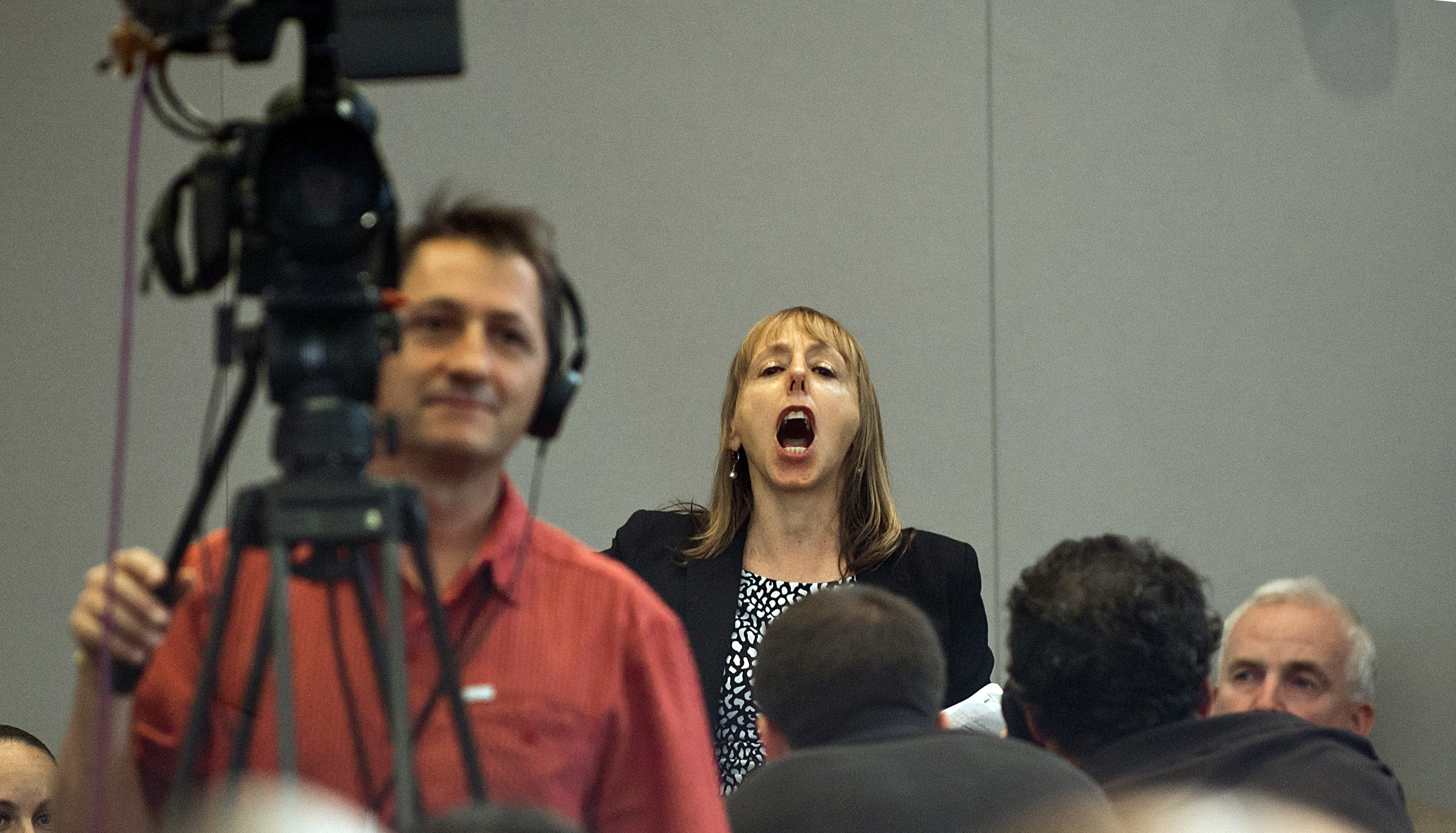
(Photo: Medea Benjamin, a protester and co-founder of Code Pink, shouts as US President Barack Obama speaks about his administration’s drone and counterterrorism policies, as well as the military prison at Guantanamo Bay, at the National Defense University in Washington, DC, May 23, 2013. By Saul Loeb/AFP/Getty Images)
 The Dish