An Eye For Mental Illness

dish_gc3a9ricault

From Ferris Jabr’s round-up “A Brief History of Mental Illness in Art,” Kate Davey features the work of Théodore Géricault:

Géricault’s Monomaniac series once consisted of ten portraits of the mentally ill, however, only five have survived into the present day. The surviving paintings include the Monomanie du commandment militaire (Napoleonic veteran suffering from the delusion of military authority), Monomanie du vol des enfants (A compulsive kidnapper), Monomanie du vol (A kleptomaniac), Monomanie du jeu (A compulsive gambler) and Monomanie de l’envie (A woman suffering fits of neurotic jealousy).

The term ‘monomania’ was first coined by French psychiatrist Jean-Etienne Esquirol, and it was an exclusively nineteenth century term referring to a person who was outwardly well, but harboured one obsessive fixation. The portraits themselves and the context within which they were painted raise many questions regarding the state of psychiatry and the treatment of the mentally ill at the time, the public’s view of the mentally ill, the progression of science and the morbidity and tragedy that art encompassed during this period. The reason for the portrait’s creation can be interpreted in a number of ways, ranging from the rarer thought that it was encouraged as a therapeutic exercise for Géricault by his psychiatrist, to the more widely received idea that the paintings were produced as part of a commission from psychiatrist Dr Etienne-Jean Georget.

Many more Géricault portraits here.

(Image: La Monomane de l’envie, Jean-Louis André Théodore Géricault, c. 1822, via Wikimedia Commons)

In Search Of Universal Truths

Kevin Hartnett traces a line from today’s massive open online courses (MOOCs) controversies to the dawn of education by textbook:

Before textbooks, learning typically happened through the dialogic method—exchanges between students and professors. But beginning in the 18th-century, scholars began redacting blocks of information into standardized books that laid out content in logical, easily digestible fashion. The goal of the textbook, according to one 18th-century French pedagogue, was to “make all truths universally familiar, and spare [ourselves] any useless effort in learning.”

The modern day textbook wars have taught us, of course, that one man’s universal truth can be another man’s heresy. [Scholar Hansun] Hsiung explains that these types of concerns were present with textbooks from the start. 18th-century Europeans worried about who had the authority to write textbooks and, as textbooks took hold, there was a backlash against the idea that a real education could take place through a book. In this way, textbooks spawned similar concerns to the ones we grapple with around MOOCs— that it’s dangerous to have a single, massively popular online course dominate the way a particular subject is taught, and that there’s only so much learning that can take place through a computer.

A couple weeks ago, Nathan Heller reported from inside the academy on views towards MOOCs:

To [historian Peter K. Bol], MOOCs look like a victory for open-access scholarship. “The question for us here was: How do you take what you’re teaching to a very small group and make it accessible to a large group?” Bol told me late one morning in his office, a kind of paper jungle piled with journals, manuscripts, and books. “Unless I’m writing popular books, I’m not reaching those people. I’m not telling them stuff that I’ve worked hard to try to understand.”

Others, like my ex-boyfriend Andy Conway at Princeton, are suddenly Internet stars – because they’re good at teaching. But not everyone is enthused:

In mid-April, the faculty at Amherst voted against joining a MOOC program. Two weeks ago, the philosophy department at San José State wrote an open letter of protest to Michael J. Sandel, a Harvard professor whose flagship college course, Justice, became JusticeX, a MOOC, this spring. “There is no pedagogical problem in our department that JusticeX solves,” the letter said. The philosophers worried that the course would make the San José State professor at the head of the classroom nothing more than “a glorified teaching assistant.” They wrote, “The thought of the exact same social justice course being taught in various philosophy departments across the country is downright scary.”

Then create and teach a better one.

The Female Gaze

dish_pinuppic

Lisa Hix explores the history of female pin-up painters from the genre’s Golden Age, the 1920s through the early 1960s:

“If you really get into it, you begin to see that women have a different way of portraying women than men do, even when they’re all trying to do something sexy for a pin-up calendar or a magazine,” [pin-up art expert Louis K.] Meisel says. “There is a certain sexy look, with black stockings, garters, and emphasis on [Gil] Elvgren, [Alberto] Vargas, and other male pinup artists do. I would say that the women portray very beautiful, idealized women, but the images are less erotic.

“With Pearl Frush, for example, her girls were very beautiful, with wonderful-looking bodies, but it wasn’t so much about being sexy as being the all-American girl. She had less emphasis on breast size and legs than the male artists,” he continues. “Zoë Mozert was often her own model. Usually, she painted a different face, but she used her own body. And I guess in doing so, she had a different idea of what she should look like to men than maybe men would.” … The men tended to make the breasts larger, and they made the legs longer. The women tended to paint very proportionate women, more of a 36-26-36 look, whereas men would make them a little top-heavy.”

(Image: A pin-up painting by Zoë Mozert)

The Nearly Nuclear Summer

It turns out the US and USSR came closer to nuclear conflict than previously thought, according to freshly declassified documents detailing a set of American war games called “Autumn Forge,” launched 30 years ago:

A total of 40,000 U.S. and NATO troops were moved across Western Europe, while 16,044 more U.S. troops were airlifted overseas in 170 missions conducted in radio silence. More ominously, U.S. and NATO officers practiced the procedures they would have to follow to authorize and conduct nuclear strikes in an unpublicized exercise called Able Archer 83, shifting their headquarters as the game escalated toward chemical and nuclear warfare. In communications, they several times referred to non-nuclear B-52 sorties as nuclear “strikes” — slips of the tongue that could have been intercepted by Soviet eavesdroppers. …

Even if his intelligence advisers were sanguine, Reagan himself was worried after the exercise that the Soviets genuinely feared the U.S. was preparing to commit nuclear aggression, writing at one point in his diaries that “I feel the Soviets are so defense minded, so paranoid about being attacked that without being in any way soft on them we ought to tell them that no one here has any intention of doing anything like that. What the h–l have they got that anyone would want.”

I love that last line. The same could be said of Iran. But Reagan’s Republicanism has long gone, replaced by militarism and paranoia.

Making Your Biological Clock Tick Louder

Aviva Shen criticizes a new British ad campaign for deciding that “the solution to the trend of women waiting longer to have children is to criticize them, prey on their fears of aging, and exploit social disgust for even moderately sexual old women”:

The average British woman bears her first child at age 30, 5 years later than American women. Kate_Garraway_Aged In the name of “provok[ing] a debate about how old is too old to have a baby,” First Response Get Britain Fertile had make-up artists transform 45-year-old British TV presenter Kate Garraway into a cartoonishly ancient-looking pregnant woman.

Yet even as First Response claims there is a lack of awareness about the female biological clock, they tout a survey by YouGov finding 70 percent of British women believe having a baby in her 40s would be too old. Women were also quite clear about their motives to wait: two-fifths said they would delay having a child until they have financial stability, while over a third said the cost of childcare is a deterrent. Another third said they would wait until they found the right partner.

Jessica Grose is no fan of the ad, but she sees reason to encourage discussion of fertility:

[T]here has to be a way to have an honest conversation about how fertility declines with age—and about what having difficulty conceiving feels like—without claims that we’re “shaming” women or ad campaigns that are designed to scare women with images of pregnant old hags. If women don’t want to have kids, that’s great! They should not have them or be made to feel bad for not having them. But when 70 percent of women say they do want kids, and more and more are having them later and later, I don’t see anything wrong with arming them with facts.

A study (pdf) from a couple years ago tested women’s knowledge of fertility. One highlight:

Nearly half (47%) of women participating in the survey correctly recognize that 10–29% of all couples are infertile. However, approximately 9 out of 10 women do not realize that more than 7 out of 10 couples in which the woman is over 40 experience fertility problems.

New Dish, New Media Update

A reader writes:

As a Dish addict, I’m biased. But I’m stunned that you still need to send out the occasional call to action for new subscribers. This post from over the weekend managed to sum up in a throwaway sentence why the Dish is required reading – and it wasn’t even from the entry itself. The delight I experienced seeing there at the bottom, with understated charm: “Previous Dish on the nexus of scholarship and heavy metal here.” If that sentence’s existence isn’t worth $20 (I’m on the “fuck the penny!” side of that reader thread), then we’re all doomed.

I’m usually a doomster myself, but I remain doggedly hopeful about the Dish model. 26,422 of you are now subscribers, which makes us, I think, the most successful subscriber-only purely-online site on the web. More encouraging, there are another 22,000 of you who have already shown you’re true Dishheads, by clicking through the maximum number of free read-ons, but who haven’t yet taken the plunge.

Without you, we’ll have trouble surviving and growing. With all of you, for just $1.99 a month, we’d be financially secure for the indefinite future – an amazing feat without advertizing or corporate subsidies. So please, if you’ve been procrastinating, [tinypass_offer text=”take a moment now”] and take out your credit card and help [tinypass_offer text=”brighten the future”] for independent online media. It takes [tinypass_offer text=”two minutes max”]. Click [tinypass_offer text=”here”].

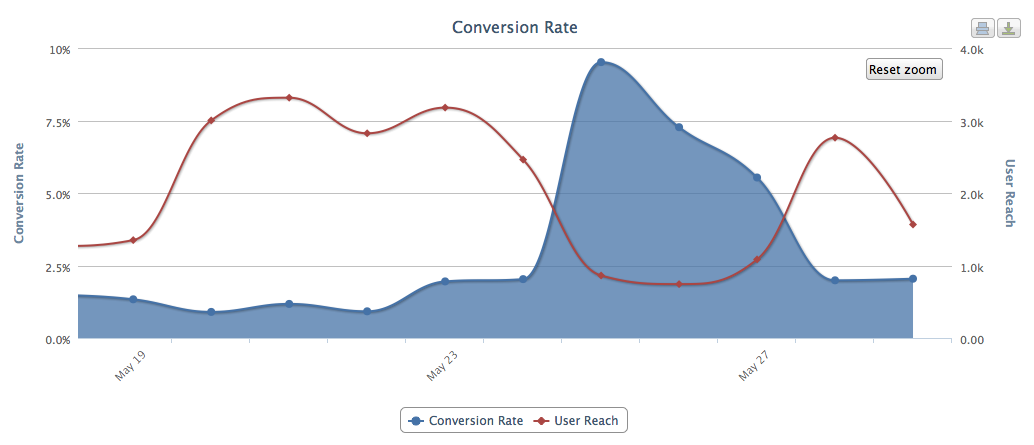
On the bright side, we have just seen a big up-tick in the percentage of people signing up after hitting the meter. It started over the weekend, with much lower traffic but much higher response rates:

Screen shot 2013-05-29 at 1.40.11 PM

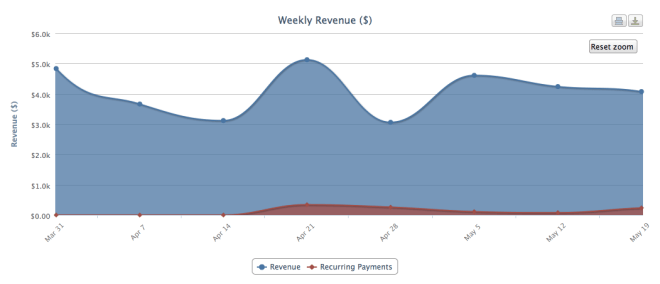
Maybe it’s easier to pay when you’re at home and not rushed at work. Either way, we’re grateful. To continue with full transparency, revenue has slowed but remains reasonably steady, and we’re inching very close toward $700,000 gross revenue (we’re around $696K as of today), with our goal of $900,000 by December 31 looking less likely, given the slowing of the pace.
Screen shot 2013-05-29 at 1.44.28 PM

Another financially strapped reader makes the case for you:

I just subscribed to the Dish for $2.68. It’s the price I pay for coffee every day. I will abstain one day each month to support this innovation.

A few more readers sound off (with a non-metered readon below, so nonsubscribers can go ahead and click without it counting towards your limit):

I’m an avid reader of the Dish and just happily subscribed.  But I thought you might be interested in why it took me so long to pay up. My reason is quite mundane, but it may reveal something about the decision-making process other yet-to-subscribe readers are going through.

Years ago I stopped carrying my wallet in my back pocket.  Instead, I stick it in the inside pocket of my suit jacket.  When I get to work, I hang my jacket up on the back of my office door.  Therefore, when I’m sitting at my desk and using my computer I don’t have ready access to my wallet.  To get my credit card (since I don’t have a PayPal account), I have to get up and get my wallet.  That simple detour away from whatever I’m doing at my desk has been enough to delay my subscription to the Dish.

Today I dressed casual.  I didn’t wear a jacket.  My wallet was in my back pocket.  When I had some time to check out my favorite blogs, it was easy to pull out my wallet and subscribe to the Dish.

Personally, I think my excuse for failing to subscribe sooner is a sad example of human laziness.  But I wonder how many other folks have similar reasons for not yet subscribing.

Another:

Longtime reader, never subscribed. Here’s what would get me to subscribe: a digest that never climbed above some fixed number of posts per day – maybe the top ten or twenty. Over time, reading the Dish has become more and more work. A recent business trip underscored this. After two days offline, my RSS feed had two unread posts from Coates, maybe eighteen from Yglesias, and 162 for the Dish. Historically I’ve been a Dish completist, but I can’t persuade myself that an hour frantically skimming those 162 posts (or three hours reading them properly) is a good use of my time.

Please understand I’m writing this from a place of deep admiration for your work. If I didn’t value the Dish, I would happily drop it, instead of agonizing. But honestly, trying to read every post eats into my day. Sampling a random 40% or 20% is no good – what if I’m missing the good stuff? So yeah, even though I don’t pay for the rest of my media diet, I’d easily throw you $20 per year in exchange for some curation, and a feed that only pinged maybe once an hour.

I hope you all will consider this. If you do, I hope you’ll reply to this email, because I’m pondering a Dish fast. And notwithstanding all of the above, thanks for your work.

What we’re going to do is replace the Daily Wrap with my own quick digest of the best posts of the day. We hope that helps.

Ask Dan Savage Anything

This embed is invalid

Dan Savage needs little introduction to Dish readers, but here is his Wiki page to peruse. Dan just came out with a new book yesterday, American Savage: Insights, Slights, and Fights on Faith, Sex, Love, and Politics. From a recent interview with Logan Lynn:

Savage: Well, the book is about marriage and family, and is a bit more political. I talk about healthcare and Obamacare, gun control, sex education…it originally started out as just a collection of essays, things I had written other places, just bringing things I had written over the last decade together. Then I started revising them and reworking them. Originally the book was going to be 80% old stuff and 20% new stuff, and now it’s 90% new stuff. There’s basically nothing in there that isn’t reworked or brand new. There is a big chapter about marriage, and where we are at right now…and that’s been changing so rapidly, I want the book to come out ASAP. I wrote about adopting, about becoming parents, about Terry and I getting married; and this book has essays about life and memoir-y stuff about my mother’s death, about my son, now 15, coming out to us as straight when he was 12, which was kind-of bizarro hilarious…

Lynn: Alternate universe!

Savage: Yeah, like, how we were so careful all his life to let him know we loved him whoever he was, and yet somehow still he thought we were going to be disappointed that he wasn’t gay. It really broke my heart. So, I touch on all of that stuff. There’s some humor and comedy in the book as well. I wrote a play – a short play – that’s in the book about Jesus and the huge asshole, which is Jesus talking to a fundamentalist Christian who opposes healthcare reform. I think people will enjoy it.

To submit a question for Dan, simply enter it into the Urtak survey after answering all of the existing questions (ignore the “YES or NO question” aspect and simply enter any open-ended question). To vote, click “Yes” if you have a strong interest in seeing Dan answer the question or “No” if you don’t particularly care.

Planning For Yet Another War?

SYRIA-CONFLICT

Cue the Jaws soundtrack. Josh Rogin reports that the administration has asked the Pentagon to draw up plans for a no-fly zone in Syria:

President Obama’s dual-track strategy of continuing to pursue a political solution to the two-year-old uprising in Syria while also preparing for more direct U.S. military involvement includes authorizing the Joint Chiefs of Staff for the first time to plan for multilateral military actions inside Syria, the two officials said. They added that no decisions on actually using force have yet been made.

“The White House is still in contemplation mode but the planning is moving forward and it’s more advanced than it’s ever been,” one administration official told The Daily Beast. “All this effort to pressure the regime is part of the overall effort to find a political solution, but what happens if Geneva fails? It’s only prudent to plan for other options.”

In an update to the story, a Pentagon spokesman claims that there “is no new planning effort underway” and that the “Joint Staff, along with the relevant combatant commanders, continue to conduct prudent planning for a range of possible military options.” Friedersdorf cuts through the pro-war jargon:

The article also quotes Robert Zarate, policy director at the Foreign Policy Initiative, a hawkish organization. His euphemisms of choice: “No doubt, the United States and its like-minded allies and partners are fully capable, without the use of ground troops, of obviating the Assad regime’s degraded, fixed, and mobile air defenses and suppressing the regime’s use of airpower.”

Does anyone think he’d describe Syrian planes bombing a U.S. aircraft carrier as “obviating” our naval assets? The question before us is whether America should wage war in Syria by bombing its weapons, maintaining a presence in its airspace, and shooting at its pilots if they take off. On hearing the phrase “no-fly-zone,” how many Americans would realize all that is involved?

I trust “start a war against Syria” would poll poorly.

Which is why we must be careful that this does not get rushed, especially after the Libya debacle. And yes: debacle. Here’s the actual Benghazi story Republicans are uninterested in, for some reason:

Attacks on police stations and patrols have become frequent in the city, which has been the scene of power struggles among armed Islamist factions.

There’s also a classic power vacuum, as the Libyan parliament bars anyone who was part of the former regime from governing, forcing the resignation of chairman of the Libyan General National Congress. It reminds me of the great error of de-Baathification in post-Saddam Iraq. Allahpundit suspects a no-fly zone (NFZ) over Syria won’t happen:

The only way a (NFZ) will play politically for Obama with American voters is if it’s the same sort of turkey shoot that the Libyan NFZ was — which it won’t be. McCain told the Daily Beast that a realistic plan for a no-fly zone “would include hundreds of planes, and would be most effective if it included destroying Syrian airplanes on runways.” It’d be a huge, aggressive operation, and the presence of those Russian missiles means it might not be without casualties.

I’d say the two most important imperatives for the Obama administration in the next three years are negative ones: not getting involved in wars in Syria or Iran. The more energy-independent we become, the easier it will be to leave this region to its own demons.

(Photo: Men search for their relatives amongst the bodies of Syrian civilians executed and dumped in the Quweiq river, in the grounds of the courtyard of the Yarmouk School, in the Bustan al-Qasr district of Aleppo on January 30, 2013. By J M Lopez/AFP/Getty Images)