Hardcore Curriculum, Ctd

Next spring, Routledge will publish Porn Studies, the first academic, peer-reviewed journal about pornography. A member of the editorial board explains why the field is worth studying:

[Editor Clarissa] Smith emphasizes three reasons in particular: pleasure, censorship, and controversy. First, porn is an important part of many people’s intimate lives, including their sexual relationships and identities, as well as their desires and fantasies. Second, pornography is often the focus for thinking about issues like censorship, regulation, freedom of speech, and ethical issues around sex and the media. And thirdly, pornography continues to be a controversial topic in the media and in other public forms of commentary, but, according to Smith, the way it is discussed often fails to engage with the evidence we have about porn.

But perhaps the biggest reason why pornography warrants critical engagement by scholars is that it’s a multi-billion dollar global industry that creates products that circulate widely and are consumed by many, yet we know surprisingly little about the conditions under which pornography is made and consumed, and how it affects people’s intimate lives and sexual identities.

On a related note, Camille Paglia rails against recent scholarly studies of kink and S&M, calling for a more rigorous approach to the topic. Previous Dish on porn in academia here.

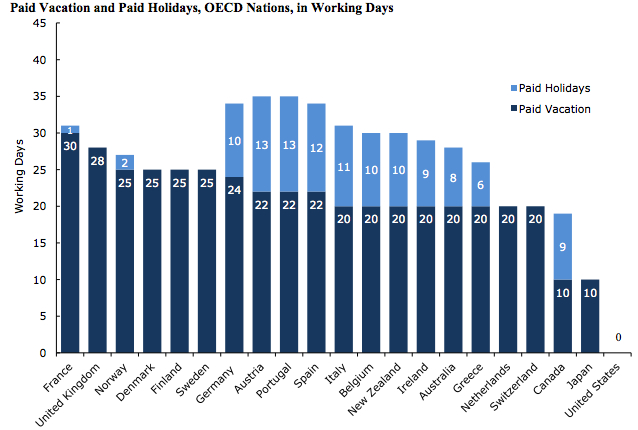
The Nation’s Vacation Policy

Is nonexistent (pdf):

America Vacation

What this means in practice:

[A]mong richer workers, almost all employers offer paid vacation and holidays, and quite a bit of it. Among poorer workers, less than half get paid vacation, and even when they do, their employers offer a lot less of it. This is one more way in which the poor often end up working much harder than the rich.

Not Everyone Is Created Genetically Equal

Dish alum Zack Beauchamp reports on the Richwine affair. He digs up some new details but also downplays the importance of genetics. Zack’s research does suggest to me that Richwine’s thesis was “good enough” empirically, but way too broad in its inferences. But then Zack writes something like this:

Alleging that, as a group, an enormous percentage of Americans are and always will be dumber than their fellow citizens isn’t just normal academic inquiry.

That’s not what even the most genetically-inclined scholars believe. There are huge overlaps of IQ among self-reported racial groupings – with all of them having much more in common than apart. And Charles Murray has never doubted that environment matters – especially in the first few years. But when you’re dealing with scores that get you into Ivy League colleges, for example, those minor differences between groups as a whole will lead to obvious racial disparities. There will be far more Asians and Jews than are represented in the population at large. Soon, liberals may have to confront this not as a black or white problem, but as a question of whether it is just to deny places to Asians and Jews just because of their ethnic background. I think liberals dismiss this data at their peril.

Freddie sighs:

Beauchamp goes hard on the notion that environment trumps everything when it comes to IQ. Indeed, he goes so hard on that attitude that most readers will likely think that there is nothing to the notion of a genetic basis for IQ. That’s simply not in keeping with the large majority of the data.

For example, that adopted children have IQs that correlate far more highly with their biological parents than their adoptive parents has been replicated repeatedly. (See, for example, Plomin et al. from 1997, for just one.) James Flynn, who I will remind you is deeply committed to social justice and is also the preeminent researcher in IQ, wrote in 2007, “The most radical form of environmental intervention is adoption into a privileged home. Adoptive parents often wonder why the adopted child loses ground on their natural children. If their own children inherit elite genes and the adopted child has average genes, then as parents slowly lose the ability to impose an equally enriched environment on both, the individual differences in genes begin to dominate.” That Flynn piece, I think, is really excellent as a discussion of how to think through and understand the interactions between genetics and environment in IQ. It is not defeatist, and could never be called racist. But it is far more sober and clear about the relationship between genetics and IQ than Beauchamp’s piece.

Why Freddie keeps fighting this fight:

We don’t have to misrepresent the importance of genetic parentage to IQ to recognize the importance of environment. Beauchamp makes some very good points about what it means to be Hispanic and about what a race is. I myself have written four times in the last week or two about why we shouldn’t listen to Jason Richwine. By misrepresenting the actual extant evidence, well-meaning people play into the hands of those who work tirelessly to establish the idea of a conspiracy to hide the truth.

Removed from the emotional grindhouse of race, why does all of this matter? It matters because our educational debates are dominated by a piety that almost everyone argues but almost no one believes: that all people are of equal ability. If you think that’s an exaggeration, consider No Child Left Behind, which insists: 100% must achieve the standard, 100% compliance. Here in the real world, 100% of people will never reach the standard in anything at all. Yet this notion that our problems can all not only be improved upon but literally erased permeates education at all levels. It is the most glaring orthodoxy in our educational debates: you must never suggest that anyone will ever fail.

Freddie, who self-identifies as a socialist, goes on to write, “I don’t mind pointing out that human beings are substantially unequal in their abilities because I don’t think that this should condemn anyone to a life of poverty.” Me too. I oppose any public policy based on racial profiling, including affirmative action. I believe in a firm safety net. I just believe in dealing with reality and making the best of it. If that means more aggressive early intervention in child-rearing, then we need to put that on the table, especially if affirmative actions falls.

“You Can’t Write It Like This For The New Yorker!”

Reviewing a new film about the German-Jewish philosopher Hannah Arendt, J. Hoberman details her role in the controversial trial of Adolf Eichmann:

It’s not every week that you get to see a movie about an intellectual contretemps, let alone one that rocked the Jewish world. Indeed, in a way, [Margarethe] Von Trotta and screenwriter Pamela Katz have attempted something far more difficult and potentially absurd than making a documentary, namely setting out to dramatize an upheaval in the life of the mind. The only filmmaker who has ever really turned the trick is Roberto Rossellini in his early-’70s telefilms Socrates, Descartes, and Blaise Pascal. (Would that he had also essayed Spinoza!)

Von Trotta and Katz could not possibly do justice to the outrage—and outrageous abuse—that Arendt inspired, or to the breadth of her continents-spanning life and thought. A sprinkling of flashbacks notwithstanding, it’s Arendt in Jerusalem and on Eichmann that Von Trotta considers in her film.

Greatly simplified, Arendt’s three great sins were 1) suggesting that the “desk murderer” Eichmann was a mediocre opportunist rather than the devil incarnate (and thus all the more frightening); 2) publicly discussing and denouncing the role of Nazi-appointed Jewish Councils in the Final Solution; and 3) examining the judicial basis for the trial itself. Arendt, however subtle in her analysis, was not given to understatement; still, to a large degree the tumult she inspired was a case of blaming the messenger.

What The Hell Is Happening In Sweden? Ctd

A cultural primer on the country:

After looking at the statistics, Frum concludes that no one should be surprised by the recent unrest:

In less than a single decade, the foreign-born share of the Swedish population has risen from under 10% to over 15%. Unemployment among immigrants exceeds 16%; among native Swedes, it is only 6%. [And d]espite a heavily redistributionist tax system and a generous welfare state, the wealth gap between natives and immigrants is wide and apparently widening.

On the corresponding rise in crime:

Swedish authorities are notoriously tight-lipped about the connection between immigration and crime. Sweden does not report data on crimes by foreign-born people, only by foreign passport holders – meaning that an immigrant who has been naturalized will be counted as a Swede for statistical purposes. Even on that restrictive basis, it’s apparent there is a real problem. In 2010, almost 30% of the people in Swedish prisons held foreign passports. A broader study of crime statistics from 1997-2001 – that is, well before the recent immigration surge – found that immigrants and children of immigrants together committed more than 40% of all Swedish crime. In particular, immigrants and children of immigrants were five times more likely than native Swedes to be investigated for sex crimes, a rising Swedish concern.

Dissent Of The Day

A reader writes:

How do you square your disdain for hate crime laws as a way to punish one motivation more than another for the same horrendous act, with your wont to decry murders by Muslims as a sign of a larger idea of “terrorism,” which you evidently give more significance that just regular crime? It seems it would be more consistent to treat the killing in Woolwich the same as this knife murder last October in Swanley Village. Does the different motivation deserve different punishment? Saying one is “terror” – a heavy term in our new unfortunate parlance that justified our current wars – and one is “not terror” does not make sense if you think elevating one motive over another is wrong. You wrote this in the NYT back in 1999:

Indeed, our media’s obsession with “hate,” our elevation of it above other social misdemeanors and crimes, may even play into the hands of the pathetic and the evil, may breathe air into the smoldering embers of their paranoid loathing. Sure, we can help create a climate in which such hate is disapproved of — and we should. But there is a danger that if we go too far, if we punish it too much, if we try to abolish it altogether, we may merely increase its mystique, and entrench the very categories of human difference that we are trying to erase.

I think you may reason the same way with regard to terrorism, given your positions on Gitmo and the Af-Pak war. But claiming that crazies who do despicable things while shouting “Allah Akbar” are terrorists, while saying crazies who do despicable things while shouting “faggot” are just regular criminals refutes that very reasoning. Why is the murderer who was driven to kill James Byrd due to white supremacy different from the murderer driven to kill in Boston due to what he saw on YouTube?

That’s a good question. It’s not one I have engaged at length – my debate with Glenn Greenwald was not about that as such, but about other elements in his column. But first, a semantic but vital point. Terrorism is not violence committed by Muslims, as my reader wrote. It’s violence committed by Jihadists or Islamists most often against other Muslims.

The Woolwich butcher should be prosecuted for murder, in my view, in a civilian court. But most murders are not followed by the murderer hanging around asking for his photograph to be taken, his bloody hands still holding the butcher knives he used to behead and then mutilate a body. There is a pride in the evil that distinguishes this particular kind of barbarism, a pride that comes from religious certainty. There is also an implied threat: “You will never be safe.” When it is allied with organizations that attempt to randomly terrorize communities by violence, I think that’s worth noting. If only as a descriptive term.

Then there is the religious element, which can also be involved in hate crimes, of course, but not quite as explicitly as in, say, the Woolwich attack. What religion does is justify what would be unjustifiable by any other argument. It ups the ante as far as brutality is concerned. It empowers individuals with divine sanction to do anything –  a particularly dangerous streak in human nature. And it may intensify brutality in ways that might justify a different category in the law. But I need to think on this some more. And I’m grateful for that challenge to my own consistency here.

Arrested Arrested Development?

Todd VanDerWerff reviews the new season:

How much you like the fourth season of Arrested Development will depend on just how quickly you can accept that it’s a show that looks a lot like Arrested Development and shares most important elements in common with that show but is also another series entirely, something more like Mitch Hurwitz and the cast of that earlier show got together to make a bunch of loosely intersecting short films about the characters from the earlier project, each with its own tone and point-of-view. It’s an occasionally hilarious, sometimes boring, always bloated boondoggle of a project, and it’s the sort of thing that’s at once staggering in its ambition and hard to approach with anything like real affection. It is, in places, masterful. It is also, in other places, at once weirdly pleased with itself and too ready to hold the audience’s hand where that hand needn’t be held. It’s also very oddly directed and edited, though some of that just might stem from the project’s inability to get the whole cast in one place at one time, due to the actors’ other commitments.

I must confess to only getting around to the first three episodes. David Cross remains priceless. But I found the dialogue often subsumed by the music or mumbled; and the genius of some moments – like Buster inhaling his mother’s cigarette smoke to blow it out of the window – got bogged down in the tedious confusion of others. But if watching the first round of AD compulsively taught me anything, it’s that

the show is terrible until you watch it all. Any critique of the show based on an incomplete viewing is one you should ignore at all costs.

So I’ll withhold judgment until we’re satiated and can get all the jokes. Jace Lacob, meanwhile, pans the season:

Whereas the first three seasons were subtle, there is a decided lack of finesse here. Season 4 feels like an anvil being dropped on the heads of the viewers, one with a note attached that reads, “LOVE ME. PLEASE LOVE ME. LOVE ME,” all in caps. The humor feels broader and more overtly self-conscious. It trades far too easily on callbacks to the early seasons, a sort of unpleasant fan service that is depressing to watch.

Brian Merchant is on the same page:

[T]he new season of Arrested Development is not all that good. It’s just not. It’s still reasonably funny, and more interesting than most things on TV, but the frantic, diabolically plotted comedy of the 00s is MIA. Instead of ensemble madness we get plodding single character-led episodes, some of which—especially the Lindsay episodes—are downright tedious. And no one ever expected to associate Arrested Development with tedium—over-stimulation, maybe, schizophrenia, sure—but not boredom. I was actually bored watching some of these episodes.

An Islamist Beheading In Britain, Ctd

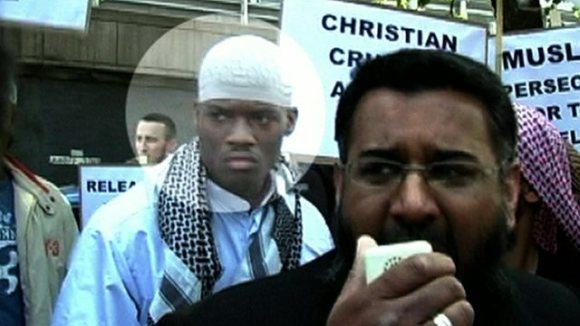
67786092_67786091

Greenwald responds to my latest post. He protests:

That I “legitimated” the London attack or argued it was a “legitimate protest” is as obvious a fabrication as it gets. Not only did I argue no such thing, and not only did I say the exact opposite of what Sullivan and others falsely attribute to me, but I expressly repudiated – in advance – the very claims they try to impose on me. Even vociferous critics of what I wrote, writing in neocon venues, understood this point (“I do find myself wanting to agree with Greenwald in arguing that this is an atrocious murder rather than an act of terror”).

I don’t fabricate things. Look at this direct quote:

“[T]he term [terrorism] at this point seems to have no function other than propagandistically and legally legitimizing the violence of western states against Muslims while delegitimizing any and all violence done in return to those states.”

Here’s my objection: the West kills “Muslims”; the Jihadists target “states.” That framing, in the direct wake of an act of religious barbarism, actually places Jihadists on a higher moral plane than the West. We’re killing people of a different faith on purpose; they’re just protesting by killing the soldiers who murder them. Maybe Glenn didn’t mean for it to come out that way. But it did.

And yes, I can see (just) how an off-duty soldier might qualify as a non-civilian, although we don’t yet fully know the details of the plot, and therefore complicate the “terror” label. That’s a point worth considering. I also conceded that a defense of the killing as blowback was involved here. So we’re not that far apart on those matters.

But I strongly resist the idea that the West has attempted to kill Muslims in the way that Jihadists have killed so many Muslims and infidels, even though civilian casualties have been a horrifying fact of the wars in Iraq and Afghanistan and the drone wars now winding down. We are seeking to defend ourselves from theocratic mass murderers after an unprovoked attack; they are seeking the triumph of their version of Islam, by any means, including mass murder. The US has not killed for religious reasons; the Jihadists kill solely for religious reasons, which include the sacrosanct nature of religiously-demarcated territory. That includes the Woolwich beheading, as the full context shows. The Jihadist was not defending the “land” he lives in. He is a British-born convert to a murderous form of Sunni Islam (which detests and seeks to murder Shiite infidels as much as any non-Muslims). He is, in fact, attacking his own land, its soldiers and its democratic norms. He wants to turn Britain into a Sharia-Islamist state. And he’s not shy about saying so. That equation of his land with, say, Pakistan, is a religious belief, not an objective fact.

Then there are the fabrications from Glenn. I “continuously justify any manner of violence and militarism” by the US. That accusation is just bizarre, given my record over the last several years, my support for withdrawal from Iraq and Afghanistan, my opposition to new wars in Libya and Syria, my long campaign against torture, and on and on. But, yes, I do believe we are in a civilizational war, as I wrote just after 9/11.

It is a war between violent Jihadist theocracy and the Western tradition of separation between church and state. It is a war we did not seek and it is a war we are trying to end. For the Islamists, in contrast, this war is for ever – until their version of theocracy is triumphant. And the butchers of Woolwich are quite clear about their goals: the imposition of Sharia law and the end of democracy in Britain, their actual native land. For them to assume other countries as “their land” is an obvious sign that what lies behind this is not strategic blowback only – it is a theology of theocracy.

Norm Geras is not as blinkered:

[I]f a man says that he’s butchered someone on the street because of… Afghanistan, it is then true, if he is not lying or self-deceived, that somewhere in the causal chain leading up to that murderous act Western intervention against Al-Qaida and the Taliban has played some part in bringing the atrocity about. But it is by no means a sufficient explanation, as you can quickly ascertain by starting to count up in your head all those angered or upset about Western intervention who haven’t butchered anybody. At the same time, you can start to compute how many people responsible for jihadist terrorism today not only cite Afghanistan and/or Iraq but frame the reference within the terms of an Islamist ideology according to which the slaughter of innocents is an apt response to Western foreign policy. That’s a very large number of people. It is also true, of course, that not all Islamists commit terrorist murder, so this isn’t a complete explanation either, but you’d think the ideological factor should have some prominence.

A rational explanation of these acts is therefore available that places central emphasis on its ideological causes, and doesn’t just parrot what the jihadists themselves say. And those leftists and liberals (verkrappt section) who always draw attention towards what the killers say and away from the belief system that inspires them are not just appealing to rational explanation, they are offering a very particular type of skewed ‘explanation’ that obscures a crucial element of the picture.

I think Glenn has gone from a completely legitimate critique of the West’s “war on terror” toward the equation of Jihadist murder with legitimate self-defense after 9/11. I can see why the latter can spawn the former. I cannot see how they are both morally equivalent.

Read the whole Dish thread on the Woolwich beheading here.
The View From Your Window Contest: Winner #155

Screen Shot 2013-05-24 at 6.18.25 PM

A reader writes:

We’ve crossed that bridge several times on our way from Paris to a small village in SW France where we like to stay. Beautiful. Just got back from NYC, so didn’t see this until this morning. If the 12 noon deadline is eastern time, I missed it.

Another:

Beylerbeyi, Turkey? That’s the Bosphorus Bridge that connects Europe and Asia.  I’m just guessing that the pic is from the Asian side.

Another:

Istanbul? I’m only making this guess because of the bridge in the background, which I think might be the Bosphourus Bridge.  Looking at a map of the area, I would guess this picture is taken from the Symbola Bosphourus Hotel.

Another Istanbul guesser:

This is as far as I’m going to get.  It’s taken from the European side, north of the Fatih Sultan Mehmet Bridge. But I’ve spent altogether too long on this, and I can’t get good enough resolution on Google Earth to figure out exactly where. First time try.  I’m betting that you’ll have lots of correct results on this one.

Another:

Hong Kong? I believe that’s the Tsing Ma Bridge in the background.

Another:

I suspect this one was too easy, if for no other reason than I was able to get a view for the first time. The bridge looked a lot like the second and newer Narrows Bridge near Tacoma, WA, but the first bridge wasn’t in the picture and nothing else matched. I looked up the list of suspension bridges on image004Wikipedia, considered and rejected the Mackinac Bridge and one of the Bosporus Bridges in Turkey, and then took a closer look at the third bridge of the right color and style and saw that it had Chinese writing on the crossbar which was also visible (though previously unnoticed) on the view.

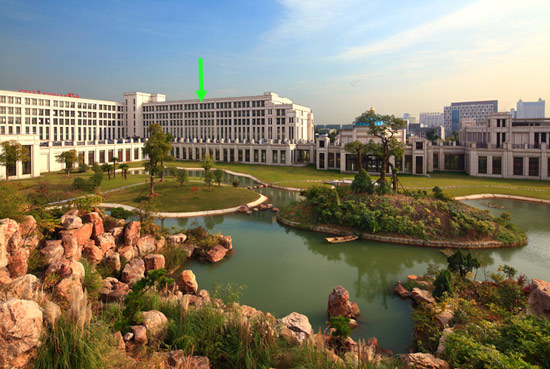
Then it’s just a matter of looking at the Jiangyin Bridge on Google Maps, confirming the view (which took seconds), and then trying to narrow down the exact window. It looks like it’s on the property of the Huangjia Sheraton Hotel, in Jiangyin, Jiangsu, China. It almost looks like the view is too close to be in the main body of the hotel, which could place it on the wall that extends from the building, but it also looks to be above ground level so I’m going to say it’s in the hotel but zoomed in to foreshorten the view. I can’t find a map of the hotel itself and so from there it’s a guess. Let’s say 4th floor of the hotel, facing north-northeast, roughly as shown in the following images.

Jiangyin, China it is. Almost all of the 200 readers who participated this week answered Jiangyin, making this contest probably the easiest one yet. Another:

The suspension bridge towers in the distance gave a me something to work with.  It looked like the bridge could be of some scale.  I googled “largest suspension bridges” and came across this YouTube video highlighting the ten largest:

The Jiangyin Bridge was listed at #6 and immediately looked promising with the blue main cables and white towers with characters on the lower cross beam of the tower.  The bridge, which apparently has a 1,385 meter main span constructed by Cleveland Bridge & Engineering Company (U! S! A!) completed in 1999, crosses the Yangtze River, connecting the northern and southern parts of Jiangsu province.

Great post from YangziMan here with historical details and photos from the area. Construction apparently completed in 2010; the current Google Maps satellite image looks to be mid-construction on the western half of the main building.  I was able to figure out that the building pictured in the foreground, which Starwood describes as “European Baroque” architecture, is the hotel’s VIP tower. If you go to this link and click on the picture shown then go to Image 2 of 2, I’m guessing that the photo was taken from a window on the 4th, 5th or 6th floor of the hotel near or above the head of the woman in gray and black seventh in from the right.

More readers try to guess the correct floor:

Most weeks I look at the photo and figure I’ll never get it.  Other weeks I think I have a shot, but don’t find anything conclusive after looking for a little while.  On this rainy Saturday afternoon, I’ve finally found my first window. This is Jiangyin, China.  The photo was taken from the Sheraton Tianjin Hotel from approximately the spot indicated in the attached image looking toward the Jiangyin Bridge over the Yangtze River:

20130525(1)

I’m going to guess it’s from the 3rd floor.  I’m sure someone will come up with the exact room number, but that’s beyond my meager skills.  Go ahead and give the book to the guy who proposed to his wife on the pretty bridge in the foreground.  I’m happy enough knowing I finally got one.

Another:

Oh my gosh I got one! I guess those hours on Geoguessr are paying off!

A visual guess from a previous winner:

VFYW Jiangyin Aerial with Marked Insert - Copy

Another reader:

How addictive is the VFYW contest?  My wife and I put off starting the new season of Arrested Development to work on it.

Another visual guess:

teti_vfywcontest_windowid

Another reader:

This is so cool! Hotel staff from the Sheraton in China actually responded to my email! I think that is so neat! I had already sent my VFYW answer in yesterday, but I’d like to add this additional detailed location info! Photo likely taken from 6 or 7th floor, from Block A Garden View rooms. Still hoping for a mention or dare I hope, a win … but getting a note from a woman on the other side if planet Earth helping a complete stranger guess was fun, in and of itself!

Another previous winner sends a visual guess of the correct floor:

hotel-334

Another reader:

Best bet of room location is west wing, 7th floor, probably Sheraton Club level, room 7035. I’m getting better at this each week so thought I would start entering.

The 7th floor it is – room 7028 to be exact. Of the half-dozen readers to guess the correct floor, the one who has participated in the highest number of contests so far (15) gets the tie-breaker this week:

Yay! A pleasantly easyish one. The suspension bridge took me straightish to it. It’s from a window in the Sheraton Jiangyin Hotel, Jiangyin 214400, China. I’m guessing lots of people will get this one, so I’m going with the 7th floor. I’ve never been to China, so I have no cute China stories. I don’t even live in a city with a China Town. I did visit China town in San Francisco when I was five. I remember getting to pick one souvenir, and I picked a small tool set. Yay!

(Archive)

Being Master Of Your Own Domain, Ctd

A reader writes:

Your thread on onanism has piqued my interest.  I don’t mind confessing that I’ve masturbated and not felt good about it.  A few years ago I went through a rough time in my career (I was laid off during the financial crisis) and found myself in a very confused and angry place.  I began to turn to more heavily to pornography during this time and, when I found I could not stop and that it was getting in the way of more productive activities, I actually broke down and began attending a 12-step “S” meeting to try and get some help.  I was hesitant at first, fearing I’d be meeting with a bunch of sexual deviants, but it turns out that 12-steppers tend to be normal (although brighter-than-average) people who are serious about gaining control of their lives, and a lot of them are remarkably accomplished (at least in New York City).

That being said, a wide variety of people attend and I’ve heard more than one 12-stepper mention that they’d found quitting heroin to be easier than quitting their porn/masturbation/fornication addiction.

The last five years have seen the widespread adoption of huge 1080p television sets and retina-display iPads and FiOS Internet connections and so forth – all of it just fuel for the porn fire. In fact, according to this article, 30% of all Internet traffic is pornography.  A choice quote:

Xvideos, the largest porn site on the web with 4.4 billion page views per month, is three times the size of CNN or ESPN, and twice the size of Reddit. LiveJasmin isn’t much smaller. YouPorn, Tube8, and Pornhub — they’re all vast, vast sites that dwarf almost everything except the Googles and Facebooks of the internet.

So, obviously, a lot of guys are jacking off.

But none of this is what prompted me to write you.  What did prompt me to write you was coming across this Kickstarter project. (They also have this Craigslist post.) It’s a couple of guys trying to make a movie about kicking their masturbation habits.  I don’t know if it will be any good, but it takes guts to tackle a subject that has so much shame surrounding it. This is obviously a conversation that society needs to have, so I think it would be great if they get their funding.

(Video: A scene from Shame, a film about sex addiction. A longer NSFW scene is here.)