
Torrey, Utah, 8.30 pm
Torrey, Utah, 8.30 pm
A summary of his response to president Obama’s pivotal speech on re-calibrating and even ending the War on Terror:
One can almost envision Greenwald sticking his fingers in his ears and singing “La-la-la-la” so as not to hear information that contradicts his Obama Derangement Syndrome.
More on his equation of Barack Obama and the Woolwich Jihadist beheader to come.

Dexter Filkins worries about Hezbollah intervening on Assad’s behalf:
[T]he most serious effects of Hezbollah’s stepped-up intervention in the Syrian war will be felt in Lebanon itself. Lebanon—which, like Syria, was created from the ruins of the Ottoman Empire in the years after the First World War—had its own civil war, which lasted from 1975 until 1990. (That’s fifteen years.) Since then, the peace in Lebanon has depended on a delicate balance among the country’s main sects: the Sunnis, Shiites, and Christians. To a great extent, this peace has depended on each group refraining from trying to grab too much power at the expense of the others. Over the past several years, Nasrallah has pushed this arrangement to the limit; Hezbollah is not just a political party but an army that is more powerful than the Lebanese state. Inside Lebanon, it its unassailable. Hezbollah’s intervention in Syria—essentially, a Shiite army crossing the border to kill Sunnis—represents a flagrant violation of Lebanon’s fragile sectarian pact.
Totten weighs in:
Washington has been understandably reluctant to get involved in the Syrian war, partly because the White House rightly fears such involvement could turn a local war into a regional war. But it looks like that just might happen regardless.
But that is not a reason to engage now. If we have not learned by now that regional wars in the Middle East are not invitations to a party, we never will.
(Photo: A Lebanese army soldier walks past graffiti on a closed shop which reads: ‘You shall fall Bashar..’ in Tripoli’s Sunni neighbourhood of Bab al-Tabbaneh, whose residents support the rebels battling to topple the regime in nearby Syria, during a truce with the Alawite district of Jabal Mohsen on May 27, 2013. Firefights in northern Lebanon between Sunni Muslims and Alawites — the Shiite offshoot sect to which Syrian President Bashar al-Assad belongs — killed 30 people last week, according to security sources. By Joseph Eid/AFP/Getty Images.)
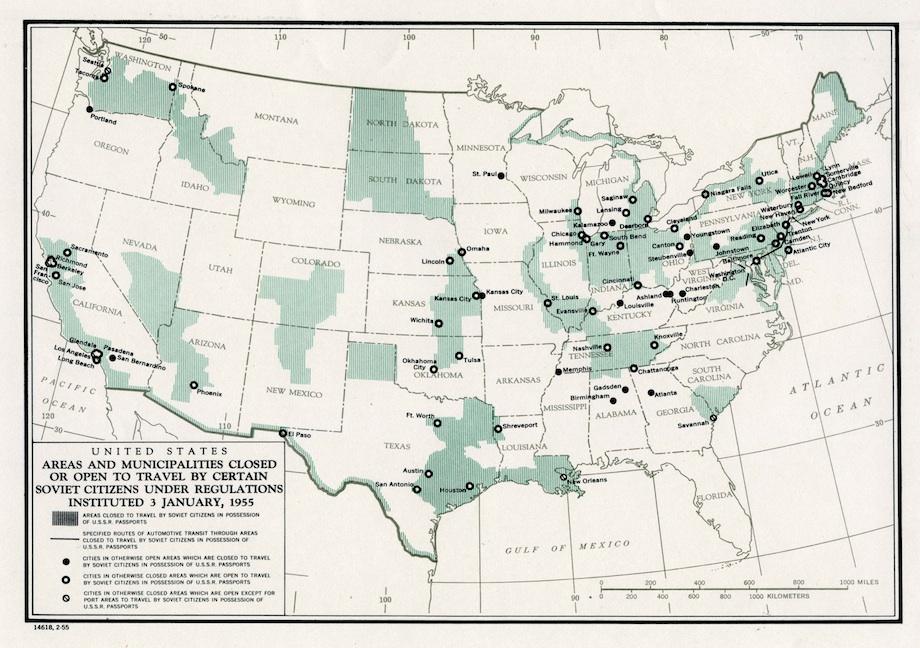
From the annals of paranoia – during the Cold War, large parts of the US was off limits to Soviets:
If you were one of select few private Soviet citizens granted permission to visit the United States in 1955, you could take in a Cubs game or ski Jackson Hole, but if you wanted to sample Memphis barbecue or check out the factories in Youngstown, Ohio, you’d be out of luck. That’s because a National Security Council directive had, on Jan. 3, 1955, allowed some “Soviet citizens in possession of valid Soviet passports” into the country, while extending controls previously placed on visiting Soviet diplomats and official representatives to apply to their travel.
This map shows where Soviet citizens, who were required to have a detailed itinerary approved before obtaining a visa, could and could not go during their time in the United States. Most ports, coastlines, and weapons facilities were off-limits, as were industrial centers and several cities in the Jim Crow South.
Daniel Larison wants to retire Reagan’s slogan “peace through strength”:
The most common abuse of Reagan’s legacy is the rote recitation of [this slogan]. Originally, the phrase implied support for creating a strong defense as a deterrent to aggression. As the threat of aggression by other states has receded, it has come to mean something very different. Many Republican hawks rely on this phrase to describe their foreign-policy views, but they long ago dismissed the importance of deterrence when dealing with states much weaker than the Soviet Union. It is common now for advocates of regime-change and preventive war to profess their commitment to “peace through strength,” but the substance of the policies they prefer shows that they reject the concept as Reagan understood it both in principle and in practice. Instead of deterring aggression to protect international peace, the new “peace through strength” often serves as rhetorical cover for the violation of that peace through acts of aggression.
Another dubious lesson from Reagan’s foreign policy:
The idea that Reagan “won” the Cold War is one of the more pernicious and enduring distortions of Reagan’s real success, which involved both opposing and engaging with the Soviet Union as its system collapsed from within largely on its own.
The claim of winning the Cold War greatly exaggerated the ability of the U.S. to shape events in other countries. That in turn has inspired later generations of conservatives and Republicans to imagine that they can successfully promote dramatic political change overseas in order to topple foreign regimes. As Kennan said in the same op-ed: “Nobody—no country, no party, no person—‘won’ the cold war. It was a long and costly political rivalry, fueled on both sides by unreal and exaggerated estimates of the intentions and strength of the other party.”
Congratulating Reagan for winning the Cold War is one more form of widespread abuse of Reagan’s legacy that has adversely affected how conservatives think about foreign policy and the proper U.S. role in the world. This has warped how the right understands American power and U.S. relations with authoritarian and pariah states for the last two decades. It also blinds many conservatives to the fact that other nations resent and reject American interference in their political affairs. In spite of the failures of nation-building in Iraq and Afghanistan and the collapse of the so-called Freedom Agenda, this myth continues to make many on the right overly confident in our government’s ability to influence overseas political developments to suit American wishes.
It’s called hubris. Peter Beinart made the definitive case for it after the end of the Cold War.
Has history not proven that John McCain just needs to meet someone for a few hours to know for sure if he or she is fit to lead?
— LOLGOP (@LOLGOP) May 28, 2013
Ah, yes, in Syria, itching for another war to lose.
My first instinct on hearing about the case of James Rosen was somewhat casual. Much too much so, in retrospect. Yes, Rosen was a pretty clueless reporter; yes, disclosure of a source in North Korea could have been extremely damaging to national security. Some kind of investigation was merited. But the move to issue a warrant to Rosen for possibly being a co-conspirator in leaking the information crossed a line. And it was crossed by Attorney General Eric Holder. Leakers are not journalists. That distinction got blurred.
Holder, in his defense, was pressured by the CIA and the Congress, which is why there’s been relatively little outrage there:
On December 3, 2009—just a few months before he approved the affidavit in the Fox case—Holder, FBI director Robert Mueller, and director of national intelligence Dennis Blair were hauled before a secret session of the Senate Intelligence Committee to explain why they weren’t punishing more leakers.
But it is the job of the AG to resist such pressure if the pursuit of the leak were to turn into near-prosecution of the press for doing its job. The good news is not that Holder is apparently experiencing regret – his excruciating remorse is expressed through Daniel Klaidman’s tiny violin here. It is that he is going to oversee new rules that will prohibit going near reporters’ records:
Among them would be stating a clear presumption in the guidelines against seizing reporters’ work product, either through subpoena or search warrant. Currently, the guidelines require that prosecutors “take all reasonable steps to obtain the information through alternative sources or means.” (A presumption test would be a higher standard to overcome.) Another priority will be making sure that search-warrant applications are subjected to the same level of internal scrutiny that subpoenas currently receive before they are approved by the attorney general. Some changes, meanwhile, will involve simply bringing the rules into the Internet Age. Originally established in 1970 and updated in 1982 to include telephone records, they don’t even mention emails, texts, or other forms of digital communication, like social media.
There’s more, as Klaidman notes. I’m not one of those people offended when government pursues leaks that could be detrimental to national security – especially a crucial source inside North Korea who was effectively deemed moot by Rosen’s report – and who may have suffered a terrible fate. But search warrants and subpoenas of reporters’ work need to end. The amateurishness of the reporter really isn’t salient here. Maintaining a bright line between the DOJ and the vital work of investigative journalism is.
And I should have seen that more clearly from the get-go.
Alyssa uses the forthcoming film Copperhead to discuss it:
We’ve become very comfortable lionizing the risks soldiers take on the battlefield, in part because those celebrations feel like a way of paying back people who are willing to experience extreme danger and the trauma of killing other people on our behalf. But we’re still reluctant, apparently, to treat people who try and fail to keep us out of wars, or as was the case with many World War I activists, to point out the disparate impact of conscription along class lines, as if they’re reasonable, much less admirable. I’m not an absolute pacifist myself, but I do think that the courage to stand up against some conflicts is admirable, and the amount of it required is more considerable than we generally acknowledge, given the risk that you’ll be labeled treasonous or mentally ill.
Rod Dreher describes how narrative storytelling can offer powerful insights into current events:
The thing is, stories — true stories — usually don’t offer us a neat moral or prescriptive plan of action. … [T]he other day in this space, a Texas reader wrote about the death of his Panhandle town, offering a tale that was politically ambiguous, in the sense that it tells a story about how federal policies, promoted by both the New Deal left and the Reaganite right, played a role in the doom of his town. What I loved about that story was how the facts failed to conform to ideology. It’s possible to have read that story and come away with different political and policy conclusions. The reason the story meant so much to me is that it incarnated policy debate in the lives of real people, people who suffered greatly in large part because of policy decisions made in Washington. You read things like that and something as dry as policy becomes real, and our ideological abstractions (of the left and the right) seem incapable of describing the world as it is.

On display at the British Academy is work by bookseller-turned-artist Justin Rowe, who creates sculptures from old books:
His intricate hobby began when he wanted to create a Christmas window display for the Cambridge University Press bookshop where he works as a senior bookseller. “My wife saw something about books being turned into art, and I thought, ‘That looks a bit difficult, but I’ll give it a go.'” Mr Rowe uses everyday craft shop implements and scours second-hand shops for the books. “I never use anything that has any kind of value. This really is art made out of other people’s junk,” he said. … The inspiration comes either from illustrations within the books – where Mr Rowe cuts and lifts them into 3D scenes – or “from my own sometimes bizarre imagination,” he said.
On the work pictured above, Rowe says:
[The Kraken] was [a] private commission. The brief was simple – a Kraken taking down a galleon. I tried a few variations for the tentacles, but they all lacked impact. In the end I overprinted the word Kraken many times on the paper before cutting them out. This darkened them, giving a menacing edge.
 The Dish