Faithful Atheism

When her young son asked about where a pet dog went after dying, Julia Fierro refused to answer by saying “heaven” – a handy reply she admits would make being a parent easier:

No matter how much I’d love to tell my children that there is always a happy ending, I can’t tell them a story I don’t believe in. Faith was a precious relief in my own anxious childhood–as was the certainty that there was a beautiful and, more importantly, safe place like heaven, no matter what your earthly life. The rituals of prayer, and its accessories–rosary beads, the plastic-framed picture of a benevolent Jesus over my bed, my collection of Virgin Mary statues and the silver crucifix I wore around my neck–were amulets against the danger I felt lurking everywhere, which would, decades later, be diagnosed as Obsessive-Compulsive disorder.

What Fierro and her husband, also an atheist, have learned from their experiences:

We used to debate whether it was worse to have faith and lose it, or to never know it at all. The debate is no longer relevant because it is clear that as we’ve grown as a couple, become parents twice-over, surpassed challenges in our careers, in our relationship, and in our children’s lives, we have become more faithless. But only in our faith in God. We’ve become more faithful to our belief in, and practice of, family. The conception and birth of a baby, and the moment-to-moment bustle specific to parenting young children, is a constant reminder that life is an act of faith. I wonder, sometimes, if I live each moment more fully than my parents because I believe this life, and every moment I have to stare at my children’s smiles, is all I will ever have.

At The End Of The Only Life You Believe In

Jonathan Rée notices the rise of funeral ceremonies tailored to self-described rationalists and humanists:

The decline of hardline rationalism about bereavement may be part of a global social trend towards blubbering sentimentality and public exhibitions of grief: Princess Diana and all that. But there could be something more serious behind it too: a suspicion that the no-nonsense approach to death advocated by pure-minded atheists bears a horrible resemblance to the attitudes that lie behind the great political crimes of the 20th century – Hiroshima and Nagasaki, the massified deaths of two world wars, the millions discarded as obstacles to progress in the Soviet Union and China, and of course the Nazi death camps.

He finds an all-too-human reason supporting the trend:

Love has always been the main issue in our dealings with the dead; and love is nothing if not an attitude of one physical being towards another. The 17th-century poet John Donne, in an ingenious poem called “A Valediction, forbidding mourning”, tried to argue that a love that depends on the apprehension of another person’s body – on “eyes, lips and hands” – is the province of “dull sublunary lovers”, unlike the refined spiritual love – “like gold to aery thinnesse beat” – that dwells wholly in the mind. But Donne can never have convinced himself, let alone anyone else.

To love someone is to treasure the hint of a smile, the strength of a hand, the set of a jaw, the plant of a foot or the curl of a lock of hair. And one of the disconcerting things about death is that it does not immediately annihilate these charms, as we might expect and even hope: more than a trace of them lingers in the cold corpse. A fuss about a trifle, of course. Or perhaps not. It is easy to mock the foibles of others; rather harder to face up to our own.

Go Big Or Go Home?

This embed is invalid

When George Saunders’ Tenth of December was released, the New York Times magazine declared it to be “the best book you’ll read this year,” and many others offered similar encomiums. Elizabeth Minkel noticed that a few dissenters from the praise asked just how great a short story writer could be:

[I]t was suggested that someone who can’t seem to accrue enough pages to pen the Great American Novel couldn’t actually be considered the writer of our time. The whole debate volleyed around the bookish corners of the Internet for a few days, one of those weird, insular, overly prescriptive bouts of literary navel-gazing. Whatever, I said. The conversation was an irrelevant one. I loved George Saunders. I was going to love this book.

After reading the collection, she fears the critics might be onto something:

If it’s so important to me to figure out how these stories work, it feels similarly important to understand how the sum of their parts seems to fall short. I felt, at times, that the stories themselves were unevenly matched: big famous ones, like the two bookends, “Victory Lap” and the final, eponymous story, shine so brightly that some of the others feel like paler echoes. And then there’s the literal echo — Saunders’s language, the tricky rhythm of modern colloquialisms that’s often so beautifully awkward — in the words of that Times piece, it’s frequently “a kind of heightened bureaucratese” — can feel gimmicky in story after story, the sheen wearing off a bit. These criticisms — the pace, the shtick —  are ones I and many, many others have leveled before all sorts of short story collections — and it’s there that we loop back around to the silly question of whether a writer who only produces short stories can really be considered the pinnacle of the profession. The question makes me cringe, for reasons I can’t quite articulate — maybe it’s because it does feel like a weird, insular, overly prescriptive bout of literary navel-gazing. Or maybe it’s because I’m beginning to suspect that it’s true.

An Aristocracy Of Everyone

Veronique Greenwood runs down research showing just how much our genealogical pasts converge:

Chances are, if you have a famous ancestor far enough back that finding out about them is a surprise, you share them with a small city of other people. And the farther back you go, the truer that is. In 2004, statistician Joseph Chang, computer scientist Douglas Rohde, and writer Steve Olson used a computer model of human genetics to show that anyone who was alive 2,000-3,000 years ago is either the ancestor of everyone who’s now alive, or no one at all. Think about that: If a person alive in 1,000 BCE has any descendants alive today, they have all of us—even people from different continents and isolated populations. This line of thought led to the revelation that everyone of European heritage alive today is a descendant of Charlemagne, who ruled over much of Europe as the first Holy Roman Emperor. As science writer Carl Zimmer wrote last week, it’s “Charlemagne for everyone!” (Zimmer’s excellent post covers a recent paper that looked at actual genomic data from European populations and came to a similar conclusion: All living Europeans, from Turkey to England, Spain to Finland, are related many times over.)

She sees our sameness as an asset:

Given that people—especially those in melting-pot countries with only a vague sense of where they came from—often search out their genealogies to find their special background, this information might be a bit disconcerting. Everyone’s genomes and families are not as enduringly specific as we tend to think. But while genetics doesn’t reflect much of our imagined genealogical uniqueness, it’s shown that we’re more closely tied to our species as a whole than we might have realized. We’re all part of this enormous human fabric, full of fascinating tendencies and bizarre biochemistry. And research is revealing more and more about humanity as a whole and our incredibly beautiful, incredibly unlikely perch in the universe. That’s a tradition to be proud of.

Where The Atheists Are

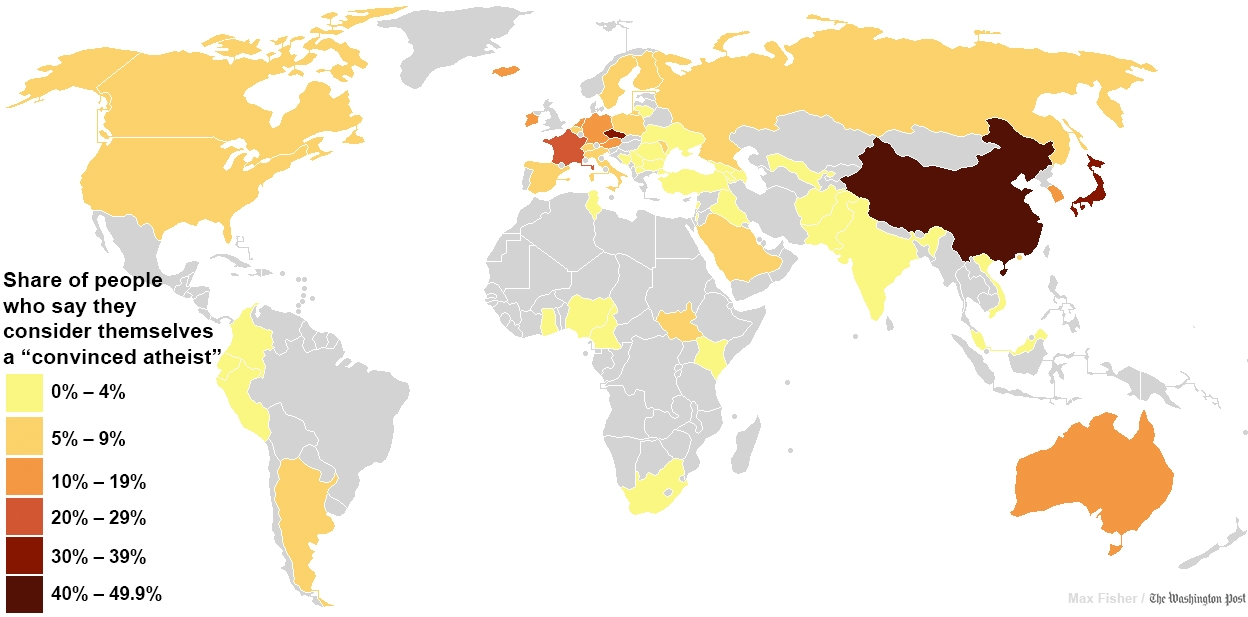
World Athiests

Mapped:

The highest reported share of self-described atheists is in China: an astounding 47 percent. Faith has a complicated history in China. The state is deeply skeptical of organized religion, which it has long considered a threat to its authority.

In the Taiping rebellion of the 19th century, a religious cult started a Chinese civil war that killed millions of people and left the country exposed to European powers. The official ideology of the Communist government scorned both “new” Western religions and more traditionally Chinese faiths, destroying countless temples and relics during the Cultural Revolution of 1967 to 1977. While today’s Chinese leaders do not seem to share Mao Zedong’s fervent belief that China’s rich religious history was holding it back from modernity, nor do they seem prepared to bring that history back.

Extrapolating Your Experience

In an interview about his new collection of autobiographical essays, This is Where My Obsession with Infinity Began, Joe Bonomo reflects on how he approaches the form:

When writing essays I’m guided in part by Wallace Stevens’ definition of a metaphor, that an ordinary object slightly turned becomes a metaphor of that object. Though my life and upbringing are pretty ordinary, when I’m following an autobiographical impulse what I hope to do is to turn myself – that is, my experiences, and my reflecting and commenting on them – in such a way as to render myself representative, emblematic of the human condition. Guillermo Díaz-Plaja said that “The essayist, really, is an arbitrary wanderer over a theme that remains hidden,” but one way a theme emerges for the essayist is via attentive, honest and candid self-interrogation. I think that the charge of any essayist is to ask, “Why does my experience matter beyond the fact that it’s my experience,” and “How might it be made to matter to others?”

The Draw Of Daft Punk

In a visually engaging Pitchfork cover-story, Ryan Dombal puts the duo in perspective:

Zoom out for a second, and this entire scene can seem deeply silly: a group of adults frantically trying to hide the image of two Frenchmen in their late 30s wearing costumes that make them look like C-3PO after a well-tailored disco makeover. But once you spend any time with Daft Punk—or even just listen to their music, or watch their videos, or gawk at their live show—such protectiveness suddenly becomes understandable, even necessary. It’s an instinct to keep the idea of mystery alive at a time when it seems to be in historically short supply.

It’s alive for Sasha Frere-Jones:

Daft Punk’s fourth studio album, “Random Access Memories,” is an attempt to make the kind of disco record that they sampled so heavily for “Discovery.” As such, it serves as a tribute to those who came before them and as a direct rebuke to much of what they’ve spawned. Only intermittently electronic in nature, and depending largely on live musicians, it is extremely ambitious, and as variable in quality as any popular album you will hear this year. Noodly jazz fusion instrumentals? Absolutely. Soggy poetry and kid choirs? Yes, please. Clichés that a B-list teen-pop writer would discard? Bring it on.

The duo has become so good at making records that I replay parts of “Random Access Memories” repeatedly while simultaneously thinking it is some of the worst music I’ve ever heard. Daft Punk engages the sound and the surface of music so lovingly that all seventy-five loony minutes of “Random Access Memories” feel fantastic, even when you are hearing music you might never seek out. This record raises a radical question: Does good music need to be good?

Hathos Alert

James Murray-White searches for silver linings in Fuck for Forest, a hilariously awful documentary that follows “a radical group based in Berlin who produce pornographic material to raise money for environmental causes”:

The most interesting parts of the film are when the group approach people to come join them and be photographed naked, or filmed having sex. They share the statistic at about 1 in every 10 they approach agree and shed their inhibitions. That is a fascinating study, which the maker could have explored a bit more, including an early scene where a chap with a lot of emotional baggage gets photographed naked in an inner-City park to try to heal.

Naturally enough, they manage to raise a huge sum of money to take to donate to Indigenous groups in the Amazon region, but here is where the well intentioned plan beaches. When they arrive there, they are welcomed, taken into the forest and the heart of the human community, even given a traditional herb to create hallucinations and open up parts of the mind to a more enlightened state. But in an excruciating scene, where the group attempt to articulate their vision to the locals, and offer up their overflowing wallet, the community want specifics from them like jobs or self-directed job creation, not idle hand-outs from oddly dressed Westerners. The group leaves bruised, mis-understood, their vision in tatters, for want of poor research and naïve ambitions.

Trailer for the film here.

So A Robot Walks Into A Bar …

And gets behind the counter:

researchers at the MIT senseable city lab have collaborated with the coca-cola company and bacardí rums, to design a robotic bar tending system known as the ‘makr shakr’, which allows users to create real time personalized cocktail recipes using a smart phone app, transforming them into crowd-sourced drink combinations. to use ‘makr shakr’, one must download the software onto their handheld devices, which allows them to create both alcoholic and non-alcoholic drink combinations from a touchscreen-operated beverage dispenser, with more than 100 drink choices. the cocktails are then shaken up by three robotic arms, whose movements – shown on a large display positioned behind the bar – mimic the actions of a bartender, from the shaking of a martini to the thin slicing of a lemon garnish.

‘makr shakr is a great example of how digital technologies are changing the interaction between people and products – a topic that our laboratory has been exploring in great depth,’ says carlo ratti, director of the MIT senseable city lab. the installation can monitor among others, alcohol consumption and blood alcohol levels – something beyond what a traditional bartender can do.