A track from Professor Kliq set to paper stop-motion:
Professor Kliq – Plastic and Flashing Lights from Patator on Vimeo.
A track from Professor Kliq set to paper stop-motion:
Professor Kliq – Plastic and Flashing Lights from Patator on Vimeo.
Liza Mundy looks at how and why gay couples are adopting marriage traditions:
“In the lesbian community, lots of people are changing their name,” said Sheila Alexander-Reid, strolling with her soon-to-be-spouse, Deborah Cummings-Thomas. Both women are officiants and have facilitated same-sex weddings in Washington, D.C., since they became legal in 2010.
Cummings-Thomas said many couples who travel to the D.C. area to marry are from states that ban same-sex marriage. Returning home, they find that “being able to change their name is a way to have their home state recognize their marriage,” in spirit if not in fact. For their own part, the two women had shown up at the courthouse early, the first same-sex couple to get a license in Howard County, Maryland. They were planning to share a name: They just had to figure out which one. Probably Reid, they were thinking.

Billings, Montana, 3 pm
Walter White is in a long tradition of meth-monsters. Fabienne Hurst traces the drug’s origins to the Third Reich:
When the then-Berlin-based drug maker Temmler Werke launched its methamphetamine compound onto the market in 1938, high-ranking army physiologist Otto Ranke saw in it a true miracle drug that could keep tired pilots alert and an entire army euphoric. It was the ideal war drug. … From that point on, the Wehrmacht, Germany’s World War II army, distributed millions of the tablets to soldiers on the front, who soon dubbed the stimulant “Panzerschokolade” (“tank chocolate”). British newspapers reported that German soldiers were using a “miracle pill.” But for many soldiers, the miracle became a nightmare.
As enticing as the drug was, its long-term effects on the human body were just as devastating. Short rest periods weren’t enough to make up for long stretches of wakefulness, and the soldiers quickly became addicted to the stimulant. And with addiction came sweating, dizziness, depression and hallucinations. There were soldiers who died of heart failure and others who shot themselves during psychotic phases. Some doctors took a skeptical view of the drug in light of these side effects. Even Leonardo Conti, the Third Reich’s top health official, wanted to limit use of the drug, but was ultimately unsuccessful.
Update from a reader:
Uppers in various forms were used in many societies well before the Nazis came to power and every military in World War II used speed.
Marisa A. Miller, a director at the National Institute of Allergy and Infectious Diseases, a unit of the U.S. Department of Health and Human Services, estimated in an article in “The American Drug Scene,” a 2004 book, that during World War II roughly 200 million amphetamine pills were given to American troops. Both the U.S. and British military studied the use of uppers on troops during the 1940s, ’50s and ’60s. “All of the important combatant nations in World War II used these drugs judiciously in aviation, especially during prolonged and hazardous bombing missions.” wrote Dr. Maurice H. Seevers, a pharmacology professor at the University of Michigan Medical School, in “Amphetamine Abuse,” a 1968 book.
During World War II, Japan’s pharmaceutical industry produced millions of doses of meth which were used by the military and civilians who were supporting the military in manufacturing and other similar industries. When Japan surrendered in 1945, those drug companies simply dumped their remaining product on the market. “After the war, the contract for a large amount of methamphetamine which had been stored by pharmaceutical companies for military use was canceled,” according to one study by a Japanese researcher in “Use and Abuse of Amphetamine and Its Substitutes,” a 1980 book. “The companies tried to sell these stocks on the open market by advertising the drug as one that would inspire the fighting spirits in daily life.”
The first man-made, amphetamine-like substances were reported by a chemist in Germany in 1887, according to “The Amphetamines: Their Actions and Uses,” a 1958 book by Chauncey D. Leake, a professor of pharmacology at Ohio State University. A Japanese chemist, identified only as A. Ogata in studies, first synthesized methamphetamine in 1919.
The Nazis did not create meth. It’s an awful drug, but this argument that says meth is bad because the Nazis made is both wrong and dumb.
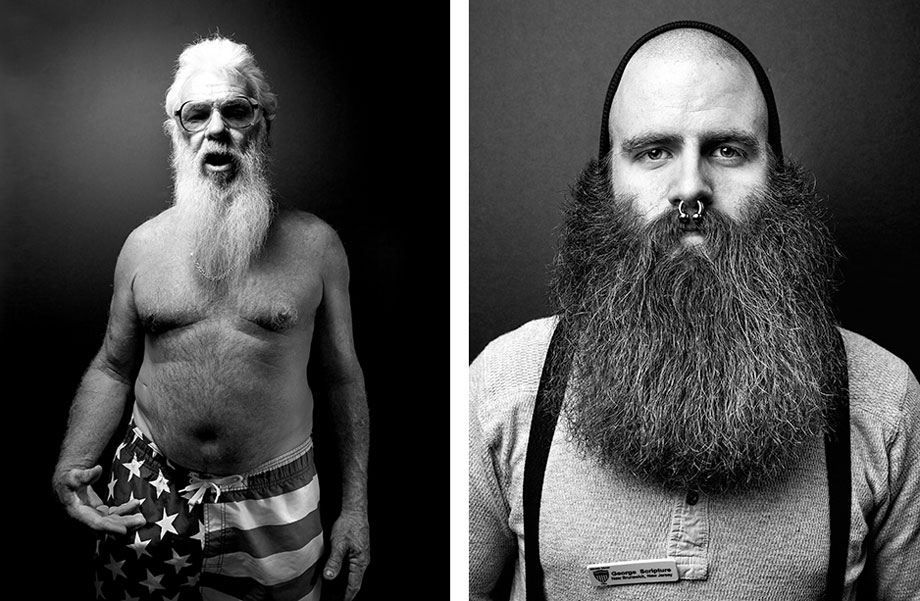
A photographer of bearded men, Justin James Muir created a photo book to help cover medical expenses for a friend with cancer:
In 2011, Muir’s good friend Mike was diagnosed with testicular cancer. Because Mike didn’t have health insurance, Muir decided to turn the beard project into a self-published book (with Mike on the cover) so he could raise money for Mike’s mounting medical bills. All proceeds from the first printing went directly to Mike. Mike is currently in great shape, and the book has sold far more copies than Muir had imagined since it’s only available for sale on his website. As part of his ongoing commitment to fighting cancer, Muir will donate all proceeds after the first pressing to the Leukemia & Lymphoma Society. This is inspired by Muir’s twin brother, who was diagnosed with leukemia in 1997 (and is now healthy and fully recovered). …
The book also includes several anecdotes that Muir collected from his subjects. “I didn’t really have a length or style in mind; you just needed to have a beard. I’m glad there are some shorter, less spectacular ones in there, because I think it shows how different everyone’s beard experience can be.”
And the winner is … Walt Whitman!
(Photo: courtesy of Justin James Muir, from A Book Of Beards. More photos here.)

The self-satisfied, self-righteous and self-appointed nanny of anyone he can get his administrative hands on is at it again. Here he is denying any scientific basis for medical marijuana – claiming that it’s actually a “hoax” – and alleging that it leads to dependency – with no evidence – and then using the pathetic argument that because marijuana is more potent today, it is somehow more dangerous. He has no evidence for that either. There is now a huge amount of data proving marijuana’s key help in addressing a variety of medical conditions that no other drug can yet match.
The man just despises freedom, as anyone living in his nanny-city of New York can attest. And his enthusiasm for the stop and frisk police policy for marijuana possession now makes more sense, doesn’t it? He’s enforcing morals and health using the police force in the crudest manner possible. He’s a Prohibitionist of the crudest, dumbest kind.
But the strangest argument is the following:
“Drug dealers have families to feed,” Bloomberg said. “If they can’t sell marijuana, they’ll sell something else.” Bloomberg says that “something else” will be worse than pot.
I don’t really know where to start with that, do you? His office tried to backtrack:
An aide later told the NY Post that the mayor is concerned that recreational users would be able to access a system intended only for those with medical needs.
So he wants to abolish medical marijuana? Why does that argument not lead directly to the case for legalizing and regulating and taxing it? And he said that medical marijuana was a “hoax.” Does he stand by that statement? Or is he now in Bachmann territory? Anything to control the lives of others, even if it means throwing vast numbers of young black men in jail for merely having a joint on them, thereby ruining their futures because they dare to enjoy something far less harmful than alcohol.
(Photo: Spencer Platt/Getty)

Earlier this week, ten members of Congress sent a letter to the front office of the Washington Redskins, pushing them to select a new mascot:
In this day and age, it is imperative that you uphold your moral responsibility to disavow the usage of racial slurs. The usage of the “R-word” is especially harmful to Native American youth, tending to lower their sense of dignity and self-esteem. It also diminishes feelings of community worth among the Native American tribes and dampens the aspirations of their people. We look forward to working with you to find a solution to this important matter.
Their idea of a solution is a bill that would amend the 1946 Trademark Act to cancel any trademark that uses the term “redskin”. Pat Garofalo figures such federal intervention may be the only way the change will happen:
For precedent, it’s worth revisiting what led Washington’s football franchise to integrate. Then-owner George Preston Marshall was perfectly content to play up the team’s racist history, leaving it the last segregated squad in the league. He finally relented in 1962, not because of any change of heart, but after the John F. Kennedy administration threatened to refuse the team access to what is now called RFK Stadium, which was on federal land, unless it integrated.
Doug Mataconis disagrees with the liberal lawmakers’ strategy:
I have to wonder why this is something that Members of Congress need to be getting involved in, or why legislation is necessary to address something that is, in the end, a private business matter.
The people who don’t like the name are free to protest it. Dan Snyder and the rest of Redskins ownership are free to reject their pleas. If there ever comes a time when the public sympathizes with the protesters, then perhaps the team will feel the kind of economic pressure most likely to cause them to change positions, then we’ll likely see a name change of some kind.
Personally, I think the odds of that happening are pretty remote. The Redskins name has been in existence now since 1933 when the football version of the Boston Braves changed its name to Boston Redskins before moving to Washington, D.C. several years later. We’re not that far away from the 100th anniversary of that name. It’s going to be around for a long time to come, and I’m just fine with that.
(Photo: Fans of the Washington Redskins cheer against the Dallas Cowboys at FedExField on December 30, 2012 in Landover, Maryland. The Redskins defeated the Cowboys 28-18. By Larry French/Getty Images)
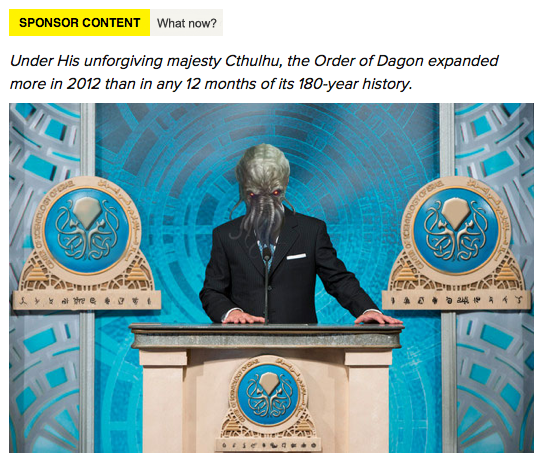
The great Jeff Jarvis takes on “sponsored content”. It’s good to have a giant in the world of online journalism weigh in on a subject so many media companies are so conveniently not writing or talking about. And he’s worried:
First, let me say that I think we in news became haughty and fetishistic about our church/state walls. The reason I teach entrepreneurial journalism is so that students learn about the business of journalism so they can become more responsible stewards of it. I argue that editors, too, must understand the business value and thus sustainability of what they produce.
That said, I worry about journalists who spend one day writing to serve the public and the next writing to serve sponsors. News organizations should never do that with staff, but I’m sorry to say that today, a few do. Freelance journalists are also turning to making sponsored content to pay the bills.
Name names, Jeff! Which news organizations have reporters who also write or edit ad copy? We need to warn their readers. The core principle here has to do with integrity as well as survival. Besides, it’s a losing game in the end:
Brands are chasing the wrong goal. Marketers shouldn’t want to make content. Don’t they know that content is a lousy business? As adman Rishad Tobaccowala said to me in an email, content is not scalable for advertisers, either. He says the future of marketing isn’t advertising but utilities and services. I say the same for news: It is a service.
(Image from The Onion)
“I now think that Ellison was … right to excoriate me for my dismissive attitude toward black culture, and that my Jewish critics were right to take offense at my questioning whether the survival of the Jewish people was worth the suffering it entailed (though at the time, the proximity to the Holocaust made it very hard for me to keep this question out of my mind and to refrain from raising it in print). On the other hand, though I think what I said about white racism in 1963 was right, the contention that nothing has changed since then seems to me almost demented,” – Norman Podhoretz, on the 50th anniversary of his infamous article “My Negro Problem – And Ours.”
Suspicion is mounting over government interference in the now stalled Chilcot Inquiry exploring the former prime minister’s role in hyping the Iraqi threat in 2002:
The central allegation against Mr Blair is that he gave a private assurance in early 2002 to President Bush that Britain would join the United States in an invasion of Iraq. Thereafter, it is said, all was decided. Even though Mr Blair later highlighted Saddam Hussein’s alleged weapons of mass destruction, and misrepresented what he was being told by the intelligence services to the House of Commons, it was of little significance to him, because the die had been cast anyhow.
Hence the central importance of access to those conversations. They are likely to cast much-needed light on whether or not the allegations that the prime minister struck a private deal with the president are true. Yet, amazingly, the Chilcot Inquiry’s website states that it has “not yet” even “begun its dialogue” with government over the treatment of these Blair/Bush conversations.
David Owen, former foreign secretary, has launched an attack, accusing Blair and Cameron of a secret deal to prevent the truth coming out:
Speaking at a public meeting, Lord Owen said that the inquiry “is being prevented from revealing extracts that they believe relevant from exchanges between President Bush and Prime Minister Blair”. The culprits, he said, are Tony Blair and David Cameron: “Publication of the Bush extracts would not be blocked if Tony Blair had not objected, nor if that objection had not been supported by the present prime minister, David Cameron. Both men are hiding behind conventions that are totally inappropriate given the nature of the inquiry.”
I agree. It is of critical importance in a democracy that a declaration of war – the gravest decision a leader has to make – is made transparently, that the case be built on facts, and that the process of deliberation is a real one – and not effectively a farce because of a secret deal to go to war regardless of the arguments. If people cannot trust their own governments to be open and truthful on these matters, then the entire democratic project is in jeopardy. Massie, always worth reading, nonetheless sticks up for Blair:
The war may have proved a grievous blunder and those who opposed it look more prescient (in some ways) than those who backed it. But later mistakes – including, of course, the failure to find WMD – do not actually mean the argument for “dealing” with Saddam Hussein was based upon arguments that were known to be untrue at the time they were being made.
And so, what is the point of “revealing” these conversations [between Bush and Blair]? What, indeed, is the point of the Chilcot Inquiry? Who can it satisfy or whose mind can it possibly change? Some people will not be persuaded because they cannot be persuaded.
If there’s an irony here it is that there were people a decade ago who took any suggestion Saddam might not have active WMD programmes as evidence of Saddam’s utter deviousness. It was proof he could not be trusted and therefore, perversely, evidence he was up to no good. Ten years later we see the same thing: the absence of evidence against Blair is proof of the former Prime Minister’s cunning. He must have been up to something, otherwise why the need for secrecy? And so down the rabbit hole we merrily go.
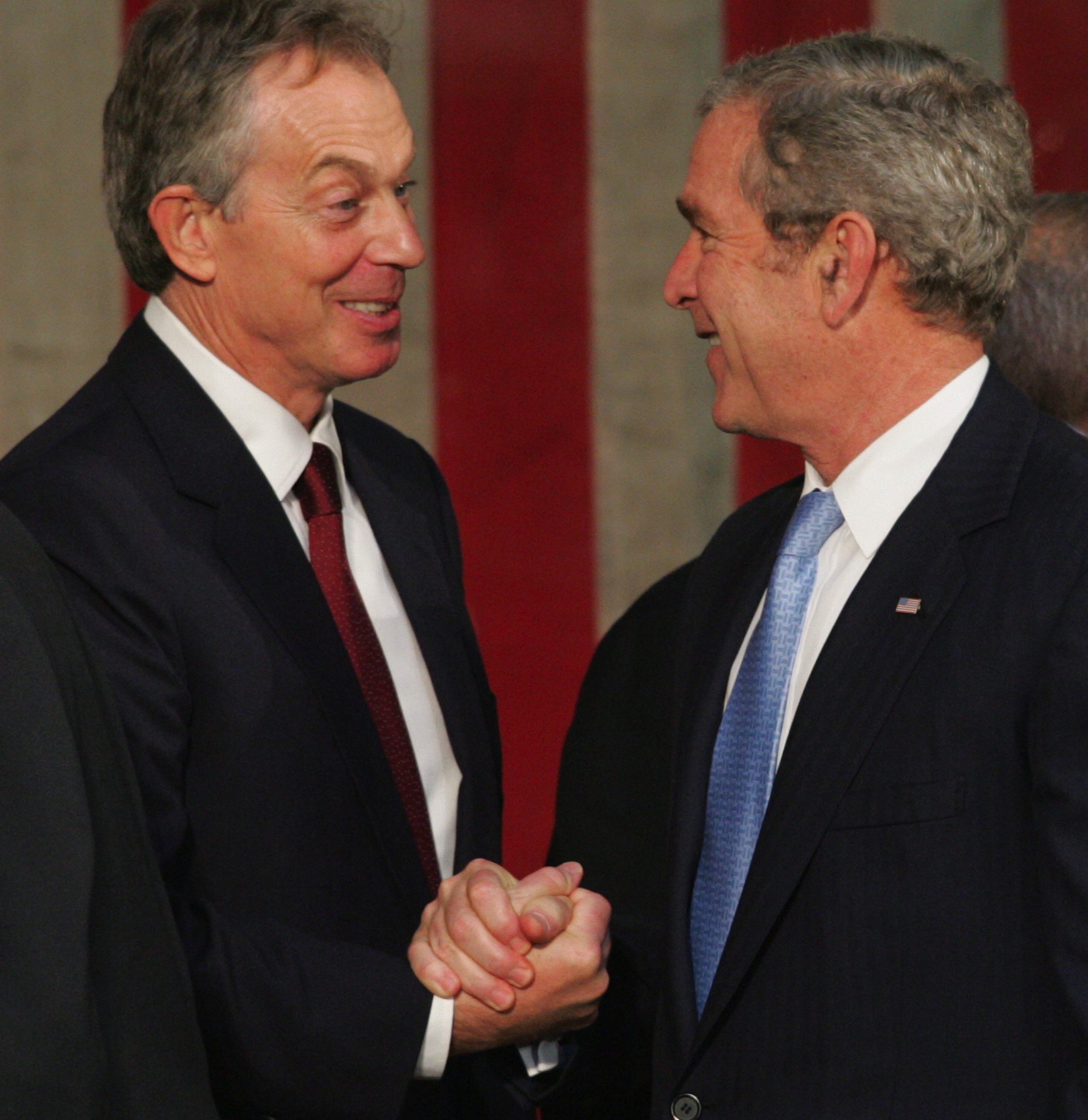
(Photo: Former British Prime Minister and Middle East Quartet Envoy Tony Blair greets US President George W. Bush following speeches during the Annapolis Conference in Memorial Hall at the United States Naval Academy in Annapolis, Maryland on November 27, 2007. By Saul Loeb/AFP/Getty Images)
 The Dish