Vive La Resistance

Chait profiles Josh Barro:

The brief arc of Barro’s young career—at National Review, then Forbes, and now Bloomberg View—displays a man losing all patience with the Republican Party. Over time, Barro’s writing has fitfully evolved from muted, oblique criticism to polite, persistent criticism to, finally, firm opposition. His alienation crystallized in a widely read post declaring Romney’s infamous “47 percent” video as fatally defining the Republican candidate. Now Barro writes things like “The party’s economic agenda, as embodied in the latest Ryan budget, is simply terrible for the vast majority of Americans.”

I recently sent Barro his 2010 article praising Ryan’s plan. After rereading it, he ticked off its flaws: He had filled in every ambiguity by assuming the best faith on Ryan’s part, while ignoring Ryan’s punishing cuts to Medicaid. The budgetary weaknesses he had identified, he had framed as problems that “need to be fixed,” whereas he now recognizes that Ryan is unwilling to do what’s needed to fix them (primarily, raise taxes).

Dissents Of The Day

US-POLITICS-OBAMA-COUNTERTERRORISM

A reader quotes the president yesterday:

When a U.S. citizen goes abroad to wage war against America – and is actively plotting to kill U.S. citizens; and when neither the United States, nor our partners are in a position to capture him before he carries out a plot – his citizenship should no more serve as a shield than a sniper shooting down on an innocent crowd should be protected from a swat team.

President Obama (and you) may feel that way, but the Constitution says otherwise.  There’s no “unless he’s a terrorist” exception anywhere in that document; if you’re a citizen, you’re entitled to due process.  If you and the president find the Constitution to be inconvenient, I suggest that you petition your respective representatives to Congress and ask them to amend it.  Due process isn’t a luxury; it’s the dividing line between being a nation of laws and a nation of presidential death squads.  We are better than this.

Give me a break. If you have joined up with an army of the enemy and are involved in the planning and execution of mass murder and intimidation of American citizens, and you cowardly choose to launch such attacks from a foreign country where you cannot easily be captured, you have forfeited the rule of law for the rules of war.

When you take up war against your own country, you are a traitor. When you do so on the battlefield itself, and join the enemy’s army, and declare war on your fellow citizens, there is no reason on earth why, after careful sifting of the evidence, the US president shouldn’t fight back by the same means you have chosen. And, look, there is no constitutional question here. Ex parte Quirin (1942) has established the constitutionality of defending this country from traitors who have joined the enemy’s army abroad. Most of the traitors captured in that case were sentenced to death by military commission, as authorized by the executive branch. They were executed outside the civilian justice system. Another reader:

You criticized George W. Bush harshly and appropriately for his suspension of habeas corpus of suspected terrorists (American or not) during his administration and in fact revisited that criticism during the South Carolina Republican Presidential debate when you said, sarcastically, referring to the Republicans,  “Habeas corpus is no big deal because presidents don’t abuse power. Unlike monarchs, I suppose. This is the party of restoring the Constitution?”  And yet, in a jaw dropping show of chutzpah, you defend Obama when he says referring to an American terrorist suspect, “his citizenship should no more serve as a shield than a sniper shooting down on an innocent crowd should be protected from a swat team.”

So in your warped sense of government, it’s unthinkable to imprison a person indefinitely without judicial review under presidential fiat but killing a U.S. citizen without judicial review under presidential fiat is just prudent policy. This from a person who is against the death penalty, for heaven’s sake.  Life imprisonment without judicial review sounds a lot better than getting killed via Hellfire missle.

I just want to know, what unconstitutional act would this president have do in order for you to criticize him?  By my figuring, a limited support role in Libya in violation of the War Power’s act will get some criticism from you but an out-and-out violation of the 5th Amendment that expressly limits the government’s power against its citizens gets support and lauding.  Unbelievable.

It would be if it were true. I have harshly criticized the failure to live up to the Geneva Conventions by initiating prosecutions of war criminals. I have criticized not releasing the Yemeni prisoners. I want GTMO bull-dozed. I have urged more caution on drone warfare. I have called for the release of even the 50 most dangerous suspected terrorists. But my reader tries to make a rhetorical point about a choice between detention without trial or murder by hellfire missile. Those are not the choices. If Awlaki were to turn himself in, he would be given proper due process and a civilian trial. But since he cannot be captured and brought to justice, and since he is at war, trying to kill American citizens, a commander-in-chief has a duty to fight back.

My readers seem to have no grasp of the concept of war, as opposed to peace, or a deliberately distant and unreachable battlefield in a foreign country, as opposed to a citizen at home. I wonder if the word “treason” has any meaning for them at all. They keep acting as if Awlaki is a suspected criminal in the US and just arbitrarily murdered by the government. It just baffles me that the actual context is just absent in their analyses. Another reader:

I’m afraid you’re missing a key point about what the president said in the speech. Drones are NOT about just Awlaki, even if I don’t share your own view on that matter (there’s a difference after all between a police sniper taking an in the moment judgment call and a the pre-meditated murder of an American citizen, however vile, by an executive without judicial oversight). In theory, the President’s case today could have been more convincing if what his administration has consistently done is actually identify targets ahead of time that are worthy of assassination. But by far the most controversial component of the drone program (morally to be sure) is the use of so-called ‘signature strikes’, which requires no prior identification of individuals being targeted.

That ridiculously low standard, coupled with the administration’s own past broad grouping of those who can be targeted (“The definition is a male between the ages of 20 and 40” as former Ambassador to Pakistan, Cameron Munter, said previously), makes any claims to self-policed rigor utterly fatuous.

That is a standard you simply would not have allowed for Bush. Why the crickets now? I say that knowing that you have criticized Obama for not clearing up drone usage before. Well, here was his chance. Where was the legal basis now? Setting up drones as an alternative to Bush’s wars or torture is a straw man, and nothing more.

It is only a straw man if you have no actual responsibility for the security of the country. And the president has clearly signaled a winding down and eventual end to the drone strikes. And he argued for a clearer and more transparent process. He went a great distance in addressing the real concerns of all of us about the endless war, and yet we still get this continued self-righteous obloquy on the man.

(Photo: Medea Benjamin, a protester and co-founder of Code Pink, shouts as US President Barack Obama speaks about his administration’s drone and counterterrorism policies, as well as the military prison at Guantanamo Bay, at the National Defense University in Washington, DC, May 23, 2013. By Saul Loeb/AFP/Getty Images)

Potbelly Pigs

Of a different variety:

Seattle-based [William] von Schneidau has been feeding marijuana scraps — leaves, stems, and root bulbs — to a stable of pigs. He’s a butcher in newly street-legal Washington; the weed feed comes from a medical marijuana co-op. Von Schneidau’s scheme is an of-the-moment novelty, allowing him to charge $120 for periodic Pot Pig Gig dinners. But he wants you to know: this isn’t about the money, or the PR avalanche (his story has gone semi-viral this week). Pot pigs are simply the latest iteration of his longtime passion — drawing connections between an animal’s diet and its meat. … Like blueberry quails, or the coveted acorn-fed pigs of Spain, von Schneidau believes meat’s flavor can be enhanced through a guided diet. Pot is the most recent of his off-template pig food, which has included spent vodka stillage, microbrew grains, and cantaloupes.

Unfortunately for the pigs, “eating raw marijuana doesn’t give mammals a high.”

White Picket Fence Poverty

It’s on the rise:

According to a new report put out by the Brookings Institute, more poor inhabitants of the U.S. now live in suburbs than in cities and rural areas. Between 2002 and 2011, the population of the suburban poor rose 67%. That’s over twice the number seen in urban areas.

Brad Plumer summarizes key points from the report:

The biggest driver is that suburbs simply grew faster than urban areas during the 2000s, particularly in the South. At the same time, jobs have been migrating to the suburbs for many years — and that includes low-paying jobs in retail and hospitality. As a result, many of the working poor have been moving to the suburbs, too.

Reihan’s perspective:

[T]he fact that a fifth of New York city’s population lives in poverty while the same is true of only 9 percent of the population in its suburbs doesn’t represent a failing — rather, it reflects the fact that density and the widespread availability of mass transit are particularly valuable to the poor, who find it more difficult to purchase and maintain automobiles and for whom density facilitates greater access to service jobs. … So suburban poverty poses problems that poverty in dense cities well-served by transit does not. The problem we face is that the U.S. has relatively few dense cities that are well-served by transit, as such cities can greatly facilitate upward mobility for the very poor.

Literary Memory

Ian Crouch reflects on his tendency to read voraciously, only to completely forget books shortly after:

This forgetting has serious consequences—but it has superficial ones as well, mostly having to do with vanity. It has led, at times, to a discomfiting situation, call it the Cocktail Party Trap (though this suggests that I go to many cocktail parties, which is itself a fib). Someone mentions a book with some cachet that I’ve read—a lesser-known work of a celebrated writer, say Eliot’s “Daniel Deronda,” to take an example from my shelf—and I smile knowingly, and maybe add, “It’s wonderful,” or some such thing. Great so far, I’m part of the in-crowd—and not lying; I did read it. But then there’s a moment of terror: What if the person summons up a question or comment with any kind of specificity at all? Basically, what if she aims to do anything other than merely brag about having read “Daniel Deronda”? Uh-oh. It’s about mining, right? Maybe blurt something about that. No, wait, that’s Gaskell’s “North and South.” I must either vaguely agree with what she says, hoping she isn’t somehow putting me on or lying herself, or else confess everything, with some version of the conversation killer: “I read that entire novel and now can tell you nothing of any consequence about it.” Or else slink away, muttering about needing to refill a drink.

The Story Of Wikileaks

Daniel Stuckey chats with Alex Gibney about his Wikileaks documentary:

I think the seeds of whom Assange has become today were always there: In his childhood, in the way he approached the world through the computer, in his kind of solitism, in the way he kind of took to himself and also imagined himself to always be a grander figure than he necessarily was, a kind of self-regarding narcissism. These were always there, but they were balanced with a healthy sense of idealism, and a self-deprecating humor. The Julian Assange that Mark Davis captured just before the Afghan War logs is a more interesting figure.

I think in the late scene, and through much of the more vicious attacks on Wikileaks, his character flew out of balance, and now he’s something that’s closer to a human megaphone. If you look at the Wikileaks’ twitter page, I think there’s something like 1.5 million followers. And then look at how many people that site is following. Two. And they’re both Wikileaks sites, so, you know (laughs), that’s kind of a grand metaphor. Lots to say, but not much to listen. Not much patience for listening, not much bandwidth for listening.

Reason also has an excellent new interview with Gibney about his film:

Twin Personalities

Ben Thomas compiles evidence that variances in young adulthood, early childhood, and even in utero nutrition set in motion the distinct personalities of genetically identical twins:

In short, Kempermann says, “Experience matters. Genes are clearly critically important – but even given identical genes and an identical environment, different experiences lead to different personalities, and to the individualization of the brain.” It’s a comforting thought, in its way: Even if DNA encodes the basic recipe for your personality; even if epigenetic changes started cooking up the ingredients months before you were born, your personal choices and experiences also define how those ingredients come together – and, to a certain extent, what sorts of recipes you pass on to your children.

It doesn’t seem reasonable, then, to claim that individuality is somehow innate at the moment of conception; or at any single point in anyone’s development. Rather, it’s a process – a series of changes that begin at the molecular level and add up over time, spurred on by the unbroken flow of unique accidents, triumphs, letdowns and challenges each individual faces every day, from pre-conscious prenatal development to the last gasping breaths of old age.

Not Knowing What You Know

Fluency Learning

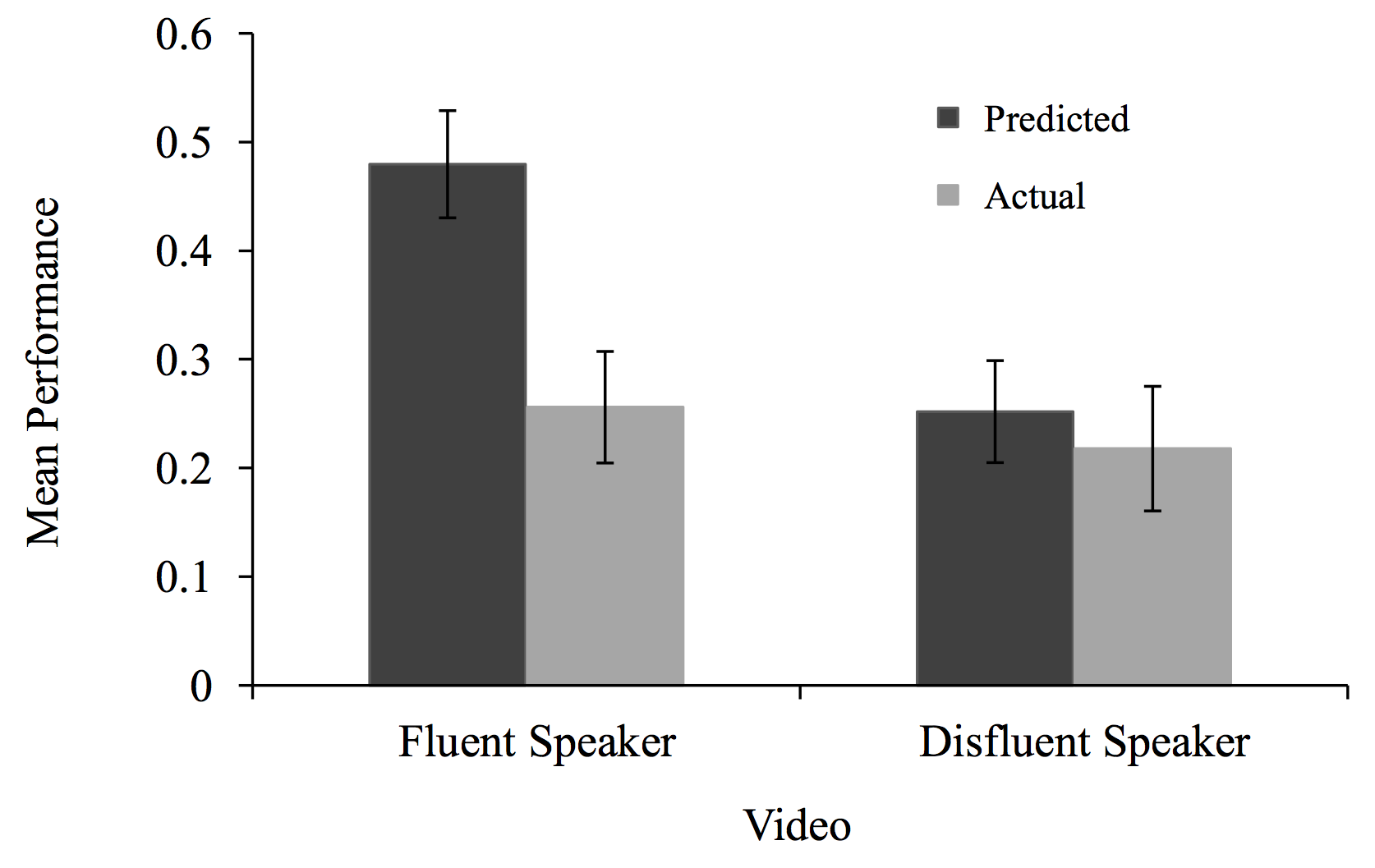
Alex Mayyasi summarizes a study (pdf) on the gap between perceived and actual learning:

One group saw a lecturer who presented with the skills of a TED speaker. The other watched the lecturer read haltingly from notes. Afterwards the students answered questions about how much they felt they had learned. As expected, students who had watched the lecturer with better presentation skills expected to remember more of the material, believed that they understood the material better, and rated their interest and motivation more highly than the students who watched the dud instructor.

But a test found that both groups had retained roughly the same amount of information:

The students who watched the skillful (or “fluent”) lecturer barely outperformed the students who watched the “disfluent speaker.” But they did much poorer than they expected to do, whereas the other group did about as well as they expected.

Drum adds:

If these results hold up, it means that flashy, TED-style lectures don’t actually impart any more knowledge than boring old-school lectures. But they do make you more confident that you learned something. Is that worthwhile all by itself? Or is it better to have a proper grasp of just how much you really know?

Machine Gun Parties

Bryan Schatz attends a “building party”, where gun enthusiasts privately collect and assemble pieces from various assault rifles:

Although US customs laws ban importing the weapons, parts kits—which include most original components of a Kalashnikov variant—are legal. So is reassembling them, as long as no more than 10 foreign-made components are used and they are mounted on a new receiver, the box-shaped central frame that holds the gun’s key mechanics. There are no fussy irritations like, say, passing a background check to buy a kit. And because we’re assembling the guns for our own “personal use,” whatever that may entail, we’re not required to stamp in serial numbers. These rifles are totally untraceable, and even under California’s stringent assault weapons ban, that’s perfectly within the law.

His takeaway:

I’m left wondering: Seeing how easy this is, are build parties monitored? Do hand-built weapons ever surface in crimes? Are the cops worried? When I call local law enforcement representatives from Los Angeles, Orange County, Santa Ana, and Garden Grove, they say they’ve never heard of such a thing. “That doesn’t happen here,” says Bruce Borihanh, an LAPD spokesman. But a cursory browse of online gun forums is enough to show that, well, clearly it does. There seems to be one about every month. Plus, I just attended one less than an hour’s drive from his office.

I’m reminded of what one of the build party hosts said before I left: “Remember that thing I told you about why people do this: These builds can happen only because they aren’t blown out to the public and law enforcement.”

Why Cord Cutting Hasn’t Killed Cable

Cable Earnings

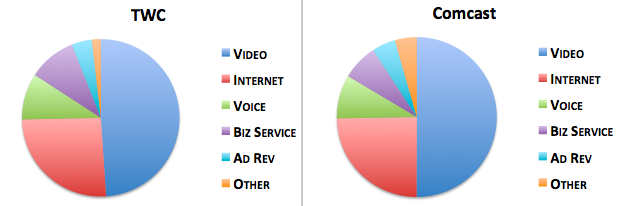
Derek Thompson explains how “cable is still making more and more money every year, despite a structural decline in cable TV subs”:

Cable ≠ video, and nothing says it more clearly than the latest earnings reports from the Big Two: Comcast, the largest provider of pay-TV in the country; and Time Warner Cable, the second largest cable provider (but behind DirecTV and Dish in total video subs). Comcast’s total revenue is almost twice TWC’s, but their businesses are remarkably similar.

Upshot: If you equate “cable” with TV, you are literally getting only half the story. Cable providers are in the business of communications transport. They’re still in business because selling communications access is still a pretty good business, with high barriers to entry and voracious demand.