A Constitutional Clash Over Keystone?

Congress is considering a bill that would take the decision on the pipeline out of Obama’s hands. Howie Klein expects it to go through:

It will in all likelihood pass the House tomorrow and, with the efforts of [John] Barrow [D-GA] and [Jim] Matheson [D-UT], will be hailed as a “bipartisan” bill. It will then go over to the Senate where it could very well pass as well, since so many Democrats take massive bribes from Big Oil. Perhaps Obama prefers it this way, so he doesn’t get the blame for this pollution bill.

Alan Grayson (D-FL) is challenging the constitutionality of the move:

Republican supporters of the bill have argued that Congress has the authority under the Constitution to regulate international commerce. They say the Keystone pipeline falls into that category because it would move tar sands oil between Canada and the United States. Opponents can point to recent court decisions saying that the responsibility for permitting for transnational pipelines has fallen on the president for several years. But if Grayson’s question comes up for a debate, Republicans are likely to argue that they are seeking to re-establish congressional authority over pipeline decisions — especially the Keystone pipeline, which the GOP says has been unduly delayed by Obama for several years.

Rebecca Burns explores the divisions the pipeline has caused within the Democratic party:

So far in the Keystone XL conflict, unions have largely ended up on the other side of the line in the tar sand. The Teamsters, the International Brotherhood of Electrical Workers, the Laborers International Union of North America (LIUNA) and others have backed the pipeline as a way to create jobs. And as environmental groups flooded the State Department with comments opposing the pipeline, members of the AFL-CIO’s Building and Construction Trades Department (BCTD) rallied to send President Obama a different message: “We can’t wait,” said BCTD president Sean McGarvey during an April 24 demonstration calling for the State Department to approve the project. In other words, the Keystone pipeline fight has turned into an XL-sized problem for an already tenuous labor-environmental alliance. …

This isn’t the first time that greens have been painted as latte liberals removed from the issues facing ordinary people. But the fight against the Keystone XL pipeline has actually helped “redraw the cultural map” of participation in the environmental movement, according to Kim Huynh, a spokesperson with the group Tar Sands Blockade. She notes that Tar Sands Blockade, the more radical edge of the broader movement, has drawn participation from conservative landowners, Texas grandmothers and indigenous communities in staging tree-sits, lockdowns and other dramatic demonstrations to halt the ongoing construction of the pipeline’s southern leg. She believes that this has succeeded in “legitimizing direct action” in the broader environmental movement and building, for the first time, a climate change movement “with real teeth.”  But do environmental activists have any hope of successfully fighting global warming without labor’s support?
An Islamist Beheading In Britain

It was in broad daylight – by two men who attacked a British soldier near his barracks. An eye-witness account:

“We saw clearly two knives, meat cleavers, they were big kitchen knives like you would use in a butcher’s, they were hacking at this poor guy, we thought they were trying to remove organs from him. These two guys were crazed, they were not there, they were just animals. They then dragged him from the pavement and dumped his body in the middle of the road. They took 20 minutes to arrive, the police – the armed response.”

There were cries of “Allahu Akbar” as the horrifying attack took place. The murderers seemed from initial accounts to be proud of what thay had done and hung around the corpse, until the police arrived and both assailants were shot. The above video is of a British man declaring Jihad against his own country. He is bragging of the beheading. He is a barbarian. Let me quote the Pope again:

To say that you can kill in the name of God is blasphemy.

Does The Pope Read Rumi?

leavesofgrass

A reader notes the striking similarity between Francis’ words today and the legendary Persian poet and mystic, as masterfully translated by Coleman Barks and John Moyne:

Out Beyond Ideas

Out beyond ideas of wrongdoing and rightdoing,
there is a field. I’ll meet you there.

When the soul lies down in that grass,
the world is too full to talk about.
Ideas, language, even the phrase each other
doesn’t make any sense.

Rejecting Rafsanjani

Iranian influential cleric and former pr

Yesterday, Iran’s Guardian Council shocked the country by disqualifying the presidential candidacy of Rafsanjani, one of the architects of both the Iranian Revolution and the country that resulted from it. Thomas Erdbrink passes along [NYT] this succinct reaction from an Iranian citizen:

“They say a revolution eats its children,” said Mehdi, 27, a teacher. “But in the case of Rafsanjani, the revolution has eaten its father.”

Erdbrink makes a key observation with regards to what this election, on its current course, may mean for Iran:

Since its founding in 1979, the Islamic republic has been characterized by constant and often public competition among opposing power centers, a back-and-forth that gives ordinary citizens and private business owners the ability to navigate among the groups.

Barring further surprises, the winner of the June election will now be drawn from a slate of conservative candidates in Iran’s ruling camp, a loose alliance of Shiite Muslim clerics and Revolutionary Guard commanders. That would the presidency under their control and would mark the first time since the 1979 revolution that all state institutions were under the firm control of one faction.

Meanwhile, Iranian MP Ali Motahari, a Rafsanjani ally, has voiced his outrage over Rafsanjani’s disqualification in a public letter that has already been deleted off of some Iranian news sites:

“My strong assumption is that if Imam Khomeini were alive and he registered under a pseudonym, he would be disqualified, because sometimes he expressed criticism.” Although Rafsanjani has never publicly criticized Khamenei, after the 2009 contested elections Rafsanjani took a moderate tone with regard to the protesters, and it is commonly understood that the two are at odds over various political and economic issues of the country.

Motahari wrote, “You are informed that with the entry of Rafsanjani to the political scene, how much enthusiasm it created among the people and how much hope it gave them for reform and growth. With his disqualification, naturally, this enthusiasm and hope has disappeared.” He continued, “My recommendation is that with a [government decree], you approve of Rafsanjani’s” candidacy.[“]

Ayatollah Khomeini’s daughter has similarly asked Khamenei to reinstate Rafsanjani’s candidacy. Suzanne Maloney thinks through the regime’s reasoning:

However absurd the Islamic Republic’s vetting process has been in the past – and more than two dozen elections over the course of 34 years have provided plenty of fodder – the suggestion that a man who has been at the apex of power in the Islamic Republic since its inception no longer meets its constitutional standards for the presidency carries the farce to a new level.

Rafsanjani sits on the Assembly of Experts, which appoints Iran’s supreme leader, and leads its Expediency Council, which adjudicates challenges to proposed legislation. The determination that he is unfit for the presidency inevitably calls into question the credibility of these other institutions. The other rationale on offer— the aspersions on Rafsanjani’s advanced age (78) that were invoked by a number of conservative power brokers— is similarly insupportable. The Islamic Republic is, after all, a clerical gerontocracy. Rafsanjani may be closing in on 80, but he cuts a relatively spry figure among the Iranian political establishment, including by comparison with its late founder who seized power as a septuagenarian.

Regardless, Maloney doesn’t buy the idea that Rafsanjani would have been some kind of savior:

The image of the former president as an infallible architect of economic reform is in fact greatly exaggerated. He did spearhead the post-war reconstruction program against considerable domestic opposition, but his policies also instigated a destabilizing debt crisis and spiraling inflation. Rafsanjani’s reputation for personal enrichment, the ascendance of his sons and daughters and nephew, and the culture of crony capitalism that emerged during his tenure left deep resentments among ordinary Iranians whose share of the post-war spoils typically did not expand.

As part of an extended look at the complicated relationship between the Rafsanjani and Khamenei, Max Fisher highlights how Rafsanjani’s flirtation with the American oil industry during his presidency may have played a role in his disqualification:

Despite those years of post-presidential loyal service to the supreme leader, Rafsanjani is still closely associated with the signature foreign policy issue that appears so anathema to Khamenei: outreach to the United States. The supreme leader, after years of tension with his country’s president during Rafsanjani’s tenure, during Khatami’s more reformist administration and, finally, in the now-ending Ahmadinejad era that saw the two grapple for power, perhaps does not want to grapple with Rafsanjani again.

Marcus George rounds up Iran’s remaining pre-approved presidential candidates:

“All of the approved candidates are either loyal to Supreme Leader Ayatollah Khamenei or are mostly irrelevant,” said Alireza Nader, an analyst at RAND Corporation. “Khamenei may still overturn the decision, but Rafsanjani’s disqualification shows that Khamenei is determined to wield all power. This appears to be a presidential selection rather than an election.”

BBC has a primer on the eight approved candidates.

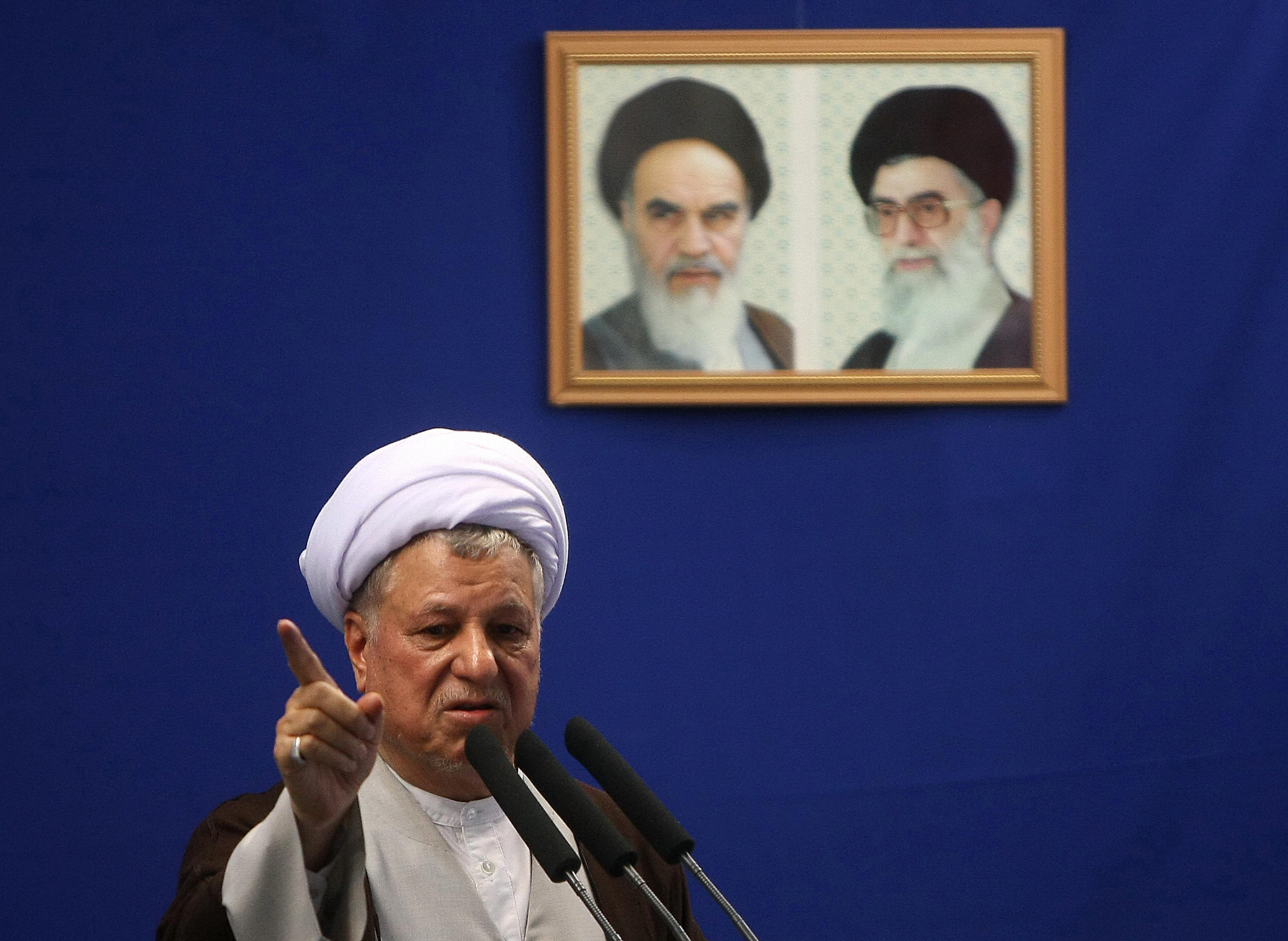
(Photo: Iranian influential cleric and former president Akbar Hashemi Rafsanjani delivers his sermon during Friday prayers at Tehran University in the Iranian capital on July 17, 2009. By Ali Rafiei/AFP/Getty Images)

Quote For The Day II

“Republicans came after LGBT families, and Democrats didn’t stand up. Who will be in the GOP’s sights next? Senators have lined up in recent months to proclaim their support for marriage equality and LGBT rights. Yet, given the first opportunity to put their vote where their talking point is, they failed. Our families need deeds, not words,” – Rachel Tiven, executive director of Immigration Equality Action Fund.

My take on the bill’s removal of gay couples here.

(Disclosure: I serve on the board of Immigration Equality.)

Ending The Perpetual Emergency

Spencer counts up the topics Obama should address in his upcoming national security speech, particularly his scroll of emergency war powers authorizing detention and surveillance:

To date, the Obama administration hasn’t talked about rolling back any of the emergency powers it enjoys. Those powers, and the rebalance of liberty and security they represent, have already outlived Osama bin Laden. The basic inertial forces of American politics position them to outlive al-Qaida. Just two years ago, cabinet officials talked about being ten or 20 kills away from strategically defeating al-Qaida. Now senior Pentagon aides talk about a war that will last ten to 20 years.

“Enduring security and lasting peace do not require perpetual war,” Obama said in his second inaugural address. Rhetoric like that is cheap, and arguably cynical, considering Obama’s geographic expansion of the war on terror. If Obama wants his speech tomorrow to surpass empty rhetoric, he can at least acknowledge that enduring security and lasting peace do not require perpetual war powers, either.

I hope Spencer is pleasantly surprised tomorrow. I think Obama understands that one of his critical legacies will be unwinding the “perpetual emergency” and to normalizing our relations with the rest of the world so we can return prudently to a pre-9/11 posture again. The ferocious critics of the drone strikes do not, it seems to me, acknowledge the role of drones in this process. The drone strikes really did help wipe out the human infrastructure of al Qaeda as a formal network in Af-Pak while allowing us to draw down troops in that region. There came a point, of course, at which their success in undermining the formal institution of al Qaeda actually fortified the informal Jihadist movement, and its support in Muslim countries, and even here, as in the Tsarnaev losers. Since that inflection point, the drone war has been reduced enormously.

This has been a terribly difficult needle to thread, and I wish some of the president’s critics would occasionally acknowledge that difficulty, instead of getting more and more shrill in blanket condemnations. Obama wants both to end the Bush-Cheney “war on terror” rubric without letting our guard down against Jihadists. That’s why I’m not too outraged by the fanatical pursuit of national security leaks.

If we are to defang Jihadist terror – and it is real and resilient – without the horrible error of occupying Muslim countries with troops, we have to use intelligence, infiltration, espionage and superior data analysis to prevent plots before they bear bloody fruit. When the existence of informants are exposed by the AP, the chances of keeping terror at bay by these least worst means dwindle. Which means the temptation to return to war and torture would remain, in the hands of future presidents. This may be hard for purists to grasp. But if Obama is going to unwind the full Bush-Cheney apparatus of the permanent war, he needs to be able to fight Jihadist terror on traditional intelligence grounds as well. And that requires some secrecy.

But it also requires more boldness than Obama has shown so far. He needs to have Gitmo closed and bulldozed before he leaves office. That may require some truly difficult calls – but that’s what the executive branch is for, especially in its control of the release of prisoners. Maybe this cannot happen until the near the end of his term. But if Gitmo is left open, its legacy of brutal torture, murder and violation of core American values will remain for a future Republican to reboot. Obama has already come a long way in unwinding much of this. But before he leaves, he must ensure that no trace of the Cheney gulag remains.

(Thumbnail photo: Joel Saget/AFP/Getty Images.)

When Equality Requires Big Government

Frum comes away with a new view of the postwar-South after reading The Warmth of Other Suns, Isabel Wilkerson’s book about the Great Migration:

Many of us on the right would like to tell a story of the post-Civil War South that indicts segregation as a product of government regulation only. Wilkerson’s quashes that illusion.

The oppressive actions of the Southern state presupposed the oppressive organization of Southern society and the Southern economy. It was no act of government that imposed the rule that a black customer in a shop must wait until all the white customers had been served. Store owners did not worry that mistreating black customers would cost them business, because the post-1865 settlement had failed to compensate ex-slaves in any way for their unpaid labor, meaning that even in freedom they remained nearly as landless and poor as ever. The stark divide between economic wealth and political power that matters so much to libertarian theory does not describe reality in the South of 1915.

In the North, the migrants encountered discrimination. No matter how much wealth they accumulated – and some accumulated a great deal – they could not gain the highest degree of status. But in the South, the utter lack of status had prevented black Southerners from accumulating wealth in the first place. To transform the South into something more like a market economy, open to all participants, would require the forceful application of federal government power in the years after World War II.