Evgeny Morozov is against the plan to make Google Maps “highly personalized, giving preferential treatment to the places frequented by our social networking friends, the places we mention in our emails, the sites we look up on the search engine”:
There’s something profoundly conservative about Google’s logic. As long as advertising is the mainstay of its business, the company is not really interested in systematically introducing radical novelty into our lives. To succeed with advertisers, it needs to convince them that its view of us customers is accurate and that it can generate predictions about where we are likely to go (or, for that matter, what we are likely to click). The best way to do that is to actually turn us into highly predictable creatures by artificially limiting our choices. Another way is to nudge us to go to places frequented by other people like us—like our Google Plus friends. In short, Google prefers a world where we consistently go to three restaurants to a world where our choices are impossible to predict.
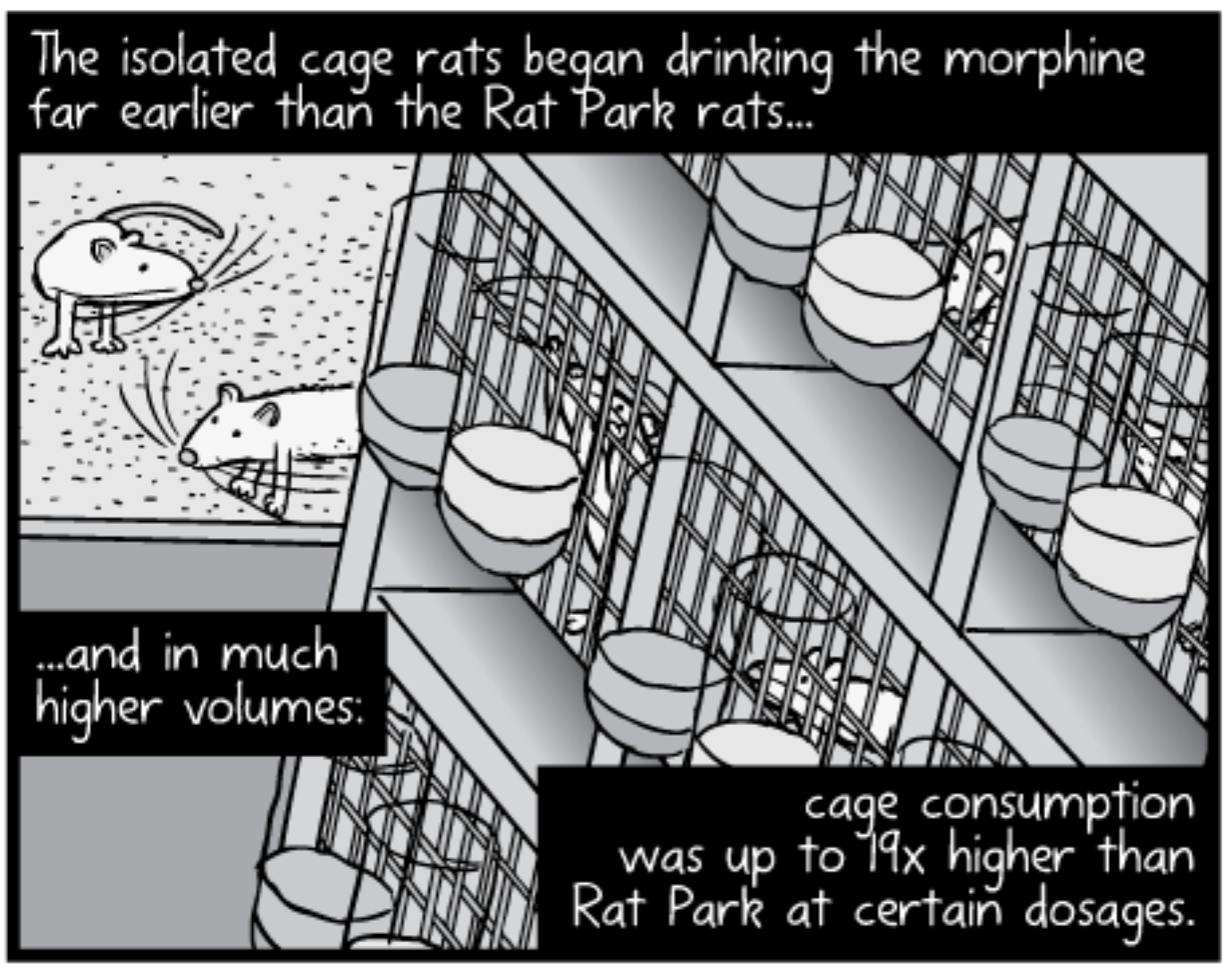
Stuart McMillen has a fascinating new comic on the question. He focuses on the Rat Park research of Bruce Alexander, who compared the drug habits of isolated rats and properly socialized rats. One frame:
I am not denying that certain drugs lend themselves to addictions. Alcohol, heroin and methamphetamines seem to be examples of drugs with properties that allow users to dull reality and escape their troubles, albeit temporarily. However, if the drugs themselves are truly the ’cause’, then by definition everyone who tries these substances should become equally addicted. And that is simply not the case.
Britons who have a planned surgery on a Friday are 44 percent more likely to die. And the few patients who had a leisurely weekend surgery saw that number jump to 82 percent. The skeleton staff working on weekends might be to blame.
Researchers stressed, however, that not only is the weekend surgery sample size small, it is also likely biased in some way—perhaps only the already-most desperate of patients would have an operation on the weekend. Operations scheduled for Friday, though, are more comfortably compared to Monday, and the jump in mortality rates is striking.
It’s not just Britian:
A similar study conducted in American Veterans Affairs hospitals found that the odds of a patient dying in the 30 days following surgery jumped when the surgery happened on Friday.
Ann Billson wishes that more filmmakers would adopt less redundant voiceovers:
The most irritating thing about The Great Gatsby (which I mostly enjoyed) was Tobey Maguire’s voice-over. “He had the kind of smile that seemed to believe you, and understand you as you wanted to be believed and understood,” says Tobey over a shot of Leonardo DiCaprio giving us exactly that kind of smile. And then, later, “Gatsby looked in that moment as if he had killed a man,” Tobey says over an image of DiCaprio looking – yes! – exactly like someone who had killed a man.
As the popular screenwriting slogan has it, “Show – don’t tell.” Just because the story is told from one character’s point of view doesn’t mean you have to hear that character’s voice blathering in your ear all the time – look at Chinatown. Voice-over narration is pointless when it’s adding nothing to what we can already see for ourselves, but it does have its uses.
She runs through many examples and embeds several YouTube clips. More embedded examples on her blog.
Nate Cohn isn’t expecting a Clinton landslide in 2016. He thinks that, if “Clinton isn’t winning Romney voters at the height of her popularity, there’s cause to be skeptical about whether she will in four years”:
In the critical battleground states of the Midwest and West, Clinton actually appears to be doing worse than Obama. Not only do recent surveys show her below 50 percent in Colorado and Iowa, but she leads candidates like Rand Paul by just 4 points in Iowa and 3 points in Colorado—worse than Obama’s 5-plus point victories in those states.
On the other hand, Clinton is performing much better than Obama in Southern states with a large number of traditionally Democratic white voters who supported Romney, like Kentucky and even Florida. But Clinton’s strength in these areas might be especially likely to fade, or at least especially unlikely to pay off.
The most popular posts of the day remained my critique of Ross Douthat and my take on the homoerotic dimension of scouting. Apart from our regular Dish views – half a million over the last two days – the post on Ross has been individually linked to more than 16,000 times.
Frank Rich worries that rapid advances in gay rights are obscuring the discrimination faced by the gay community in the recent past:
For younger Americans, straight and gay, the old amnesia gene, the most durable in our national DNA, has already kicked in. Larry Kramer was driven to hand out flyers at the 2011 revival of The Normal Heart, his 1986 play about the AIDS epidemic, to remind theatergoers that everything onstage actually happened. Similar handbills may soon be required for The Laramie Project, the play about the 1998 murder of the gay college student Matthew Shepard. A new Broadway drama, The Nance, excavates an even older chapter in this chronicle: Nathan Lane plays a gay burlesque comic of 1937 who is hounded and imprisoned by Fiorello La Guardia’s vice cops. Douglas Carter Beane, its 53-year-old gay author, is flabbergasted by how many young gay theatergoers have no idea “it was ever that way.”
It’s particularly remarkable given the extreme trauma of mass death that the gay world experienced as recently as a decade and a half ago. But for today’s young gays, that’s not just another country; it’s another continent.
I have to say I feel very mixed feelings about this. Having struggled a quarter of a century ago to stop marriage equality from being treated as a joke by straights and as a neo-fascist plot by gays, it’s staggering now to realize that many young gay kids take their right to marry almost for granted – even though it still isn’t granted fully anywhere in the US yet (because of no federal recognition).
So yes, it’s oddly alienating to feel that one’s entire life has now been rendered moot. But also, exhilarating. One of the key reasons I always believed marriage and marriage alone could turn the gay-straight chasm into a bridge is its generational impact. When I figured out I was only virtually normal, I was around seven. And all I really knew about sex and love was that mummy and daddy were married and I never could be. That’s a huge psychic wound in the souls of gay kids. From that wound, often nursed alone and in private, comes a panoply of pain, pathology, self-destruction, and lack of self-worth. Few can afford the kind of intensive therapy required to get past this – because the wound is so deep and inflicted so young.
But today, that seven-year-old will know, simply if he or she watches the TV, that marriage is an option for him or her. They will know in a way my generation didn’t that they have a future in the society they live in, like their siblings. There are still wounds inflicted by misguided religion or panicked families. But the ur-wound is gone. And the generations of gay kids I meet today are simply way less fucked up at their age than I was, or may ever be. In that sense, I celebrate their amnesia and look up to them. I want the struggle of the past to be flooded by the normality of the present.
But we gays are also crippled in terms of communal memory. Ethnic minorities beget ethnic minorities; and parents are able to tell the stories of their past communal struggles, whether they be Jewish or African-American or even simply immigrant stories that link us to the past. But the parents of gay kids are, by and large, straight. They never went through the gay struggle. They have no gay history to share with their kids, who are born de novo, and required eventually to go outside their own families to find out about the history of their kind.
Most don’t. And I sure wouldn’t want them indoctrinated in any way. But can you imagine Jewish grandchildren of Holocaust survivors never being told about it? Or African-American kids never knowing fully about slavery?
We have no permanent national monument to commemmorate a plague that killed five times as many young men in the same space of time as the Vietnam War. Only now are we seeing the beginnings of memory – the revival of “The Normal Heart”; the documentary “How To Survive A Plague“; or the one-night revival of David Drake’s “The Night Larry Kramer Kissed Me.” Which is not surprising, if you have studied the end of plagues. The first sentence in my own plague memoir, Love Undetectable, is the following:
First, the resistance to memory.
That is understandable at first, as Camus noted, but it is becoming increasingly unforgivable. We need as a community to honor the veterans of that war, to hold them up and keep them close, and to retrieve the unimaginable agony of those days of psychological terror and excruciating physical pain. And if that makes me sound like a bitter war veteran, please know that bitterness is the very last thing I feel.
We lived for this moment, these years when we would finally see our freedom. Many of us doubted we would ever get to this mountaintop and were fully prepared to die somewhere in the foothills. But if we do not ever look back, and see the trail of corpses along the way, and the ocean of grief and pain we overcame, we will never fully grasp the dimensions of the victory. Or its real and deeper meaning: a spiritual awakening about the dignity of all human beings; about their universal need, above all other things, for love; about how Christianity, at a key moment of testing, sided against love and lost a generation.
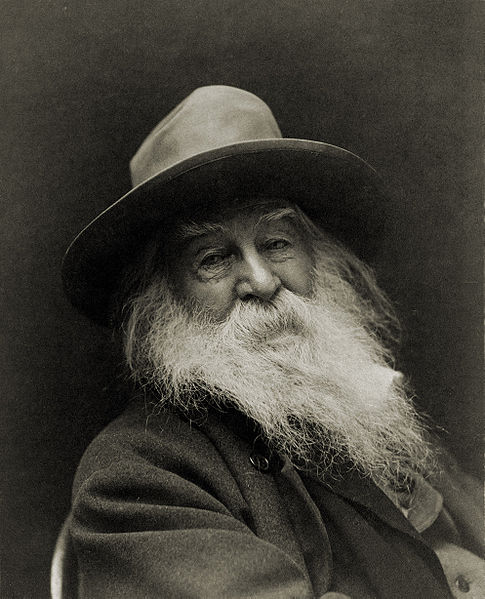
“You do yourself no good by not seeing the greatness even in people who have held disreputable ideas. To look at Walt Whitman and just see a racist is precisely what makes racism wrong: you don’t see the entire person–in all his complexities, virtues, and foibles–you just see the race. By doing this, you artificially flatten the person, and thus you literally lie to yourself, for you intentionally deny the truth that a great man can have within him both grandeur and vice.
If you want to be better than Whitman, rid yourself of the habits of mind that in him resulted in the beliefs that you now find offensive. The ability to separate the wheat from the chaff is a sign of intellectual maturity. Thus, discarding the wheat because you can’t bear the chaff does not punish Mr. Whitman; it punishes you,” – Francis Beckwith, on a Northwestern University student refusing to play a song containing words written by Walt Whitman.
(Photo of the original bear by George C Cox, 1887. From Wiki: “The image is said to have been Whitman’s favorite from the photo-session; Cox published about seven images for Whitman, who so admired this image that he even sent a copy to the poet Tennyson in England. Whitman sold the other copies.”)
Most men’s obliviousness to charm supports the proposition that the quality is not essential, even as that obliviousness makes for a decidedly less pleasant world. Charm is a social—a civilized—virtue. But its very refinement, the weight it places on self-presentation, means that it is inherently manipulative.
All of [Cary] Grant’s characteristic winning expressions—the double take, the cocked head, the arched eyebrow, the sideways glance—signaled that he was pulling something off. The charming man (or woman) always knows that he (or she) is pulling something off, no matter whether that charm is used to put the wallflower at ease, to get the soccer dad to exchange some pleasantries, or to close the sale. The charmer knows that he or she is manipulating—and in the end, it’s impossible not to be at least slightly contemptuous of the object of one’s manipulation.
[A]ll these numbers are simply guesses. Really. That’s it. California’s numbers are guesses. Maryland’s numbers are guesses. Oregon’s numbers are guesses. Vermont’s numbers are just guesses. Everyone is just guessing. … We’re covering those guesses in the press. When they come in low, we say it’s good news for Obamacare. When they come in high, we say it’s bad news for Obamacare. But we don’t really know whether the guesses are right or wrong either.
Even more interesting is what happens in year two. By then, insurers will know who signed up and how much their care actually cost. But at that point, their pricing won’t really be up to them. The law’s medical loss ratio rules require insurers in the exchanges to spend at least 80 percent of premiums on actual health care. If the care costs less than that, insurers have to send consumers a rebate — something many have already had to do.
Aaron Carroll wonders if political maneuvering based on these “guesses” will come back to haunt Republicans actively opposed to implementation:
[T]he gambit of those opposing Obamacare seems to be a full throated and all-out-effort to show that Obamacare doesn’t work. The danger, though, is that it might.
The jury is still out, of course. But it’s important to recognize that full-out opposition to reform like this is somewhat novel in American politics. No one knows what such a strategy will bring in the long run.
Many thought passing the Affordable Care Act would be President Obama’s “Waterloo.” It wasn’t. In fact, some have argued that the flat out refusal to negotiate in the law’s passage cost opponents the chance to get a final product more to their liking. Things are shaping up similarly now. If, a year from now, it appears that exchanges are working out in states that embraced them, and that the Medicaid expansion is succeeding in states that allowed it, then it may turn out that refusing to bend may have instead caused the opposition to break.

 The Dish