Love In The Time Of Immortality

Matt Bieber of The Believer interviews philosopher Todd May about the pros and cons of eternal life:

BLVR: Let’s get into some of those specific changes that you think might take place under conditions of immortality. Could true love exist among immortals?

You seem to doubt it—you say that relationships would probably be “shallower.” And my intuition is to say that the intensity that brings lovers together, the passion and the urgency, has something to do with knowing we’re going to die, and that that sort of fervor might not be necessary under conditions of immortality. Is that where you’re going?

TM: Yeah. And I think we can broaden it outside of death here as well, which is that part of loving is the urgency of recognizing that the person that you’re with may not always be there. It may go back to what you were saying earlier, that there’s a solidarity about death that perhaps we share—and share intimately—with someone we love.

If you’re immortal, you can imagine being sad or grieving if a lover leaves you. But if everyone were immortal, then that leaving isn’t necessarily forever. There’s always a chance that you get them back somewhere down the road—you know, in 5, 10, 20,000 years. So I think that the urgency of the moment gets sapped. One of the things that’s crucial to me about love is that it has to be in the moment. Love is not a promissory note. And once you remove some of that urgency, you diminish love.


A Poem For Saturday

SONY DSC

“For D.” by Christian Wiman:

Groans going all the way up a young tree
half–cracked and caught in the crook of another

pause. All around the hill-ringed, heavened pond
leaves shush themselves like an audience.

A cellular stillness, as of some huge attention
bearing down. May I hold your hand?

A clutch of mayflies banqueting on oblivion
writhes above the water like visible light.

(From Every Riven Thing © 2011 by Christian Wiman. Reprinted with kind permission from Farrar, Straus and Giroux, LLC. Photo by Flickr user heycountryboy)

Taking Down Dan Brown

Clive James, who recently translated The Divine Comedy, has some damning words for Dan Brown and his Dante-inspired Inferno:

Having read The Da Vinci Code with close attention to its sales figures, I have a great belief in Dan Brown’s attractions as a writer. The belief is all the greater because I can’t quite define what those attractions are. Certainly they don’t have anything to do with his prose, which would be unreadable if it were not so riveting. From that strange anomaly, I deduce that it’s his ability to ‘tell a story’ that pulls in the customers. (I once met a man who told me that he was reading all of Jeffrey Archer’s novels for a second time because of Archer’s ability to ‘tell a story.’ I asked for more details, but the man was led away to take his meds.) …

All I can say at this point is that Dante can ‘tell a story,’ too, and that I have tried to make my translation faithful to the story he tells. Dare I say that there are moments of narrative poetry in the Divine Comedy that would challenge even Dan Brown’s subtlety and sense of nuance? Catching the shades and tones took me all the skill I had, which meant that it took a lifetime to get ready: a lifetime of writing verse, with the occasional very small check and a croak of approval from a literary critic. Dan Brown has spent his lifetime learning to write the kind of prose that has earned him nothing except millions of dollars. I pity him deeply.

Recent Dish on Brown’s Inferno here. Update from a reader:

Gotta tell you I am sick to death of all the interwebz literary snobbishness. So, FINE, Dan Brown probably won’t win the next Pulitzer or Man Booker or whatever. Neither will James Patterson or Nora Roberts or Robert Parker (RIP) or Terry Pratchett or Christopher Moore or whoever? But what is so Goddamned wrong about wanting to just ESCAPE for a few hours, laying aside our OH SO HEAVY INTELLECT for just a little while? Do we always have to be reading something “IMPORTANT”? Clive James seems like a real drag, and should probably get over himself as soon as possible.

Mr. Messy Gets Washed

Sadie Stein points to a droll Amazon UK review of Roger Hargreaves’s “Mr. Men” series:

If ‘1984‘ or ‘The Trial‘ had been a children’s book, Mr Messy would be it. No literary character has ever been so fully and categorically obliterated by the forces of social control. Hargreaves may well pay homage to Kafka and Orwell in this work, but he also goes beyond them.

We meet Mr Messy – a man whose entire day-to-day existence is the undiluted expression of his individuality. His very untidiness is a metaphor for his blissful and unselfconscious disregard for the Social Order. Yes, there are times when he himself is a victim of this individuality – as when he trips over a brush he has left on his garden path – but he goes through life with a smile on his face.

That is, until a chance meeting with Mr Neat and Mr Tidy – the archetypal men in suits. They set about a merciless programme of social engineering and indoctrination that we are left in no doubt is in flagrant violation of his free will. ‘But I like being messy’ he protests as they anonymize both his home and his person with their relentless cleaning activity, a symbolism thinly veiled.

This process is so thorough that by the end of it he is unrecognizable – a homogenized pink blob, no longer truly himself (that vibrant Pollock-like scribble of before). He smiles the smile of a brainwashed automaton, blandly accepting what he has been given no agency to question or refuse. It is in this very smile that the sheer horror of what we have seen to occur is at its most acute.

The reviewer, Hamilton Richardson, tackles more of the characters here.

The View From Your Window Contest

Screen Shot 2013-05-17 at 4.35.28 PM

You have until noon on Tuesday to guess it. City and/or state first, then country. Please put the location in the subject heading, along with any description within the email. If no one guesses the exact location, proximity counts.  Be sure to email entries to contest@andrewsullivan.com. Winner gets a free The View From Your Window book. Have at it.

When Music Gets Mushed Up

In a wide-ranging interview, Jaron Lanier, a musician and author of the new book Who Owns The Future?, worries that new technology increasingly conceals the personal effort involved in creative work:

I’m quite concerned that in the future someone might not know what author they’re reading. You see that with music. You would think in the information age it would be the easiest thing to know what you’re listening to. That you could look up instantly the music upon hearing it so you know what you’re listening to, but in truth it’s hard to get to those services.

I was in a cafe this morning where I heard some stuff I was interested in, and nobody could figure [it] out…. Then it changed to other music, and they didn’t know what that was. And I tried to use one of the services that determines what music you’re listening to, but it was a noisy place and that didn’t work. So what’s supposed to be an open information system serves to obscure the source of the musician. It serves as a closed information system. It actually loses the information.

So in practice you don’t know who the musician is. And I think that’s what could happen with writers. And this is what we celebrate in Wikipedia is pretending… that the speaker doesn’t matter. And if we start to see that with books in general… [y]ou see the thing decontextualized.

I have sort of resisted putting my music out lately because I know it just turns into these mushes. Without context, what does my music mean? I make very novel sounds, but I don’t see any value in me sharing novel sounds that are decontextualized. Why would I write if people are just going to get weird snippets that are just mushed together and they don’t know the overall position or the history of the writer or anything? What would be the point in that. The day books become mush is the day I stop writing.

Collecting Shards Of Heartbreak

dish_breakup

Aminatta Forna describes the creation of the Museum of Broken Relationships in Zagreb, Croatia:

Olinka Vistica and Drazen Grubisic, the museum’s founders, were once a couple in love. One hot summer some years ago they stopped being in love and began to divide the contents of their apartment. Theirs had been an amicable split, though no less sad for that, and so they sorted through the rooms together, parsing shared memories of their relationship. Cups, CDs, ashtrays, coffee grinders, pans, rugs, books, badges, scarves: “even the most banal object [had] a story to tell.” These were the sorts of objects every well-meaning friend, every self-help manual, every magazine article offering advice on how to recover from heartbreak urged people like them to throw away, burn, break or give to charity—to get rid of at all costs. When love ends there must be no reminders.

But this pair didn’t wish to do any such thing. They wondered at the mercilessness of disposing of the evidence of love that may have given years of joy and much pleasure. They decided to curate a travelling exhibition of donated items, to offer bereft lovers the chance to create a ritual, an alternative to the vandalism proposed by the self-help manuals—”a chance to overcome an emotional collapse through creation”, as the printed sign above Ana’s boots tells newcomers.

From Forna’s tour of the museum:

Against the opposite wall is a shaving kit given by a 17-year-old girl to her married lover in the late 1980s. When he donated it to this museum, the married man wrote: “I hope she doesn’t love me any more. I hope she doesn’t know she was the only person I ever loved.”

(Photo by Flickr user woodleywonderworks)

This Diploma Goes To Eleven

Nottingham Trent University will now offer a degree in Heavy Metal Music Performance. Colin Schultz is curious:

As a venue for securing employment, sure, maybe it’s not the most straightforward approach. Then again, according to Forbes, a whole host of college degrees, from film and art to philosophy and history, are pretty much pointless if your whole goal is to secure a high-paying wage. But as an intellectual pursuit, how is studying the history and cultural force of heavy metal music any different than studying, say, the societal impact of Renaissance era French poets? For many, college is a time to expand your horizons, to think weird thoughts and to absorb knowledge you’d probably never encounter otherwise. Rock on, Nottingham, \m/.

But the degree does have a practical side:

New College Nottingham has launched the degree to capitalise on the rock and metal music scene in the city which is home to Download festival [that attracts more than 75,000 rock and metal fans every year] and where Iron Maiden’s Bruce Dickinson hails from. … Tutors say the degree isn’t about ‘creating the next rock star’ but is about capitalising on the thriving music industry in the city and enthusiasm for music to make students ready for a career in the industry, not just as performers but to work in music publishing, record companies and teaching.

Previous Dish on the nexus of scholarship and heavy metal here.

In The Moment

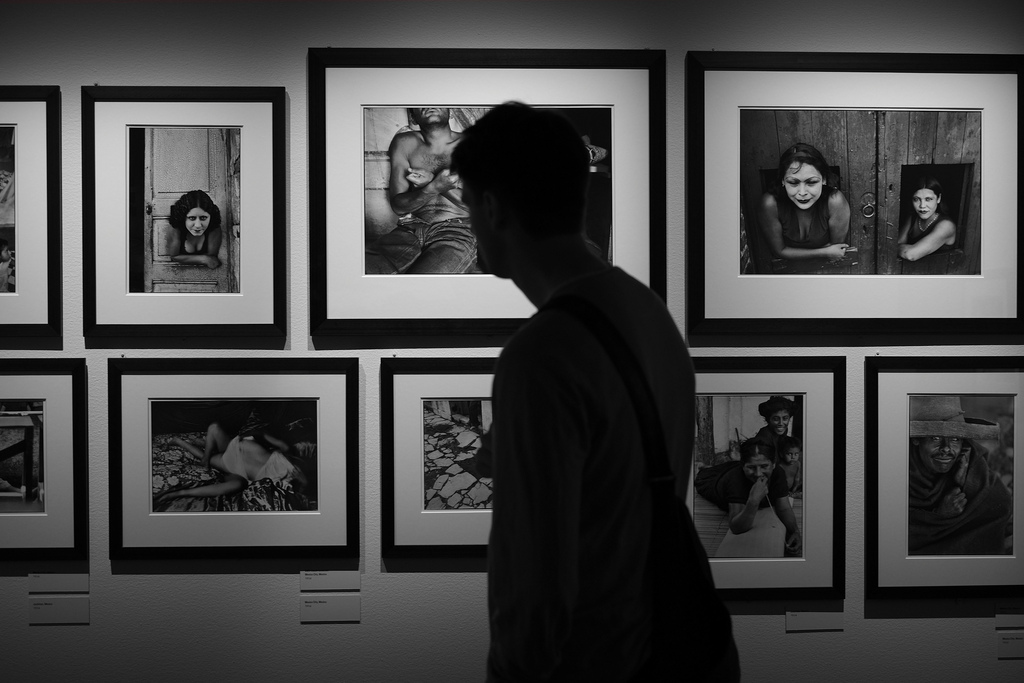
Clayton Cubitt contemplates the “Decisive Moment”:

Henri Cartier-Bresson believed that the photographer is like a hunter, going forth into the wild, armed with quick reflexes and a finely-honed eye, in search of that one moment that most distills the time before him. In this instant the photographer reacts, snatching truth from the timestream in the snare of his shutter. The Decisive Moment is Gestalt psychology married to reflexive performance art in the blink of a mechanical eye. It is the creation of art through the curation of time.

He envisions a future of “Constant Moments”:

With the iPhone 5 camera module currently estimated to cost about $10/unit, and dropping like a rock with the inexorability of Moore’s Law, we can see how even an individual photographer might deploy hundreds of these micro-networked cameras for less than it costs to buy one current professional DSLR. What might a photographer do with a grid of networked cameras like this, with their phone as the “viewfinder?” A street photographer could deploy them all over a neighborhood of interest, catching weeks worth of decisive moments to choose from at leisure. A photojournalist could embed them all across a war zone, on both sides of the battle, to achieve a level of reality and objectivity never seen before. A sports photographer could blanket the stadium and capture every angle, for the entire game, even from each player’s perspective. Activists could choose to link their networked cameras and capture a live feed from every protestor in a march of hundreds of thousands, each one flaggable, perhaps to highlight any police abuses as they occur, from every perspective nearby, editable live from anywhere else on Earth. All of this is closer to the now than to the future.

(Hat tip: Xeni. Image of Cartier-Bresson’s work by Mikael Moreira)