I take issue with the contention that George Orwell’s “Homage to Catalonia” is “a model for modern war journalism.” I don’t feel that Orwell can accurately be categorized as a “journalist” in the Spanish Civil War. Orwell fought on behalf of one of the belligerent parties, and actively participated in the frontline battles of the POUM, the Trotskyite militia. He recounts trench warfare in the mountains, night raids, and his other combat experiences. It certainly provides a gripping, fascinating look at the inept manner in which the war was fought in his mountainous sector; his accounts of the attitudes of the population and his other observations are also invaluable, and I don’t mean to disparage their importance.
But I don’t think they provide a very good model for modern war journalism, assuming that we want our journalists to have some semblance of objectivity. I can remember the howls of derision with which many treated reports from journalists “embedded” with American military units in 2003, because those journalists frequently sacrificed objectivity and overtly favored the soldiers with whom they spent all their time.
Well, Orwell took that a step further, and became one of those soldiers. While I appreciate and value the information Orwell provided, I hardly think that his perceptions, opinions, and analyses can fairly be considered “objective,” given that he purposely set that objectivity aside and risked his life to help one side in the conflict prevail by attempting to murder the soldiers on the other side of the conflict. If that is a model for modern war journalism, then we might as well stop sending journalists to cover the wars at all, and simply let some of the more-erudite soldiers from each side send back their own anecdotes and experiences, complete with their own pre-existing ideological and personal biases of the type one acquires from trying to murder the enemy and from having that enemy try to murder you.
Friday on the Dish, Andrew slammed Peggy Noonan’s latest column, parsed public opinion on the IRS and Benghazi, and recalled Rumsfeld’s shut-down argument style. He encouraged consenting adults to let their freak flags fly and dove deep on the meaning of IQ scores. In political coverage, Politico looked to Cheney for guidance as scandals continued to dominate the news, Shafer explained the significance of the leaks that prompted the AP investigation, and readers filled in the tax policy details relevant for the IRS scandal while we looked into why it was important.
Elsewhere, American agricultural workers were less likely to stick around, trans troops made strides, civil unions crept into the mainstream, and David Drake tried to get to the core of the gay rights movement. Abroad, Mohsen Milani prepared us for Iran’s upcoming election, which took some unexpected turns, while we struggled to quantify violence in Syria and a reader provided some on-the-ground perspective from the Syrian border.
In other miscellanea, Razib Khan defended the connection between race and genetics, while readers added their views on tolerance around the world and Mike Kinsley discouraged stigmatization. Chinese cities employed the sincerest form of flattery, Barry Brook and Ben Heard touted the benefits of nuclear power, and the “debate” over global warming was settled among scientists, while climate change chased fish away from home. Venezuela was left with a bit of a mess on their hands after running out of TP, Martin Lewis worried that slowing birth rates were slipping under the media’s radar, and the NTSB considered lowering the bar for a DUI. Jon Lee Anderson examined YouTube as a tool for terrorists, Jeff Saginor worried about Google’s relationship with journalists and John McWhorter found that ending sentences with a proposition was something he could put up with.
As Tom Shone traced Richard Linklater’s work from sun-up to sun-down and Beckham explored the full range of ‘dos, Dr. Dre embodied conservative values, “discussing Uganda” lost its innocence, and the Officereached its expiration date. We surveyed readers about the Wrap, put out a last request for Dishterns, and a reader detailed his slipping self-identification as a dog-person. The MHB garnered multiple “gesundheits” and we spied Stockholm in the VFYW, while the VFYWW took us around the world and a vampire channeled Bachmann in the FOTD.
The rest of the week after the jump:
Thursday on the Dish, Andrew attempted to parse the tax policy details of the IRS scandal, pondered the implications of attempts to tie Obama to the current array of scandals, and clarified his thoughts on genetics and race, Elsewhere, he digested a recent study on worldwide intolerance while one of his dogs showed him almost cat-like disdain.
In political news and views, the Beltway made mountains out of molehills as Kelsey Atherton explained why the courts should take another look at phone records and DOJ surveillance took a real toll on journalists. The IRA scandal brought paranoia back, we weighed the IRS director’s culpability as the scandal claimed his scalp, and the Daily Caller flailed in its attempts to hang it around Obama’s neck. Waldman tired of the semantic arguments over Benghazi and Daniel Klaidman previewed Obama’s upcoming speech on counterterrorism.
Friedersdorf picked apart proposals to tie immigration to IQ, Stephanie Mencimer uncovered the empty coffers of the anti-equality movement, and Casey Mulligan wondered which employers would be the first to drop coverage under the ACA. Overseas, Haj Kadour sacrificed his art for the rebel cause in Syria, Michael Knights blamed turmoil in Iraq on a slow slide back to authoritarianism, we checked in on the results of Pakistan’s recent election, countries struggled to reintegrate detainees,
In assorted coverage, Benjamin Wittes and Stephanie Leutert bashed Wikipedia’s distrust of blogs as the New Yorkereased the stress of blowing the whistle. Drones took to the fields to increase yields and RoboCrow took flight, while readers contributed their thoughts on the military’s sexual assault problem and spoke to both sides of the fracking debate.
Meanwhile, Naomi Alderman panned 21st century mindsets in historical fiction, network TV freed writers by constraining them, and cinema consumed conspicuously. Sue Halpern shared her thoughts on end-of-life happiness, a star-studded cast compiled a heart-wrenching lip-dub for a dying teenager, and Manet and Picasso experimented with product placement. Baths depressed a cat-sized dog in the MHB, Obama checked the skies in the FOTD, and night fell over Denver in the VFYW.
Oh my. Dick Morris says IRS scandal could lead to Obama's impeachment. Which means…it won't.
Wednesday on the Dish, Andrew defended Jason Richwine against the presumption of racism while applauding Ron Unz’s careful analysis of his work, saw room for long-term spending reform in the latest deficit numbers, and cheered Bret Easton Ellis. He gagged at Politico’s insider take on the current spate of scandals, tried to put Benghazi in perspective, and struggled to pick sides in the Syrian civil war. Elsewhere, he found hope for Obama in Dick Morris’ dire predictions and compared the dangers from prescription drugs and pot.
In political coverage, we examined end-of-life decisions for countries and filled in the details of the IRS and DOJ scandals, while Krauthammer provided a Republican voice of reason on Benghazi. Harvey Silverglate cast doubt on the FBI’s policy of not recording interrogations as sexual assault issues continued to plague the military, and we debated geoengineering while looking ahead to how climate change will create refugees in the not-so-distant future.
In miscellaneous coverage, Angelina Jolie made a private health decision in public while we pondered the recent SCOTUS case on patentable genes, and loneliness led to genetic mutations. While Tesla struggled to break out of the classic car dealership model, Alex Mayyasi studied the high cost of academic papers and education failed to entertain. Jonathan Rauch was unflinchingly honest about his past denial, PTSD sufferers benefited from a puff, drugs carried heavier sentences than murder, and rhino horns enticed poachers.
Meanwhile, Sadakichi Hartmann discovered the private significance of scents and Sue Halpern and Pransky calmed a troubled senior. Linda Holmes reminisced about the days when MTV played music, Jeff Koons revitalized pop art, and we found out how to get, how to get to Sesame Street. Pig poop foam threatened farms, Julia Ioffe smiled at comical spy gadgets, we reclined on Freud’s couch and meditated on music’s ability to move us. We took in a stunning view of New Orleans in the VFYW, creatively cracked a few beers in the MHB, and uncovered one of Communism’s victims in the FOTD.
Tuesday on the Dish, Andrew called for accountability at the IRS while the government took a credibility hit, wondered at the media’s silence on the recent New Orleans shootings, worried about intellectual freedom in research on race and IQ. Elsewhere, he cringed at Kessler’s assessment of the Benghazi scandal and remained unconvinced about its import while believers struggled to place it on a map. He pushed back against Greenwald’s view of world violence and digested cross-national perceptions in the “utopian project” that is the EU. In lighter fare, he defended dogs against Ryan Kearney and celebrated our 26,000th subscriber for the new Dish.
In political potpourri, readers pointed to Minnesota’s strong Lutheran as instrumental for marriage equality, Steve Stockman earned an Yglesias nod for his comments on abortion, and Jon Cohn probed Obamacare’s weaknesses. In scandal-mania coverage, the DOJ landed in hot water for collecting phone records and Nick Confessore got right to the heart of the IRS scandal. Kevin Drum predicted short-term upheaval as robots continue to enter the workforce and Ritchie King tabulated pot taxes in Colorado. In international coverage, we compared American economic growth to that in Europe as the US turned a blind eye to poppy production in Afghanistan.
In assorted coverage, honeybee populations plummeted while Priscilla Long found a familiar culprit responsible for the demise of the Neanderthal, and 1927 London brightened up. Ann Friedman embraced journalism’s new chaos, journals were the Twitter of the 19th century, Jessica Helfand listed the pros and cons of lists, and book bans left prison libraries with slim pickings. While Yglesias and Kevin Roose debated Gatsby’s credit score, David Haglund pondered fake reality entertainment and Sue Halpern cured doggie ennui with therapy training,
Meanwhile, Twitter mapped out hate, Bloomberg journalists crossed the line, college students navigated porn in the classroom, and The Economisttraced our language patterns back to the 1066 Norman Invasion. Maple Leafs fell in the FOTD, we enjoyed a beautiful evening on the Oregon coast in the VFYW and cruised the tropics in the contest, and romance novels hit the dance floor in the MHB.
Monday on the Dish, Andrew found Obama’s connection to the Tea Party audits tenuous at best, wondered whether conservatives would be able to get under Hillary’s skin, and hesitated to throw Keynes’ economic baby out with the misogynist bathwater while chuckling at the irony of its origin. He plumbed the depths of our need for enemies, relayed the latest numbers for the Dish model, noted how far the US has come since Virtually Normal, and welcomed Minnesota to the marriage equality movement.
In political reporting, Felix Salmon called out universities’ use of Pell money, Michael Moynihan downplayed the importance of the Koch brothers, and Michael Grunwald defended government investment in green energy. Overseas, James Surowiecki saw encouraging signs for laborers in Bangladesh, Maher and Greenwald debated the “inherently violent” nature of Islam, and Iran silenced critical journalists as we previewed Iran’s upcoming election. Heidi Vogt looked ahead to a news vacuum left after reporters leave Afghanistan as Peter Beinart reminded us of our continuing obligations abroad, and politics in the Middle East needed a reboot.
In assorted news and views, Jonathan Zeller ran down the 15 “New Yorkiest” episodes of the show about nothing, coaches lived the easy life on taxpayer dollars, and researchers tried to distill consciousness to its core algorithm while Michal Lemberger found groupthink in advice columns. Big Brother rode shotgun in Google’s driverless cars, readers continued the discussion of corporate painkiller peddlers, we celebrated all sizes and shapes of snow, and Sue Halpern and her dog brought joy to seniors.
Elsewhere, Sam Allingham struggled to break out of his fan-fiction cage, cursive proved to be a sinister requirement for a left-handed reader, Michael Deacon channeled Robert Langdon, and we were tongue-tied by foreign languages. An Egyptian activist smiled from behind bars in the FOTD, Killarney Clary penned a Monday verse, while we marveled at Main’s green streets in the VFYW, ground control called a real-life Major Tom, and “To The River” caught the eye in the MHB.
Last weekend on the Dish, we stepped away from politics to share the cultural coverage that fascinated us the most. In matters of religion and philosophy, Cass Sunstein reviewed the doubt-driven thought of Albert O. Hirschman, Ollie Cussen praised Anthony Pagden’s new history of the Enlightenment, Daniel Dennett offered a tip for assessing arguments, and a new study suggested that people who often talk in terms of “I” and “me” tend to be more depressed. Giles Fraser found that being a burden can be beautiful, Rod Dreher noted how you can find meaning in unexpected places, and John Waters talked about how nuns inadvertently inspired him. Christopher Brittain revealed which churches are growing the fastest, Julian Baggini described Kierkegaard’s leap of faith, and Dan Siedell connected his fascination with modern art to his religious life.
In literary coverage, Maria Popova cataloged the writing advice of famous authors, Alexander Aciman grappled with translating Proust, William Faulkner proved better on the page than the screen, and Orwell led the way for modern war correspondents. Keith Gandal deciphered one of The Great Gatsby‘s mysteries, S. Hope Mills mused on the meaning of not finishing books, Tom Shone defended sentimentality in film, and Jess Nevins found the source of H.P. Lovecraft’s longevity. William S. Burroughs also lived the chemical life, Words Without Borders featured a poet crushed by propaganda, L.E. Sissman compared writing poetry and writing ad copy, and Alex Dimitrov discovered poetic inspiration in using Grindr. We featured the work of poet Killarney Clary here and here.
In assorted news and view, Buddy Bradley marveled at a FILMography project, Doctor Science considered NC-17 rating from the perspective of a fanfiction reader, and Tom McCormack recalled the novel equipment used to film Vertigo. David Banks rooted the ethos of the Internet in the Cold War’s rivalry, Emily Witt embedded with a pornography shoot, and Amy Fleming offered a rundown of menu mindgames. Graeme Wood detailed the disturbing policy that the nation of Georgia used to tackle its prescription drug problem, Brain Pickingshighlighted the history of the modern coffee industry, and Tim Fernholz looked to California’s manicure industry to understand the benefits of low-skilled immigrants. Hathos alert here, MHBs here and here, FOTDs here and here, VFYWs here and here, and the latest window contest here.
[One experiment] incorporated data on 5,631 Americans, who reported their level of loneliness, described their marijuana usage (if any), and assessed their mental health and feelings of self-worth. Not surprisingly, the researchers found a relationship between loneliness and feelings of self-worth, but it was significantly weaker for regular pot smokers.
“Marijuana use buffered the lonely from both negative self-worth and poor mental health,” the researchers write.
Another experiment, featuring 537 people, found those who were experiencing social pain were less likely to have suffered a major depression in the past year if they smoked pot relatively frequently.
More Dish on the recent studies of loneliness here.
Artists Sebastian Acker and Phil Thompson highlight the surreal phenomenon of “copy towns”, where cities from Europe and the Americas are replicated for Chinese citizens:
[G]enerally China has a long history of copying, especially within architecture and the arts. For centuries the emperors would replicate lands that they had conquered within their own palace gardens. These constructs would often include fauna and plants from the conquered regions. This ability to replicate and maintain the distant land demonstrated the emperor’s control over the original region. Then there is also China’s desire to replicate the West and become a first-world country. A lot of Chinese people look up to the West as an ideal, so the construction of these towns could be seen as a way of accelerating their progress; a quick way of achieving through emulation.
(Photo above of Thames Town by Flicker user triplefivechina. Wikipedia describes it as “a new town in Songjiang District, about 30 kilometres (19 mi) from central Shanghai, China. It is named after the River Thames in England. The architecture is themed according to classic English market town styles. There are cobbled streets, Victorian terraces and corner shops.” )
Each cold-blooded fish species has a particular temperature range in which it thrives. If water temperatures depart from that range, they may experience reduced growth and reproduction, ultimately reducing their numbers in a particular area and changing the species’ distribution. Climate change-driven shifts in fisheries pose the biggest threat to livelihoods in developing countries, especially in the tropics, where adaptation capacity of both people and fish themselves are more limited, [researcher William] Cheung said. …
With climate change predicted to accelerate in coming decades due to the rising amount of greenhouse gases in the atmosphere, even faster shifts in fish populations are possible, which could even lead to disputes between countries if commercially valuable fish shift out of one country’s waters and into another’s, according to Boris Worm, a marine biologist at Dalhousie Univeristy in Nova Scotia who was not involved in the Nature study.
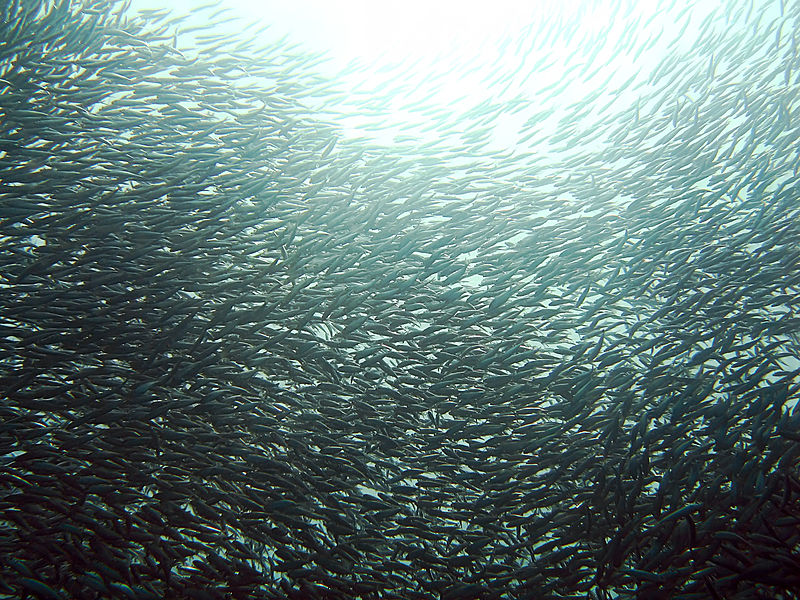
Previous Dish on populations displaced by climate change here and here. Photo of a school of sardines by TANAKA Juuyoh via Wiki.
Robert Jones and Daniel Cox examine support for civil unions over time:
The changing political composition of civil union supporters shows that the center of gravity of this debate has shifted significantly. The civil union option has moved from being a middle way dominated by political moderates a decade ago to one that is, today, most attractive to political conservatives. And looking ahead, there is evidence that the civil union option may have a limited future, at least if younger Americans are any indication. When given a three-way choice, civil unions are the least popular option among Millennials (Americans born after 1980). Only slightly more than 1-in-10 (13%) Millennials prefer civil unions, while 67% say they support allowing gay and lesbian people to marry, and 15% oppose any legal recognition of a gay couple’s relationship.
But Chris Geidner highlights a promising development for transgendered members of the military:
The Pentagon formally recognized earlier this month that there are transgender veterans — a step that LGBT advocates say is a long way from open transgender service in the military, but also a significant first step in that process. In a short letter dated May 2, a Navy official told Autumn Sandeen, a veteran and transgender activist: “Per your request the Defense Enrollment Eligibility Reporting System (DEERS) has been updated to show your gender as female effective April 12, 2013.”
John McWhorter defends ending sentences with prepositions:
Should “she refused to come in” be recast as “in she refused to come”? Of course not. [Eighteenth-centuryauthor Robert] Lowth [who popularized the preposition rule] was referring only to language in its Sunday best when he wagged his finger about the sentence-ending preposition, and at one point in his book, he even wrote, “This is an idiom, which our language is strongly inclined to.” Whether Lowth was aware of the irony is something he took to his grave.
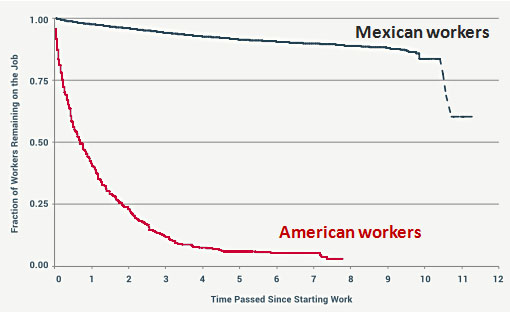
Kevin Drum thinks so. He posts the above chart, which compares the percentage of American and Mexican agricultural workers in North Carolina who stayed on the job over a 12-month period:
Within two months, 80 percent of the native workers had quit. By the end of the growing season, only seven were left. Now, as Matthews notes, this report doesn’t exactly come from a neutral source. It’s from a pro-immigration group working with a group of pro-immigration farmers. But unless they’re flat-out lying here, the numbers are pretty compelling. Most Americans just aren’t willing to do backbreaking agricultural labor for a bit above minimum wage, and if the wage rate were much higher the farms would no longer be competitive.
Farm laborers in Australia make much more than American ones. And yet they still have a functional agricultural sector. It turns out that allowing companies to import an unlimited number of foreign workers desperate to work at a wage of epsilon will create shitty working conditions and low wages!
Noah Millman wonders about the consequences of paying farm workers more:
What would happen if agricultural labor were better-compensated? To some degree American agricultural enterprises would become less-competitive—we’d import more of some kinds of food from abroad. Which would mean more money flowing into the agricultural sector in those countries, and more employment for agricultural labor there, as opposed to here. From the perspective of the farm laborers that’s not obviously a bad outcome—they have jobs and not have to uproot themselves to get them.
Another possibility is that American farmers would innovate, and find ways to get the same crop yields with fewer workers, through the application of automation. That advance in productivity would reduce agricultural employment overall, with the remaining employees earning a higher wage, more conducive to economic and social security. Genuine advances in productivity are usually counted as a good thing for everybody.
Jon Kelly lists the top 10 “most scandalous euphemisms”:
2. “Discussing Uganda” In 1973, the satirical magazine Private Eye reported that journalist Mary Kenny had been disturbed in the arms of a former cabinet minister of President Obote of Uganda during a party. Variations of “Ugandan discussions” or “discussing Uganda” – the term is believed to have been coined by the poet James Fenton – were subsequently used by the Eye to describe any illicit encounter, and the phrase soon became part of common usage.
Two more choice picks from Jon: “slipping my moorings” and “watching badgers”. These, one should add, are very British. They’re basically inside jokes for an entire country, and Private Eye is their central location.



 The Dish