The Republican War On Electric Cars

A proposed law in North Carolina takes aim at Tesla. First, some context:

You can buy almost anything on the Internet: uranium ore, wolf urine, a levitating hover scooter. But you can’t buy a car straight from the factory. Go to the Web site of Ford or Honda or any other major automaker, and they will send you to your local dealer to conduct anything resembling an actual transaction. It isn’t an accident. Rather, it is the result of hard-fought efforts by auto dealers to maintain, through state laws, their exclusive role as the place where one can buy a new automobile. Direct sale of autos by manufacturers is against the law in nearly every state, and there’s a range of related state laws governing auto dealers’ ability to enter or exit a market.

The new bill aims to maintain that:

Its sponsor is state Sen. Tom Apodaca, a Republican from Henderson, who has said the goal is to prevent unfair competition between manufacturers and dealers. What makes it “unfair competition” as opposed to plain-old “competition”—something Republicans are typically inclined to favor—is not entirely clear. …

In its current form, North Carolina’s bill would be the harshest of a handful of anti-Tesla regulations around the country. In Texas, the company is fighting a law under which the employees of its “showroom” in Austin are not allowed to sell any vehicles, offer test drives, or even tell customers how much the car costs. But at least Texas still lets people buy the car online, which North Carolina’s law would prohibit.

Tesla’s [Diarmuid] O’Connell rejects the idea that laws prohibiting automakers from selling their cars are designed to protect consumers, as trade groups like the North Carolina dealers’ association claim. He says the franchise-dealer model might work fine for giant automakers, but not for a startup like Tesla—especially since Tesla’s products represent a challenge to the traditional auto industry on which dealerships rely.

The counterargument:

But it’s not Tesla per se, that worries the dealers. It’s the precedent. The prospect threatens the livelihood of North Carolina’s 7,000 licensed dealers, who invest millions in building big lots and showrooms to efficiently move product, say supporters of the bill. …  The whole misunderstanding would go away, the dealers say, if Tesla sold its cars through licensed dealerships.

Mike Masnick huffs:

This is the same thing we see over and over again in other contexts. Companies in an entrenched legacy position trying to use regulations to block disruptive upstarts. There is no good reason for this law other than to block Tesla and to prop up dealerships. It’s somewhat disgusting to see politicians actively seek to stamp out innovation.

Race And IQ. Again. Ctd.

Ron Unz, who strongly objects to the treatment of Jason Richwine, nevertheless disagrees with the substance of Richwine’s dissertation:

First, he argues that the large IQ deficit of impoverished Hispanic immigrants is likely to inflict a long-term social disaster upon American society. However, it is well known that nearly all previous immigrant groups—southern and eastern Europeans—who came here in poverty similarly scored very low on IQ tests in the decades after their arrival, with results that were sometimes far below those of today’s Mexican immigrants. Yet after a generation or two their tested intelligence had almost invariably converged close to the American mean. Evidence of the past does not necessarily predict the future, but such a strong historical pattern should leave us cautious about assuming it will not continue.

In fact, Richwine specifically discusses the famous study by Carl Brigham, who concluded on the basis of the tests taken by WWI recruits that southern and eastern Europeans were drastically inferior in innate mental ability to America’s mostly northwestern European population and argued that their continuing immigration would produce a national disaster. Richwine rather cavalierly dismisses this historical analysis as having been based on poor testing methods and probably motivated by a belief in “bizarre … racial categories.”

But Brigham was a highly regarded psychometrician and his careful research was widely accepted by nearly all the leading experts of that time. Having carefully read his book, I cannot find any serious fault with his methods nor any indications of unscientific bias on his part. Brigham may have been mistaken in his conclusions, but they seem to have been based on the best evidence and theory of his day.

Furthermore, Richwine chooses to ignore a vast amount of additional evidence from that same period, much of which was collected in Clifford Kirkpatrick’s important 1926 academic monograph “Intelligence and Migration.” Kirkpatrick provides page after page of separate studies demonstrating that during the 1920s the tested IQs of American schoolchildren of Greek, Slavic, Italian, and Portuguese ancestry were usually in the 75-85 range, and that Jewish schoolchildren sometimes performed just as poorly. These results are hardly obscure since they have been cited for decades by Thomas Sowell, and I think it is a serious scholarly lapse for Richwine to have essentially ignored them. Perhaps he simply believes that all IQ experts of a century ago were frauds and their empirical work should be dismissed, but if so, he should explicitly make that argument. Otherwise, we must accept that southern and eastern European immigrant groups had very low IQs a century ago and have average ones today, which is an extremely important finding. In fact, I have demonstrated that there is overwhelming evidence that various other group IQs have risen rapidly over time, and I also provided some strong indications that this exact process is already occurring among today’s Hispanic immigrants.

On another matter, Richwine must be aware that Arthur Jensen and Hans Eysenck rank as two of the greatest figures in twentieth century psychometrics. Yet decades ago both these scholars reviewed the structural evidence of Mexican-American IQs, and reached conclusions almost identical to my own, namely that the acknowledged gaps to white intelligence scores were largely perhaps almost entirely due to environmental factors and would steadily disappear as the population became more affluent and acculturated. Scientists should not argue from authority and Jensen and Eysenck might certainly have been mistaken, but it seems unreasonable for Richwine to never mention their contrary analysis.

This is the kind of criticism that is far more serious and cogent than cries of racism.

The DOJ’s Press Probe, Ctd

US-POLITICS-OBAMA-POLICE

Ambers adds some vital context to the debate:

Why was this leak so bad, then? Why pursue these leakers so aggressively?

Because Brennan might have been implicated and may have spoken off the cuff or too hastily in his briefing, and because he was slated to be the president’s next CIA director (everyone assumed this in Washington but it hadn’t been confirmed), and because Congress demanded an investigation of this particular leak, and because (I’ll grant) the information released could well have been harmful, a perfect storm arose, and the Justice Department found it had the political backing to aggressive and unflinchingly pursue the leakers.

Hence the GOP’s reluctance to take this one on. They wanted an investigation in the first place. And the question of harming national security in this case was a real one:

On May 7, 2012, the AP ran its story; the perpetrator was in custody over the objections of the White House. Other parts of the national security machine were attempting to pursue the loose ends of the plot to see whom it might ensnare, and that effort was apparently cut short.

Greenwald’s column notes that the investigation was legal, but way too broad:

What makes the DOJ’s actions so stunning here is its breadth. It’s the opposite of a narrowly tailored and limited scope. It’s a massive, sweeping, boundless invasion which enables the US government to learn the identity of every person whom multiple AP journalists and editors have called for a two-month period. Some of the AP journalists involved in the Yemen/CIA story and whose phone records were presumably obtained – including Adam Goldman and Matt Apuzzo – are among the nation’s best and most serious investigative journalists; those two won the Pulitzer Prize last year for their superb work exposing the NYPD’s surveillance program aimed at American Muslim communities. For the DOJ to obtain all of their phone records and those of their editors for a period of two months is just staggering.

Still we have been told that the AP email search came after 500 field interviews, did not include all AP emails from April and May 2012, and was trying to protect future anti-terrorist actions from premature public scrutiny, after being told to by the Congress. I find the whole thing troubling – but not outrageous. There’s a trade-off here, as Ambers fairly notes, that Glenn doesn’t acknowledge. Massimo Calabresi notes that Obama promised more transparency:

Obama came into office offering Americans a deal on secrecy. On the one hand, he promised to shrink the number of secrets created by the government, ending the problem of “overclassification” which produces so many secrets that few are well protected. At the same time, he said he would aggressively defend the secrets the government did need to keep by going after leakers and making them pay. Obama has delivered on the crackdown–he’s prosecuted twice as many leakers as all his predecessors combined–but he hasn’t delivered on the secrecy reduction.

Agreed. The administration’s abuse of the state secret loophole has been off the charts. While I’m at it: release the Senate Intelligence Committee’s report on the Bush-Cheney torture program!

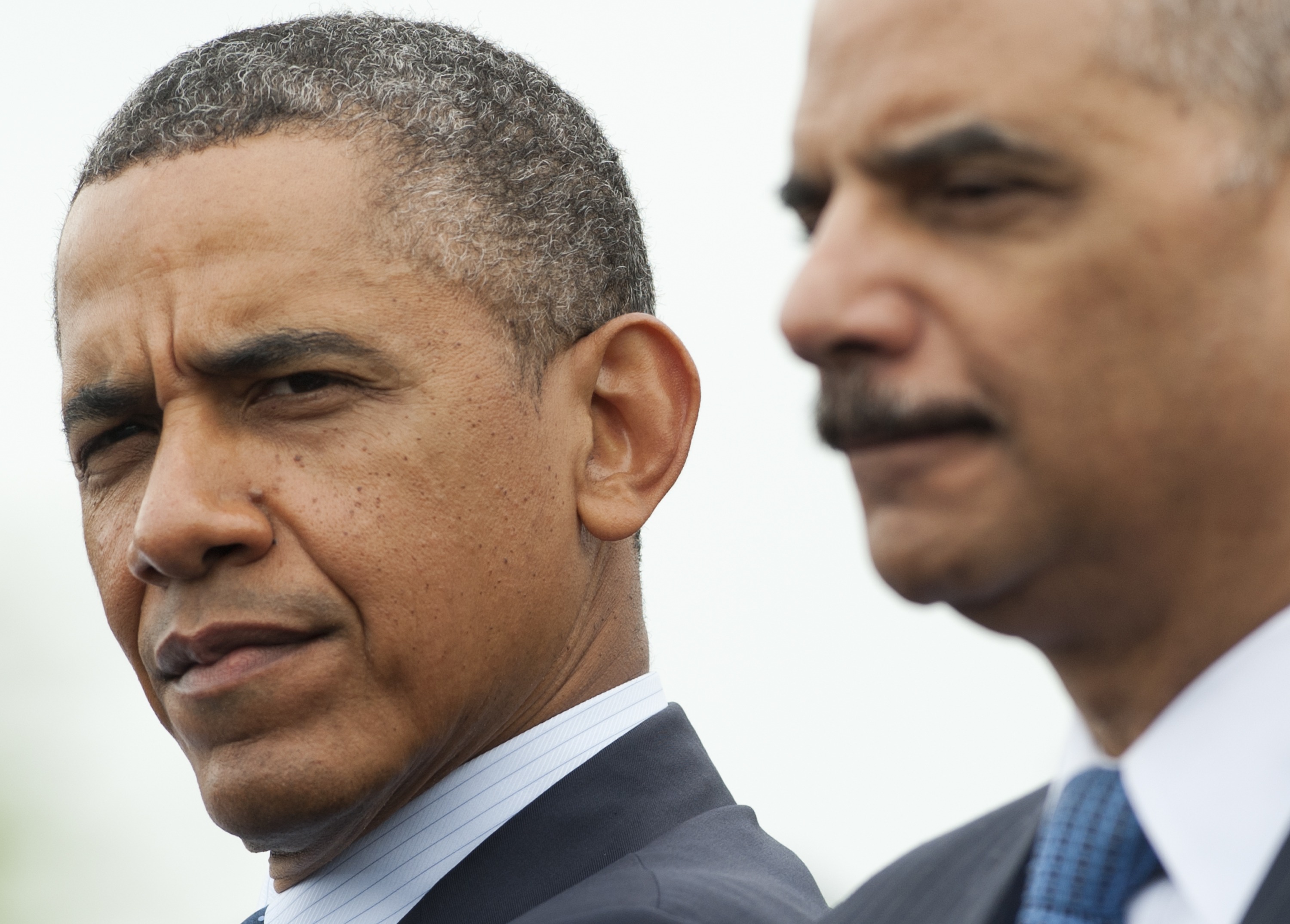
(Photo: US President Barack Obama and Attorney General Eric Holder (R) attend the National Peace Officers Memorial Service, an annual ceremony honoring law enforcement who were killed in the line of duty in the previous year, at the US Capitol in Washington, DC, May 15, 2013. By Saul Loeb/AFP/Getty Images.)

Syria’s Descent Into Hell

From the NYT’s description of the murder scene above:

This graphic video posted online shows 20 members of one family, including nine children, said to have been killed by government forces in al-Bayda, a village in the Baniyas district. Rebels said the government killed at least 322 Sunnis in Baniyas last week, and hundreds are missing. This video shows dead women and children in a darkened room. One woman’s body is surrounded by five children, while another woman’s head slumps back, a baby on her shoulder. The cameraman repeats, “Oh God, oh God.”

Meanwhile, one of the rebel commanders is in another video making the rounds. I’ll let Human Rights Watch describe it:

“The figure in the video cuts the heart and liver out of the body and uses sectarian language to insult Alawites [Assad’s minority sect]. At the end of the video [the man] is filmed putting the corpse’s heart into his mouth, as if he is taking a bite out of it.” Hamad, also known as Abu Sakkar, said he also had video footage of himself using a saw to cut a Shabiha government militiaman into “small and large pieces”.

They are so proud of these atrocities they film them for bragging rights! The indiscriminate violence committed by Assad is more widespread and more lethal than the rebels’. He bears most of the responsibility for this horrifying Hobbesian world. But the opposition forces are degenerating fast as well.

I ask myself of those who committed these atrocities: if I were president, who would I back to be the next ruler of Syria? The question, tragically, answers itself. Neither.

The Tea Party Audit, Ctd

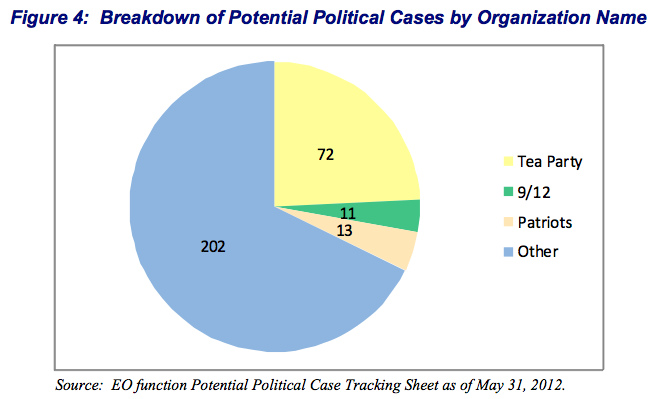
Organization Names

The full Inspector’s General report on the IRS scandal came out late yesterday. Drum peruses it:

I was hoping there might be some interesting tidbits now that we can see the whole thing. Not really, though. Mainly, it paints a drearily predictable picture of bureaucratic FUBARism, with various groups in various places either misunderstanding each other; not responding to each other; or assuming that stuff was getting done that, in fact, wasn’t getting done. Anyone who reads Dilbert regularly gets the picture.

Weigel passes along the above chart from the report. Earlier, he looked at the hoops Tea Party groups had to jump through:

A typical letter looked like the one sent to the Ohio-based Liberty Township Tea Party—35 questions, most of them with multiple sections. Question 3: “Provide details regarding all of your activity on Facebook or Twitter.” Question 5 asked for biographies of “each past or present board member, officer, key employee, and members of their families,” to check whether any of these people might run for office, or might have filed a 501(c)(4) request for somebody else. Question 12 asked for a tally of all activity ever engaged in by the group, by percentage, adding helpfully that the “total of all activities should equal 100 percent.” Question 34 asked for “copies of articles printed or transcripts of items aired” if the Tea Party had been covered by the media.

Yesterday, Josh Marshall pinpointed one reason this story has legs:

If you wanted create a scandal to have maximal appeal to GOP base freakout, this is it. And it has the additional advantage of not creating the same sort of off-putting crazy as hitting other bugaboos beloved by base Republicans. It’s not about Obama’s ties to the Muslim brotherhood or his foreign birth. It’s about taxes, something everyone has an experience with and understands. And it’s at least rooted in something that’s true. Something really did happen. And it’s not good. It shouldn’t happen. It even has unexpected knock-on effects like the IRS’s supposed connection to the dreaded ‘Obamacare’.

That’s why you’re seeing Mitch McConnell go so full bore on this. He’s not particularly well-liked in his state and he’s not particularly well liked by Tea Parties or base Republicans. But now he can bang the drum on something that appeals deeply to these folks. He can now be with them cheek and jowl. And that is a very, very big deal. As can basically every other national Republican elected official.

And Tim Murphy, calling the 2012 IRS audits “depressingly normal,” compiles a list of organizations that have gotten similar treatment under past presidents.

Yglesias Award Nominee

“[T]he one advice I give to Republicans is stop calling [Benghazi] a huge scandal. Stop saying it’s a Watergate. Stop saying it’s Iran Contra. Let the facts speak for themselves. Have a special committee, a select committee. The facts will speak for themselves. Pile them on but don’t exaggerate, don’t run ads about Hillary. It feeds the narrative for the other side that it’s only a political event. It’s not. Just be quiet and present the facts,” – Charles Krauthammer.

OMG! The Deficit Is Shrinking

Deficit

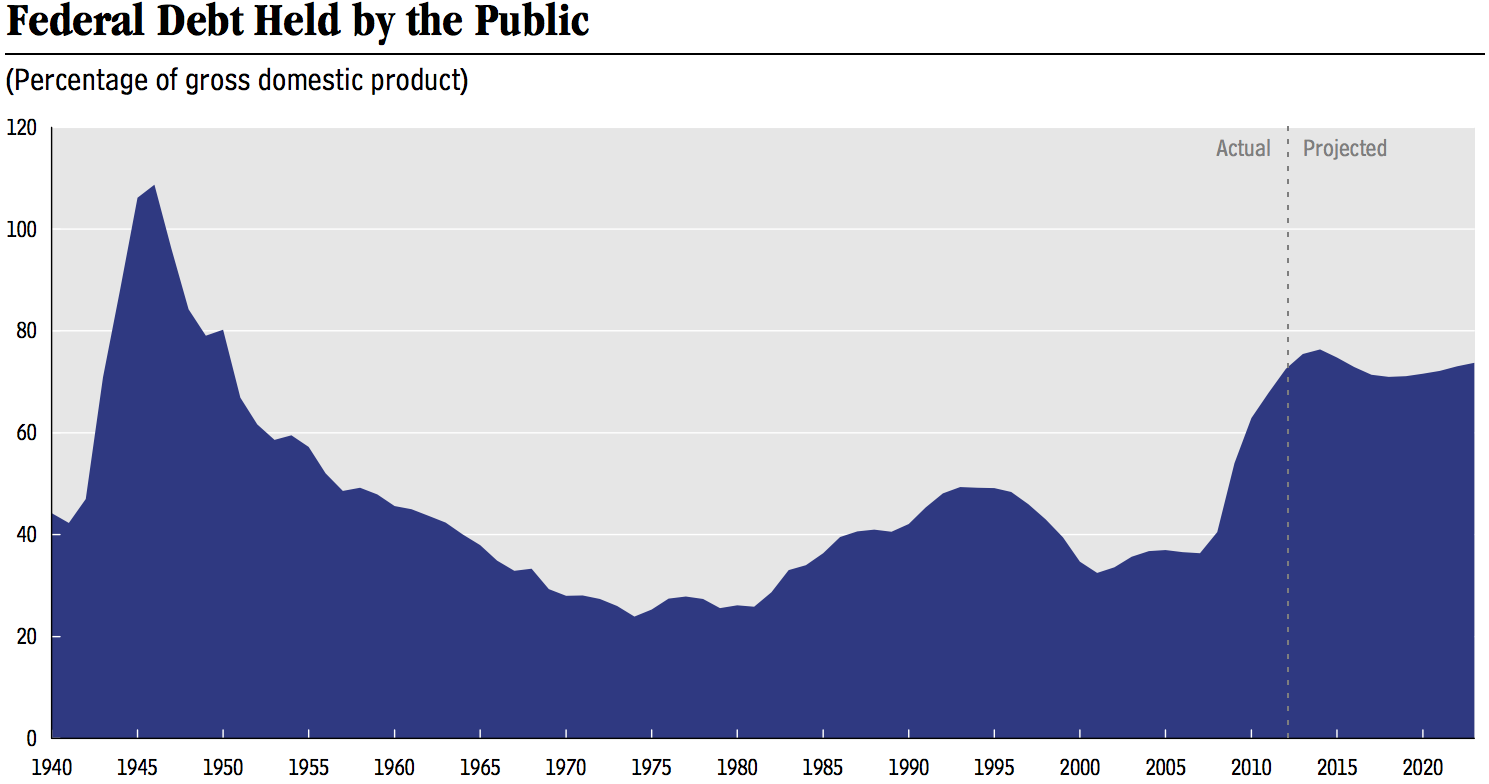
According (pdf) to the CBO – in a truly dramatic turn-around. Barro throws some cold water:

This is great news about this year. But it doesn’t say very much about the long-term fiscal outlook. CBO’s revisions cut this year’s deficit by 1.3 percent of GDP, but they only shrink the next 10 years’ projected deficits by 0.3 percent of GDP.

That’s because the main factors cutting this year’s deficit are one-time effects. Half of this year’s deficit reduction comes from Fannie Mae and Freddie Mac, the mortgage giants that have been under federal conservatorship since 2008. They will make unexpectedly large dividend payments to the government this year, but that won’t happen again. The other half of this year’s change comes from higher-than-expected revenues, which are also mostly a one-time spike.

That’s a teensy bit too much cold water when you see the impact of growth on government revenues which underlies some of the data (growth that would not have happened if the GOP had adopted the premature austerity measures favored in Europe). What all this says to me is that we have a breathing space to move on longer-term spending, i.e. entitlements and defense. My own view is that Republicans are throwing away the chance of a lifetime to get a Democratic president to sign off on real entitlement reform. That would give them more cover for unpopular cuts than they will ever have if they get back into the White House. John Harwood has an excellent summary of the incentives here. Derek Thompson focuses on healthcare spending:

Here’s the story I wish more people would talk about: Our incredible shrinking Medicare projections. Since August, CBO has now revised down its projections of mandatory health care spending by nearly $500 billion, as Michael Linden pointed out. Since the 2010 CBO report, projected Medicare spending between 2013 and 2020 has fallen by just over $1 trillion … or 16%.

Among Ezra’s takeaways:

If this report clarifies anything it’s that our debt problem, insofar as we have one, is a long-term problem, not a short-term problem.

But sequestration disappears in 10 years. The policies in a deficit deal, by contrast, continue to grow. If you care about the long-term debt you should see a world in which sequestration replaces a debt deal to be a disaster. The calm of the Republican Party on this point either bespeaks a disinterest in debt or a misunderstanding about sequestration.

And Yglesias thinks long-term:

The current projection has the deficit shrinking for the next couple of years and then growing again. That leaves us with a very manageable 2024 deficit. The problem is that it’s trending upward. And nothing in this revised projection changes that fact. Under current law, the deficit will bottom out in a few years and then grow and grow forever. The flipside, though, is that there’s really no need to panic or think that there has to be a grand bargain. What we need are more measures to reduce the cost of health care and more measures to boost economic growth.