Uncandid Camera

This video, understandably, went viral last week:

As you might have guessed, the video was probably staged. David Haglund asks:

[I]s such fakery OK? A year ago, after Mike Daisey’s fabrications in a This American Life story about Apple factories in China came to light, we examined how much lying people are generally willing to accept from various kinds of storytellers. (See the resulting infographic below.) Two things we learned would seem to apply here. First, when humor’s involved, people grant a lot more latitude. David Foster Wallace’s unacknowledged use of composite characters in his very funny pieces for Harper’s and elsewhere disappointed some people, but it has not really besmirched his reputation. David Sedaris fictionalizes his “nonfiction” considerably, and yet when this is pointed out, most people shrug.

The second relevant lesson is that people seem to hold writing to a higher standard than storytelling on screen or on a stage. Comedians say that things happened to them just the other day that have never happened to anyone on any day. Nobody minds.

26,000 Subscribers

That’s the number we just passed a few minutes ago. Thanks so much for this level of support. 26,000 is a great little magazine. And to have effectively created it since January without any marketing, expense, or even a publisher is a testimony to your belief in a future for online journalism that is more signal than noise, and your dedication and devotion to the Dish. We’re immensely proud and grateful.

Just a recap for new readers. Here’s the manifesto for this new media venture. And [tinypass_offer text=”click here”] to subscribe for full access to the Dish for only $1.99 a month or $19.99 a year or anything you want to pay above that minimum. It takes a couple of minutes max.

Conquering Vocab

The Economist‘s language blog considers the linguistic legacy of the 1066 Norman invasion:

When the Normans, who spoke a dialect of Old French, ruled over England, they changed the face of English. Over the ensuing two centuries, thousands of Old French words entered English. Because the ruling class spoke Old French, that set of vocabulary became synonymous with the elite. Everyone else used Old English. During this period, England’s society was diglossic: one community, two language sets with distinct social spheres.

Today, English-speakers pick and choose from the different word sets—Latinate (largely Old French borrowings) and Germanic (mostly Old English-derived words)—depending on the occasion. … In informal chat, for example, we might go on to ask something, but in formal speech we’d proceed to inquire. There are hundreds of such pairs: match/correspondmean/intendsee/perceive,speak/converse. Most of us choose one or the other without even thinking about the history behind the split. Germanic words are often described as earthier, simpler, and friendlier. Latinate vocabulary, on the other hand, is lofty and elite. It’s amazing that nine hundred years later, the social and political structure of 12th-century England still affects how we think about and use English.

Reality Check

From a new PPP poll:

Of the 41 percent of Republicans who consider Benghazi to be the worst political scandal in American history, 39 percent are unaware that Benghazi is located in Libya. 10 percent said it’s in Egypt, 9 percent in Iran, 6 percent in Cuba, 5 percent in Syria, 4 percent in Iraq, and 1 percent each in North Korea and Liberia, with 4 percent unwilling to venture a guess.

In Government We Don’t Trust

Silver sizes up the IRS scandal:

In a basic sense, scandals that reduce trust in government have the potential to harm those who argue for more government. Mr. Obama has predicated much of his agenda on the idea that Americans can and should trust the government to take action on health care, gun legislation and other issues.

Enten argues along the same lines:

There are reasons to believe that Democrats shouldn’t see major losses [in 2014]. The economy is doing better, and an incumbent president’s party rarely loses big twice in midterms. Still, if trust falls, it may trump these structural factors. The thing to watch over the next days, weeks, and months is how big the scandals become. If they become big news, and that seems quite possible, Obama’s Democratic party may be heading for major losses in 2014.

Nyhan’s research “suggests that the structural conditions are strongly favorable for a major media scandal to emerge.”

Will Robots Take Our Jobs?

A new police drama imagines a world where AI surpasses human intelligence:

Kevin Drum’s new article argues that this kind of technology might not be science fiction much longer. He thinks this will be beneficial in the long-term but worries that such advances will hugely disrupt the labor markets in the short-term:

Unlike humans, an intelligent machine does whatever you want it to do, for as long as you want it to. You want to gossip? It’ll gossip. You want to complain for hours on end about how your children never call? No problem. And as the technology of robotics advances—the Pentagon has developed a fully functional robotic arm that can be controlled by a human mind—they’ll be able to perform ordinary human physical tasks too. They’ll clean the floor, do your nails, diagnose your ailments, and cook your food.

Increasingly, then, robots will take over more and more jobs. And guess who will own all these robots? People with money, of course. As this happens, capital will become ever more powerful and labor will become ever more worthless. Those without money—most of us—will live on whatever crumbs the owners of capital allow us.

In an interview, Drum speculates about what will happen next:

Societies that suffer from mass unemployment, the history of what happens to those societies is not a bright one. At some point you have to respond, and there’s going to be a lot of resistance to responding because of ideology, because of politics, because of pure greed, but eventually we are going to respond to this. It’s going to be obvious what’s happening, that people are unemployed due to no fault of their own, and that we have to respond.

In the meantime, we’re going to resist responding, and we’re probably going to resist responding very very strongly, because rich people don’t like giving up their money. We’re in for a few decades of a really grim fight between the poor, who are losing jobs, and the rich, who don’t want to give up their riches.

Yglesias and Karl Smith chip in their two cents on the subject. Previous Dish on the subject here.

The Gatsby Budget

Kevin Roose estimates it, concluding that “Jay Gatsby was probably either living paycheck-to-paycheck or digging himself into debt”:

I ran Gatsby’s estimated cash flows by Rocco A. Carriero, a Southampton-based private wealth advisor. Carriero said that he would never take Gatsby on as a real-life client, given the illegality of his bootlegging business. But after looking at my estimates, he agreed with me that there’s no way a person earning as much as Gatsby did should be spending with such abandon. “He’s got to cut back on the lifestyle expenses,” Carriero told me of a hypothetical Gatsby-like client. “Rather than having fifteen parties at $150,000 apiece [in 2013 dollars], he may want to consider having one party, with maybe half the people.”

Yglesias thinks it’s not so simple:

The problem here is the dread relative price shifts. Over long time horizons not only does the overall price level shift but the relative price of different goods and services shifts. In particular, back in the 1920s labor-intensive services were very cheap. In her autobiography, Agatha Christie writes that when growing up she thought she’d never be so wealthy enough to own a car nor ever be so poor as to be unable to afford servants. And recall that Nick Carraway, who does not earn a lavish salary, has a “demoniac Finn” who cleans his house and cooks him breakfast on a daily basis. But if you were to calculate the 2013 price of a full-time servant and then retroactively attribute that income level to Nick, you’d end up vastly overstating how much he’s making in the bond game. It’s just that cars were expensive back then and unskilled human labor was incredibly cheap. The cost of throwing a giant party is primarily the cost of the labor involved, so huge parties would have been much more affordable in the twenties than today.

Reefer Revenues

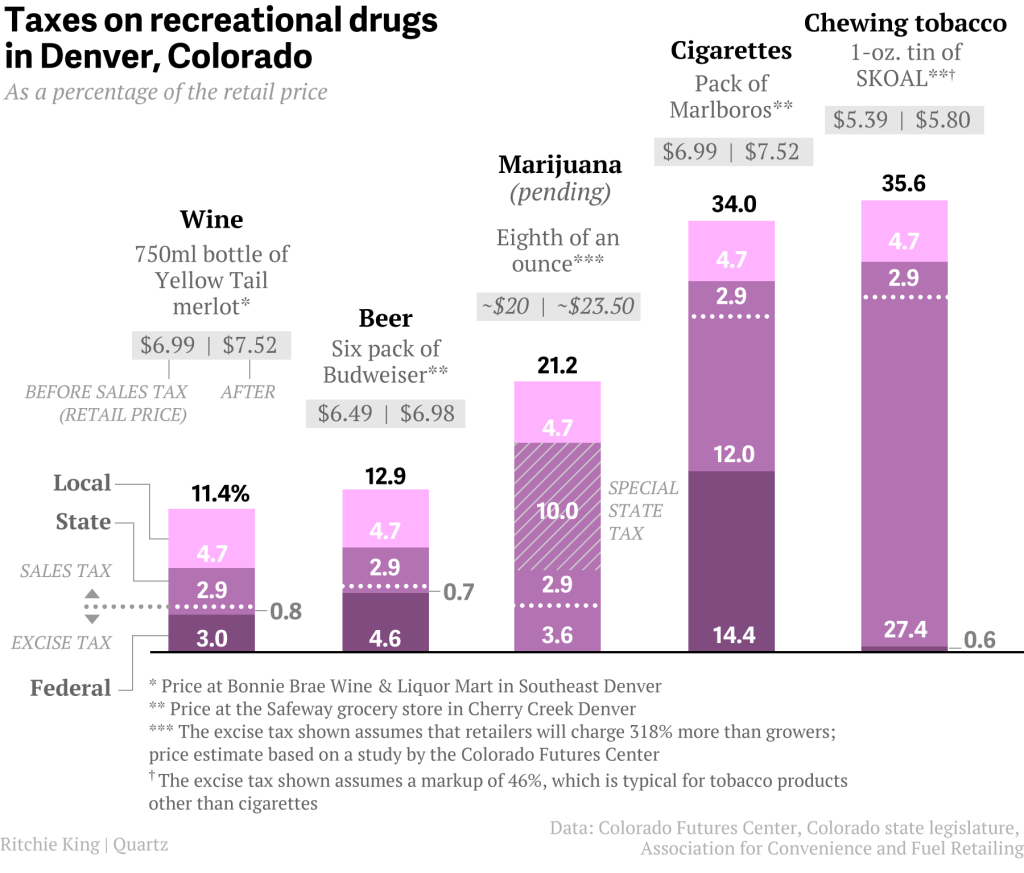
coloradopottax-chart2

Ritchie King checks in on pot taxes in Colorado:

One of the bills (pdf), passed on Wednesday, lays out the tax rates: a 15% excise tax on wholesale pot and a 10% special state sales tax, in addition to the standard sales tax of 2.9%. The taxes will take effect at the beginning of next year, when licensed retail stores first start selling the drug (pending approval of the bill by the governor and the state’s citizens, which are both expected). These rates will put pot in a tax realm that is somewhere in between a case of beer and a pack of cigarettes.

The big picture:

[Researchers at Colorado State] estimate that next year, 642,772 Coloradans (about 13%) will buy an average of 3.53 ounces apiece, making for a total tax revenue of $94.4 million. Though that amounts to almost a one percent increase in total state revenue, some, including the study’s authors, have expressed concern that the money raised won’t be enough to cover the cost of enforcing new marijuana laws, such as legal driving limits. But they don’t take into account the money that will be saved by not prosecuting and incarcerating the many marijuana users who were breaking the law prior to legalization but aren’t anymore. The Colorado Center on Law and Policy estimates those savings (pdf) to be $12 million per year.