A Hate Map Of The US

dish_hate1

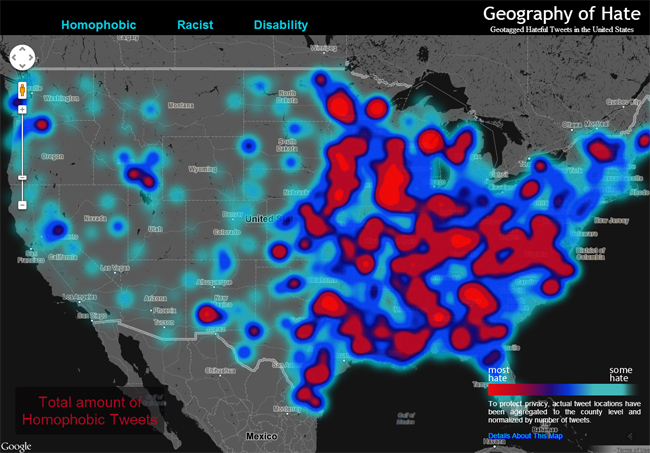
Researchers at Floating Sheep analyzed more than 150,000 geotagged tweets that included a homophobic, racist, or ableist slur and mapped the data:

Perhaps the most interesting concentration comes for references to ‘wetback’, a slur meant to degrade Latino immigrants to the US by tying them to ‘illegal’ immigration. Ultimately, this term is used most in different areas of Texas, showing the state’s centrality to debates about immigration in the US. But the areas with significant concentrations aren’t necessarily that close to the border, and neither do other border states who feature prominently in debates about immigration contain significant concentrations.

… Ultimately, some of the slurs included in our analysis might not have particularly revealing spatial distributions. But, unfortunately, they show the significant persistence of hatred in the United States and the ways that the open platforms of social media have been adopted and appropriated to allow for these ideas to be propagated.

Brian Anderson adds:

How can we be sure “positive” uses of an otherwise hateful slur (e.g., “dykes on bikes #SFPride”) weren’t inadvertently swept up in the Geography of Hate? Contextualiztion is crucial–is everything, really. Did Stephens’ team allow for it? They did. In fact, this is why they used humans (read: Humboldt State students), not machines, to analyze the entirety of the 150,000 offending tweets, all drawn from the University of Kentucky’s DOLLY project.

An interactive version of the map is here.

Malkin Award Nominee

“Democrats do not want abortion to be safe or rare. Democrats oppose even the most basic of health and safety standards for abortion mills. Democrats don’t care how many women are maimed, infected with diseases or die on the routinely-filthy abortion mills. Democrats worship abortion with same fervor the Canaanites worshipped Molech,” – Congressman Steve Stockman (R-TX).

Hardcore Curriculum

The course instructor for “Navigating Pornography” at Pasadena City College explains what, exactly, goes on in the classroom:

We examine the history of sexualized imagery in art, exploring the often-murky, frequently false distinction between what was created to arouse and what was designed to inspire worship.428px-Sade-Biberstein
We explore the 18th-century origins of modern pornography (lots of time with the Marquis de Sade) and we focus on the history of several centuries of legal sanctions on “obscenity.” We look at the development of the modern mainstream porn business (based in the nearby San Fernando Valley), and analyze the way it has adapted and transformed over the four decades since the Supreme Court’s ruling in Miller v California (1973) essentially legitimized the adult industry.

My goal isn’t just to give my students an historical and cultural overview of pornography. It’s to give them tools “to navigate the sexually mediated world we live in,” as Long Beach State professor Shira Tarrant puts it.  Most of my students were born in the early-to-mid-1990s; they hit puberty under the influence of two conflicting social realities: the widespread availability of broadband and the Bush-era abstinence-only sex education policies.

Previous Dish on pornography here, here and here.

(Image: Depiction of the Marquis de Sade by H. Biberstein in L’Œuvre du marquis de SadeGuillaume Apollinaire (Edit.), Bibliothèque des Curieux, Paris, 1912, via Wikimedia Commons)

Bee Afraid

Honeybees are in deep trouble:

Almost a third of managed U.S. honey bees died last winter, according to a new survey of commercial and home beekeepers. That’s more than triple the losses of 5 to 10 percent that used to be normal for beekeepers before 2005 — and double the 15 percent that beekeepers say is acceptable for their businesses to continue unharmed. The finding marks a disturbing trend among honey bees: each winter since 2006, the Bee Informed Partnership has documented losses of 21.9 to 36 percent of U.S. hives. … The large-scale die offs — attributed in part to a phenomenon known as Colony Collapse Disorder — have gained widespread attention in the recent months. That’s partly because if the deaths continue, they could have a major impact on the nation’s food system. … The U.N. Food and Agriculture Organization estimates that 71 percent of the world’s most widely-consumed crops are pollinated by bees — and these crops are worth at least $207 billion. But this year, bee losses caused farmers to come extremely close to a pollination crisis, leading to warnings about impending food insecurity.

Alan Boyle explains “Colony Collapse Disorder”:

The malady is almost certainly due to combination of factors — including the Varroa mite, a single-celled parasite known as Nosema, several varieties of viruses, and pesticides. Researchers point to one particular class of pesticides, known as neonicotinoids, as a prime suspect.

Neonicotinoid-based pesticides are commonly applied as a coating on corn seeds, but the chemicals can persist in the environment. Although they have low toxicity for mammals, they’ve been found to have a significant neurotoxic effect on insects, including bees. Several European countries have banned neonicotinoids, the European Union has been looking at a wider ban, and the Environmental Protection Agency is considering new limitations as well.

Dr. Doug Yanega cautions that we still don’t fully understand the causes of Colony Collapse Disorder, examples of which date back as far as the late 1800s:

[I]n both 2007 and 2009 another paper pointed out that there were at least 18 historical episodes of similar large-scale losses of honey bees dating back to 1869, at least several of which had symptoms similar enough that they cannot be ruled out as being the exact same ailment. Yet, how often have you seen any of the scientists and journalists and beekeepers acknowledging that any theories about the cause of CCD need to accommodate the evidence for similar bee crashes that pre-date neonicotinoid pesticides, high-fructose corn syrup (HFCS), migratory beekeeping, cell phones, genetically modified crops, or any of the other human-made “causes” that have been run up the proverbial flagpole? …

A reasonable course of action, to my mind, is acknowledging that we aren’t likely to find that any man-made factors are the true cause of CCD, devoting energy to looking for contagious pathogenic agents, and taking a closer look at genetic diversity in honey bees themselves (e.g., are there strains that are resistant to CCD?), while at the same time working towards reducing the exposure and impacts of man-made factors that are capable of harming bees (but without BLAMING them in the process, or overreacting).

The Queerness Of Keynes

[Re-posted from earlier today]

“I think I shall have to give up teaching females after this year. The nervous irritation caused by two hours’ contact with them is intense. I seem to hate every movement of their minds. The minds of the men, even when they are stupid and ugly, never appear to me so repellent” – John Maynard Keynes.

It seems to me that we can readily acknowledge and accept many unpleasant features of Keynes’ life (like his misogyny) without thereby impugning his economic arguments. If you want to read the ur-smear-job, check out the latest from Forbes, which manages to compile every little thing that could possibly alienate a reader about Keynes, without any serious attempt to relate it to his economic ideas. (The accusation of pedophilia is based on nothing but use of the term “boys” to mean tricks. The youngest man Keynes slept with was 16, which is the current age of consent in the UK.) Yes, his broad argument for the economy was culturally counter-intuitive (which “moralist” in the early 20th century would think that there are times when thrift is collectively self-defeating?) – but it remains supported by the data, even now. Perhaps especially now. That’s how I view Keynes’ “immoralism”. It was about rejecting conventional morality if the real world showed its empirical futility. And, of course, I think he was absolutely right to dismiss any moral difference between heterosexuality and homosexuality. He was just way ahead of his time.

I have no doubt that Keynes sexual orientation might have given him an outsider’s view of what “morality” was deemed to be, and he was understandably and bravely skeptical about it. That may have given him the impulse to challenge conventional wisdom, but the products of his prodigious mind seem to me to be best analyzed by economists on their merits. On sexual matters and economic ones, in the long run, Keynes is very much alive – and helping future generations in ways most of us would dream about.

The Daily Wrap

Today on the Dish, Andrew found Obama’s connection to the Tea Party audits tenuous at best, wondered whether conservatives would be able to get under Hillary’s skin, and hesitated to throw Keynes’ economic baby out with the misogynist bathwater while chuckling at the irony of its origin. He plumbed the depths of our need for enemies, relayed the latest numbers for the Dish model, noted how far the US has come since Virtually Normal, and welcomed Minnesota to the marriage equality movement.

In political reporting, Felix Salmon called out universities’ use of Pell money, Michael Moynihan downplayed the importance of the Koch brothers, and Michael Grunwald defended government investment in green energy. Overseas, James Surowiecki saw encouraging signs for laborers in Bangladesh, Maher and Greenwald debated the “inherently violent” nature of Islam, and Iran silenced critical journalists as we previewed Iran’s upcoming election. Heidi Vogt looked ahead to a news vacuum left after reporters leave Afghanistan as Peter Beinart reminded us of our continuing obligations abroad, and politics in the Middle East needed a reboot.

In assorted news and views, Jonathan Zeller ran down the 15 “New Yorkiest” episodes of the show about nothing, coaches lived the easy life on taxpayer dollars, and researchers tried to distill consciousness to its core algorithm while Michal Lemberger found groupthink in advice columns. Big Brother rode shotgun in Google’s driverless cars, readers continued the discussion of corporate painkiller peddlers, we celebrated all sizes and shapes of snow, and Sue Halpern and her dog brought joy to seniors.

Elsewhere, Sam Allingham struggled to break out of his fan-fiction cage, cursive proved to be a sinister requirement for a left-handed reader, Michael Deacon channeled Robert Langdon, and we were tongue-tied by foreign languages. An Egyptian activist smiled from behind bars in the FOTD, Killarney Clary penned a Monday verse, while we marveled at Main’s green streets in the VFYW, ground control called a real-life Major Tom, and “To The River” caught the eye in the MHB.

D.A.

Addicted To Advice

Not Savage For Work:

Michal Lemberger confesses:

I read advice columns. A lot of them. “Ask Polly” on The Awl. The Washington Post/Slate’s “Dear Prudence.” “Dear Sugar” on The Rumpus was a staple until it disappeared last spring. Philip Galanes’s “The Social Q’s,” Chuck Klosterman as “The Ethicist,” and John Hodgman, all in The New York Times, are regulars. Dan Savage in The Stranger makes for a raunchy (and often eye-opening) change of pace. The list goes on and on.

What she’s gleaned from the genre:

[It] depends on a strange convention: that journalists, rather than trained psychologists, are deemed qualified to dole out advice in response to our most private questions. We readily accept that tradition, despite our era’s trust in training and narrow specialization. Maybe because we’ve been doing it that way for centuries. At first, there were “agony aunts,” anonymous writers who took on the guise of trusted older women who could give relationship advice to the young and love-struck, in “letters to the lovelorn” columns. That was an import, brought over from England sometime in the 18th century. …

As much as the American self-image depends on the idea of straight-talking, cut-through-the-crap honesty, the reality is far more timid. We don’t really value frank communication. Instead, we demand that everyone fit in with the group.

Avoiding The Next Factory Collapse

James Surowiecki hopes that Bangladesh can get its act together:

[T]he real lesson of the past two decades is that if labor standards are actually to improve government has to play a role. Private power alone won’t cut it: as long as consumers and companies insist on the lowest price and endless variety, there’ll always be factories that are willing to cut corners to get the business.

It’s encouraging, then, that Bangladesh has announced that it will work with the International Labour Organization to institute and enforce minimum labor standards. There’s understandable skepticism about the government’s ability to achieve this, given widespread corruption, and there’s also concern that tougher standards will lead Western companies to pull out of Bangladesh. Yet research shows that smart regulations work, particularly when they’re backed by international pressure. A recent study of reforms in Indonesia in the nineteen-nineties demonstrated that they improved conditions without increasing unemployment. Richard [Locke, author of The Promise and Limits of Private Power,] points to the Dominican Republic, where an “incompetent and corrupt labor inspectorate” has been overhauled, working conditions have improved, and the country’s export industries have become more competitive.

Recent Dish on the Bangladesh tragedy here.