Movie Match-ups

dish_annie hall

For his FILMography project, photographer Christopher Moloney aligns movie stills with their present-day backdrops. Buddy Bradley marvels at the continuity:

One of the things that’s so impressive, particularly in the US where everything always seems in a state of flux, is how some of the sites used in films from the 1940s and 1950s have hardly changed at all, or how the same sites have been re-used for different films, sometimes using different perspectives.

Henry Grabar appreciates the discrepancies:

The building don’t always line up perfectly; the colors seldom match. But the dissonance gives the shots meaning. (If you wanted seamless, you should have rented the movie.)

Explore hundreds of match-ups here.

(Photo: Annie Hall, 1977, and FILMography by Christopher Moloney)

The Sin In Cinema

Tom Shone defends sentimentality in film:

The Victorian disdain for sentimentality was, in part, a reaction against the rise of potboilers and romances written by, or for, women—and all too often, it came down to discomfort about emotional displays of any kind. A similar chauvinism prevails at the movies, a medium born halfway between the limbic system and the Kleenex box. When the New York Times praised Martin Scorsese’s “Hugo”, an evocation of cinema’s early days, for keeping “the treacle at bay”, nothing would have struck the directors of that era as more heretical. Charles Chaplin, D.W. Griffith, Frank Capra and George Cukor prided themselves on the accuracy of their strike at the audience’s emotions. The problem with “Hugo” was not that it was too sentimental, but that it was not sentimental enough. Scorsese couldn’t summon the ease with emotions demanded by the material.

That is what makes him a modern artist, just as sentimentality is the modern sin. We thrill at the pitilessness of directors like Paul Thomas Anderson, Darren Aronofsky and David Fincher, and we haze old-school empaths like Spielberg until they repent. The granddaddy of them all—the original cold haddock—is Kubrick, who made movies much the same way he played chess, to win before you’d even taken your seat, hence the nagging suspicion—happily embraced by his fans—that the best thing to do with a Kubrick movie is not so much watch it as submit to it, the way you submit to a superior argument.

“Imagine If Oscar Wilde Had Had An iPhone!”

Reviewing Alex Dimitrov’s debut collection of poetry, Begging for It, Jeremy Glazier describes the use of Grindr as a literary device:

The three Grindr “poems” offer a peek into Dimitrov’s self-mythologization. Each is a screenshot of a smartphone conversation between the poet and an anonymous guy from Grindr, and in each case, Dimitrov’s contributions are limited to laconic replies to his interlocutor’s promptings. In the first, called “Poems actually,” the two words of the title are the poet’s only part, typed in response to the query, “What sort of stuff do you write?” The rest is the rather effusive effort on the part of the other guy to pin down Dimitrov’s poetic credentials: “Epic poems, limericks or like what? / And who is your poetry inspiration / Was that grammatically correct? I don’t think it was but you get what I am saying.” The humor resides partially in the contrast between Dimitrov’s terseness and the garrulousness of the other guy — and in the unexpected “literary” chat on an app that’s more usually reserved for swapping cock pics.

In another Grindr piece, “Proust’s Grave,” one of Dimitrov’s anonymous online admirers has figured out who he is and messages him out of the blue, at 1:22 in the morning: “One shouldn’t lie on Proust’s grave,” he texts — a reference to a photograph online of Dimitrov wallowing on said grave. Dimitrov’s response, “Who the fuck is this,” is immediate — and that’s the end of the conversation. Part found poem, part unwitting collaboration, the poem’s appeal for the reader is essentially voyeuristic: our sense that we are eavesdropping on something private and potentially intimate. For Dimitrov, the act of cruising online is charged poetically as well as libidinally, and like a sexed-up version of Stevens’s Hoon, he invites us into his private “palaz” for “tea.”

The People Behind The Porn, Ctd

Emily Witt embedded with Kink.com for a couple of intense shoots, including Public Disgrace, “an online pornography series that advertises itself as ‘women bound, stripped, and punished in public.’” Her takeaway:

It’s tempting to think that life before internet porn was less complicated. There are sexual acts in porn that it would not occur to many people to attempt. We have more expectations now about what kind of sex to have, and how many people should be involved, and what to say, and what our bodies should look like, than we might have at a time when less imagery of sex was available to us. But if the panoply of opportunity depicted in porn seems exaggerated, the possibilities are no less vast outside the internet. The only sexual expectation left to conform to is that love will guide us toward the life we want to live.

What if love fails us? Sexual freedom has now extended to people who never wanted to shake off the old institutions, except to the extent of showing solidarity with friends who did. I have not sought so much choice for myself, and when I found myself with no possibilities except total sexual freedom, I was unhappy. I understood that the San Franciscans’ focus on intention—the pornographers were there by choice—marked the difference between my nihilism and their utopianism. When your life does not conform to an idea, and this failure makes you feel bad, throwing away the idea can make you feel better.

Recent Dish on the lives of adult actresses here. My take on porn in moderation here.

Face Of The Day

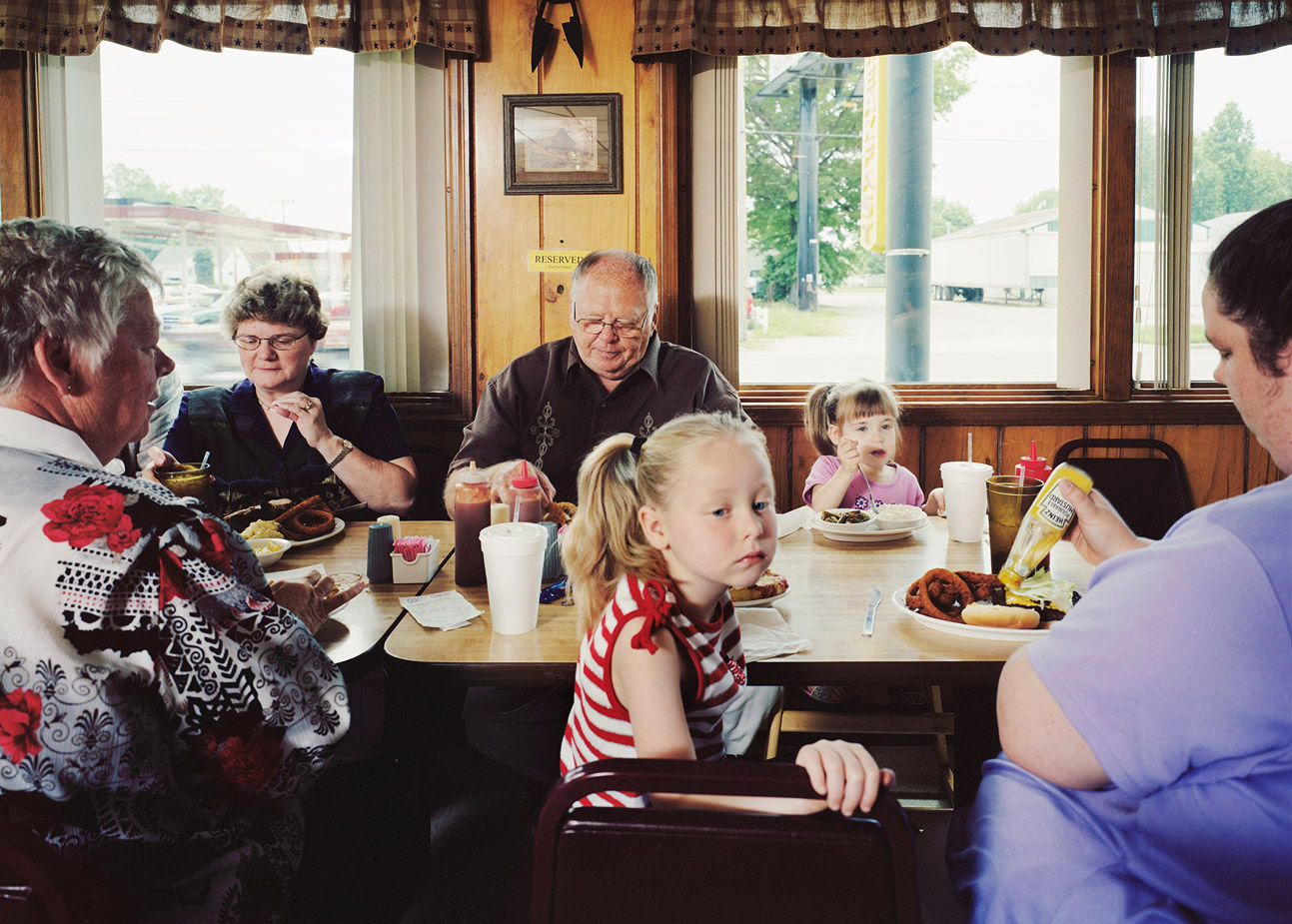
Carolyn Rauch praises Family Meal, a series by Doug Adesko:

To date, he’s made roughly 75 portraits over the past decade. His interest arose from early childhood memories, and grew as he watched his own daughter at the family table. The portraits seem simple at first glance, but a second, deeper look presents a subtle range of detail—dynamics among family members, hierarchy within the family group, and glimpses into how personality traits affect the behavior of adults and children when together.

Menu Mindgames

Amy Fleming runs through many examples:

In his menu-deconstruction exercise, Poundstone refers to the £70 Le Balthazar seafood plate as a price anchor. “By putting high-profit items next to the extremely expensive anchor, they seem cheap by comparison.” So, what the restaurant want you to get is the £43 Le Grand plate to the left of it. It’s a similar story with wine. We’ll invariably go for the second cheapest. Set menus, or “bundles”, meanwhile, seem like good value and therefore give us an excuse to eat and spend more. Everyone’s a winner.

A Poem For Saturday

sprinkler

In 1989, Killarney Clary published Who Whispered Near Me, her debut volume of poems with Farrar, Straus and Giroux, the publishers of Bishop, Lowell, and Berryman. She was 33.  John Ashbery said at the time, “Hers is a stunning new voice in American poetry.” The San Francisco poet Tom Clark wrote a beautiful review of the book, declaring that these “startling, unsettling prose poems…vault Killarney Clary into some rarefied company. Baudelaire and Rimbaud come to mind…No writer in English has ever done more breathtaking things with the prose poem than this unheralded newcomer from Pasadena.”

The book was a runner-up for the Pulitzer Prize and a book that people talked about for years. Now it is being reissued by Tavern Books, a Portland, Oregon publishing house dedicated to reviving distinctive out-of-print books, printing them on Heidelberg printing presses, commissioning original art to ornament them, and promising the authors that they will remain in print.

Clary has published two other collections, Potential Stranger and By Common Salt, books that have kept her name aloft among those who buy books of poems for themselves and share them fervently with others. This passionate cohort will be happy to know that she has completed a new manuscript, Shadow of a Cloud but No Cloud.  After you discover her, you’ll know why. We will be running poems of hers from the just-reprinted book, Who Whispered Near Me, today, tomorrow, and Monday. It is available in bookstores and can also be accessed here.

Here’s our first selection of Clary’s poetry:

Every time I step into the bathtub, Theresa, I think of you;
I think of your foot that was burned when you lived in
Michigan. And Claire is on bridges like the Colorado where
her mother fell or jumped. I think of Kathy when I see
sprinklers turning in roses or I hear the name of her brother,
George, Sydne in dime stores. Helen in lavender. Anne
Marie with folded notes. Every time I am hit, Jeffrey, I
can help, Taka. I cross the border, Billy. When I sleep,
large, recent faces repeat what they’ve told me in the past
few days, then you come toward me with names I haven’t
said aloud in years, each one of you faint but completed,
carrying small stories—where you were once, what it was
that happened. And you say, “Here.” You see what I have,
what you might need to tell someone else.

(From Who Whispered Near Me © 2013 by Killarney Clary. Used by kind permission of Tavern Books, Portland, Oregon. Photo by Flickr user Florian)

– A.Q.

Gatsby Goes To War

At one point in The Great Gatsby, Tom – Daisy’s husband – asks how Gatsby “got within a mile of her unless [he] brought groceries to the back door,” implying he was baffled by how two people from such different class backgrounds connected. The novel’s only hint is that Gatsby first met Daisy “with other officers from Camp Taylor.” Keith Gandal claims that raises a further question – how “a poor farm boy from North Dakota and apparently a German-American to boot, got to be an officer in the US Army when Germany was the enemy.” He does the detective work to find the answer:

The World War I American army, which had to build an officers’ corps of 200,000 rapidly and almost from scratch, needed some quick methods for identifying men who might be officer material, and specifically those who might make good captains. It developed a couple of unprecedented programs to do so: a rating system for identifying captains, and an intelligence test that identified potential officers and superior officers. The even more radical move that the army made — shocking to privileged young men, such as Fitzgerald, who expected traditional class and ethnic discrimination — was not to exclude immigrants and ethnic Americans from consideration for officer. (Indeed, the army’s initial plan was to have no racial prejudice and to open up such promotions to blacks as well, but the government under pressure from Southern civilian officials nixed the original idea of a complete meritocracy.) The army designated four training camps at which to pioneer the intelligence tests in late 1917 and Camp Taylor was one of them.

A further detail about Camp Taylor:

The other thing to know about Camp Taylor is that there were a large number of men of German descent there; by end of the war, they numbered nearly 1500. There is no doubt that the American army, though it was fighting Germany, had plenty of German-American officers.