A research team led by Johannes Zimmermann suggests that people who often talk in terms of “I” and “me” tend to be more depressed:
Frequent use of first-person singular pronouns went hand in hand with higher depression scores and with interpersonal distress characterised by what the researchers called an “intrusive style”, including inappropriate self-disclosure, attention seeking, and an inability to spend time alone. “First-person singular pronoun use may be part of a … strategy that pulls for friendly-submissive attention from others,” the researchers said. A “tendency to seek attention from others rather than self-focused attention.”
In contrast, greater use of first-person plural pronouns was associated with lower depression scores and lower interpersonal distress. To the researchers’ surprise, this was characterised by a “cold” interpersonal style. However, they think this is a “functional” kind of coldness – the ability to help others with their needs while also remaining appropriately detached for self-protection.
From its original African home, coffee propagation has spread in a girdle around the globe, taking over whole plains and mountainsides between the Tropics of Cancer and Capricorn. In the form of a hot infusion of its ground, roasted seeds, coffee is consumed for its bittersweet bouquet, its mind-racing jump start, and social bonding. At various times it has been prescribed as an aphrodisiac, enema, nerve tonic, and life extender. … Beginning as a medicinal drink for the elite, coffee became the favored modern stimulant of the blue-collar worker during his break, the gossip starter in middle-class kitchens, the romantic binder for wooing couples, and the sole, bitter companion of the lost soul. Coffeehouses have provided places to plan revolutions, write poetry, do business, and meet friends. …
The modern coffee industry was spawned in late nineteenth-century America during the furiously capitalistic Gilded Age. At the end of the Civil War, Jabez Burns invented the first efficient industrial coffee roaster. The railroad, telegraph, and steamship revolutionized distribution and communication, while newspapers, magazines, and lithography allowed massive advertising campaigns. Moguls tried to corner the coffee market, while Brazilians frantically planted thousands of acres of coffee trees, only to see the price decline catastrophically. A pattern of worldwide boom and bust commenced. By the early twentieth century, coffee had become a major consumer product, advertised widely throughout the country.
To understand the benefits of low-skilled immigrants, Tim Fernholz looks to California’s manicure industry:
For every five Vietnamese who entered, two non-Vietnamese workers were displaced—but the authors are quick to note that most of that effect came from workers choosing not to enter the profession, rather than people who already worked as manicurists losing their jobs. Why was this possible? Because the immigrants were—wait for it—innovators in the manicure space.
They developed the idea of the standalone nail salon that reduced costs, “making a once-exclusive service commonplace.” That meant more nails to paint, not just more workers per nail. The benefits of immigration accrued to people who got their nails painted, to the new immigrants, and even to the remaining non-Vietnamese manicurists.
While nail-care business might not be the perfect stand-in for all low-income work, it does reflect what economists find more broadly: When new immigrants come, it does mean new competition for similarly-skilled local workers, but the new immigrants may also create opportunities that lead to more investment, which maintains wage growth and leads to economic growth. Indeed, with more immigration, average wages seem to rise, not fall.
Friday on the Dish, Andrew further pondered the brutality surrounding the Gitmo hunger strike, challenged Leon Wieseltier’s moralizing on Syria, and separated out the scandal from the politicking in the Benghazi fiasco. He, weighed in on the millennial-knocking Time cover story, raised an eyebrow at the latest Buzzfeed Brews event, and channeled Eugene Debs in the Quote of the Day. Later, Andrew tipped his hit to Boris Johnson, answered Farhad Manjoo’s complaint about the rise of the canines, and pointed to a speech by a minister for marriage equality.
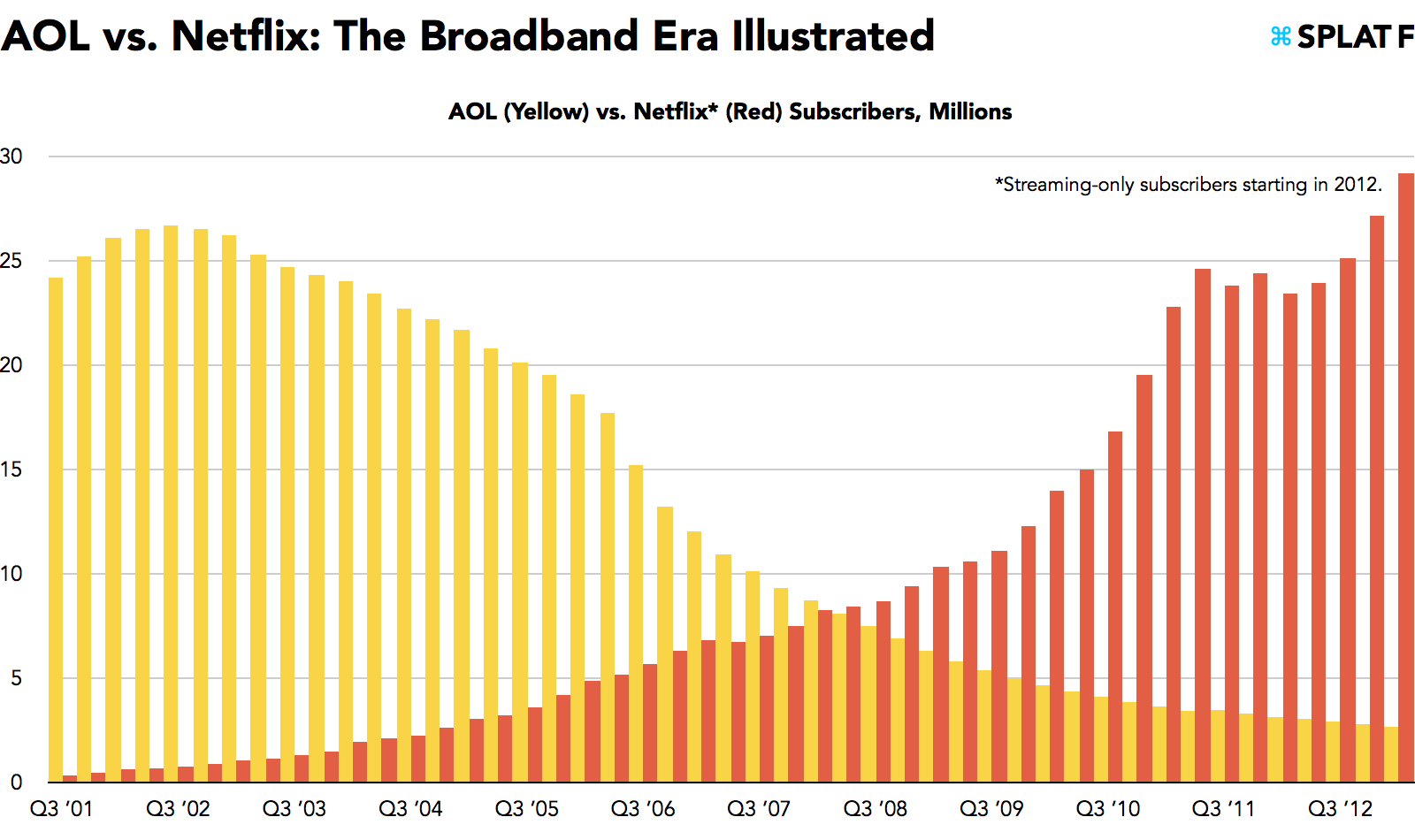
In political coverage, Ezra Klein doubted the power of campaign finance reform, Marc Tracy struck back at Time’s new cover story on millennials, and we spotted what could be a genuine scandal for conservatives to rage about. Readers sounded off on the controversy of Tamerlan Tsarnaev’s burial (which turned out to involve a thoughtful Christian), dug deeper into the latest stats on military rape, and kept up the debate over fracking. We waved goodbye to the psychiatrists’ handbook and Mark Oppenheimer lost his squeamishness on artificial insemination. Elsewhere, we surveyed the demise of AOL and the rise of Netflix in the Chart of the Day, Mark Kleiman asked for chemically transparent pot trade, and we eyed research on a vaccine for heavy drug treatment.
In assorted news and views, we witnessed a David Foster Wallace speech richly illustrated, readers chimed in on Andrew’s interpretation of Doctor Who, and we continued the debate over the greatness of Gatsby. We investigated the myth of hot hands, came across a Google descendent of the VFYW contest, and Allie Brosh articulated the reality about clinical depression. Later, we enjoyed a cringe-worthy poseur alert from an anonymous law clerk, observed the Earth twist and shift from above, and climbed inside the heads of New Yorkers. Ben Yagoda sang high praise for Obama’s comedic timing, we saw a colorful display in the Face of the Day, and commiserated with fluffy animals in the MHB.
–B.J.
The rest of the week after the jump:
Thursday on the Dish, Andrew engaged readers over Hawking’s Israel boycott, considered the implications of Sanford’s SC victory, glimpsed the GOP’s 2016 strategy in the Benghazi hearings, and railed against the obstructionism on the right. He marveled at the Tao of Drudge, found an English deity in the Doctor, and blasted those who prevented the burial of Tamerlan Tsarnaev while a reader compared him to Lee Harvey Oswald.
In political coverage, we rounded up responses to the Benghazi hearing, the Right continued to reform, and Frum defended Heritage. Reihan pondered the possibility of a 2015 surplus as Minnesota joined the marriage equality movement and the Feds tried to contain 3D-printable guns. Steve Brill’s healthcare exposé yielded results, Simon Shuster tied the Boston bombers to radical Islamists, and Kevin Spacey and Steny Hoyer debated the cynicism of Washington. Climate change got its day in court, Skeptical Science provided us with one-line responses for climate deniers, and Ohio voters approved local fracking.
In assorted news and views, Veronique Greenwood examined sensory curiosities, we drew parallels between the venus flytrap and our brains, Meher Ahmad explored married couples who stayed together by living apart, and Randy Frost found beauty in hoarding. Wiretaps moved into the 21st century, Jon Ronson profiled Kim Dotcom the non-pirate, and tech worked its way into our family trees.
Elsewhere, Doug Wignall lauded architects as political heroes, Gideon Lewis-Kraus griped about Yelp, and Fallows recognized the elegance in yesterday’s Google doodle. Politico erected a paywall, Tim Park sought out translators’ heavy touches, and Brandon Connely remembered a stop-motion legend. We browsed a London art fair in the FOTD, visited Venezuela in the VFYW and took to the skies for a VFYW bonus, and Between Two Ferns brought monogamy to spring break in the MHB.
Wednesday on the Dish, Andrew processed Stephen Hawking’s announced boycott of Israel, speculated about the reasons for its strike in Syria last week, and Butters called for a bigger footprint in the Mideast. He unpacked what we know about the Internet’s role in the Tsnarnaevs’ radicalization, shook his head at Cheney’s latest demagoguery over Benghazi, rationalized the latest Kinsley photobomb, and acknowledged the latest victory for marriage equality in Delaware.
In political coverage, we collected more shocking footage and photography of the plight of workers in Banglaldesh, Mike Crowley shot straight about the threat of al-Qaeda getting chemical weapons in Syria, and Max Fisher tracked South Korea’s 180 on relations with the US. We found that Independents are faulting the GOP for gridlock, Krugman beard-shamed his fellow economists, and Sean Trende emailed in after reader pushback on his take on the Republican South.
We crossed our fingers over some encouraging news about the slowdown in health care spending, Yglesias rolled his eyes at the Heritage’s new report on the costs of immigration reform and we corrected a faulty study on our trusty bus companies. Later we reviewed disturbing evidence of the military’s problem with sexual assault, and later heard from readers with experience. Readers asked Josh Fox about the property rights involved in the fracking game and ruminated on the news of Chris Christie’s operation while Washington’s flower thief pissed off one committed gardener.
In assorted coverage , Brett McKay leafed through the first guy’s mag, Theodore Dalrymple took a life lesson from Pooh’s friend Owl and said a word for our meme-ified heroes. S Abbas Raza pondered how consuming food is time consuming, Darwin Hamblin dug up Cold War-era concerns about man-made global warming, Gary Kelly presented Mary Wollstonecraft as a trailblazer for women in modernity. We provided a meme-based map of the US, readers kept up the debate over teaching cursive and reacted to unorthodox addiction treatment. Li Bingbing starred in the Face of the Day, we watched a sketchy kind of Street Fighter in the MHB and spent the afternoon in Juneau, Alaska for the VFYW.
Tuesday on the Dish, Andrew posted a notice for a new Dishtern, reiterated his opposition to meddling in Syria’s civil war, and put Obama on notice regarding the release of the torture report. He explained his embrace of Keynesian economics in an era that calls for it, declared the Burekean origin of Anglo-American conservatism, and eyed the fraying edges of the Eurozone and the EU. Elswhere, Andrew spotlighted a worthwhile documentary on drag culture, agreed with Albert Camus on the true payoffs of independent journalism and kept tabs on the push for marriage equality in Minnesota.
In political news and views, we registered new evidence that Earth has never been hotter as Josh Fox listed some red state reasons to oppose fracking. We noted Obama’s principle that Dwight makes right, separated the Syrian rebels’ hippies and jihadis, and Hamza Mohamed filed from Somalia, the world’s dodgiest country for correspondents. Victor Davis Hanson earned a Malkin Award nod for his Benghazi hyperbole, Tim Verstynene poked and prodded at Obama’s BRAIN program, and Salman Rushdie took a shapshot of global censorship in 2013. Later we followed the grim story of Amanda Berry, who fled her kidnapper of ten years and met the federal employees protesting sequestration in the Face of the Day.
In assorted coverage, we questioned the literary value and legacy of The Great Gatsby, took a tutorial in the languages of Game of Thrones, andBerlatsky sensed the overlap between male and female fiction. Weconnected the dots between mental health and HIV,let readers ask Sue Halpern anything, and Matthew Battles traced the moment that gave us the term “computer bug.” Readers reflected on the imperfect glory of country singer George Jones and observed the perils of unintentional pop plagiarism.
Edward McClelland investigated the shipwrecks of the Great Lakes, the first plastic handgun emerged from its 3-D printer, and we learned that happy tweets come on vacation. We revealed this week’s VFYW contest, Jon Rauch took apart the myth of gay “choice,” and we sampled smogged and non-smogged Beijing in the VFYW before enjoying a bite-sized share of Malick for the MHB.
Monday on the Dish, Andrew put his foot down on Israeli airstrikes in Syria and the calls for US intervention. He went another round on the Boston bombers and Internet jihad, bringing in Anwar al-Awlaki’s shadowy role, and unpacked the dicey semantics of critiquing the AIPAC. Later on, Andrew picked apart the latest evidence implicating Rumsfeld’s deep involvement in the torture regime, weighed in on the debate of the Oregon State Report on Medicaid, answered readers who refused to accept Niall Ferguson’s apology on Keynes, and nodded at CNN’s interrogation of Howard Kurtz.
In political coverage , Moynihan trolled the jihadi web as we checked the status on potential drone courts and witnessed five defectors’ flight from North Korea. Readers dissented on Josh Fox’s work on fracking, we sized up the lighter carbon footprint of vegans and admired how younglings in India put their slum on the map. Bill Richardson earned a Moore Award Nomination for his remarks on Ted Cruz, we read an aggressively ominous Quote of the Day from a funeral in Kentucky, and a reader fact-checked Sean Trende on the Republican South. Elsewhere, we kept looking for a way to measure intoxication of the reefer and met the ghost of journalism’s future.
In assorted coverage, Steven Soderbergh justified art in a world of poverty and war, we surveyed the history of the undie advert and spied an ad that literally spoke straight to kids in the Cool Ad Watch. Ian Stansel found humanity in suburbia, Joyce Carol Oates reviewed Julian Barnes and we explored the glamorous façade of Sylvia Plath. We also searched for more apples fallen from the tree and choked on the dearth of restaurant reviews online. Meanwhile, Romain Jacquet-Lagreze gazed the sky between Hong Kong skyscrapers, zombie PSAs made for good health and safety tips, and we polled readers on the value of teaching kids cursive. Lastly, we shined a light on Imran Khan for the Face of the Day, witnessed a pitbull in suspended animation and watched the sun rise in Hof, Iceland in the VFYW.
Last weekend on the Dish, Andrew addressed Niall Ferguson’s offensive comments about John Maynard Keynes’ homosexuality, following-up by musing on quotes from both Burke and Keynes on capitalism.
We also provided our usual eclectic mix religious, books, and cultural coverage. In matters of faith, doubt, and philosophy, Simon Willis argued particularism was the best philosophy, Molly Crockett debated the ethics of a “morality pill,” and Tim Kreider embraced doubt. Damon Linker found Christ in Malick’s To the Wonder, David Sessions grappled with losing his religion, and Jonathan Fitzgerald excoriated a Christianity Today piece on hip-hop. Roger Tagholm pondered the effects of holy books going digital, Russell D. Moore eulogized country singer George Jones, and Frans de Waal challenged Christian assumptions about animals. Patrick Kurp outgrew his resistance to talking about his heroes, Claire Messud pondered our contradictory natures, and John Berryman reflected on the connection between suffering and creativity.
In literary and arts coverage, Olive Senior thought literature couldn’t help but be political, Mason Currey chronicled the chemical lives of great writers, and Tony Woodlief defended the democratization of art. D.G. Myers observed a paradox in understanding literature, Nathaniel Rich considered the despair he found in the novel Miss Lonelyhearts, and Andrew O’Hagan contemplated writers whose work was informed by another medium. Thom Yorke divulged his ideal of beauty, the pacifist author of Winnie the Poohstruggled with his wartime conscription, and Maria Bustillos penned a love letter to her favorite highway. Read Saturday’s poem here and Sunday’s here.
In assorted news and views, Brian Eno expounded on his vintage pornography collection, Helen Lewis visited a collection of harvested tattoos, and Jonathan Harris described the moments of unexpected intimacy caught on film between pornstars. Maria Popova pointed to a great list from Susan Sontag, Miles Raymer assessed the unlikely success of the band Neutral Milk Hotel, and a member of Alcoholic Anonymous developed a strange alternative therapy for the disease. Robert W. Gehl wondered if there is any hope for haters, the Internet proved to be for marriage, and a profile of an electronic cigarette revealed how advertisers try to brand what’s bad for you. Malkin Award nominee here, MHBs here and here, FOTDs here and here, VFYWs here and here, and the latest window contest here.
In an interview, the film’s creators explain how they skirted the copyright issues for the audio:
We had little to no budget for this project and we knew that the publishing house was going to be really skeptical of our little company’s request to utilize his work. We had faith in our vision for the video and that once it was complete they would see that this was something made with the best intentions in mind. We are in no way making any money directly from this video; it was purely a passion project. While we had high hopes for this, we could have never seen all of this attention coming. Sometimes it’s better to ask for forgiveness than permission.
The director of the National Institute of Mental Health (NIMH), Thomas Insel, announced last week that the NIMH will no longer rely on the Diagnostic and Statistical Manual of Mental Disorders (DSM), a longtime guidebook for psychiatry:
While DSM has been described as a “Bible” for the field, it is, at best, a dictionary, creating a set of labels and defining each. The strength of each of the editions of DSM has been “reliability” – each edition has ensured that clinicians use the same terms in the same ways. The weakness is its lack of validity…. Patients with mental disorders deserve better.
Dr. Russ Poldrack offers a detailed description of the NIMH’s new focus, the Research Domain Criteria (RDoC) project. Vaughan Bell summarizes:
RDoC… aims to uncover what it sees as the ‘component parts’ of psychological dysregulation by understanding difficulties in terms of cognitive, neural and genetic differences. For example, difficulties with regulating the arousal system might be equally as involved in generating anxiety in PTSD as generating manic states in bipolar disorder.
[T]his won’t be changing how psychiatrists treat their patients any time soon. DSM-style disorders will still be the order of the day. …[The] RDoC is currently little more than a plan at the moment – a bit like the Mars mission: you can see how it would be feasible but actually getting there seems a long way off.
Adopting a religious analogy, Neuroskeptic concludes that the switch from the DSM to the RDoc is less a “revolution” than a “reformation”:
This is why it’s wrong to see this as a paradigm shift. The NIMH proposals don’t mean a revolution in either research or treatment. Although researchers applying for NIMH grants will have to adapt the language of their pitches, framing it in terms of domains rather than disorders, I suspect that what they do with the money will be much the same.
Anthropologist Andrew Irving recorded people’s inner thoughts spoken out loud as they walked through New York, mapping “part of the city’s thoughtscape, layered beneath its audible soundscape.” In the first clip, seen above, Ferris Jabr hears echoes of Clarissa Dalloway in Mrs. Dalloway:
As she walks the streets of London, Clarissa entertains an ephemeral memory of throwing a shilling into the Serpentine, before transitioning to a more somber meditation on death: “Did it matter then, she asked herself, walking towards Bond Street, did it matter that she must inevitably cease completely; all this must go on without her.” Moments later she is commenting to herself on books in a shop window, then deriding her “pea-stick figure,” then admiring a fishmonger. She converses with herself about war, immortality, past romances and what kind of flowers she should buy for her party.
[Virginia] Woolf would likely have adored Irving’s videos. She wanted to write about “an ordinary mind on an ordinary day.” As opposed to many of her contemporaries, she was far more interested in what was happening inside people’s heads—in thought, memory and consciousness—than in detailed descriptions of buildings, countenances and clothes. She wanted the reader to perceive almost everything through her characters’ minds, rather than dictating a traditional plot with third-person narration. Like a telepathic moth, the narrator in Mrs. Dalloway flits from one person’s consciousness to another as they go about their business in London. … “There’s always this assemblage of voices simultaneously going on in public all the time—but you can’t hear it,” Irving says.
As Dan Frommer observes, “it doesn’t get more clear than this”:
At the end of March, almost 2.7 million people still subscribed to AOL service, the company reported this morning. That’s about where Netflix stood at the end of 2004. Since then, Netflix’s subscriber base has grown — 29 million at the end of March — and AOL’s has declined at a remarkably parallel rate. But that makes perfect sense: Nothing says “dialup” more than AOL, and few services have benefited more from the growth of broadband than Netflix. (The paths cross in early 2008, just as Netflix’s streaming video service was starting to take off.)
John Timmer reviews new research that could change the way we treat heroin addicts:
Antibodies that latch on to drugs could keep them away from their sites of action in the brain, blocking any rewarding high. So far, the results haven’t been as promising as the idea, but a new vaccine against heroin appears to do better specifically because it’s designed to work with how the drug is processed by the body. …
The most intriguing test, however, involved rats that had been allowed to self-dose with heroin, which was accompanied by a blinking light.
After an extended withdrawal, the rats would go right back to self-medicating if they were given a single dose of heroin or shown the blinking light. Once they were treated to raise the dynamic antibodies, however, the dose of heroin would no longer set off a bout of drug-taking (though the blinking light still would). The antibodies appeared to block the drug efficiently enough that it no longer registered in the brains of these rats.
This isn’t an easy or simple solution. Vaccinating the rats required three doses within a month, and the rats still could get a hit off the drug—it just took a lot more of it. In human societies, addicts requiring a lot more of a drug can be a recipe for serious problems. But for those enrolled in supervised treatment programs, it could make a significant difference in keeping a momentary lapse from becoming a full relapse.
[Director Baz] Luhrmann’s movie, and the vast array of marketting that surrounds it, is phony. But so is Gatsby. Gatsby is tasteless and vulgar and spends too much money. Gatsby is the original icon of hype. Which is why his story remains so relevant. The movie could easily have been set in Silicon Valley today. The illusions that Gatsby and Luhrmann create are lies and ultimately cheap and corrupt, but their spell is nonetheless powerful. The critics are unintentionally paying Luhrmann a compliment, I think; his version is not so much a film about Gatsby as the film Gatsby would make about himself. It’s the most Gatsbyesque Gatsby possible. What better standard is there for adaptation?
For all of its lurching and gyrating party scenes, for all the inflated pomp of the Gatsby palace and the Buchanan mansion, for all the colorful clothing and elaborate personal styling, Luhrmann takes none of it seriously, and makes none of it look remotely alluring, enticing, fun. His whizzing 3-D cinematography offers lots of motion but no seduction; his parties are turbulent and raucous without being promising, without holding out the allure of magical encounters. …
That notion brings to mind what is perhaps Fitzgerald’s most famous sentence, from the essay “The Crack-Up,” in which, preparing to describe his own breakdown, he adds:
Before I go on with this short history, let me make a general observation—the test of a first-rate intelligence is the ability to hold two opposed ideas in the mind at the same time, and still retain the ability to function. One should, for example, be able to see that things are hopeless and yet be determined to make them otherwise.
The movie conveys the sense of waste but not of what was wasted, of the superfluous but not of excess, and of the phony but not of the gloriously theatre of life. In its reductive way, it not only doesn’t display two opposed ideas; it offers no ideas at all.
Ariane Lange illustrates the “8 Meanest Things 1920s Critics Said About ‘The Great Gatsby'”.
(Image: Lines from Arrested Development mashed up with Gatsby scenes via Book Riot)


 The Dish