Explain This, Mr President

Obama-admin-visitorsThis chart is from a propaganda sheet called the Daily Caller. It may be distorted in some way because visitor logs are not always accurate about the entire comings and goings at the White House (many senior figures aren’t counted, for example). I’d be grateful for reader scrutiny of this data – simply because I do not trust the source, and there may be context I’m missing. But if the Caller is right that in the Bush years, “Shulman’s predecessor Mark Everson only visited the White House once during four years of service in the George W. Bush administration,” we need an explanation – and fast.

Update from a reader:

I just read your post about Doug Shulman’s excessive number of visits, and the context seems clear to me. I may be viewing this through an experience filter, as it’s my full-time job to work with a major health insurance company to implement Obamacare, but the IRS is the agency primarily responsible for figuring out who is eligible for the plans and subsidies offered via the exchanges. They are undergoing, with HHS, a massive implementation effort right now to ensure the new plans can be purchased in October. While this may not explain all of the visits, it could certainly explain a large part of them. There’s a lot of investment across the board in making sure this goes right, and there certainly wasn’t anything like it during the Bush administration.

Update: More readers dismantle the Caller’s bullshit here.

Better “Sponsor Content”

Since I’ve bashed the concept as blurring the line between editorial and advertizing, it’s good to see that publishers are beginning to be clearer about the difference. Atlantic Media’s Quartz does a much better job than its predecessors. Take the headline first:

Screen shot 2013-05-30 at 10.22.34 AM

That’s impossible to miss. Better still, the following simple sentence at the end of the piece:

This article is written by Boeing and not by the Quartz editorial staff.

I remain queasy about bringing an ad agency essentially in-house – because Quartz’s marketing department works with corporations to write, conceive and presumably edit their ad copy, which comes perilously close to editorial work. But as long as there is no overlap between the two staffs, marketing and editorial, and there are no lateral moves from one to the other, the perception of corporate control of journalism is mitigated. Not eliminated – I refuse to buy the propaganda that these are simply “better ads” – but mitigated.

Meanwhile, the Grey Lady has done something actually quite interesting and innovative on this front. It already has an app for navigating this bewildering, dense, rude, urine-baked tunnel-warren of a city.

And they could easily have incorporated the new Citibike guide on their app without Citibank actually paying for it. But they got the money from the sponsor and provided a service to local readers on top. I agree with Joshua Benton on this:

It’s a callback to the classic news advertising idea — we assemble the audience, you provide the content, we make a match — in a mobile, apped-up world… And it’s a match that can go both ways: The Times says that Citi Bike’s own iOS and Android apps will be updated this summer to feature … The Scoop’s listings of restaurants, coffee shops, and the like.

The difference, it seems to me, is that this content isn’t really journalism as such. It’s data you could get elsewhere (which bikes are available where, etc.) and, combined with the NYT’s version of Yelp, it’s obviously useful – unlike an editorial from some executive at IBM.

Telling Holder To Shove It

Holder Speaks At Naturalization Ceremony At Justice Department

It was no doubt meant as an act of reconciliation and dialogue; but it backfired, and rightly so. If my emails had been searched by the DOJ, I’d be eager to talk to the man who authorized, in the case of James Rosen, a potentially criminal warrant. But I’d want that talk to be open, clear and accountable. To try to address the question of secret government intrusion into the press in secret is like something out of a John Le Carre novel.

I’m not qualified to judge the legal dimensions of Holder’s term as attorney-general. And it does seem to my eyes that he did nothing actually illegal in the leak cases, but rather pushed the boundaries of government monitoring of the press to new, invasive levels. Some of this is about technology – emails are far easier to monitor that previous communications. Some of it is about genuine issues of national security – the outing of a mole in North Korea, for example, which any government needs to keep secret. There is a mass of gray area in there that does not easily fit into a narrative of an outrageous abuse of government power.

But politically, Holder is now and long has been a dreadful communicator, appearing both weak and yet intrusive at the same time. That’s an awful combination, only underlined by this latest example of complete tone-deafness. Let’s have the meeting. It’s important to clear the air, clarify differences, and build consensus for a new media shield law.

But let’s do it in public and on the record. I seem to recall a candidate once promising a transparent administration. So why is the current air so thick with fog?

(Photo: U.S. Attorney General Eric Holder attends a naturalization ceremony at the U.S. Department of Justice May 28, 2013 in Washington, DC. By Win McNamee/Getty Images.)

Ask Dan Savage Anything

This embed is invalid

[Re-posted from yesterday with many questions added by readers]

Dan Savage needs little introduction to Dish readers, but here is his Wiki page to peruse. Dan just came out with a new book this week, American Savage: Insights, Slights, and Fights on Faith, Sex, Love, and Politics. From a recent interview with Logan Lynn:

Savage: Well, the book is about marriage and family, and is a bit more political. I talk about healthcare and Obamacare, gun control, sex education…it originally started out as just a collection of essays, things I had written other places, just bringing things I had written over the last decade together. Then I started revising them and reworking them. Originally the book was going to be 80% old stuff and 20% new stuff, and now it’s 90% new stuff. There’s basically nothing in there that isn’t reworked or brand new. There is a big chapter about marriage, and where we are at right now…and that’s been changing so rapidly, I want the book to come out ASAP. I wrote about adopting, about becoming parents, about Terry and I getting married; and this book has essays about life and memoir-y stuff about my mother’s death, about my son, now 15, coming out to us as straight when he was 12, which was kind-of bizarro hilarious…

Lynn: Alternate universe!

Savage: Yeah, like, how we were so careful all his life to let him know we loved him whoever he was, and yet somehow still he thought we were going to be disappointed that he wasn’t gay. It really broke my heart. So, I touch on all of that stuff. There’s some humor and comedy in the book as well. I wrote a play – a short play – that’s in the book about Jesus and the huge asshole, which is Jesus talking to a fundamentalist Christian who opposes healthcare reform. I think people will enjoy it.

To submit a question for Dan, simply enter it into the Urtak survey after answering all of the existing questions (ignore the “YES or NO question” aspect and simply enter any open-ended question). To vote, click “Yes” if you have a strong interest in seeing Dan answer the question or “No” if you don’t particularly care.

Fracking Ignorant

Very few Americans know much about hydraulic fracturing:

[A]pparently, in 21st century America, nobody pays attention to public demonstrations unless the protesters are wearing tri-cornered hats, nobody watches documentaries but film school snobs, and nobody reads those august publications anymore, period. Which is why we get this, according to the Yale study: “Fifty-four percent of Americans have heard nothing at all or only ‘a little’ about fracking.” Which, wow. And, “Only 9% have heard ‘a lot.'” Toss in the 13% that “don’t know” what they’ve heard about fracking in any way, shape, or form, and you’ve got yourself a portrait of a populace that’s wildly uneducated about one of the biggest energy developments in years. Really, these numbers suggest that 67% of Americans don’t really know what fracking is.

Hollywood’s No Smoking Policy

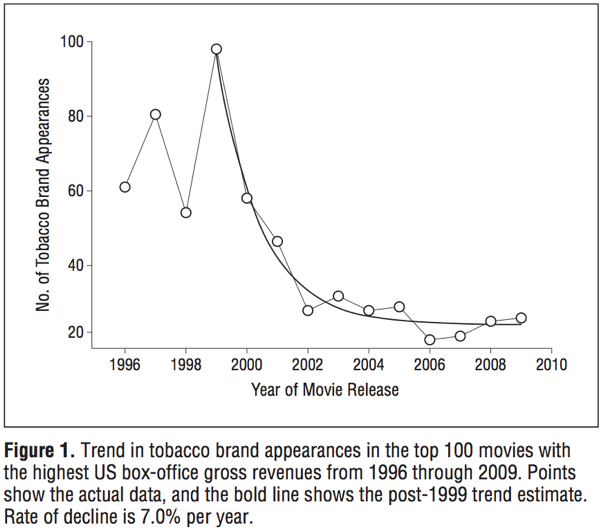
Branded cigarettes have made far fewer appearances on screen since tobacco product placement on TV and in movies was banned in 1998:

tobacco_jama

Alyssa suspects that alcohol would be more resilient:

Even if cigarettes became a model, and all of the vice industries were banned from paying for product placement in entertainment, I suspect the relatively heavy inclusion of alcohol in movies would continue, if only as a way to signal the characters are adults, and as real men, they drink beer, or as real women, they drink some sort of lady-approved cocktail (or, if cool, brown liquor). The social capital of alcohol remains high enough for it to be a useful signifier. And maybe instead of wanting to get all product placement out, we should be more concerned with getting certain kinds in more prominently. I could stand to see Trojan get some free advertising, for example, if movies could be persuaded that it’s as important to show couples using birth control once they get in to bed as it is to show them drinking to prove their grown-up and gender bona fides on their way to the bedroom.

Ah, yes, what every movie-goer really wants: more condom visuals.

Under The Knife And Behind The Veil

Celebrity plastic surgeon Jason Diamond set up shop in Dubai and was surprised by his clientele:

It could seem counterintuitive for these women to invest so much in their appearances given that they are covered most of the day. Diamond explained, “It took me a while to figure out, but in the Middle East many men are allowed to have four wives. The women want to be feminine and beautiful for their men. That is their only job. They are not out working. There’s no women’s lib. There’s none of that stuff. Their job is to look good for their men and that’s all they care about.”

“It’s my opinion,” Diamond added, “and I’m as a big an authority on this as anyone in the world, that they care more about their appearance than Beverly Hills’ women.”

Even though these women are very invested in looking good for their husbands, the men are uninvolved when it comes to the actual surgeries their wives undergo. On occasion women have a mother or sister with them, but more often than not, these women show up alone. “I would say I see more often here [in Beverly Hills] men coming in with their wives saying, ‘She needs to do this, or I really wish her breasts were bigger or smaller,'” said Mani. “The women are very self-directed there; they’re very empowered over their own bodies and know what they want. Men are not driving their wives to have plastic surgery.”

Drug War TOTAL FAIL

Drug Prices And Prisoners

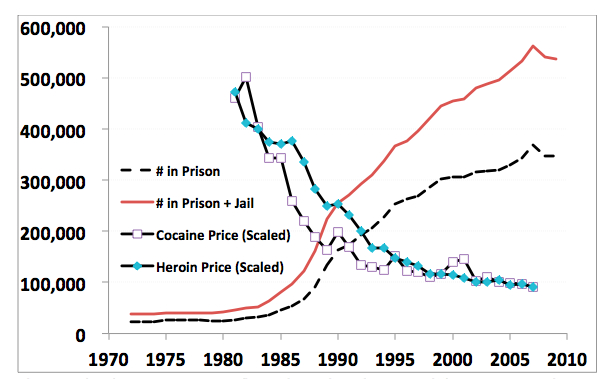
Harold Pollack writes that “this may be the most embarrassing graph in the history of drug control policy”:

Law enforcement strategies have utterly failed to even maintain street prices of the key illicit substances. Street drug prices in the [above] figure fell by roughly a factor of five between 1980 and 2008. Meanwhile the number of drug offenders locked up in our jails and prisons went from fewer than 42,000 in 1980 to a peak of 562,000 in 2007.