The first 3-D printed gun, christened “The Liberator” by its developer, Defense Distributed, just debuted:
The weapon is crude and can potentially explode, and it’s still a work in progress, Wilson tells Danger Room at a small workshop in Austin, Texas — the inside mostly taken up by a used $8,000 Stratasys Dimension SST 3-D printer, which produced the gun. “The design is based on two to three features that worked first. We had been testing barrels for almost two months, and we used the barrels and ABS that worked,” he says, referring to the type of thermoplastic material used by the machine. “We used 60 to 70 different springs, not all separate designs, but just trial and error. We cannibalized a spring off a toy on Thingiverse, a wind-up car toy.”
Now come the legal questions:
On Sunday, Sen. Charles Schumer of New York became the most prominent lawmaker to call for banning 3-D printed handguns.
“Guns are made out of plastic, so they would not be detectable by a metal detector at any airport or sporting event,” Schumer told reporters on Sunday. “Only metal part of the gun is the little firing pin and that is too small to be detected by metal detectors, for instance, when you go through an airport.”
The senator also proposed updating the Undetectable Firearms Act of 1988 — which bans guns that can defeat airport security metal detectors — to include printable gun magazines. Defense Distributed has a federal firearms manufacturers license, which Wilson sought after being questioned by the Bureau of Alcohol, Tobacco and Firearms in 2012. That was shortly after a 3-D printer Wilson had rented was seized by its manufacturer over worries he’d violate the Undetectable Firearms Act. The law, which is set to expire this year, exempts licensed manufacturers to produce plastic guns for use as a models and prototypes.
Previous Dish coverage of the printed handgun here and here.
Pamela Collins, a Director at the National Institute of Mental Health, points to an under-acknowledged fact about HIV:
People with severe mental illnesses have a much higher prevalence HIV infection in the United States. Yet, this is not a population that we usually hear about in public health efforts to prevent HIV and care for people with HIV. But the risk for HIV infection is not solely a high-income country phenomenon. Studies from sub-Saharan Africa also show a high prevalence of HIV infection among people hospitalized in psychiatric facilities. This population also has higher rates of mortality and earlier mortality from non-communicable diseases.
It’s been a long time since I attended a country concert, but when I was growing up in South Carolina, it was standard practice on all country radio and TV shows to sign off with a gospel number. It was just expected. There was a ton of hypocrisy; I know for a fact that a popular local gospel quartet kept its tour bus well stocked with Jack Daniels. This isn’t to put down George Jones; he really was the greatest, and the loss of that voice is a loss indeed. It’s just to point out that there’s a lot of ritual to the Saturday Night/Sunday Morning pattern of country music.
Jones’s songs lifted country-music aphorisms to a kind of high art, and his life and now death seem to demand aphorism as well, something blunt and simple like: George Jones was an imperfect man with a perfect voice. …
The stories of Jones’s drunken antics are legion, and while their hard-living, hard-loving particulars might inspire a bit of awe (and gave him cred with rock and punk artists), just ask the women in his life what it was like to live with him. Yet, even in some of his lowest personal moments, Jones created great, signature music. He recorded “Bartender’s Blues,” written by James Taylor, in 1978. His rendering of the chorus, with its “four walls around me to hold my life,” may be the best expression of his incredible vocal gifts—despair and joy fighting out their eternal battle.
The recording sessions for “He Stopped Loving Her Today” took a long time, and were contentious. Jones was capricious and unreliable—other words for saying that he was a drunk. He never liked his nicknames. “Possum” disparaged his middling looks. “No Show Jones” impugned his reliability and professionalism. Both were unkind, and both were deserved. He idolized Hank Williams, and it seemed like he was bound to follow him to an early grave. Yet “He Stopped Loving Her Today” was a hit, and three years later, at rock bottom, Jones quit the drinking and drugs, and lived on for three more decades, making music, recording too many albums, lending his golden voice to innumerable duets. He was Nashville royalty, name-checked by every young country singer with any sense.
He’d been married to his fourth wife, Nancy, for those thirty years. In the end, he wasn’t the lonely, regretful man in his most famous song.
“She’s My Rock”, seen above, was released shortly after marrying Nancy. “He Stopped Loving Her Today” can be heard here.
Salman Rushdie, almost 25 years after the Ayatollah’s fatwa, discusses global censorship:
I’d say that, in general, [it’s] gotten worse. But one of the things our report highlights is that people have more tools to resist censorship using new media. For instance, in China, while there’s increased repression in the form of arbitrary arrests, artists held incommunicado and put under house arrest, and increasing hostility towards literature and free expression, there is at the same time a growing willingness of Chinese citizens to find ways to express themselves. In spite of all the repression, there’s been a growth of independent, non-state publishers to print things that wouldn’t be approved by state houses, and people have shown the willingness to post things online even if they’re not to the liking of the state.
He also worries about a “very disturbing trend” of increased censorship in his democratic home country, India. In another recent interview, Rushdie proposed one way to protect writers in oppressive countries: keep them in the public eye:
One of the strange things about violent and authoritarian regimes is they don’t like the glare of negative publicity. If you can make them sufficiently uncomfortable, they frequently respond by doing what you need them to do in the spirit of setting people free or ceasing arrests, which has worked time and time again with PEN. The PEN/Barbara Goldsmith Freedom to Write Award is a way of spotlighting individual cases. If you look at the history of the award, the freedom rate is very high: a very high percentage of people who receive those awards are freed in the next six months to a year. The only weapon there is attention, but interestingly it works.
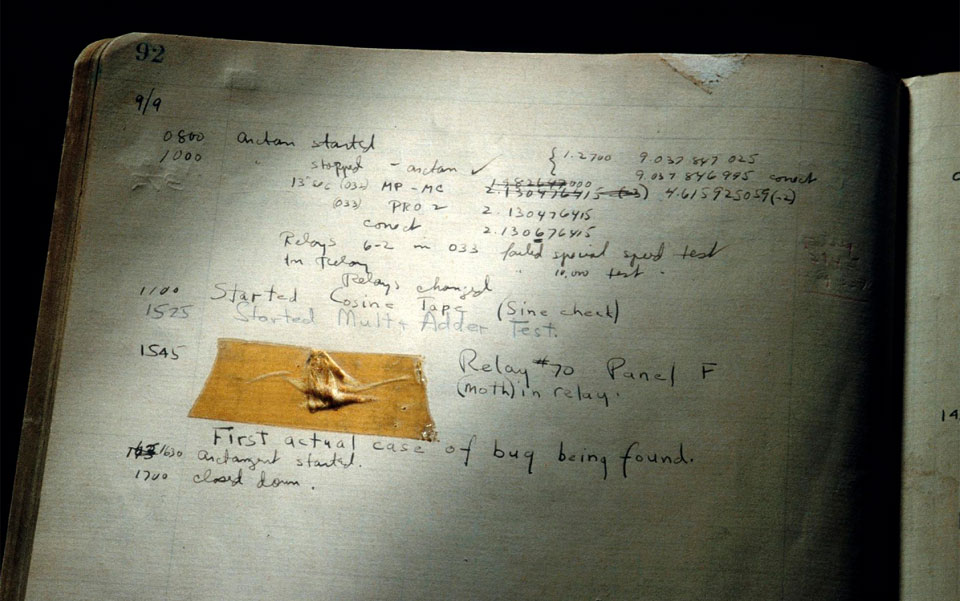
Matthew Battles unearths the above logbook from the Mark II, one of the “early electromechanical computers, instantiating computational logic in a vast, greasy array of switches, shafts, and clutches”:
In effect, the logbook, which resides in the Smithsonian’s Museum of American History in Washington DC, is a record of early computer bugs rendered in precise, empirical terms. And in those records, one bug stands out: on page 92, at 1545 on 9/9 1945, an actual moth was fixed to the page with a piece of tape. ‘Relay #70 Panel F/(moth) in relay,’ reads the journal; below, in what is likely Hopper’s hand, the line ‘First instance of actual bug being found.’
Alas, that use doesn’t mark the origin of the term “bug”:
Already in the late-19th century, technicians in Thomas Edison’s lab were using the word ‘bug’ to describe thorny technical problems. From the syntax of Hopper’s notes in the journal, it’s clear that engineers working on the Mark II were familiar with this usage; the ‘actual’ bug was entered into the log as a cheeky aside, a bit of lab humour. Bug is an ancient word, and its use in specific reference to creeping arthropods dates only from the 17th century, according to the Oxford English Dictionary. Prior to that, the word named the nameless: bugbears, monsters and creatures of mystery and shadow.
(Photo courtesy Smithsonian’s National Museum of American History)
Let us suppose, for argument’s sake, that there are people who declare: “Actually, I would prefer to be (probably) childless, to face a hundred kinds of social difficulties, to disappoint and maybe horrify my parents, to risk alienating myself from some of my friends and many of my peers, to be an object of disgust and scorn to many millions of people. Sure. Sounds fun.”
Let us also overlook, again for argument’s sake, that many homosexuals, far from embracing their condition, struggle desperately to change or suppress it, even to the point of suicide. No: imagine that homosexuality is something many people contemplate and choose. Now arises the question: suppose (I want to ask heterosexuals) you decided, at age 14, to fall desperately in love with a classmate of your own sex. How would you go about doing it? How would you talk your temples into throbbing and your throat into constricting? How might you arrange to get a stone hard erection, all out of nowhere, whenever you touch the image of a certain young man’s strong hand?
Today on the Dish, Andrew put his foot down on Israeli airstrikes in Syria and the calls for US intervention. He went another round on the Boston bombers and Internet jihad, bringing in Anwar al-Awlaki’s shadowy role, and unpacked the dicey semantics of critiquing the AIPAC. Later on, Andrew picked apart the latest evidence implicating Rumsfeld’s deep involvement in the torture regime, weighed in on the debate of the Oregon State Report on Medicaid, answered readers who refused to accept Niall Ferguson’s apology on Keynes, and nodded at CNN’s interrogation of Howard Kurtz.
In political coverage , Moynihan trolled the jihadi web as we checked the status on potential drone courts and witnessed five defectors’ flight from North Korea. Readers dissented on Josh Fox’s work on fracking, we sized up the lighter carbon footprint of vegans and admired how younglings in India put their slum on the map. Bill Richardson earned a Moore Award Nomination for his remarks on Ted Cruz, we read an aggressively ominous Quote of the Day from a funeral in Kentucky, and a reader fact-checked Sean Trende on the Republican South. Elsewhere, we kept looking for a way to measure intoxication of the reefer and met the ghost of journalism’s future.
In assorted coverage, Steven Soderbergh justified art in a world of poverty and war, we surveyed the history of the undie advert and spied an ad that literally spoke straight to kids in the Cool Ad Watch. Ian Stansel found humanity in suburbia, Joyce Carol Oates reviewed Julian Barnes and we explored the glamorous façade of Sylvia Plath. We also searched for more apples fallen from the tree and choked on the dearth of restaurant reviews online. Meanwhile, Romain Jacquet-Lagreze gazed the sky between Hong Kong skyscrapers, zombie PSAs made for good health and safety tips, and we polled readers on the value of teaching kids cursive. Lastly, we shined a light on Imran Khan for the Face of the Day, witnessed a pitbull in suspended animation and watched the sun rise in Hof, Iceland in the VFYW.
The above video shows an Israeli airstrike in Damascus on Saturday night, reportedly targeting regime munitions bound for Hezbollah. It comes on the heels of another attack late last week, on missiles stored at Damascus airport. Assad’s regime now declares it will retaliate, and the IDF says this won’t be the end of the strikes:
Officials [in Israel] are concerned that as the Syrian state devolves into chaos, sophisticated weapons not previously available to Hizballah will make their way across the border to Lebanon, altering the military equation between Israel and the well-armed Shi‘ite militia sponsored by Iran and aided by the Syrian government.
We are told this was not an act of war. Why? Er, because Israel did it and therefore it is not an act of war. It may have killed close to 100 Syrian army soldiers, among many others; it may have been the biggest single explosion in Syria’s capital city throughout the entire conflict; it may have required entering another country’s airspace and bombing its capital city; but this is not a war. Moreover, this not-war is embraced by the US. Because Israel did it:
In a series of high-level meetings between U.S. and Israeli officials over the last year, the Israelis explained in detail the conditions that would lead them to attack targets inside Syria. Israel’s “red lines,” articulated in private and public, include the shipment from Iran of advanced anti-aircraft weapons, advanced missiles, and chemical or unconventional weapons to the Lebanese militia and political party Hezbollah, according to public reports and U.S. officials. … President Obama signaled Sunday that the U.S. had no objections to the strikes.
Which begs the obvious question:
If Syrian planes bombed Israel’s Ramat David Airbase because it houses US-supplied weaponry, what would the appropriate Israeli reaction be?
Imagine a foreign military bombing Washington. Would we not regard that as an act of war? At what point are we going to admit that, in our view, all the rules of international law apply to every party but the US and its allies? Blake Hounshell considers the impact of the air strikes on all parties:
[W]ow, this is awkward for the Syrian opposition. The regime will seek to exploit the raids to tie the rebels to the Zionist entity, after spending two years painting them as an undifferentiated mass of “terrorist gangs.” (Syrian television is already testing out this line, according to Reuters: “The new Israeli attack is an attempt to raise the morale of the terrorist groups which have been reeling from strikes by our noble army.”)
But the propaganda can cut both ways. The rebels can point to the Israeli attacks as yet more evidence that Assad’s army is for attacking Syrians, not defending the country. It’s not clear to me which argument will carry the day.
The strikes also promise to hypercharge the debate over Syria in the United States. Advocates of intervention will ask: If Syrian air defenses are so tough, as U.S. officials have been saying, why was Israel able to breach them so easily? Of course, a no-fly zone is a much more difficult and risky endeavor than a one-off raid, but you can expect that important distinction to get blurred.
It was, in fact, amazing to see how Israel’s complication of an already metastasizing conflict did not prompt concerns in the US about the war expanding – but immediately gave us commentary that this proves how easy war against Syria can be – and so why are we waiting? Yes, a decade after “Mission Accomplished” we are asking why not go to war in a Middle Eastern Muslim country racked by a splintering insurgency? Here’s why:
The Israeli strikes aim at specific, identifiable direct threats to vital Israeli interests and use the smallest force and lowest risk possible to eliminate those threats. The Israelis may not be able to solve the problem of potential arms transfers to Hezbollah writ large, but standoff strikes against discrete targets do not tie down Israeli forces enough to make it a distracting quagmire.
A [No-Fly-Zone], on the other hand, requires massive amounts of aircraft and munitions in both standoff and air superiority roles to even deliver the basic goal of grounding the Syrian air force. A Syrian NFZ presents an even larger operation than the Libyan air campaign, and one that is likely to be even less effective, especially if it is a pure NFZ that refrains from the additional aircraft, munitions, and ground/intelligence efforts that would be necessary to support a campaign to target the Syrian army. Syria’s mix of ground forces and paramilitary groups appear far more combat effective than their Libyan regime equivalents, and, even without air cover, would not be operating at crippling loss without their air force (Syrian aircraft appear far more competent at terror bombing than tight close-air support).
What we have here is a regional, sectarian war that has been brewing since the Iraq implosion tore the region’s fragile stability apart – and further fueled by the energies unleashed by the Arab Spring. Beneath the Iran-Israel stand-off, we also have a Shia-Sunni struggle, in which Assad and Khamenei and Hezbollah and Maliki are fighting off the hardcore Sunni Jihadists and democrats trying to depose Assad. My point is that this is emphatically not our fight, it is an intensely complex one in a fractured and splintering region, that there are no good options, but that remaining on the sidelines seems to me to be the least worst one right now.
To intervene is to help some faction directly or indirectly, which means alienating another faction directly or indirectly. It swiftly becomes a maze from which no adventurer exits. Part of this maze of confusion: the fact that the UN has now said it has found evidence that it may be the rebels, not the regime, who have used Sarin gas:
The United Nations independent commission of inquiry on Syria has not yet seen evidence of government forces having used chemical weapons, which are banned under international law, said commission member Carla Del Ponte.
“Our investigators have been in neighboring countries interviewing victims, doctors and field hospitals and, according to their report of last week which I have seen, there are strong, concrete suspicions but not yet incontrovertible proof of the use of sarin gas, from the way the victims were treated,” Del Ponte said in an interview with Swiss-Italian television. “This was use on the part of the opposition, the rebels, not by the government authorities,” she added, speaking in Italian.
So, sorry, Mr Keller, but Syria is very much like Iraq. A dictator leaving a vacuum in a half-liberated country? Check. A sectarian war we cannot understand let alone direct? Check. A Sunni insurgency increasingly allied with Jihadist elements? Check. Nebulous accusations and counter-accusations about WMDs, without hard proof of much at all? Check. A conflict swayed by interference across the region – from the Sunni monarchies to the Shi’a powers? Check.
You can argue that this could have somehow been prevented. I doubt it. You could also argue that the United States has an interest in an outcome that is neither Assad nor the al Nusra brigades. But no one can explain to me how to get from here to there. This is their regional war, not ours’. And our only reliable ally in the region seems perfectly capable of protecting itself and its own interests, without even informing us in advance.
Please, Mr President: just say no. You were elected to end this kind of hubristic, short-sighted, if well-intentioned military intervention. We did not elect you over McCain in 2008 merely to watch you follow that unreconstructed neocon’s advice, which is always to intervene first and figure out what to do once we have.
You know better. Trust your instincts. Do as little as possible.
Gawker has the details. All of the CIA’s suggested changes make the CIA look better. Mark Boal complied with all of them. If you ponder the meaning of Maya’s decision not to join in a torture session at the outset, ponder no more. The CIA said it didn’t happen that way. So Boal complied. Money quote:
Wired‘s Spencer Ackerman, for example, interpreted Maya’s complex relationship to on-screen torture as a sign of a complex inner life: “Maya is… a cipher: she is shown coming close to puking when observing the torture. But she also doesn’t object to it.” Of course, the scene reads a bit differently if the choice was dictated by a CIA propaganda officer.
The CIA also took issue with an interrogation scene that featured a dog intimidating a detainee. Boal took it out: “We raised an objection that such tactics would not be used by the Agency,” the memo reads. “Boal confirmed in January that the use of dogs was taken out of the screenplay.”
 The Dish