The best legal analysis I’ve yet read.
Month: June 2013
Quote For The Day
“Detainees retain basic human rights. The International Committee of the Red Cross has indicated its opposition to forced feeding. The procedure involves shackling and strapping down the detainee as a tube is inserted through the nose into the stomach. Rather than resorting to such measures, our nation should first do everything it can to address the conditions of despair that have led to this protest.
In light of these concerns, I ask you to conduct a careful review of conditions for detainees at Guantanamo and move expeditiously to work with other Administration departments to release the 86 who have already been cleared and to make good on the President’s commitment to close this facility that has become a symbol of indefinite detention without trial,” – Richard E. Pates, Bishop of Des Moines, written on behalf of the National Conference of Catholic Bishops, to Defense Secretary Chuck Hagel, on Sunday.
Mental Health Break
The best trick of all – training your dog to be the dog walker:
Who Will Take Snowden In? Ctd
As the NSA leaker continues to linger in the Moscow airport and seeks asylum in Ecuador, Max Fisher profiles a dissident that the South American country once sheltered, a Belarussian whistleblower:
Belarus is the last remaining dictatorship in Europe. Alexander Barankov was a policeman in the capital city of Minsk, in the financial crimes unit. He uncovered what he believed to be systemic government corruption. Barankov saw evidence that top Belarus officials, including the president, were illegally smuggling energy resources to fund their personal bank accounts. When state security caught on to him, he fled, first to Russia (sound familiar?) then to Egypt and, finally, Ecuador. Like Snowden, he started spilling his country’s secrets online and, eventually, won asylum.
Here’s the hitch: unlike Assange, who was sheltered by Ecuador’s London embassy as soon as he fled there from house arrest, Barankov had to push for three years before he won asylum.
That’s actually not unusual for non-famous asylum-seekers, including those who land in the United States. What’s unusual is that in June 2012, Ecuador’s government arrested Barankov and held him for 84 days as it considered Belarus’s long-standing extradition request. The timing was strange; Barankov had been in the country for years at that point. But Time’s profile points out that he was arrested just three weeks before Correa met with Belarus’s president, the same man whom Barankov had publicly accused of corruption. The Time story suggests that Correa’s government may have used Barankov “as a pawn” to ease tension with Belarus.
But Ecuador’s foreign minister just said Snowden has to get into the country in order to get asylum. Allahpundit reacts:
That’s a problem for Snowden. So far, Russia has parried US demands to extradite Snowden on the basis that he hasn’t officially entered the country yet. Even if he did, though, the US and Russia don’t have an extradition treaty in place. Besides, Vladimir Putin is having far too much fun at the Obama administration’s expense …
Realistically, the Russians could seize him in the airport if they desired, but it might be a little embarrassing for Putin to do so now after he and Foreign Minister Sergei Lavrov stood on the technicality for the last couple of days. If Snowden officially enters Russia — which he would need to do in order to get to the Ecuadorian embassy — then all bets are off. However, even that’s problematic, as his American passport is no longer valid. Ecuador could supply him with a new passport, of course, but they’d have to do that before he got to the embassy. It doesn’t sound as though Ecuador is in any rush to do that, even if it would make Snowden feel a little more at home in Ecuador if he arrives there at all.
The Marriage Equality Population, Ctd
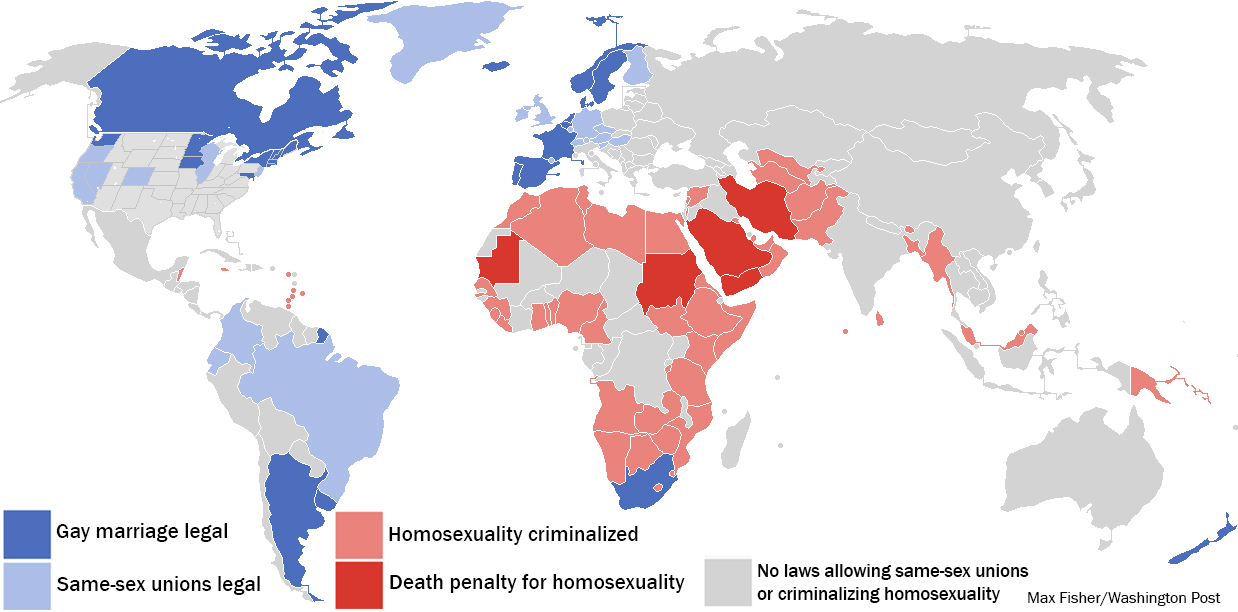
Fisher makes a map:
The list of countries that grant full gay marriage rights is pretty short: 14 countries in all.
Most of those are in Western Europe: France, Spain, Portugal, Sweden, Norway, Iceland, Belgium and the Netherlands. They’re joined by two other Western countries: New Zealand and Canada. Also on the list is South Africa, famous for its progressive (but politically controversial) gay rights laws. And in South America, perhaps the most gay-friendly part of the world outside of Europe, both Argentina and Uruguay allow gay marriage. Brazil also looks like it might be on the verge.
He also highlights the 76 nations where homosexuality is criminalized:
Most of them are in Africa and the Middle East, although they’re joined by some Caribbean and Southeast Asian nations. Five of those 76 countries include laws permitting the state to hand out the death penalty for homosexuality: Mauritania, Sudan, Saudi Arabia, Yemen and Iran.
The IRS Inspector General Must Resign
A reader writes:
Did you see this new development? It has come out that the Inspector General’s report on the IRS was deliberately limited to only discussing Tea Party groups, and the IG says it was Congressional Republicans who ordered this limitation. In other words, the whole “scandal” was ginned up from the start. It’s not just that the IRS was targeting progressive groups also, but that the entire IG report was deliberately skewed, with undisclosed parameters, to create the false impression that Tea Party groups were being singled out. Now the IG and the Republicans are pointing the finger at each other, and the only scandal concerns the investigation itself.
Garance has a great post about the IG himself. It seems to me that the more we learn about this, the clearer it is that Bush appointee J Russell George should resign. We have no evidence whatever that the White House was involved in any way, and we now know that the IRS scrutiny included left-liberal groups, and yet the Inspector General, fully aware of these facts, testified under oath:
This is unprecedented, Congressman …. During the Nixon Administration, there were attempts to use the Internal Revenue Service in manners that might be comparable in terms of misusing it.
Did he ever cop to the fact that progressive and liberal groups were also targeted?
In May, George declined to answer questions about whether progressive groups were targeted, a kind of cageyness that now raises questions about his impartiality in presenting findings about what went on at the IRS.
At the May 22 House Oversight and Government Reform Committee hearing “The IRS: Targeting Americans for Their Beliefs,” Chairman Darrell Issa asked George point-blank about “be on the lookout” orders: “Were there any BOLOs issued for progressive groups, liberal groups?”
“Sir, this is a very important question,” the courtly George replied. “Please, I beg your indulgence …. The only ‘be on the lookout,’ that is BOLO, used to refer cases for political review were the ones that we described within our report.”
That’s either perjury or incompetence. But almost certainly perjury. He should resign.
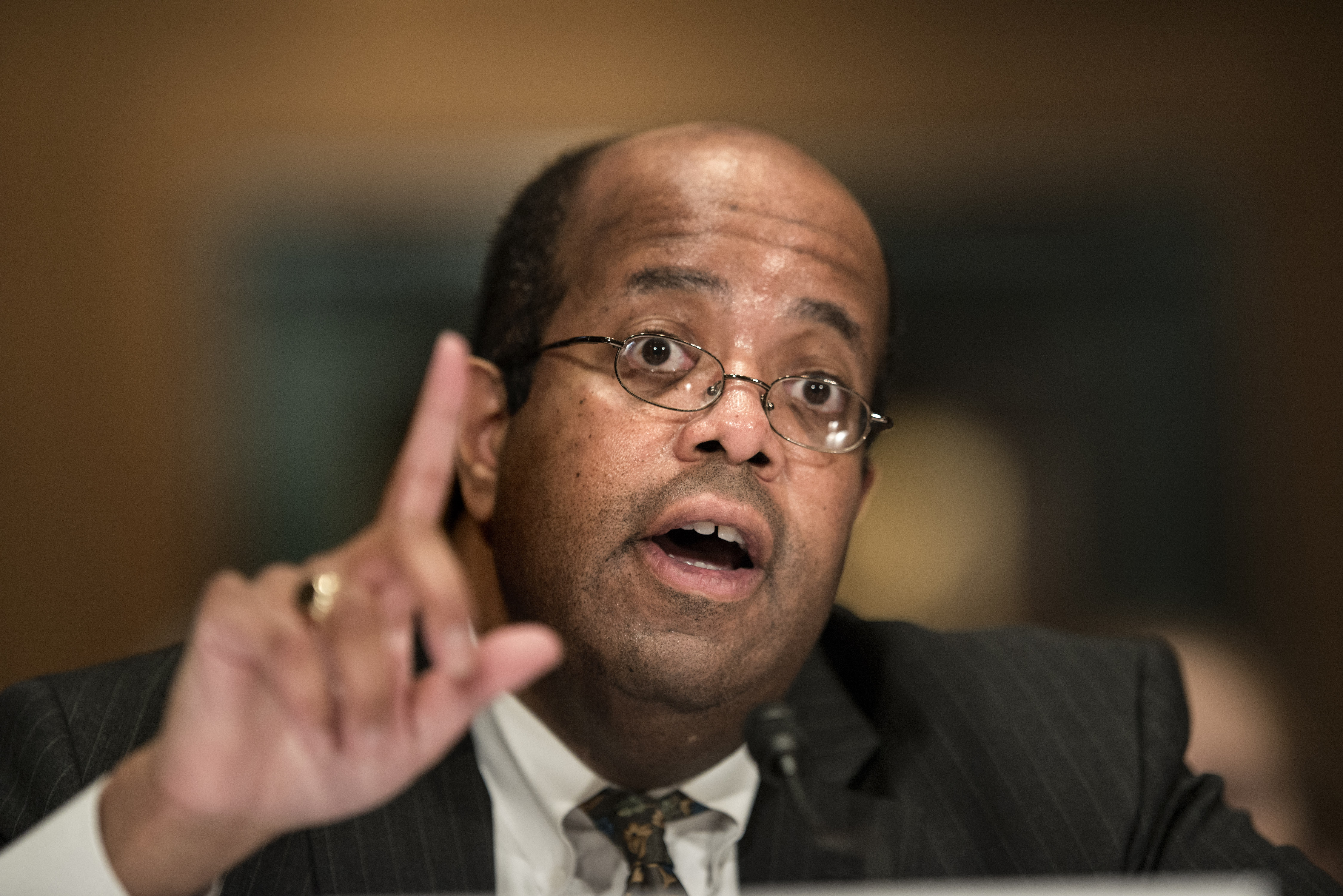
(Photo: J. Russell George, Treasury inspector general for tax administration, speaks during a hearing of the Senate Finance Committee on Capitol Hill May 21, 2013 in Washington, DC. Acting IRS Commissioner Steven Miller and others appeared before to committee to testify about the targeting of politically conservative 501(c)(4) groups applying for tax exempt status. By Brendan Smialowski/AFP/Getty Images.)
“It Was The Economy, Faggots”
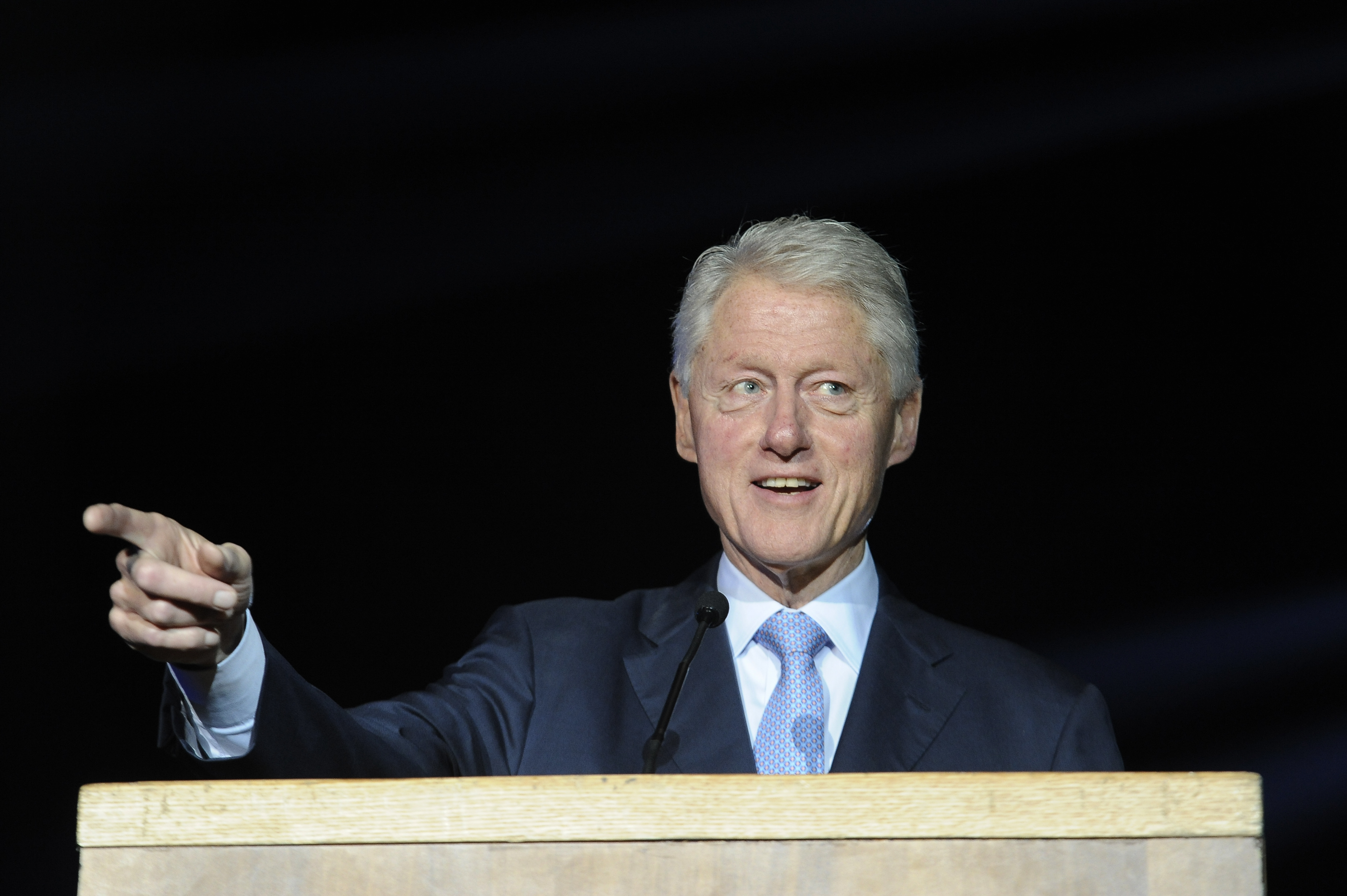
David Graham takes stock of Clinton’s “PR blitz,” as the man who signed DOMA celebrates its downfall:
In March of this year, the former president wrote a column in the Washington Post calling for overturning DOMA, but while his policy suggestion was clear, he didn’t dwell on his own role. Clinton resorted to the old “it was a very different time” line and simply suggested he’d come around; there was no emotional expression of regret, all the more notable from a president known for emoting so well. Still, Clinton’s PR blitz hasn’t been fruitless. GLAAD, one of the nation’s largest gay-rights groups, named him an “Advocate for Change” in April. And as one of the nation’s most popular public figures, his advocacy does matter for LGBT rights.
But in 50 years, what will be remembered? Clinton’s late-career conversion, or DOMA? As more and more gay-rights victories like the Supreme Court’s DOMA decision pile up, the major milestones of discrimination will loom larger still, icons of the bad old days. Those who lived through the 1990s may well remember the complicating factors, the mitigating circumstances, that went into Clinton’s compromise on DADT and cave on DOMA. They will protest that gay marriage wasn’t even something anyone beyond a choice few (notably Sullivan) talked about seriously in 1996. They will point to his support for AIDS research and employment nondiscrimination laws. They will insist that a stronger gay-rights stand would have been untenable.
That may be true; it’s also a defense that some politicians who did nothing to stop segregation used to absolve themselves. Regardless, those shades of gray will be increasingly faint as history recedes and the past looks more black and white. The clearly defined policies will be remembered in a way the qualifiers won’t be.
The man has never fully owned the damage he did to gay people and to the cause of equality. As for GLAAD, please. I saw Clinton’s hypocrisy and callousness up close in trying to persuade donors and HRC and the rest at the time.
The Clintons wanted marriage equality to go away fast; and HRC and all the major donors went along. Bill Clinton’s sociopathic side was never better illustrated, in many ways. Years later, Dick Morris actually asked me out to lunch to apologize for DOMA. Weird, but at least honest. Clinton can never accept he was a true fighter against civil rights as president. But he was. He’ll now say what he can to get back into power via his wife’s candidacy – including all the right things on marriage.
But he wasn’t just a fair-weather friend as president; he was our enemy – and more lethal because he was a Democrat and gave legitimacy to the opposition like no one else. I’m happy he’s for us now; but he sure was against us then. Clinton administration official Bob Hattoy once summed up Clinton’s views on the entire subject in his presidency: “It’s the economy, faggot.”
The View From Your Window

Karachi, Pakistan, 2.22 pm
Equality Before The Taxman
Roberton Williams looks at the tax consequences of the DOMA decision:
Edith Windsor sued the federal government because her wife’s estate had to pay more than $363,000 in estate taxes. The estate would have paid nothing if the federal government recognized her marriage.
The estate tax provides only marriage bonuses. An estate may claim an unlimited spousal exemption for inherited assets—and thus pay no tax—while the total exemption for all other heirs is limited, currently to $5.25 million. And any unused part of that limited exemption carries over to the estate of the surviving spouse, thus guaranteeing that $10.5 million of the couple’s combined assets will go to heirs estate tax-free. DOMA’s demise can thus result in lower estate taxes for same-sex couples, although very few will be affected: less than 0.2 percent of decedents leave estates big enough to owe tax.
But he notes that for “many same-sex couples will find that federal recognition of their marriages means higher income tax bills.” TNC, who writes that “the right to marry is the right to protect one’s family,” reflects on the estate tax money that will be refunded to Windsor, in the context of slavery:
The state repossessing a couple’s wealth because it finds them icky, is wholly unjust. It recalls a particularly horrible aspect of slavery–the assault on the families of people deemed to be outside the law. There is a particular war here, which better people than me can speak to. But power is at the core of the long war which began sometime in the mid-17th century with the passage of the first slave codes. The prohibitions against same-sex marriage are not simply about witholding the right to be pretty in a dress or dashing in a tux (though I would deny no one their day.) It is about ensuring that only certain kinds of people, and certain kinds of families, are able to amass power, and with that power, influence over the direction of our society.
To Which States Will Today’s Decision Apply? Ctd
HRC has a primer on what the DOMA decision means for same-sex couples in various states:
Brian Beutler explores the implications of the SCOTUS’ decision to leave Section 2 of DOMA, “the section that says states don’t have to recognize marriages from other states,” intact:
Marriage equality supporters are understandably ecstatic that the Supreme Court has declared section three of DOMA unconstitutional. But for a subset of same-sex partners, the ruling won’t truly guarantee them equal treatment under the law. The nature of the court’s DOMA decision, combined with its decision to punt the California Prop 8 case about whether there’s a constitutional right to gay marriage, will ultimately create a sort of three-tiered status for same-sex partners. …
“As a general rule, a person who legally married a different-sex partner will be considered married in all states,” [Shannon] Minter [the legal director for the National Center for Lesbian Rights] said. “But that is not true for same-sex spouses. Many states have enacted constitutional amendments that prohibit the state from respecting the marriages of same-sex couples who validly married in another place. It is not yet clear whether same-sex spouses who live in states that do not respect their marriages will be eligible for federal benefits that turn on whether a marriage is valid where the couple or surviving spouse lives. At least in the short run, there are some federal benefits that same-sex couples in these states likely will not receive.”
Allan Brauer, who married his husband in California in 2008, explains what the ruling means for him:
The DOMA decision means that my spouse and I will now be able to file joint Federal income tax returns as well as state ones, my spouse will no longer pay Federal taxes on the value of my health insurance, and the tragedy of losing a spouse will no longer be exacerbated by unequal treatment of our estate and Social Security benefits. Hooray!
But… If we were to relocate to a state that does not permit SSM or recognize such marriages performed elsewhere, some of those Federal benefits may simply disappear. Poof! Current Federal regulations vary across departments in whether they look at your legal status based on where you live, or where your marriage was performed.
Linda Beale predicts more litigation in the near future:
[T]here is a huge problem looming because of the failure of many states to recognize same-sex marriages performed in other states even though they recognize all other marriages performed in those other states. Section 2 of DOMA–which allows states to refuse to recognize sister-state marriages–in flagrant violation of the normal rules of comity between states–was not at stake here and thus its repeal remains for future cases. This means that there will be considerable uncertainty –and much bigotry and discrimination against gay couples for some time as those states that have enacted discriminatory constitutional or statutory provisions against gays continue to deny marriage rights to gay married couples when they move into them, and perhaps prevent them from retaining custody of their children or being able to legally divorce their spouses or will estates to their spouses.
These problems will be resolved, at least for now, under each states “conflict of laws” provisions, with the overlay of the state’s constitutional prohibitions, where existing, on recognition of same-sex marriages. This will cause harmful suffering to gay couples, so one would expect that there will be litigation on this issue soon.
 The Dish