To Which States Will Today’s Decision Apply?

Marriage States

Lyle Denniston attempts to answer the question:

With the demise of the Defense of Marriage Act’s benefits ban in Section 3, for legally married gays and lesbians, the Court immediately — even if inadvertently — gave rise to a situation in which couples living in states that will not allow them to marry because they are homosexuals will still be able to qualify for federal benefits, many of which are handed out or managed by state governments.

But the ruling did not do anything explicitly about another section of DOMA — Section 2, which gives the states the right to refuse to recognize gay marriages performed in other states.  That thus raised the prospect that a same-sex couple married in one of the states now allowing such unions could face obstacles to their marital rights when they moved into states that still do not recognize their unions.  This might be a particular problem for already-married gay couples serving in the military, who often have to move from state to state.

Ilya Somin examines the situation in California:

As Marty Lederman explained in this January post, it is not entirely clear whether Judge Walker’s district court opinion striking down Proposition 8 is binding with respect to gay marriages other than those of the plaintiffs in the case. As Lederman points out, both sides in the litigation agree that he intended it to be so binding. But they differ on whether he had the power to do so. The Supreme Court’s opinion in Hollingsworth does not address this question, which could end up being settled by lower court litigation. Lederman also notes that the governor (who opposes Prop 8 and refused to defend it in court) could simply choose not to enforce Proposition 8 in the aftermath of the Supreme Court’s ruling. In practice, therefore, it is quite likely that Proposition 8 will no longer be enforced even if Judge Walker’s ruling isn’t binding beyond the parties to the immediate case.

In a press release California Governor Jerry Brown writes that he has “directed the California Department of Public Health to advise the state’s counties that they must begin issuing marriage licenses to same-sex couples in California as soon as the Ninth Circuit confirms the stay is lifted.”

(Map of states with full marriage equality from The New Yorker)

DOMA Struck Down: Your Thoughts

U.S. Supreme Court Issues Orders On DOMA And Prop 8 Cases

A reader writes:

I am so glad to be alive to appreciate this moment.  And to carry the memory of people who didn’t survive, whose deaths and whose battles for acceptance and love, whether private and within their families, or public, whether gentle or fierce, helped bring this to be.  As you note, timing mattered so much in determining who lived and who died.  But the survivors, like you, carried on the fight.  My best friend’s older brother died of AIDS in 1994.  He had come out as a teenager, in the late 1970s.  He was never able to have a spouse, but his little brother – also gay, but much younger – was spared from the plague, and can now marry his sweetheart of 25+ years.  Free at last.

Another:

I’m a young straight white man in the USA, and this feels like a victory for me, and for the open-heartedness and dignity and simple wisdom of the world I live in. I can only imagine how it must feel for those millions of you who have been openly disparaged and oppressed for so long. I can only imagine how it must feel to have seen and felt the culture shifting as dramatically as it has these last few decades, and yet to have remained imprisoned by idiotic and hateful bureaucracy. But even though this victory is less mine than yours – not least because you took up this fight long before it seemed plausible – I am nevertheless not shy in declaring victory and expressing my gratitude to you and everyone who has fought for this. The collapse of DOMA and the blossoming of equality and freedom – our becoming a more perfect union – is a gift to us all.

Of course it’s not over, but the light is shining clearly now. Congratulations for this day, and, hey, for the federal benefits you are now rightly entitled to! Fuck yeah.

Another:

Like you, I was elated and relieved to see DOMA struck down this morning. A few hours later, that elation has ebbed. As I read the reactions and commentary, specifically as I read about the federal rights that are still residency-based, I am selfishly saddened. Because my partner, my son, and I live in Texas, and we still can’t get legally married in our home, in front of our closest family and friends. You have repeatedly stated on your blog that you support states’ rights to make the marriage decision individually and independently, but as I (and many of your other readers, I’m sure) have said time and time again, that’s easy to say when you live in a state that recognizes your marriage, or you have the means to move to elsewhere. If you live in one of those states that doesn’t, you still feel a bit like a second-class citizen today.

Another:

You wrote: “Immigration equality is here. Again: after two decades of extreme anxiety, history wipes it away. You have no idea how much relief so many bi-national couples are now feeling.”

That’s likely not quite accurate.

The opinion appears to create a “dual federalist” system in that the federal government must defer to a state’s law to define marriage. Thus, a bi-national couple that wanted to reside in, say, Texas, which has a law on the books expressly forbidding recognition of gay marriage from other jurisdictions, would not be recognized under federal law even if actually married in a foreign jurisdiction. Thus, immigration equality appears to only exist in state’s recognizing gay marriage.  We need a Section 2 challenge to wrap this thing up.

Another:

Just wanted to direct your attention to this petition. Because of the patchwork of different regulations used by federal agencies, many couples who are legally married in a US state still won’t be eligible for benefits in that state if it doesn’t recognize same-sex marriage. The reason for this is that some agencies use a “place of celebration” standard while others use a “place of residence” standard. This leads to perverse consequences like a same-sex couple married in Maryland but residing in Virginia being eligible for benefits through the DOD but not Veterans’ Affairs. President Obama can immediately correct this by issuing an executive order instructing federal agencies to adopt a uniform place-of-celebration standard. More people need to know about this.

Another:

I’ve never understood the whole “Scalia is so brilliant” thing.  I’ve been hearing it for years and years, particularly from certain law school profs (who were raging unreconstructed old school liberals, but who loved to let us all know that they found “Nino” quite charming at cocktail parties).  I’m a corporate lawyer, but my father was a federal appellate civil rights lawyer with the NAACP Legal Defense & Educational Fund for almost 40 years.  He argued cases in front of SCOTUS including after Scalia was appointed.  My father’s impression of him based on appearing before him seems totally consistent with my read of Scalia’s claptrap opinions – he’s a somewhat intelligent but extraordinarally belligerent narcissist.  Reading his stuff, for me, provokes revulsion at his immaturity – which brings disrepute to the institution – and whiplash at his rampant inconsistency.

Live-blog coverage of the ruling here. More of my thoughts here. Blogger reax here and tweet reax here.

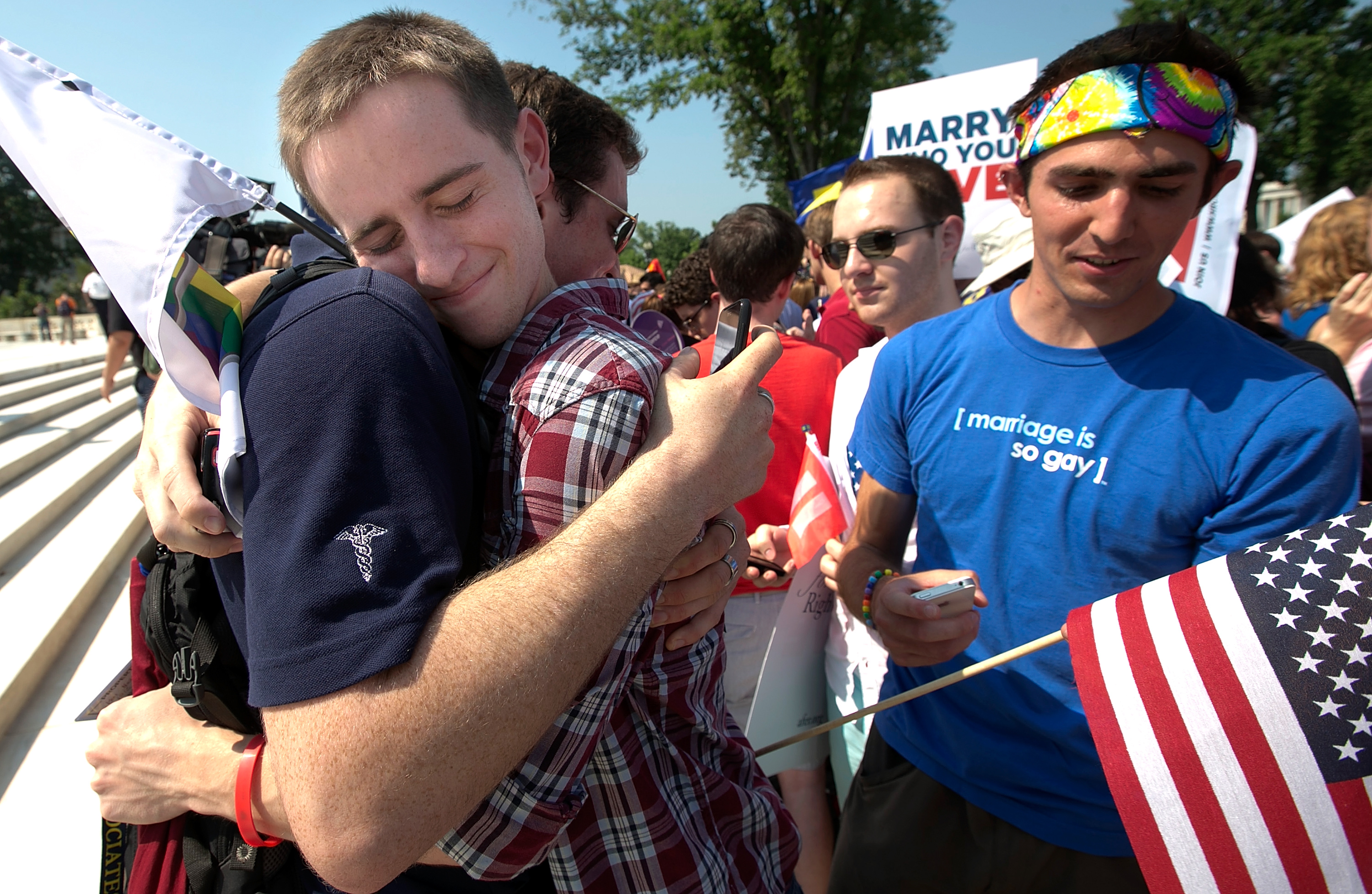
(Photo: Chase Hardin (2nd L) hugs friend Kai Neander (L) on the steps of the Supreme Court after favorable rulings were issued in same sex marriage cases June 26, 2013 in Washington, DC. By Win McNamee/Getty Images)

When Will Marriage Equality Return To SCOTUS?

Gabriel Arana wonders:

Today’s opinion hints that the Justices have little desire to get too far ahead of public opinion. Mostly likely, the current cases making their way through the legal system will stop at the Supreme Court’s door. But given the incoherent legal patchwork the rulings leave in place, it’s only a matter of time before the Justices will have to revisit the issue. The question is when. It was 17 years between Bowers v. Hardwick, in which the Court upheld anti-sodomy laws, and Lawrence v. Texas, which reversed Bowers. Twenty years went by between the Court’s landmark abortion ruling in Roe v. Wade and Planned Parenthood v. Casey, which addressed the the constitutionality of restrictions on abortion. But with public opinion on gay rights evolving at breakneck speed, gay-rights advocates say the timetable may be shorter.

What Precedent Does Perry Set?

Ed Morrissey is bothered by the Prop 8 decision:

The voters in California amended the state constitution by referendum legally, to define a legitimate government policy regarding the recognition of marriage. The court is making the case that this is a matter for California to settle, not the federal courts, and there is a very good case to make there. However, the effect of this is to overturn an election whose legality was never in doubt just because some people didn’t like the outcome. That to me is a more dangerous outcome than a precedent-setting decision on standing.

Scott Lemieux also has misgivings:

[W]hile I’m happy the Prop 8 will be struck down standing is the worst grounds for a good outcome: it’s a pernicious argument. The courts shouldn’t be foreclosed from hearing appeals just because the current government declines to defend a law.

Kevin Drum makes a related point:

In California, it’s routine for the people to pass initiatives that neither the governor nor the legislature supports. In fact, that was the whole point of the initiative process when it was created. In cases like these, of course the governor and legislature are going to decline to defend the law in court. With today’s decision, the Supreme Court is basically gutting the people’s right to pass initiatives that elected officials don’t like and then to defend them all the way to the highest court in the land.

To me, this has neither the flavor of justice nor of democratic governance, regardless of whether I like the outcome.

Marriage Equality’s Big Day: Blog Reax

U.S. Supreme Court Issues Orders On DOMA And Prop 8 Cases

Ilya Somin unpacks the DOMA decision:

[W]hat [Kennedy] seems to be saying is that the the Congress’ pursuit of purposes beyond the normal scope of federal authority in DOMA makes the law a “discrimination… of an unusual character” and justifies imposing tougher scrutiny under the Fifth Amendment. … The idea that federal statutes are suspect if they seek to achieve purposes outside the scope of federal power is not a new one. In McCulloch v. Maryland (1819), Chief Justice John Marshall famously wrote that Congress may not “under the pretext of executing its powers, pass laws for the accomplishment of objects not intrusted to the Government.” The rule that “unusual” laws get tighter scrutiny in equal protection cases is also not new. But the DOMA decision is the first to tie these principles together.

From Jack Balkin’s legal analysis:

Windsor is a reminder of the fact that the scrutiny rules we teach our students as gospel are a relatively recent invention–less than fifty years old.   They were designed to make it easier to think about when laws are constitutionally unequal. But sometimes they don’t really assist our understanding of the issues; they just get in the way.  In fact, you actually can explain Windsor in terms of the existing structure– it’s a “rational basis with a bite” case, and that’s how the casebooks (including the one I co-author) will probably classify it. But we should be able to look behind the doctrinal superstructure, which explains little, and see the deeper principles at stake, principles that have a long history in American constitutional thought.  DOMA singled out gay people for special burdens in an important area of social life; it declared their marriages less valuable, and therefore, to that extent, it made them second class citizens.  Even if this wasn’t obvious in 1996, it is increasingly obvious today.

Jonathan Cohn focuses on plaintiff Kris Perry’s reaction:

Perry’s comments focused on the children—in the U.S., and in California, and in her very own home: “We believed from the very beginning that the importance of this case was to send a message to the children of this country that you are just as good as everybody else, no matter who you love, no matter who your parents love,” Perry said. “And today we can go back to California, and say to our own children, all four of our boys, your family is just as good as everybody’s else’s family, we love you as much as anybody else’s parents love their kids, and we are going to be equal.”

Weigel looks ahead:

So what happens politically? Republicans haven’t rushed to the microphones yet, but the House GOP lost—they paid to defend DOMA, and it was struck down. It’s within their power to try to defund the removal, and we’ll suss out soon whether there are enough House Republicans passionate about the issue to do this.

But the court’s decision not to write a new definition of marriage (to just overturn Prop 8) means that marriage rights return to the states, to be voted on in referenda, state legislatures, and in courtrooms. The polling in favor of gay marriage has stalled somewhat, after tipping into positive territory nationally. But we’re going to see a series of campaigns and scattered lawsuits from couples who now can say they deserve marriage benefits and there’s no act of Congress stopping them.

Enten expects the DOMA ruling to “be welcomed by most Americans”:

In poll after poll taken over the past few months, at least 60% of Americans have agreed that the federal government should recognize same-sex marriages in those states that allow it. This is significantly higher than the roughly 53% of Americans who believe same-sex marriage should be legalized everywhere.

Jonathan Tobin gives American culture credit for today’s decision:

How did this sea change come about? Liberals may consider it a natural evolution of thought to more progressive opinion (since as we saw with President Obama and gay marriage, reversals on such issues that end with an endorsement of the more liberal position are regarded as evolution rather than a flip-flop). But it could never have happened outside of the context of American popular culture that has normalized gays and gay marriage in films and TV to the point that they are now regarded as unexceptionable. As my colleague John Podhoretz noted on Twitter this morning after the ruling, the credit for the decision on DOMA belongs as much to the producers of the Will and Grace television show as it does to any legal scholar.

Dreher plays the victim:

Scalia has chillingly illuminated the future for marriage traditionalists: the only reason to oppose same-sex marriage is hate. In constitutional law, there is no rational basis for supporting traditional marriage. Henceforth, the Court has declared open season on religious and social conservatives and their institutions. Given the majority’s holding that hatred is the only plausible explanation for denying same-sex marriage, I see no reason why the Supreme Court will not declare same-sex marriage a constitutional right.

And the logic of the Court’s language here ought to put fear into the hearts of anyone who does not share the belief that homosexuality is morally neutral, or morally good. The Supreme Court says we are haters, full stop.

Waldman, on the other hand, tackles Scalia:

[T]his is a guy who, in a decision delivered just yesterday, helped gut the Voting Rights Act, one of the most important pieces of legislation ever passed by Congress and one that was reauthorized in 2006 by votes of 390-33 in the House and 98-0 in the Senate, yet spends two-thirds of this very dissent arguing that the Supreme Court is a bunch of black-robed tyrants when they invalidate a law passed by Congress. In other words, despite his carefully cultivated reputation as a principled “originalist,” the only principle that guides Antonin Scalia is “what he can get away with.” For him, it’s the outcome that matters. The justification comes after. Is that true of the Court’s liberals as well? Maybe. But it’s a little rich to make that charge when your own hypocrisy is on such obvious display.

Dylan Matthews notes that immigration equality is now law:

This does open the door for bi-national same-sex couples to be treated equally under the law. That means that comprehensive immigration reform probably need not include a provision specifically tailored to making sure bi-national partners of same-sex couples can get visas automatically, the same as opposite-sex partners. As Paul Smith, a partner at Jenner & Block and arguably the leading gay rights litigator in the country (he won Lawrence v. Texas, overturning state bans on gay sex), told me, “My understanding is that the elimination of DOMA would by itself mean that all bi-national married couples would have the same rights, whether same sex or not.”

Steve Benen points out another consequence, among many:

The Defense Department, for example, ended DADT, but could not apply equal benefits to gay servicemembers because of this law. Now that it’s been struck down, it’s no longer an issue.

Hagel has released a statement to that effect:

The Department of Defense welcomes the Supreme Court’s decision today on the Defense of Marriage Act.  The department will immediately begin the process of implementing the Supreme Court’s decision in consultation with the Department of Justice and other executive branch agencies.  The Department of Defense intends to make the same benefits available to all military spouses — regardless of sexual orientation — as soon as possible.  That is now the law and it is the right thing to do.

And June Thomas reflects on what the decision means to her personally:

When the Supreme Court’s decision on the constitutionality of the Defense of Marriage Act was released Wednesday morning, I was genuinely surprised and totally unprepared. I knew it was coming, but I hadn’t dared to hope that the court would do the right thing for families such as mine. Votes had gone the wrong way too many times in the past. Feelings had been hurt. What did straight Americans have against their gay and lesbian compatriots that they would go into a voting booth or stand on a legislature floor and choose to deny them basic civil rights?

As the decision was announced, I finally allowed myself to experience a feeling of belonging.

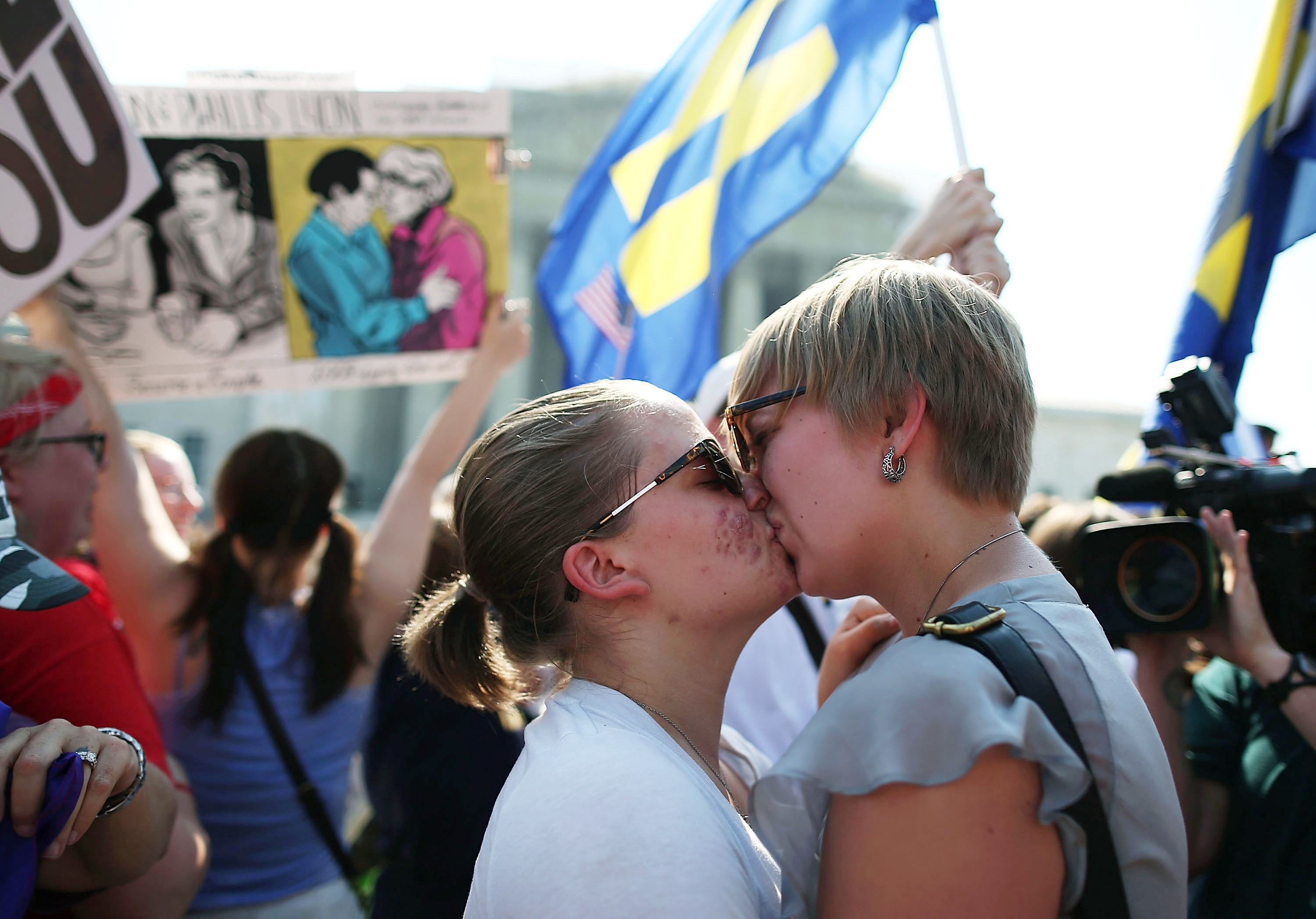
(Photo: American University students Sharon Burk (L) and Mollie Wagoner (R) kiss after hearing that the U.S. Supreme Court ruled that the Defense of Marriage Act (DOMA) is unconstitutional at the Supreme Court, June 26, 2013 in Washington, DC. By Mark Wilson/Getty Images)

From The Annals Of Chutzpah

“By overturning the Defense of Marriage Act, the Court recognized that discrimination towards any group holds us all back in our efforts to form a more perfect union. We are also encouraged that marriage equality may soon return to California. We applaud the hard work of the advocates who have fought so relentlessly for this day, and congratulate Edie Windsor on her historic victory,” – former president Bill Clinton, who signed DOMA, insisted it was constitutional at the time, double-crossed the gay activists who originally funded him, ran ads in the South bragging of passing DOMA, doubled the rate of gay discharges from the military and signed the HIV travel ban into law.

DOMA Struck Down: Tweet Reax