“I cultivate this beard not for the usual given reasons of skin trouble or pain of shaving, nor for the secret purpose of covering a weak chin, but as pure unblushing decoration, much as a peacock finds pleasure in his tail. And finally, in our time a beard is the one thing that a woman cannot do better than a man, or if she can her success is assured only in a circus,” – John Steinbeck, Travels with Charley.
Month: June 2013
An Unconditional Victory In The Culture War
A reader responds to the apology from the president of Exodus:
Allow me a small victory dance. Thirty years ago this month I attempted suicide. I was 23 and had just finished a year of horrendous reparative therapy (including aversion therapy). Five years before that my first love killed himself because he couldn’t bear to have people know who he was. I went to my church leader, who subscribed to Exodus views, and he sent me to the hell that was reparative therapy. After a year of that, I was sure my church hated me my and family hated me, but most importantly, God hated me. The only solution was to end a life that was even despised by a loving God. I will not go into details of that attempt, but obviously I made it through. Many more have not.
In fact, I spent the ensuing three decades battling the demons forced on my by reparative therapy – and I won.
I then went on to battle for my rights and my liberty. I am now married to my loving husband of 17 years and have two amazingly beautiful and sweet daughters whom we adopted. My extended family is unconditionally accepting, as are my Mormon in-laws. I have an amazing career as a scientist and lead a fulfilling and joyous life. In spite of Exodus-inspired reparative therapy, I was able to live and find love and a meaningful life. There are thousands of men and women who never had that chance. The demons of self-loathing that reparative therapy instilled in them destroyed their lives.
I was so shocked and surprised when I read that Exodus International was shutting down and apologized – a real apology – that I couldn’t help but break down and sob in joy. I am so very grateful that this has occurred and accept the heartfelt apology.
But please, allow me a small victory cheer. It was a decades-long battle, both personally and as a community, one that saw many lives destroyed. I am giving a victory cheer today for all my compatriots who didn’t make it to see this day. Their suffering has been repented of by the perpetrators. I am giving a small victory cheer for all the future young men and women who might not have to go through that hell because this organization will not exist any longer.
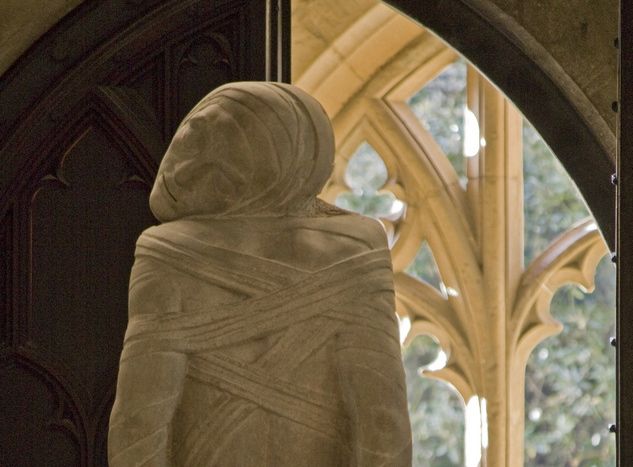
(Photograph: Lazarus rising from the dead, by Sir Jacob Epstein, New College, Oxford. Via Lawrence OP, Flickr. His full album is amazing.)
Hathos Alert
Islam is …
How We Judge SCOTUS
Joseph Daniel Ura reviews research showing how “the Supreme Court’s legitimacy is not dependent on agreement on individual questions of policy between the Court and the public” but upon “the public’s perception that the Court uses fair procedures to make principled decisions—as compared to the strategic behavior of elected legislators.” Furthermore:
Though much of the public may sharply disagree with a decision of the Supreme Court—producing an initial backlash against the policy implications of a particular ruling or set of rulings—the decisions of the Court tend to lead public opinion over the long run. In a recent analysis of more than 50 years of data on Americans’ collective responses to Supreme Court decisions, I find that public responses to important Supreme Court decisions were typically marked by a negative response in public opinion in the short-term that decays and is replaced by a long-run movement in public opinion toward the positions adopted by the Court.
Do Mascots Need Modernizing? Ctd
The popular thread continues:
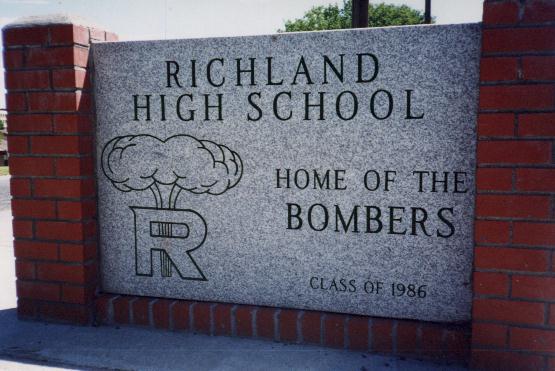
In a different twist to potentially offensive school mascots, consider the Richland High School Bombers, which have an atomic mushroom cloud as their mascot. The school is near Hanford, Washington, where the “Fat Man” atomic bomb dropped on Nagasaki was manufactured. There has been substantial controversy over the mascot for some time now (e.g. here and here).
Another adds:
I know what the Hanford nuclear reservation means to that community and how proud they are what they did for the war effort, but … come on. Being proud of it is one thing, but celebrating and reveling in it is another.
Update from a reader:
I went to Richland High School and even graduated in 1986, the year the sign was made. I don’t think the students understood the gravity of that symbol. The symbol fit with the pro-nuclear stance of the community – the defense aspect that goes all the way back to WWII and the power generating aspect. A good friend of mine was a football coach there and worked hard to bring back the original (I think) meaning of ‘Bomber’ – a plane that was financed by the workers at Hanford. Look up “A Day’s Pay” plane. My friend was really frustrated, though, with some of the adult boosters – team fan club – that pushed the mushroom cloud aspect. (P.S. I love The Dish and am one of your early subscribers!)
Another reader:
The high school in Orofino, Idaho shares its town with a state mental hospital:

Another adds to this tangent:
North Dakota does indeed have a long and storied history of dealing with colorful team names and mascots. My favorite has to be the controversy surrounding the Devils Lake Satans. Yes, you read that right: The high school teams were known as the Satans, complete with a red imp mascot.
After a great hue and cry by evangelical Christians throughout the ’90s, the school board finally voted to retire the nickname and mascot in 2002 and
directed the school to come up with something new. The overwhelming choice of the students was to change to The Blaze, but that got shot down when someone on the school board realized that “Blaze” was slang for smoking marijuana. The eventual compromise? The Firebirds.P.S. The best high school sports match-up in North Dakota history: 1981 semifinal basketball game between the Devils Lake Satans and the St. Mary’s Saints. Oh, you can just imagine the cheers coming from both sets of fans …
Last but certainly not least:
Maybe a little off topic: the mascot for the Arkansas School for the Deaf is the leopard, or, as they put it on their webpage, “Welcome to the Arkansas School for the Deaf Leopards.”
The Tea Party’s Defining Characteristic
A recent book on the Tea Party by Christopher Parker and Matt Barreto suggests that hate of Obama unifies the group. This prompts Michael O’Donnell to ask, “If Obama-bashing sustains the Tea Party, will it go away without him?”
According to Parker and Barreto, 91 percent of Tea Party supporters hold negative opinions of Obama. (This beats the 82 percent who hold negative views of illegal immigrants, and, even more tellingly, the 85 percent who report a preference for limited government.) Sixty-seven percent of Tea Party supporters believe that Obama is a socialist, and 71 percent think he will destroy the country. Destroy the country! In contravention of basic, established facts, solid majorities do not believe that he is a Christian (71 percent) or that he was born in the United States (59 percent). Parker and Barreto take pains to distinguish these views from those of non-Tea Party conservatives, and to ensure—by means of regression analysis—that Tea Party affinity, and not some other factor like support for the Republican Party, accounts for the figures.
Do We Really Need The Self-Driving Car? Ctd
A reader writes:
Just a quick response to the question: My mother is 88 years old. She’s in great shape for 88, very self-sufficient. But she’s not really physically fit to drive and thankfully gave up her car keys willingly about 8 years ago. Many “seasoned citizens” are decidedly NOT willing to give up their keys, and it’s a terrible battle within families when it’s time for Grampa to give up driving for good.
My mom feels very stranded and many times wishes she could still drive. She loves the idea of a self-driving car, it would give her back some of the freedom she gave up when she stopped driving. She’s doubts she’ll live to see the day when self-driving cars are a reality, but I can see how it can really improve the lives of elderly folks, as well as the handicapped.
Another agrees – and expands the argument:
Autonomous cars will be a boon for aging populations.
Many old people rely on their cars but should not be driving. Simply taking them off the road does not help them go to the hospital, store, to socialize and live active lives. But a chauffeur-less car would allow them to do these things without driving.
If there’s an argument that old people should be driven automatically, there’s an argument that all people should be. There’d be far fewer accidents, no traffic, no parking meters, no parking garages, no drunk driving, no insurance issues, no traffic stops, and no DMV. And you could text and talk to your heart’s content, with even a beer if you like, or work on your computer on the way to the office – all the negatives associated with car culture would be abated. You would not need to own a car; you could subscribe to a car service. “Your car” would always be within five minutes of you, among a vast fleet.
Aside from ferrying people around, the most impact from driverless vehicles would be on trucking. “Trucks” would be like those strange little boxy robots in the early Star Wars movies, zipping along on their individual missions. They would completely revolutionize how things are transported and delivered, from the macro to the micro, in driverless trucks of all sizes, down to the pedestrian level. A pharmacy might dispatch your medicines from a secure mini-truck in your area. Order online, get your pills in a few minutes. Or takeout, Amazon goodies – all “things” would be in motion. Not to mention the impact of drone delivery systems. A totally different world, to be sure.
I just wonder if there’s a tradeoff of freedoms. Would you get into your driverless car, and find yourself locked in and being taken to the IRS, FBI, NSA or police for some infraction that’s on your record? Driverless paddy wagons?
Those Pesky Unproven WMDs
Here we go again:
The United States, Britain and France have supplied the United Nations with a trove of evidence, including multiple blood, tissue and soil samples, that U.S. officials say proves that Syrian troops used the nerve agent sarin on the battlefield. But the nature of
the physical evidence — as well as the secrecy over how it was collected and analyzed — has opened the administration to criticism by independent experts, who say there is no reliable way to assess its authenticity… Jean Pascal Zanders, who until recently was a research fellow at the European Union Institute for Security Studies, said he has scoured the Internet for photographs, video and news reports documenting alleged nerve agent attacks in Syria. What he has seen has made him a skeptic.
Few of the photographs, Zanders said, have borne the trademark symptoms of a chemical weapons attack.

Let’s do a quick check-list against Iraq? Hateful dictator? Check. Sectarian civil divisions now in full-out civil war? Check. Middle Eastern Muslim country? Check. Saudis and Jordanians on board? Check. Massive emotional and moral appeal for getting rid of a dictator? Check. No idea who the opposition really is? Check.
Seriously, how can anyone – anyone – back getting involved in such a war only a decade after the worst foreign policy catastrophe since Vietnam? Especially all those, like Bill Clinton and John McCain, who were wrong about Iraq having assured us they were so very, very right.
The End Of The Auto Age?
Michael Todd wonders if we’ve passed “peak car”:
A new study from the University of Michigan’s Transportation Research Institute looking at cars and car ownership data between 1984 and 2011 argues that while the total number of cars and other light vehicles in the U.S. is almost certainly going to rise from its pre-recessionary peak of 236.4 million in 2008, the rate of ownership among individuals has stalled and likely will remain in a lower gear down the road. … [Study author Michael] Sivak expects that as the economy perks up and the population grows that the absolute number of vehicles will drive past that 2008 peak. But a raft of societal changes, not to mention expensive fuel, are likely to depress individual ownership rates. Among those are growing rates of telecommuting and use of public transportation and the aging out of getting a license or indeed, a car itself.
Jordan Weissman is skeptical:
It’s an interesting theory. But were Americans really rethinking their gas guzzling ways before the economy went south? I’m not quite sure. Remember, before we had a recession, we had a housing bust. Home values peaked in 2006, and families that had bet on infinitely rising prices by taking out second mortgages to finance their lifestyles started getting whacked. That marked the beginning of the end for the over-consuming oughts. And, given that housing values and spending tend to move in tandem, it’s no surprise that vehicle registrations went into retreat around then, just as they retreated after the dotcom collapse.
When Good Causes Go Bad
PZ Myers is disappointed by the results of the Tampa Bay Times‘ recent investigation into how charities are spending the money they collect:
The worst are the cancer charities, and the article singles out the Reynolds family and their nepotistic mill for turning dying people into salaries. Cancer is so easy for these crooks: everyone hates it, there’s no plus side to the disease, and there’s a wealth of tragic heart-string-tugging tales to be mined from it. And you can’t tell from the names what they’re doing! “Breast Cancer Society,” for instance…how can you refuse to support that? “Children’s Cancer Fund of America” — OMG, children with cancer? Here’s $50. And then the members of the family doing the bilking make 6 figure salaries for shipping boxes of surplus junk to cancer patients. It reinforces my opinion that most people are good, but that there are always parasites who know what buttons to push to exploit them.
The Times’ list of the 50 worst charities here.
 The Dish